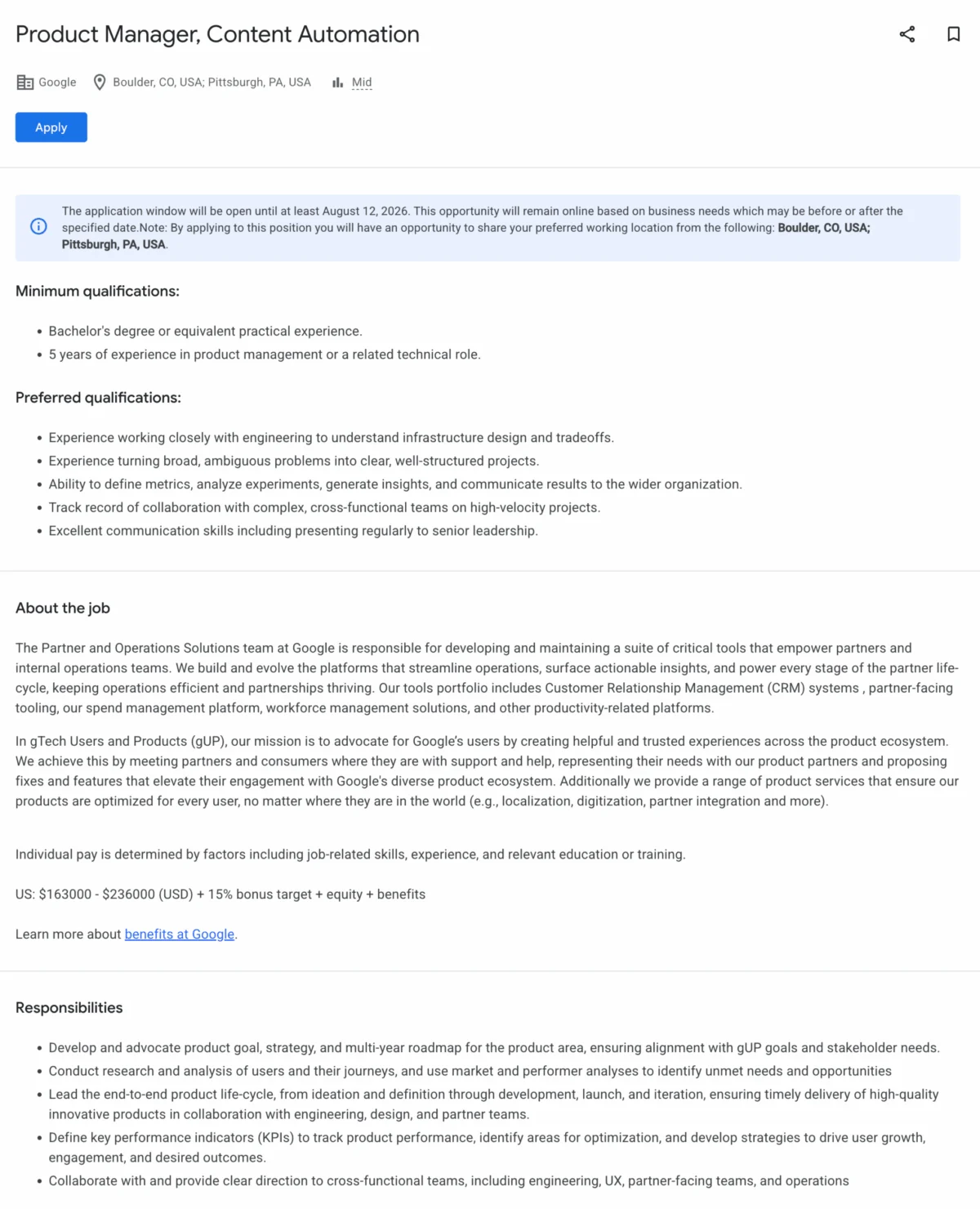
Google, the global technology giant renowned for its search engine and AI innovations, has recently posted a job listing for a Product Manager, Content Automation, a move that has quickly captured the attention of industry observers and the SEO community. The position, initially posted approximately two weeks prior, is open for two key Google locations: Boulder, Colorado, USA, and Pittsburgh, Pennsylvania, USA. This development sparks considerable discussion, given Google’s long-standing public stance against low-quality, automatically generated content on the web.
The job listing, while succinct in its description of the automation aspect, explicitly titles the role as "Product Manager, Content Automation." The broader context provided within the job description points towards responsibilities within Google’s "Partner and Operations Solutions team" and "gTech Users and Products (gUP)" division. These teams are described as instrumental in developing and maintaining a suite of critical tools that empower both external partners and internal operations teams. Their mandate includes building and evolving platforms that streamline operations, surface actionable insights, and manage the entire partner lifecycle, ensuring operational efficiency and thriving partnerships. The portfolio of tools encompasses Customer Relationship Management (CRM) systems, partner-facing tools, a spend management platform, workforce management solutions, and other productivity-related platforms.
Within gTech Users and Products (gUP), the mission is clearly defined: to advocate for Google’s users by creating helpful and trusted experiences across the product ecosystem. This is achieved by providing support and assistance to partners and consumers, representing their needs to product partners, and proposing fixes and features that enhance their engagement with Google’s diverse product offerings. Furthermore, gUP delivers a range of product services designed to optimize products for every user globally, including localization, digitization, and partner integration. While the specific responsibilities related to content automation are not detailed in the publicly available excerpt, the title itself suggests a strategic focus on leveraging technology to manage and potentially generate content in a structured, scalable manner. The discovery of this job posting was initially highlighted by Noah within a private SEO Community Slack channel, subsequently drawing wider attention from digital marketing professionals.
Dissecting the Job Description: A Focus on Internal Operations
A close examination of the provided job description reveals a significant emphasis on internal operational efficiency and partner support, rather than on content generation for Google’s public-facing search index. The "Partner and Operations Solutions team" is explicitly tasked with developing tools that "streamline operations," "surface actionable insights," and "power every stage of the partner life-cycle." This language strongly suggests that the "Content Automation" aspect of the role is likely geared towards internal documentation, structured data generation, or the creation of standardized communications for Google’s vast network of partners and internal teams.
The mention of "Customer Relationship Management (CRM) systems," "partner-facing tooling," "spend management platform," and "workforce management solutions" further reinforces this interpretation. Within such complex operational ecosystems, there is an immense need for consistent, accurate, and rapidly deployable content. This could include automated generation of reports, summaries of partner interactions, FAQs for support portals, policy documents, training materials, or even templated communications that ensure brand consistency and compliance. For instance, automating the creation of release notes for partner tools, or generating localized help articles based on a master template, would fall squarely within the purview of operational content automation.
Moreover, the gUP mission to "advocate for Google’s users by creating helpful and trusted experiences" and its involvement in "localization, digitization, partner integration" hints at content automation in the context of global scalability and user support. Automating the localization of help content into numerous languages, or digitizing legacy content into modern, searchable formats, would be critical functions for a product manager in this domain. Such automation would not only improve efficiency but also ensure that Google can deliver timely and consistent support to its global user base and partners, adhering to its principle of providing helpful and trusted experiences. The absence of keywords related to public web content, SEO, or search ranking within the job description’s body further distinguishes this role from any perceived involvement in generating content for Google Search itself.
Google’s Evolving Stance on Automated Content: A Historical Perspective
The perception of "content automation" at Google is often viewed through the lens of its long-standing fight against web spam. Historically, Google has maintained a strict stance against automatically generated content designed solely to manipulate search rankings. Early iterations of Google’s Webmaster Guidelines, now known as Search Essentials, explicitly warned against "automatically generated content" that adds no value, is low-quality, or is created to deceive search engines. Practices such as keyword stuffing, doorway pages, and machine-generated gibberish were actively penalized through various algorithm updates over the years. This historical context explains the immediate "irony" perceived by many in the SEO community when Google itself posts a job for "Content Automation."
However, Google’s perspective on AI-generated content has evolved significantly, particularly with the advent of sophisticated large language models (LLMs). In February 2023, Google clarified its position, stating that while it condemns content generated primarily for ranking manipulation, "AI-generated content is not against our guidelines." The crucial distinction lies in the quality and purpose of the content. Google’s guidance emphasizes that content, regardless of how it’s produced (human or AI), must be "helpful, high-quality, original, and people-first." This shift acknowledges the technological advancements in AI, recognizing that AI tools can be used to produce valuable, relevant, and engaging content when used responsibly and overseen by human expertise.
This nuanced stance suggests that Google’s internal content automation initiatives would adhere to these same high standards. If Google is leveraging AI for content creation internally, it would be within the framework of generating helpful, accurate, and high-quality information for its partners and internal teams, rather than mass-producing low-value text. The company’s consistent updates, such as the "Helpful Content Update" first rolled out in August 2022, and subsequent spam updates, reinforce its commitment to prioritizing useful and reliable content for its users. Therefore, the "Content Automation" role likely signifies an effort to apply these principles internally, streamlining the creation and management of content that serves a clear, helpful purpose within Google’s operational framework.
The Nuance of Content Automation: Beyond SEO Spam
To truly understand the implications of Google’s new role, it is essential to differentiate between "content automation" for internal operational and support functions versus the historically frowned-upon practice of "automated content generation" for manipulative SEO purposes. The latter typically involves creating vast quantities of low-quality, often nonsensical text with the sole aim of stuffing keywords and building links, without providing genuine value to human readers. This is precisely what Google’s algorithms have been designed to detect and penalize.
The type of "content automation" implied by the job description, however, aligns with modern enterprise content strategies. In a company the size and complexity of Google, managing the sheer volume of information required for internal processes, partner communications, and global user support is an monumental task. This includes, but is not limited to:
- Structured Content Generation: Automating the creation of highly structured data or content elements. For example, product specifications, API documentation snippets, or standardized legal disclaimers that need to be consistently applied across numerous platforms and languages.
- Knowledge Base and FAQ Management: Streamlining the creation, update, and localization of articles for internal knowledge bases, external partner portals, and user help centers. AI could assist in identifying gaps in existing documentation, drafting initial versions of answers based on common queries, or ensuring consistency in terminology.
- Report Generation and Summarization: Automating the compilation of performance reports for partners, internal project summaries, or incident reports. This involves taking raw data and converting it into digestible, narrative-driven content.
- Localization and Translation Workflows: As mentioned in the gUP mission, "localization" is key. Content automation tools could integrate with machine translation systems and post-editing workflows to rapidly adapt content for global audiences, ensuring cultural relevance and linguistic accuracy.
- Content Governance and Compliance: Automating checks for brand voice, legal compliance, or adherence to internal style guides across a vast content library.
- Workflow Automation for Content Lifecycle: Managing the entire content lifecycle from creation, review, approval, publication, to archival, using automated triggers and processes.
This form of content automation is not about creating spam; it’s about leveraging technology, including AI, to enhance efficiency, maintain consistency, reduce human error, and accelerate the delivery of necessary information. It transforms the way content is managed as an asset within a large organization, rather than being a tool for deceptive practices on the open web.
Industry Context: The Rise of AI in Content Management

The creation of a Product Manager for Content Automation role at Google is not an isolated event but rather a reflection of a broader industry trend. The past few years have witnessed an explosion in the development and adoption of AI-powered tools for content creation, management, and optimization across various sectors. Companies, both large and small, are increasingly exploring how AI can augment their content strategies to achieve greater efficiency, scale, and personalization.
According to various market research reports, the global market for AI in content creation and management is projected to grow significantly, with estimates often reaching multi-billion dollar valuations by the end of the decade. Key drivers for this growth include the increasing demand for personalized content, the need for rapid content generation across multiple platforms, and the desire to reduce operational costs associated with manual content production.
Major technology companies, including Microsoft, Adobe, and Salesforce, have already integrated AI capabilities into their content management systems (CMS), marketing automation platforms, and customer service solutions. These integrations allow for automated content personalization, smart content recommendations, AI-assisted copywriting for marketing campaigns, and even the generation of dynamic content for user interfaces. For instance, customer service chatbots often rely on automated content generation to provide instant, contextually relevant answers.
Within this landscape, Google, as a leader in AI research and development, is strategically positioned to leverage its own advanced large language models (LLMs) like Gemini. A Product Manager for Content Automation at Google would likely be at the forefront of integrating these cutting-edge AI capabilities into internal tools and platforms, enabling more sophisticated and intelligent content automation solutions than those available to the general market. This is not just about writing text; it’s about building systems that understand content needs, generate appropriate responses, and manage the flow of information intelligently across a massive enterprise.
Potential Responsibilities and Strategic Imperatives
While the specific responsibilities were not detailed, based on the context of a Product Manager role within such teams and the "Content Automation" title, several key areas can be inferred:
- Strategy and Vision: Defining the roadmap and strategic vision for content automation tools and platforms across Google’s partner and operations ecosystems. This would involve understanding business needs, identifying opportunities for automation, and setting clear goals.
- Product Development and Feature Prioritization: Working closely with engineering and UX teams to design, develop, and launch new content automation features and products. This includes gathering requirements, writing detailed specifications, and prioritizing features based on impact and feasibility.
- Stakeholder Management: Collaborating with various internal stakeholders, including operations teams, legal, policy, product managers from other Google divisions, and external partners, to ensure content automation solutions meet diverse requirements and comply with Google’s standards.
- Performance Measurement and Optimization: Establishing metrics to measure the effectiveness and efficiency of automated content processes. This could involve tracking content quality, user satisfaction with automated content, reduction in manual effort, and time-to-publication.
- AI/ML Integration: Exploring and implementing Google’s internal AI and machine learning capabilities to enhance content automation, potentially involving natural language generation (NLG) for structured content, semantic analysis for content organization, and intelligent content routing.
- Content Governance and Quality Assurance: Developing frameworks and processes to ensure that all automated content adheres to Google’s high standards for accuracy, helpfulness, brand voice, and legal compliance.
The strategic imperative behind such a role is clear: to maintain Google’s operational excellence and leadership in a rapidly evolving digital landscape. As Google’s product ecosystem expands and its global partner network grows, the manual management of content becomes increasingly unsustainable. Automation is not just about cutting costs; it’s about ensuring scalability, consistency, and the ability to deliver timely, high-quality information at an unprecedented volume. This role is a testament to Google’s commitment to leveraging its own technological prowess to enhance internal efficiency and improve the experience for its partners and users.
Implications for Google’s Content Strategy and the Broader Web
The introduction of a Product Manager for Content Automation at Google has significant implications, both internally for the company’s operational content strategy and externally for the broader web and the SEO community. Internally, this role signals a mature approach to content management, recognizing content not just as text but as a strategic asset that requires sophisticated tools for its lifecycle. It suggests a future where a substantial portion of Google’s internal communications, support documentation, and partner-facing resources could be managed, generated, and localized with significant AI assistance. This could lead to faster content updates, greater consistency across diverse platforms, and ultimately, a more streamlined and efficient operational backbone for Google.
For the broader web and the SEO community, this move underscores the critical distinction between responsible, helpful AI-generated content and spam. While Google is developing internal tools for content automation, it simultaneously continues to refine its algorithms to detect and penalize low-quality, manipulative content on the open internet. This reinforces the message that webmasters and content creators should focus on generating truly helpful and valuable content for users, regardless of whether AI tools are used as an aid in the process. The "how" of content creation is becoming less important than the "what" and the "why" – is the content helpful, trustworthy, and user-centric?
The discussion around this job posting also highlights the increasing normalization of AI in content workflows. As even Google invests in such roles, it encourages other enterprises to consider how AI can enhance their own content strategies, from technical documentation to marketing copy. It shifts the conversation from whether to use AI to how to use AI responsibly and effectively to produce high-quality, impactful content.
Navigating Public Perception and Trust
One of the challenges Google faces with a role titled "Content Automation" is managing public perception and maintaining trust, especially within the SEO community. Given Google’s history of combating automated spam, there is an understandable initial reaction of surprise or even skepticism. It becomes crucial for Google, albeit implicitly through its actions and the nature of the role, to clearly differentiate between the internal, operational use of content automation for efficiency and quality, and the external guidelines for web content.
Google’s continued emphasis on "helpful content" and "people-first content" for its search results serves as the primary safeguard against misinterpretation. The company’s credibility in maintaining a high-quality search index relies on this distinction. The Product Manager for Content Automation will likely be tasked with building systems that produce content that is inherently helpful and trustworthy for its intended internal or partner audiences, thereby upholding Google’s core values even within an automated framework. This internal application of content automation, when executed responsibly, can actually enhance Google’s ability to provide better support and information, reinforcing its reputation as a helpful and reliable technology provider.
Conclusion: A Strategic Move for Operational Efficiency
Google’s job posting for a Product Manager, Content Automation, represents a strategic and forward-thinking move to enhance operational efficiency and improve partner and user experiences within its vast ecosystem. Far from signaling a reversal of its stance against web spam, this role underscores Google’s commitment to leveraging advanced AI and automation technologies to manage its immense internal and partner-facing content needs. The position is likely focused on streamlining the creation, localization, and management of high-quality, helpful content for internal operations, support, and partner relations, rather than generating content for Google’s public search index.
As the digital landscape continues to evolve, and the volume of information grows exponentially, large organizations like Google must embrace sophisticated content management solutions. This role signifies a proactive step towards building scalable, consistent, and highly efficient content workflows that align with Google’s overarching mission to organize the world’s information and make it universally accessible and useful, even within its own operational framework. It’s a clear indication that for Google, content automation, when applied thoughtfully and responsibly, is an essential tool for maintaining operational excellence in the AI era.