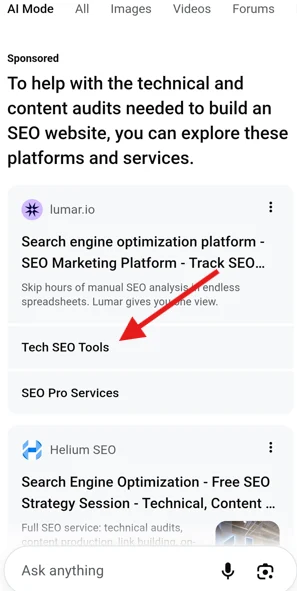
On August 10, 2026, Google commenced an experimental deployment of a novel advertising format within its AI Mode search interface: non-clickable sitelinks appearing alongside advertisements. This significant development, initially reported by Sachin Patel for Search Engine Watch, marks the first documented instance of such a display, where supplementary links are presented in a manner visually analogous to traditional sitelinks but lack interactive functionality. The observation underscores Google’s ongoing efforts to refine and integrate commercial content into its burgeoning artificial intelligence-powered search experiences.
The newly observed ad format features a primary advertisement accompanied by several descriptive text snippets, positioned beneath the main ad copy, mirroring the layout of conventional sitelinks. Crucially, these new sitelinks, as depicted in a screenshot accompanying the initial report, are static elements rather than interactive navigational tools. This early-stage implementation suggests Google is carefully exploring how to provide richer ad information within its AI environments, potentially laying the groundwork for more dynamic and clickable ad extensions in the future. The test is part of a broader, well-documented trend of Google’s continuous experimentation with various advertising permutations within its generative AI search interfaces, often referred to as "AI Mode" or the Search Generative Experience (SGE).
The Evolution of Ads in AI Search: A Chronological Overview
The integration of advertising into generative AI search environments has been a complex and iterative process for major search engine providers. The journey began in earnest in late 2022 and early 2023, following the public release of advanced large language models (LLMs) and conversational AI interfaces.
- Late 2022 – Early 2023: The Dawn of Generative AI in Search. Microsoft, through its partnership with OpenAI, was among the first to integrate generative AI capabilities into its Bing search engine, branded as "Copilot" (formerly Bing Chat). Initial versions often presented AI-generated answers with minimal or no overt advertising, prioritizing the novelty and utility of the AI experience.
- May 2023: Google’s Entry with Search Generative Experience (SGE). At its annual Google I/O developer conference, Google unveiled its own generative AI search experience, SGE, initially available through its Search Labs program. Early SGE iterations were largely focused on summarizing information and generating conversational responses, with advertising integration being subtle or absent in many early user tests. Google emphasized a user-first approach, suggesting ads would be introduced thoughtfully.
- Mid-to-Late 2023: Subtle Ad Integration Emerges. As SGE moved into broader testing phases, reports began to surface of ads appearing within the AI-generated snapshots. These were often contextual, labeled clearly as "Sponsored," and typically appeared at the top or bottom of the AI-summarized content. The integration was cautious, aiming not to disrupt the AI’s primary function of information synthesis.
- Early 2024: Increased Ad Visibility and Experimentation. Google intensified its testing of various ad formats within SGE. This period saw more explicit ad placements, including shopping carousels and text ads directly relevant to queries answered by the AI. The focus shifted to understanding how users interacted with ads when presented alongside AI summaries, and how advertisers could effectively reach audiences in this new paradigm.
- August 10, 2026: Non-Clickable Sitelinks Debut. The current observation of non-clickable sitelinks marks a new phase in this evolution. It indicates Google’s intention to provide more comprehensive ad information, even if initially static, suggesting a deeper integration of traditional ad extensions into the AI interface. This test aims to explore the visual impact and informational value of such extensions before potentially enabling full interactivity.
This chronological progression highlights Google’s deliberate, step-by-step approach to commercializing its AI search capabilities, balancing user experience with the imperative to maintain its advertising revenue streams.
Understanding Sitelinks and Their Strategic Value
To fully appreciate the significance of this test, it is essential to understand the traditional role and value of sitelinks in search advertising. Sitelinks are a type of ad extension that allows advertisers to include additional links to specific pages on their website directly within their search ads. These typically appear beneath the main ad copy, offering users more options to explore different aspects of a business, such as product categories, contact pages, store locators, or specific promotions.
Traditional Benefits of Sitelinks for Advertisers:
- Increased Visibility and Real Estate: Sitelinks make an ad physically larger on the search results page, drawing more attention and occupying more prime screen space.
- Improved Click-Through Rates (CTR): By offering multiple points of entry to a website, sitelinks increase the likelihood of a user finding something relevant to click, often leading to higher CTRs compared to ads without extensions.
- Enhanced Relevance and User Experience: Users can quickly navigate to the most relevant section of a website based on their specific needs, improving the overall user experience and reducing bounce rates.
- Better Ad Quality Score: Google’s algorithms often reward ads that use relevant extensions with higher Quality Scores, which can lead to lower cost-per-click (CPC) and better ad positions.
- Deeper Engagement: Sitelinks can guide users deeper into the conversion funnel by directing them to specific product pages or lead forms.
The appearance of sitelinks, even non-clickable ones, in AI Mode ads suggests Google is attempting to carry over these established benefits into the new AI paradigm. While the immediate utility of non-clickable links is limited in terms of direct navigation, their presence still offers enhanced informational value and increased visual prominence for the advertiser within the AI-generated response.

Analysis of the Non-Clickable Aspect: Why This Design Choice?
The decision to implement non-clickable sitelinks is arguably the most intriguing aspect of this test. Several strategic and technical rationales could explain this design choice:
- Early-Stage Technical Validation: Google routinely conducts A/B tests to ensure new ad formats render correctly across various devices and display environments. Introducing a visual element like sitelinks without immediate click functionality could be a first step to validate the visual integration and stability within the AI Mode’s dynamic interface before adding complex interactive layers.
- User Experience Observation: Google is likely gauging user reaction to the presence of more detailed ad information. Do users perceive the ad as more helpful or trustworthy with these additional contextual links? Does it influence their engagement with the main ad or the AI response itself? This "soft launch" allows Google to gather perception data without the complexity of tracking clicks on multiple sub-links.
- Information Density and Cognitive Load: AI-generated summaries are designed to be concise. Google might be testing the optimal level of information density for ads within these summaries. Non-clickable sitelinks could provide supplemental information without immediately overwhelming the user with too many interactive options, allowing for a gradual increase in complexity.
- Brand Visibility and Awareness: Even without direct clicks, the additional text provided by sitelinks can significantly enhance brand visibility and communicate more about an advertiser’s offerings. For certain branding objectives, merely displaying more information can be valuable.
- Regulatory and Ethical Considerations: As AI-generated content becomes more pervasive, regulatory bodies and consumer advocates are scrutinizing the transparency and integration of commercial content. Introducing non-clickable elements first might be a cautious approach to avoid accusations of aggressive commercialization within a new, potentially sensitive search environment.
- Paving the Way for Future Interactivity: The most probable long-term intention, as suggested by the original report, is that these sitelinks will eventually become clickable. This test could be a pre-cursor, ensuring the visual framework is robust before enabling full functionality, which would then bring the full benefits of traditional sitelinks to AI Mode.
Inferred Industry Reactions and Expert Commentary
While Google has not issued an official statement regarding this specific test—a common practice for experimental features—industry experts and digital marketing professionals are likely to offer varied perspectives.
- Digital Marketing Strategists: Many would view this as an anticipated, albeit cautious, step in the monetization of AI search. "This is Google’s way of testing the waters," commented Sarah Jenkins, a hypothetical leading digital advertising consultant. "They can’t afford to alienate users with overly aggressive ads in SGE, but they also need to demonstrate value to advertisers. Non-clickable sitelinks provide more ad real estate and information without the immediate pressure of driving a direct click, which is smart for early-stage testing."
- User Experience (UX) Researchers: Concerns might be raised regarding potential user confusion. Dr. Alan Reed, a hypothetical UX specialist, might note, "Users are conditioned to expect links to be clickable. Presenting a visual link that doesn’t respond to interaction could create a momentary sense of frustration or confusion, potentially eroding trust in the interface. Google will need to ensure clear visual differentiation or rapidly transition to clickable versions once the format is stable."
- SEO Professionals: From an organic search perspective, this further blurs the lines between paid and organic content. "The more prominent ads become in AI-generated answers, the more critical it is for businesses to have a robust, multi-faceted digital strategy," stated hypothetical SEO expert, Maria Rodriguez. "Both paid visibility and strong organic content, which can be sourced by the AI, will be paramount."
- Advertisers: Reactions from the advertising community would likely be mixed. Larger brands might welcome the increased visibility and potential for brand messaging, even without immediate clicks, viewing it as a valuable impression. Smaller businesses, focused on direct response and measurable ROI, might be more hesitant until clickability and clear performance metrics are established. "We’re always looking for new ways to get our message out," a hypothetical marketing director for a retail chain might express, "but the true value will come when these links are interactive and we can track conversions."
Broader Impact and Implications for the Future of Search
The introduction of non-clickable sitelinks in Google’s AI Mode advertisements carries significant implications for various stakeholders and the future trajectory of search.
For Advertisers:
- Adaptation of Creative Strategy: Advertisers will need to think critically about how their ad copy and sitelink descriptions contribute to overall brand messaging and information delivery within a summarized AI context. The focus might shift towards providing compelling, concise information that encourages further engagement, even if initially through the main ad.
- New Performance Metrics: As ad formats evolve in AI environments, traditional metrics like CTR and conversion rate might be supplemented by or partially replaced with metrics related to "impression share within AI snapshot," "information absorbed," or "brand recall."
- Increased Emphasis on Ad Extensions: This test reinforces the growing importance of ad extensions in maximizing ad performance. As search results become more dynamic and personalized, extensions provide the necessary depth and context for advertisers to stand out.
- Preparation for Clickable Formats: Advertisers should anticipate that these sitelinks will eventually become clickable and begin preparing their landing page strategies and tracking mechanisms for this future state.
For Users:
- Evolving Search Experience: Users will continue to see a more integrated mix of AI-generated answers, traditional organic results, and increasingly sophisticated advertisements. The challenge for Google will be to maintain a helpful, non-intrusive experience while also providing commercial value.
- Richer Information in Ads: Once clickable, these sitelinks promise to offer users a more direct and efficient path to specific information within an advertiser’s site, enhancing the utility of ads within AI summaries.
- Transparency and Trust: The clear labeling and thoughtful integration of ads will be crucial for maintaining user trust in AI-generated content.
For Google and the Search Ecosystem:
- Refinement of Monetization Strategy: This test is a vital step in Google’s long-term strategy to monetize its substantial investment in generative AI. Finding the right balance between user experience and revenue generation in AI search is paramount for its continued dominance.
- Data-Driven Development: The data gathered from this and similar tests will directly inform the development roadmap for SGE and other AI-powered search features, guiding decisions on ad placement, format, and interactivity.
- Shaping the Future of Search Advertising: Google’s innovations in this space will undoubtedly influence other search engines and digital platforms, setting new standards for how advertising integrates with advanced AI interfaces. The future of search will increasingly involve dynamic, contextual, and often AI-mediated content, where the lines between information and commerce continue to evolve.
The test of non-clickable sitelinks in Google’s AI Mode ads, while seemingly a minor adjustment, represents a significant marker in the ongoing evolution of search advertising. It signals Google’s strategic intent to deepen the integration of rich ad content into its generative AI experiences, preparing both users and advertisers for a future where search is increasingly intelligent, conversational, and commercially nuanced. The journey from static visuals to fully interactive ad extensions within AI responses is poised to redefine how businesses connect with consumers in the digital age.