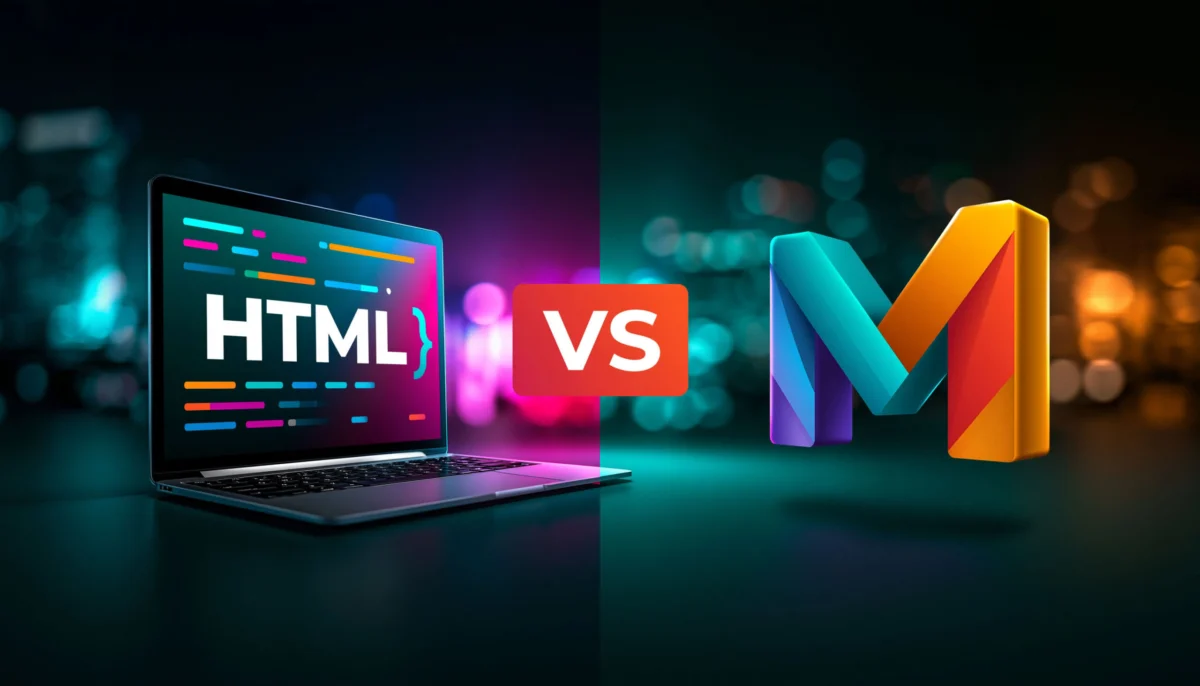
Google has unequivocally stated that HyperText Markup Language (HTML) remains the foundational standard for search engine optimization (SEO) and content discovery, advising webmasters and developers that Markdown files offer no inherent SEO benefit. This definitive clarification emerged from a recent episode of Google’s “Off The Record” podcast, titled “Markdown vs HTML,” featuring prominent Google Search advocates John Mueller and Martin Splitt. Their discussion underscored that for all practical purposes related to content discoverability and indexing by search engines, a standard HTML website is not just preferred but essentially required.
The “Off The Record” podcast, a platform where Google’s search team members delve into technical aspects of search and web development, specifically addressed the growing query regarding Markdown’s potential utility for SEO, especially in light of advancements in artificial intelligence and large language models (LLMs). John Mueller and Martin Splitt, both Senior Webmaster Trends Analysts at Google, collectively dismissed the notion that Markdown files could provide any SEO advantage over traditional HTML. Mueller succinctly summarized the stance, stating that “for all of the SEO-related things and discovery of content, a normal HTML website is like… what you need.” He further elaborated, “the generic SEO angle of how do I find a website that sells me a photograph is almost going to be completely bound to HTML pages and normal web pages.” This perspective reaffirms Google’s long-standing reliance on HTML as the primary medium for web content.
Understanding HTML’s Indispensable Role in Web Discovery
HTML, the language that structures content on the web, has been the bedrock of the internet since its inception. Developed by Tim Berners-Lee in the early 1990s, HTML provides a standardized way to create web pages and web applications. Its robust structure allows for the semantic organization of content through various tags such as headings (<h1>, <h2>), paragraphs (<p>), lists (<ul>, <ol>), links (<a>), and images (<img>). This inherent semantic structure is precisely what makes HTML so powerful and efficient for search engines to process.
Search engine crawlers, often referred to as spiders or bots, have evolved over decades alongside HTML. These automated systems are designed to navigate the web, read HTML documents, extract information, and build an index of the internet’s content. The algorithms employed by major search engines like Google are meticulously trained and optimized to parse HTML effectively, understanding not just the words on a page but also their hierarchical relationships and contextual significance as defined by HTML tags. For instance, an <h1> tag signals to a crawler that the enclosed text is the primary topic of the page, holding more weight than text within a <p> tag. Similarly, <strong> or <em> tags provide emphasis, while alt attributes on <img> tags offer descriptive text for images, crucial for accessibility and image search.
The maturity of HTML parsing technologies means that extracting plain text, identifying links, understanding page layout, and interpreting semantic meaning from HTML documents is a trivial and highly optimized task for search engines. This decades-long investment in HTML processing infrastructure by Google and other search providers ensures that valid, well-structured HTML is the most direct and efficient pathway for content to be discovered, indexed, and ranked.
Markdown’s Purpose and Its SEO Limitations
In contrast to HTML, Markdown is a lightweight markup language created by John Gruber and Aaron Swartz in 2004. Its primary design philosophy was simplicity and readability, allowing users to write plain text that can be converted into structurally valid HTML. Markdown is widely adopted in contexts where quick, easy-to-write formatting is paramount, such as documentation (e.g., README files on GitHub), forum posts, instant messaging, note-taking applications, and content management systems for internal use. Tools like Jekyll, Hugo, and Gatsby also leverage Markdown for static site generation, converting Markdown files into HTML before deployment.
While Markdown excels in these specific applications due to its ease of use and low barrier to entry, it was never intended to be a direct replacement for HTML in terms of web content publication or for direct consumption by search engine crawlers. The inherent limitation of Markdown for SEO purposes stems from its lack of semantic richness compared to HTML. Markdown provides basic formatting (headings, bold, italics, lists) but lacks the extensive array of semantic tags that HTML offers for conveying deeper meaning about content structure, data types, and relationships. For instance, Markdown does not have native tags for <footer>, <nav>, <article>, <section>, <time>, or <table> in the same structured way HTML does.
When a search engine crawler encounters a Markdown file directly (which is rare on the public web, as most Markdown is rendered to HTML before serving), it would lack the sophisticated cues it relies on to understand the content’s hierarchy and context. To be properly indexed and rendered in a web browser, Markdown must first be converted into HTML. It is this resultant HTML that search engines actually process. Therefore, any perceived “benefit” of Markdown for SEO is indirect and entirely dependent on the quality and validity of the HTML it is converted into. As Google’s experts affirmed, using Markdown internally for content creation and then converting it to HTML for publication is a perfectly valid workflow, but the SEO value resides solely in the final HTML output.
The AI/LLM Conundrum and the Risks of Dual Content Strategies
A significant portion of the “Off The Record” podcast also addressed emerging speculation within the web development community regarding content optimization for Large Language Models (LLMs) and other AI systems. With the rise of generative AI tools like ChatGPT and Google’s own Gemini, some developers have theorized that LLMs might prefer “cleaner,” less verbose content formats like Markdown, potentially leading to better representation or extraction by AI. This conjecture led to questions about whether creating separate, parallel Markdown versions of a website, specifically to cater to AI systems, could offer a strategic advantage.
Google’s response to this was clear and cautionary: webmasters should not create separate Markdown versions of their sites solely for LLMs. The search giant explicitly warned against maintaining two distinct versions of content—one in HTML for human users and traditional search engines, and another in Markdown supposedly optimized for AI. Such a strategy, they explained, introduces significant technical debt and operational risks.
Firstly, maintaining two versions of a site effectively doubles the workload for content creators, developers, and quality assurance teams. Any update, correction, or addition would need to be meticulously applied to both versions, increasing the chances of inconsistencies, outdated information, or errors. This parallel maintenance significantly increases technical complexity, requiring robust synchronization mechanisms that are prone to failure.
Secondly, and perhaps more critically, if a “hidden LLM version” of a page breaks or contains errors, human users will never encounter it. This means that such errors could go unreported and undetected by traditional monitoring systems, which are typically focused on the user-facing HTML. An automated system, including search engine crawlers or AI models, might then blindly index or process the broken or erroneous Markdown content, potentially leading to inaccurate information being propagated or negatively impacting the site’s perceived quality by AI systems. Google’s message implies that AI systems, much like their traditional crawling counterparts, are designed to process the same public HTML content that human users interact with. There is no special “AI-only” content format that provides an advantage. The best practice remains to provide a single, high-quality, semantically rich HTML version of content that serves both human users and all forms of automated systems.
Decades of Crawler Expertise: Why HTML is King
The fundamental reason for HTML’s undisputed reign in SEO lies in the decades of investment and refinement in web crawler technology. Search engines have spent over 25 years developing sophisticated algorithms and systems to parse, understand, and index the vast ocean of HTML content on the internet. This long history has led to highly optimized processes for:
- Robust Parsing: HTML, despite its complexities, has a well-defined standard (W3C standards). Search engines have built parsers that can handle not just perfectly valid HTML but also common quirks and errors found in real-world web pages, gracefully degrading where necessary to extract core content.
- Semantic Interpretation: As discussed, HTML provides semantic tags that crawlers leverage to understand the hierarchy and meaning of content. This goes beyond mere text extraction; it’s about understanding the context of the text.
- Link Discovery: HTML’s
<a>tags are crucial for navigation and for crawlers to discover new pages, understand site structure, and determine authority through backlinks. - Resource Discovery: HTML links to other resources like CSS for styling, JavaScript for interactivity, and images, all of which are part of a page’s comprehensive rendering and understanding by search engines.
- Accessibility Integration: HTML is inherently designed to support web accessibility standards (WCAG), which are increasingly important for search engine ranking. Semantic HTML structure aids screen readers and other assistive technologies, and crawlers can indirectly benefit from this structure.
Extracting plain text from HTML is, as Mueller noted, a “trivial task” for automated systems. Libraries and tools have existed for decades to perform this with high accuracy. The challenge for search engines isn’t just getting the text, but understanding its structure, relevance, and context, which HTML facilitates far more effectively than raw Markdown.
Implications for Web Developers, Content Creators, and SEO Professionals
Google’s clear directive has several important implications for various stakeholders in the web ecosystem:
- For Web Developers: The message reinforces the importance of focusing on writing valid, semantic, and accessible HTML. Developers should continue to prioritize web standards, clean code, and performance for their user-facing HTML. While Markdown can be an excellent tool for content authoring or internal documentation, its output must be high-quality HTML for public consumption. This means ensuring that any Markdown-to-HTML conversion process generates well-formed HTML with appropriate semantic tags, rather than just barebones markup.
- For Content Creators: Content creators should continue to focus on creating high-quality, relevant, and engaging content, structured within the framework of HTML best practices. Understanding how headings, paragraphs, lists, and other HTML elements contribute to content readability and discoverability remains crucial. The choice of authoring tool (e.g., a rich text editor that outputs HTML directly, or a Markdown editor that converts to HTML) is less important than the quality of the final HTML output.
- For SEO Professionals: This clarification debunks a potential misconception and solidifies existing SEO best practices. The emphasis should remain on optimizing the HTML content, including proper use of meta tags, structured data (Schema.org), internal linking, and ensuring crawlability and indexability of HTML pages. The notion of optimizing directly for “AI crawlers” with a separate content format is not supported by Google. Instead, optimizing for traditional search engine crawling through robust HTML simultaneously optimizes for any AI system that processes web content.
The integration of structured data, leveraging schemas from Schema.org, further highlights HTML’s critical role. Structured data, embedded directly within HTML using formats like JSON-LD, Microdata, or RDFa, provides explicit semantic information about content (e.g., identifying a product, a recipe, an event, or an article). This data helps search engines understand the content more deeply and can enable rich results in search. Markdown has no native mechanism for structured data; it must be implemented within the generated HTML.
Beyond SEO: The Broader Ecosystem and HTML’s Enduring Value
The discussion extends beyond mere SEO benefits to the broader health and functionality of the web. HTML is not just for search engines; it’s for browsers, accessibility tools, and the entire ecosystem of web technologies.
- Browser Compatibility: All modern web browsers are built to interpret and render HTML. Deviating from HTML as the primary content format would break fundamental web functionality.
- Accessibility: Semantic HTML is the backbone of web accessibility. Screen readers and other assistive technologies rely on HTML’s structure to convey information to users with disabilities. By adhering to HTML standards, websites become inherently more accessible, a factor that Google has increasingly emphasized as important for user experience and ranking.
- Long-Term Stability: HTML, continuously evolved and maintained by the W3C, offers long-term stability and backward compatibility. This ensures that content published today will remain accessible and interpretable by future web technologies.
In conclusion, Google’s message is a clear reaffirmation of HTML’s enduring and central role in the architecture of the web and its discoverability. While Markdown serves valuable purposes in content creation and specific development workflows, it is not a direct substitute for HTML in the context of public web content intended for search engine indexing and user consumption. Webmasters and developers are advised to continue prioritizing the creation of high-quality, semantic, and accessible HTML as the singular standard for ensuring their content is fully discoverable, understandable, and well-represented across the evolving landscape of search and artificial intelligence. The emphasis remains on a unified approach: build for the open web, and build it with HTML.