rifanmuazin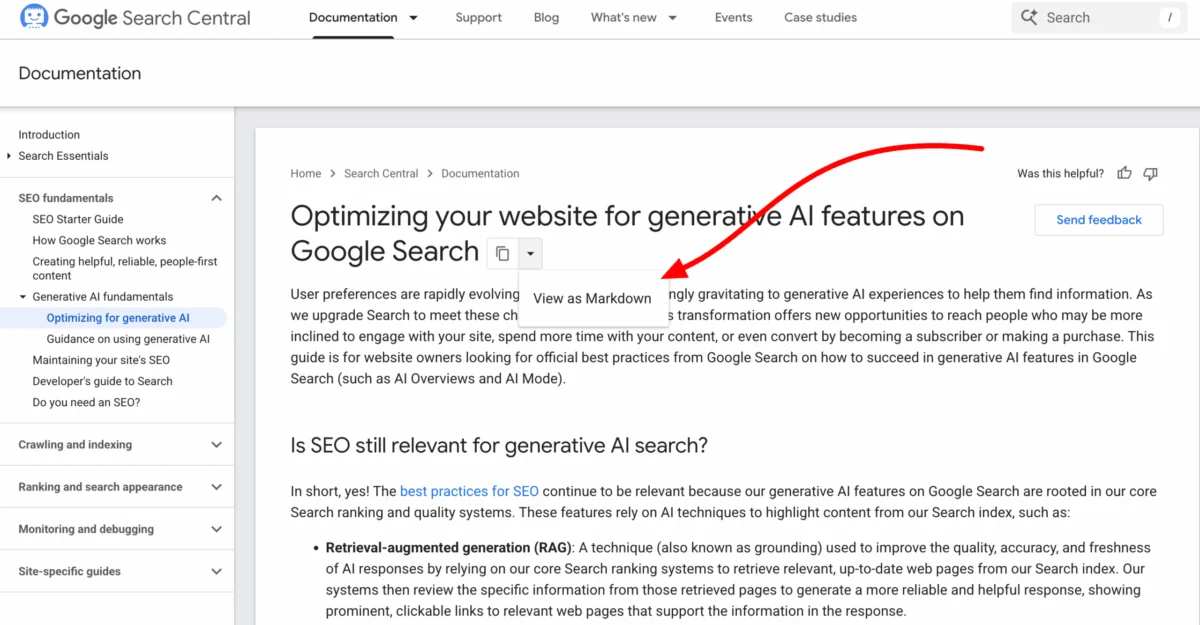
Google has introduced Markdown files, specifically identified as .md.txt files, within its comprehensive Google Search help documentation, a development that initially sparked considerable interest among webmasters and SEO professionals. However, this feature has been accompanied by an explicit clarification from Google’s Search Advocate, John Mueller, stating unequivocally that these files are not being utilized for the primary Google Search index or for generating responses within Google’s generative AI features. This move signals an internal operational enhancement for Google’s documentation processes rather than an immediate change in how search algorithms process information or how AI models are trained.
The introduction of these Markdown files was first observed across various pages within the Google Search developer documents. A notable example can be found on pages such as the “AI Optimization Guide,” where a dropdown menu now provides direct access to the corresponding .md.txt file. This functionality allows users, particularly developers and technical documentation enthusiasts, to easily download or view the plain-text Markdown version of the documentation, offering a streamlined way to consume the content in a format widely favored for its simplicity and readability.
Understanding the Rollout and Google’s Clarification
The availability of these files became apparent as users navigated Google’s developer resources. The visual cue of a dropdown link leading to a .md.txt file quickly caught the attention of the SEO community, known for meticulously observing any changes or additions to Google’s infrastructure that might hint at future search or indexing practices. The immediate question that arose was whether these Markdown files represented a new signal for Google Search’s ranking algorithms or a direct source for training its increasingly prominent generative AI models.
Responding to the burgeoning discussion and speculation, John Mueller took to LinkedIn to provide a definitive answer. His statement, “This is not being done for Search or generative AI responses in Search,” served to temper expectations and clarify the precise scope of this new implementation. This direct communication from a key Google spokesperson underscored the company’s commitment to transparency regarding its search mechanisms and AI development. The immediate implication of Mueller’s statement is that, for the time being, the presence of these .md.txt files should not be interpreted as a new vector for SEO optimization or as an additional data source directly feeding Google’s public-facing AI capabilities.
For context, a direct link to one such Markdown file, for instance, the “AI Optimization Guide,” can be accessed at https://developers.google.com/search/docs/fundamentals/ai-optimization-guide.md.txt, allowing anyone to inspect the raw content format. This accessibility reinforces the idea that these files are intended as a convenience for users of the documentation rather than a hidden layer of data for Google’s core products.
The Utility of Markdown in Technical Documentation
Markdown is a lightweight markup language created by John Gruber and Aaron Swartz in 2004. Its design goal was to enable people “to write using an easy-to-read, easy-to-write plain text format, and optionally convert it to structurally valid XHTML (or HTML).” Markdown has since gained immense popularity, especially within the developer community, for its simplicity, human-readability, and versatility.
Key advantages of Markdown include:
- Simplicity: Its syntax is intuitive and easy to learn, allowing users to format text without complex code.
- Portability: Markdown files are plain text, making them highly portable across different operating systems and applications.
- Version Control Friendliness: Because they are plain text, Markdown files integrate seamlessly with version control systems like Git, making it easy to track changes, collaborate, and revert to previous versions. This is particularly valuable in dynamic documentation environments.
- Conversion Flexibility: Markdown can be easily converted into various other formats, including HTML, PDF, and Word documents, using readily available tools.
- Developer Preference: Many developers prefer writing and reading documentation in Markdown due to its clean structure and minimal overhead. Platforms like GitHub heavily rely on Markdown for README files, wikis, and issue descriptions.
Given these benefits, Google’s adoption of Markdown for its help documentation is a logical step for internal consistency and developer convenience. It likely streamlines their documentation workflow, allowing writers to focus on content rather than complex formatting, and facilitates easier updates and maintenance. For external users, it provides a clean, easily parsable version of the content, which can be useful for offline reading, local indexing for personal reference, or integration into internal knowledge bases.
A Look Back: The LLMS.txt Precedent
This recent development regarding .md.txt files draws striking parallels to a previous incident involving LLMS.txt files in Google’s developer documentation. In late 2023, Google briefly introduced files named LLMS.txt to its help documentation, leading to widespread speculation within the SEO and AI communities. The LLMS.txt file was initially perceived by some as a potential equivalent to robots.txt but specifically designed for controlling how large language models (LLMs) might crawl or consume web content.
The LLMS.txt specification, had it been widely adopted and endorsed, could have provided website owners with a mechanism to dictate which parts of their content LLMs were permitted to access for training or response generation. This concept resonated deeply with the growing concerns surrounding AI ethics, data sourcing, and intellectual property rights in the age of generative AI.

However, much like the current situation with Markdown files, Google quickly moved to clarify its stance on LLMS.txt. After a brief period of availability and community discussion, Google removed the LLMS.txt files and issued a statement confirming that it did not endorse LLMS.txt as a standard. John Mueller again played a role in this clarification, emphasizing that the files were an internal experiment or oversight and not an official directive for the web. This incident highlighted the sensitivity surrounding Google’s AI initiatives and the keen eye with which the public scrutinizes any related changes to its web infrastructure.
The LLMS.txt saga serves as a critical backdrop to the .md.txt announcement. It demonstrates Google’s cautious approach to introducing new file types or protocols that could be misinterpreted as new signals for search or AI. The rapid clarification for .md.txt files suggests that Google learned from the LLMS.txt experience and sought to preempt similar widespread speculation by proactively stating the files’ intended purpose and limitations.
Why Google Might Not Use These Files for Search or Generative AI
Google’s decision not to use .md.txt files for direct search indexing or generative AI responses is rooted in several technical and strategic considerations:
- Redundancy and Canonicalization: Google Search primarily indexes HTML content. The
.md.txtfiles are essentially plain-text versions of the HTML pages. Indexing both would create redundancy and potential canonicalization issues, where Google would have to decide which version is the primary one. Google’s existing indexing systems are highly optimized for HTML. - Lack of Semantic Markup: While Markdown is great for readability, it lacks the rich semantic markup (e.g., Schema.org, Open Graph) often embedded within HTML, which provides search engines with deeper context about the content. Using plain Markdown files directly for search might strip away valuable signals.
- Content Quality and Control: Google’s search algorithms are sophisticated, incorporating hundreds of signals to evaluate content quality, relevance, and authority. Relying on raw Markdown files, which might lack certain metadata or rendering nuances present in the HTML, could complicate this evaluation process.
- Generative AI Training Data: Generative AI models, especially large language models (LLMs), are trained on vast datasets of text and code. While Markdown files contain text, their specific format (e.g., headings with
#, bold with**) might not be the most efficient or desired input for certain training pipelines without prior parsing and conversion. Furthermore, Google likely has established internal pipelines for ingesting and processing documentation content for any AI applications, which may already be based on the HTML versions or a more structured internal format. - Focus on Original Content: Google’s algorithms prioritize original, high-quality content. The
.md.txtfiles are derivative versions of the primary HTML documentation. Using them for search or AI might dilute the focus on the canonical source. - Avoiding Misinterpretation and Manipulation: By explicitly stating that these files are not used for search, Google prevents webmasters from attempting to optimize or manipulate these
.md.txtfiles in hopes of gaining an SEO advantage. This maintains a clearer boundary for what constitutes an actionable SEO signal.
Implications for Developers and Documentation Management
While the .md.txt files may not impact search rankings, their introduction is a significant convenience for the developer community and Google’s internal documentation teams:
- Enhanced Developer Experience: Developers often prefer working with plain text and command-line tools. The ability to directly access documentation in Markdown format facilitates scripting, parsing, and integration into local development environments or internal knowledge bases. This aligns with Google’s broader commitment to supporting the developer ecosystem.
- Version Control and Collaboration: For Google’s internal teams, using Markdown likely streamlines their documentation creation and maintenance workflows. Markdown’s compatibility with Git and other version control systems simplifies collaboration among technical writers and engineers, ensuring consistency and ease of updates.
- Offline Access and Tooling: Users can easily download these Markdown files for offline reading or integration with various Markdown editors and viewers, enhancing productivity and flexibility.
- Accessibility for Non-Browser Tools: The plain text nature of Markdown files makes them readily accessible to various automated tools and scripts, which can process the content without needing to render a full HTML page.
Broader Context: Google’s Cautious Approach to AI and Content Sourcing
Google’s careful messaging around .md.txt and the prior LLMS.txt incident reflects a broader industry trend of heightened scrutiny over how AI models acquire and utilize data. As generative AI becomes more pervasive, questions of copyright, attribution, and the ethical sourcing of training data have come to the forefront. Content creators and publishers are increasingly concerned about their work being consumed by AI without proper compensation or acknowledgement.
In this environment, Google is treading carefully. By explicitly disavowing the use of .md.txt files for search or generative AI, Google reinforces that its primary methods for understanding and indexing web content remain consistent and that any new internal formats are not automatically new signals for its public-facing AI products. This helps manage expectations and mitigate potential legal or ethical challenges related to content sourcing for AI. It also underscores Google’s ongoing efforts to provide clarity in a rapidly evolving digital landscape, where the lines between content creation, indexing, and AI consumption are constantly shifting.
Conclusion and Future Outlook
The addition of Markdown files to Google’s help documentation is an internal operational improvement primarily benefiting developers and Google’s documentation teams. It enhances the accessibility and manageability of technical content, aligning with modern documentation practices. However, as explicitly stated by John Mueller, these .md.txt files currently hold no direct sway over Google Search rankings or the generation of AI responses within Search.
This clarification is crucial for the SEO community, preventing misdirected efforts to optimize these files. It also serves as a reminder of Google’s careful approach to integrating new technologies, particularly those related to AI, into its core services. While the .md.txt files themselves might not directly influence search outcomes, their presence signifies Google’s continuous refinement of its internal processes and its commitment to providing robust and accessible documentation for its vast ecosystem of users and developers. The future may hold alternative uses for these structured text files within other Google products or internal applications, but for now, their role remains distinct from the core functions of Google Search and its generative AI capabilities. The ongoing dialogue between Google and the webmaster community remains vital for navigating these evolving technological landscapes.