Muslim

The landscape of customer experience management (CXM) platforms is undergoing a significant transformation, with a growing number of large organizations re-evaluating their strategic investments. As 2026 approaches, a notable trend indicates that many enterprises, initially drawn to comprehensive solutions like Sprinklr, are now actively seeking alternatives. The primary drivers behind this shift are consistently cited as the high cost of ownership and the extended, often complex, implementation cycles associated with such expansive platforms. This re-evaluation is prompting businesses to compare a diverse array of alternatives based on pricing models, specific feature sets, and their suitability for distinct operational needs.
The Evolution of CXM Platforms and Sprinklr’s Dominance

For years, Sprinklr has positioned itself as a unified customer experience management platform, a formidable solution designed to integrate social media management with broader marketing, advertising, customer care, and market research functions within a single, cohesive system. Its appeal has traditionally been strongest among large, multinational organizations managing multiple brands, diverse regions, and extensive teams. The platform’s modular architecture, encompassing publishing, scheduling, sophisticated social listening, paid social advertising, agent-based customer service, and advanced analytics, often layered with AI for sentiment detection, intelligent routing, and comprehensive reporting, made it an attractive proposition for enterprises aiming for a "single pane of glass" view of their customer interactions. This breadth of capability was, and remains, a significant draw for enterprise buyers seeking to consolidate disparate tools and streamline complex workflows.
However, this extensive functionality comes with inherent challenges. Sprinklr’s business model typically involves an enterprise sales process, custom quotes rather than published standard pricing, and modular contracts that often necessitate substantial implementation support. For many teams, particularly those whose core needs revolve around social publishing, listening, and basic customer care, the investment in a platform of Sprinklr’s scale can lead to over-provisioning—paying for a far larger social media management ecosystem than they actively utilize.
The Catalyst for Change: Why Enterprises Seek Alternatives in 2026

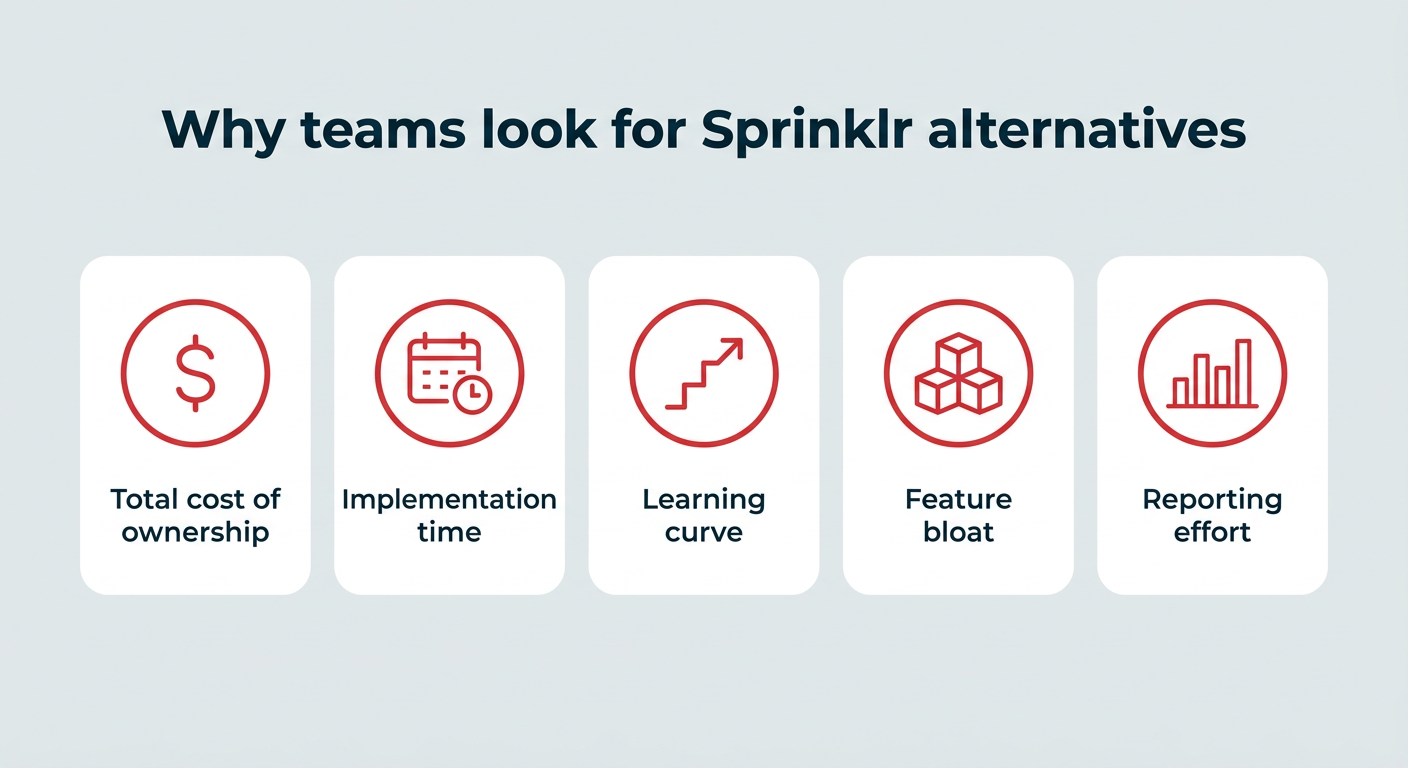
The current wave of re-evaluation, notably highlighted by Forrester’s projection that 81% of B2C marketing executives planned to assess their social suite heading into 2025, underscores a fundamental shift in enterprise priorities. While the raw capabilities of platforms like Sprinklr are rarely questioned, the growing dissatisfaction stems from the economic and operational burdens associated with their deployment and ongoing maintenance. In an increasingly agile and cost-conscious business environment, the protracted implementation phases and non-transparent pricing structures of mega-suites are proving to be significant deterrents.
Several key factors contribute to this growing demand for Sprinklr alternatives:
- Prohibitive Costs: The lack of transparent, standard pricing models often results in bespoke, high-value contracts that can escalate quickly, especially when additional modules or increased user counts are required. This unpredictability in expenditure makes budget forecasting challenging for finance departments.
- Extended Implementation Timelines: Deploying a comprehensive platform like Sprinklr across a large organization often involves months, if not quarters, of integration, customization, and training. This lengthy time-to-value can delay critical marketing and customer service initiatives, impacting competitive responsiveness and return on investment (ROI).
- Feature Overload and Underutilization: Many enterprise teams find themselves paying for an extensive suite of features that exceed their immediate operational requirements. This "bloat" can complicate user adoption, create unnecessary training overhead, and lead to inefficient resource allocation.
- Demand for Agility and Faster ROI: Modern businesses, facing dynamic market conditions, require tools that can be deployed swiftly and demonstrate tangible value in a shorter timeframe. The traditional "big bang" approach to enterprise software implementation is increasingly being challenged by a preference for more modular, scalable, and agile solutions.
- Evolving AI Landscape: While Sprinklr integrates AI, the rapid advancements in artificial intelligence mean that many specialized, often more cost-effective, alternatives are now offering robust AI capabilities tailored to specific social media management functions, from content generation to advanced sentiment analysis.
This convergence of financial pressure, operational inefficiencies, and technological advancements is driving a strong impetus for organizations to explore platforms that offer comparable enterprise-scale social operations but with significantly faster implementation times and reduced overhead.
Emerging Landscape: A Comparative Overview of Top Sprinklr Competitors
The market has responded to this demand with a robust selection of platforms, each offering distinct strengths tailored to various business sizes and operational focuses. From comprehensive social operating systems to niche tools specializing in listening or visual content, the alternatives provide a spectrum of choices for enterprises seeking more tailored and efficient solutions.
Here’s a quick comparison of leading Sprinklr competitors:
| Tool | Best for | Starting Price | Key Differentiator |
|---|---|---|---|
| Hootsuite | Enterprise and mid-market social ops | $99/user/month | Listening, publishing, care, and governance in one social OS |
| Meltwater | PR and media monitoring teams | Custom quote | Combined earned media and social monitoring |
| Brandwatch | Listening-first research teams | Custom quote | Deep consumer research and segmentation |
| Sprout Social | Mid-market publishing and engagement | Custom/per-user | Polished UI with per-user pricing |
| Khoros | Digital care and online communities | Custom quote | Community platform plus agent-based care |
| Emplifi | Social commerce and care | Custom quote | Commerce and influencer features alongside social |
| Zoho Social | Teams already using Zoho apps | Premium $65/month | Tight integration with Zoho CRM and suite |
| Buffer | Small businesses and solo marketers | Free, paid from $6/channel/month | Lowest-cost entry point |
| Later | Creators and visual-first SMBs | Paid from $25/month | Visual planning and link in bio |
| HubSpot | Teams running social inside a CRM | Marketing Hub Pro $890/month | Social tied directly to CRM data |
In-Depth Analysis of Leading Alternatives for 2026
Each of these platforms presents a unique value proposition, addressing specific pain points and catering to diverse organizational needs.
1. Hootsuite: The Enterprise Social Operating System
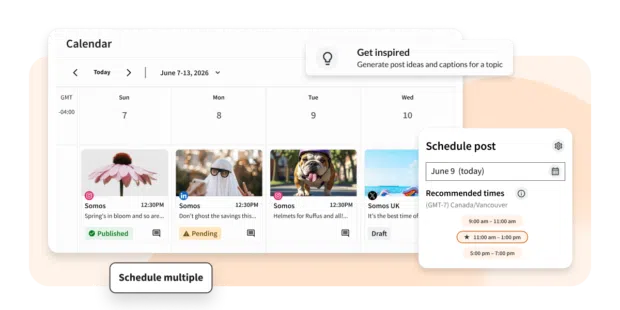
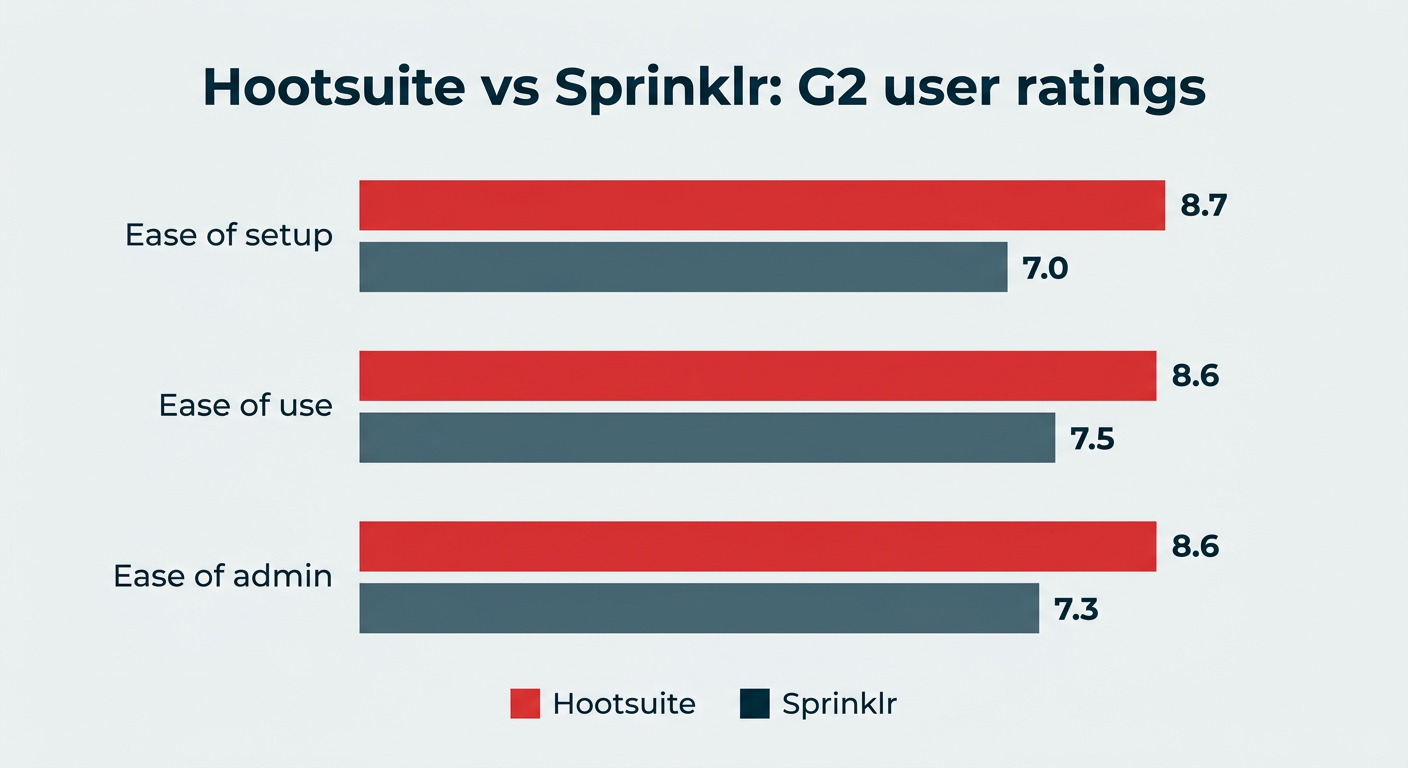
Hootsuite stands out as a leading contender for enterprises and mid-market organizations. It offers a comprehensive social media management tool that streamlines post scheduling, conversation monitoring, and performance measurement across all major social networks. Its "Social OS" paradigm integrates listening, publishing, care, and governance into a single operating system, ensuring that insights and actions are intrinsically linked. For enterprise buyers, Hootsuite emphasizes a significantly faster time-to-value compared to Sprinklr, boasting integrations with existing tools like Salesforce, Adobe, and Microsoft, enabling teams to go live in days rather than quarters. G2 reviewers consistently rate Hootsuite higher than Sprinklr in ease of setup (8.7 vs 7.0), usability (8.6 vs 7.5), and administrative features (8.6 vs 7.3), underscoring its user-friendliness and efficient deployment. Its core capabilities include advanced social listening, robust publishing and scheduling with extensive content libraries, AI-powered content creation, comprehensive analytics, and sophisticated governance features for large teams.
Pros: Full-suite enterprise capabilities, rapid deployment, strong integrations, user-friendly interface, competitive pricing model, excellent governance and collaboration tools.
Cons: Some advanced niche features might require specific add-ons, though core functionality is robust.
Good for: Large enterprises, mid-market businesses, multi-brand organizations, teams needing strong governance and workflow automation.
Pricing: Starts at $99/user/month (annual billing).
2. Meltwater: Mastering Media Intelligence
Meltwater excels as a media intelligence platform, primarily serving PR and media monitoring teams. Its strength lies in its expansive coverage across earned media, allowing organizations to track and measure online conversations, uncover insights, and monitor brand mentions across traditional press, broadcast media, and social channels. While it includes social media management tools like scheduling and publishing, its core differentiation is the unified reporting on earned and owned media. However, its social execution capabilities—such as advanced publishing, approvals, and complex inbox management—are generally considered lighter than dedicated social suites.
Pros: Comprehensive media monitoring (earned and social), strong insights for PR, unified reporting.
Cons: Less robust social publishing and engagement tools, can be complex for social-only teams.
Good for: PR agencies, communications departments, businesses focused on earned media and brand reputation.
Pricing: Custom quotes based on modules, users, and mention volume.

3. Brandwatch: Deep Dive into Consumer Insights
Brandwatch is a powerful, data-driven platform primarily for research and insights teams. It specializes in scouring vast social media data to deliver actionable consumer insights, offering features like advanced sentiment analysis, competitor benchmarking, trend spotting, and deep audience segmentation. Brandwatch directly competes with Sprinklr on the intelligence and listening front, providing unparalleled depth in understanding narratives and conversation data. Teams requiring both deep listening and day-to-day publishing often pair Brandwatch with a separate management platform or opt for a more integrated suite.
Pros: Industry-leading social listening and analytics, deep consumer research, advanced segmentation.
Cons: Limited publishing and engagement capabilities, primarily a listening tool.
Good for: Market research teams, insights analysts, brands needing deep consumer intelligence.
Pricing: Custom quotes based on mention volume, data history, and seats.
4. Sprout Social: User-Friendly Engagement at Scale
Sprout Social is a popular social media management software known for its polished user interface and ease of use, making it an attractive option for mid-market businesses. It provides robust features for content scheduling, social media monitoring, customer service management, and intuitive reporting. Sprout positions itself as a simpler, quicker-to-deploy alternative to Sprinklr, with presentation-ready reports out-of-the-box. However, advanced listening is typically an add-on, and its per-user pricing model means costs can escalate significantly for larger teams with many stakeholders.

Pros: Intuitive UI, strong reporting, excellent customer service features, easy to learn.
Cons: Listening is an add-on, per-user pricing can be costly for large teams, less governance for complex workflows.
Good for: Mid-market businesses, agencies, teams prioritizing user experience and engagement.
Pricing: Prices per user by plan tier, with additional users billed separately.
5. Khoros: The Community and Care Specialist
Khoros is an enterprise-grade Sprinklr competitor built specifically around digital customer care and online communities. Unlike Sprinklr’s broad CXM scope, Khoros concentrates on conversations: agent-based social support, messaging, and branded community forums. This specialized focus makes it a preferred choice for support-heavy organizations in sectors like telecom, financial services, and consumer tech, where managing high volumes of customer interactions and fostering online communities is critical. Marketing-centric teams primarily focused on publishing and analytics may find Khoros more robust than their needs dictate.
Pros: Industry-leading digital customer care, robust community platform, strong moderation tools.
Cons: Less emphasis on broad social media marketing and advertising, can be heavy for non-support focused teams.
Good for: Customer service departments, brands building large online communities, regulated industries requiring secure care.
Pricing: Custom quotes by module, agent seats, and volume.

6. Emplifi: Social Commerce and Holistic CX
Emplifi, formerly Socialbakers, offers a direct competition to Sprinklr by covering social media marketing, commerce, and customer care. It uniquely blends publishing and analytics with influencer management and shoppable content features, distinguishing it from tools focused solely on scheduling and reporting. Retail and consumer brands, particularly those actively engaged in social commerce alongside organic publishing, tend to derive the most value from Emplifi. Organizations with a primary focus on deep listening or complex governance may find other options more suitable.
Pros: Strong social commerce features, influencer management, comprehensive customer experience tools.
Cons: Listening capabilities can be limited compared to dedicated listening tools, custom pricing.
Good for: Retailers, consumer brands, e-commerce businesses, teams focused on social commerce.
Pricing: Custom quotes based on modules, profiles, and users.
7. Zoho Social: Integrated Ecosystem Advantage
Zoho Social is part of a much larger ecosystem of business applications offered by Zoho, including CRM, CRO, email marketing, and e-commerce platforms. Its primary appeal lies in its tight integration with other Zoho apps, making it an excellent choice for businesses already embedded in the Zoho suite. While comprehensive, Zoho’s suite operates on a pay-per-feature model, meaning users may need multiple subscriptions to access all desired functionalities. User feedback sometimes points to a cluttered interface, occasional issues with account linking, and challenges with advanced tracking or support.

Pros: Seamless integration with Zoho CRM and other Zoho products, affordable for existing Zoho users.
Cons: Interface can be cluttered, advanced features may require multiple subscriptions, reported support issues.
Good for: Small to mid-sized businesses already using Zoho’s ecosystem.
Pricing: Standard at $15/month, Professional at $40/month, Premium at $65/month (monthly billing).
8. Buffer: Simplicity for Smaller Teams
Buffer offers a straightforward solution for small to midsize businesses and solo marketers, providing an easy way to schedule, publish, and analyze content across multiple networks from a central dashboard. It serves as an excellent entry point into social media management due to its simplicity and affordability. However, Buffer is not an enterprise-grade Sprinklr replacement. It lacks advanced features such as an enterprise governance layer, agent-based customer care, or sophisticated social listening capabilities, making it ideal for lean teams rather than complex, multi-region operations.
Pros: User-friendly interface, affordable pricing (including a free plan), easy content scheduling.
Cons: Lacks advanced listening, customer care, and governance features, not scalable for large enterprises.
Good for: Small businesses, solo marketers, startups, teams with basic social media needs.
Pricing: Free plan for up to three channels, paid plans from $6/channel/month.

9. Later: Visual-First Content and Creator Tools
Later specializes in visual-first content planning and publishing, making it a strong alternative for creators and small to mid-sized businesses that prioritize visual storytelling on platforms like Instagram, TikTok, and Pinterest. Its intuitive drag-and-drop interface simplifies content scheduling and planning. Later’s strengths lie in visual planning, link-in-bio tools, and influencer features. However, it does not cater to enterprise requirements like governed approvals, comprehensive listening, or shared customer care queues, positioning it firmly as a tool for content creators and visually-driven SMBs.
Pros: Excellent visual planning tools, strong for Instagram/TikTok, link-in-bio features, influencer marketing.
Cons: Limited for enterprise-level governance, listening, and customer care, niche focus.
Good for: Influencers, content creators, visual-first brands, small businesses focused on Instagram/TikTok.
Pricing: Paid plans from $25/month for one user and one social set.
10. HubSpot: Social within the CRM Powerhouse
HubSpot, a prominent customer relationship management (CRM) platform, integrates social media scheduling and management functions within its broader Marketing Hub. It offers a robust suite of marketing tools, including email automation, analytics, and reporting. HubSpot users often find it easier to use than Sprinklr and appreciate its customer service. However, social media management is a feature within its comprehensive platform rather than its primary focus. Consequently, its content calendar, creation tools, and shared inbox may lack the depth and specialized functionalities found in dedicated social media management products.

Pros: Seamless integration with HubSpot CRM, comprehensive marketing suite, user-friendly interface.
Cons: Social features are not as deep as dedicated tools, higher entry cost due to full suite.
Good for: Businesses heavily invested in HubSpot’s CRM, marketing teams seeking an integrated solution.
Pricing: Social tools are in Marketing Hub Professional, starting at $890/month (monthly billing) plus onboarding.
Feature Comparison: A Detailed Look at Capabilities
Understanding how these alternatives stack up on core features is crucial for informed decision-making. The distinctions often lie in the depth and breadth of specific functionalities, especially regarding listening, customer care, governance, and AI integration.

| Tool | Publishing | Listening | Customer Care | Analytics | AI Features | Advocacy | Governance |
|---|---|---|---|---|---|---|---|
| Hootsuite | Yes | Yes | Yes | Yes | Yes | Yes | Yes |
| Meltwater | Limited | Yes | Limited | Yes | Limited | No | Limited |
| Brandwatch | Limited | Yes | Limited | Yes | Yes | No | Limited |
| Sprout Social | Yes | Add-on | Yes | Yes | Limited | Add-on | Limited |
| Khoros | Limited | Yes | Yes | Yes | Yes | No | Yes |
| Emplifi | Yes | Limited | Yes | Yes | Limited | No | Limited |
| Zoho Social | Yes | Limited | Limited | Limited | Limited | No | No |
| Buffer | Yes | No | No | Limited | Limited | No | No |
| Later | Yes | No | Limited | Limited | Limited | No | No |
| HubSpot | Yes | No | Limited | Yes | Limited | No | Limited |
This comparison highlights that while most platforms offer basic publishing, scheduling, and reporting, the critical differentiators for enterprise-scale operations lie in the depth of social listening (e.g., real-time monitoring, historical data access, sentiment analysis), the robustness of customer care features (e.g., agent routing, SLA management, integration with CRM), the sophistication of governance (e.g., granular permissions, approval workflows, audit trails), and the integration of advanced AI capabilities beyond basic content suggestions. For example, a "Limited" in listening or customer care implies that a separate tool or manual process might be needed, increasing operational complexity and potentially negating the benefits of a "unified" platform.
Strategic Considerations for Choosing the Best Sprinklr Alternative
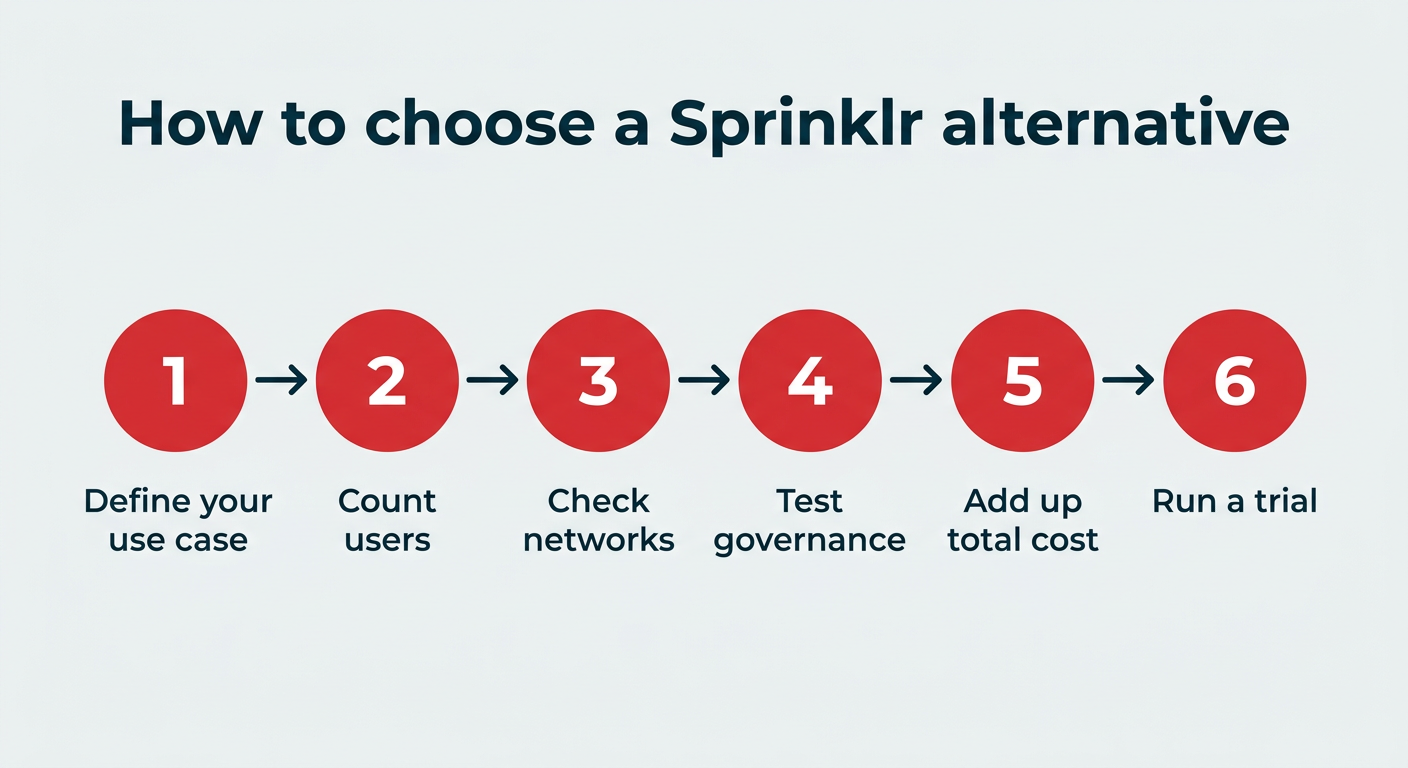
Selecting the ideal social media management tool is not a one-size-fits-all decision. Organizations must embark on a structured evaluation process that aligns with their specific business objectives, team structure, and budgetary constraints.

- Conduct a Thorough Needs Assessment: Before engaging with vendors, clearly define your organization’s precise requirements. What are the core social media functions that are absolutely critical? (e.g., publishing, listening, customer service, analytics, advertising). Identify current pain points with existing tools or processes.
- Evaluate Scalability and Future Growth: Consider not just your current needs but also your anticipated growth. Can the platform accommodate more users, brands, regions, and social networks as your business expands? What are the cost implications of scaling up?
- Assess Integration Capabilities: Social media management rarely operates in a silo. How well does the alternative integrate with your existing technology stack, including CRM, marketing automation, data analytics, and customer service platforms? Seamless integration is crucial for maintaining a holistic customer view.
- Prioritize User Experience and Adoption: A powerful tool is ineffective if teams struggle to use it. Evaluate the platform’s ease of use, intuitive interface, and the availability of training and support. Faster user adoption translates to quicker ROI.
- Understand Pricing Models and Total Cost of Ownership (TCO): Beyond the headline price, delve into the full cost implications, including setup fees, training, ongoing support, and costs for additional modules or users. Transparent pricing is key to predictable budgeting.
- Review Governance and Compliance Features: For regulated industries or large enterprises, robust governance features—such as role-based permissions, multi-stage approval workflows, and audit trails—are non-negotiable for brand safety and compliance.
- Pilot and Proof of Concept: Whenever possible, leverage free trials or conduct a pilot program with a shortlist of alternatives. This hands-on experience provides invaluable insight into real-world performance and team feedback.
In essence, the choice boils down to a clear understanding of your use case. For enterprise-scale social operations requiring comprehensive functionality, robust governance, and fast deployment, platforms like Hootsuite Social OS and Khoros present strong arguments. For deep listening, Brandwatch is unparalleled. For integrated CRM functionalities, HubSpot offers a compelling solution. And for smaller, agile teams, Buffer or Later provide cost-effective entry points.
Market Implications and Future Outlook
The trend of enterprises seeking Sprinklr alternatives signals a broader evolution in the CXM and social media management software market. Vendors are increasingly pressured to offer more flexible pricing, modular solutions, and a stronger focus on faster time-to-value. The emphasis is shifting from monolithic "unified" platforms that attempt to do everything for everyone, to more agile ecosystems where businesses can pick and choose best-of-breed solutions that integrate seamlessly.
Artificial intelligence will continue to play a pivotal role, not just in advanced analytics and sentiment detection but also in automating content creation, optimizing campaign performance, and personalizing customer interactions. The ability of an alternative to effectively leverage AI, integrate with emerging social channels, and adapt to evolving data privacy regulations will be critical for its long-term viability and competitive edge. This dynamic environment encourages innovation and ultimately benefits businesses by providing a wider array of tools that are better aligned with their specific strategic and operational imperatives.
Conclusion: The Shifting Paradigm
The current climate dictates that businesses are no longer willing to compromise on cost-effectiveness or protracted deployment cycles for comprehensive functionality. The market for social media management and CXM platforms is maturing, with a clear delineation emerging between highly specialized tools and integrated suites that prioritize agility and tangible ROI. Enterprises in 2026 are demanding solutions that are easier to implement, more transparent in pricing, and precisely tailored to their operational needs, without sacrificing the scale and sophistication required for modern customer engagement. The move away from traditional, heavy enterprise solutions towards more nimble and efficient alternatives is not merely a cost-cutting measure, but a strategic imperative for maintaining competitive advantage in a rapidly evolving digital landscape.


 Layla Zulfa

 Asro