Asep Darmawan

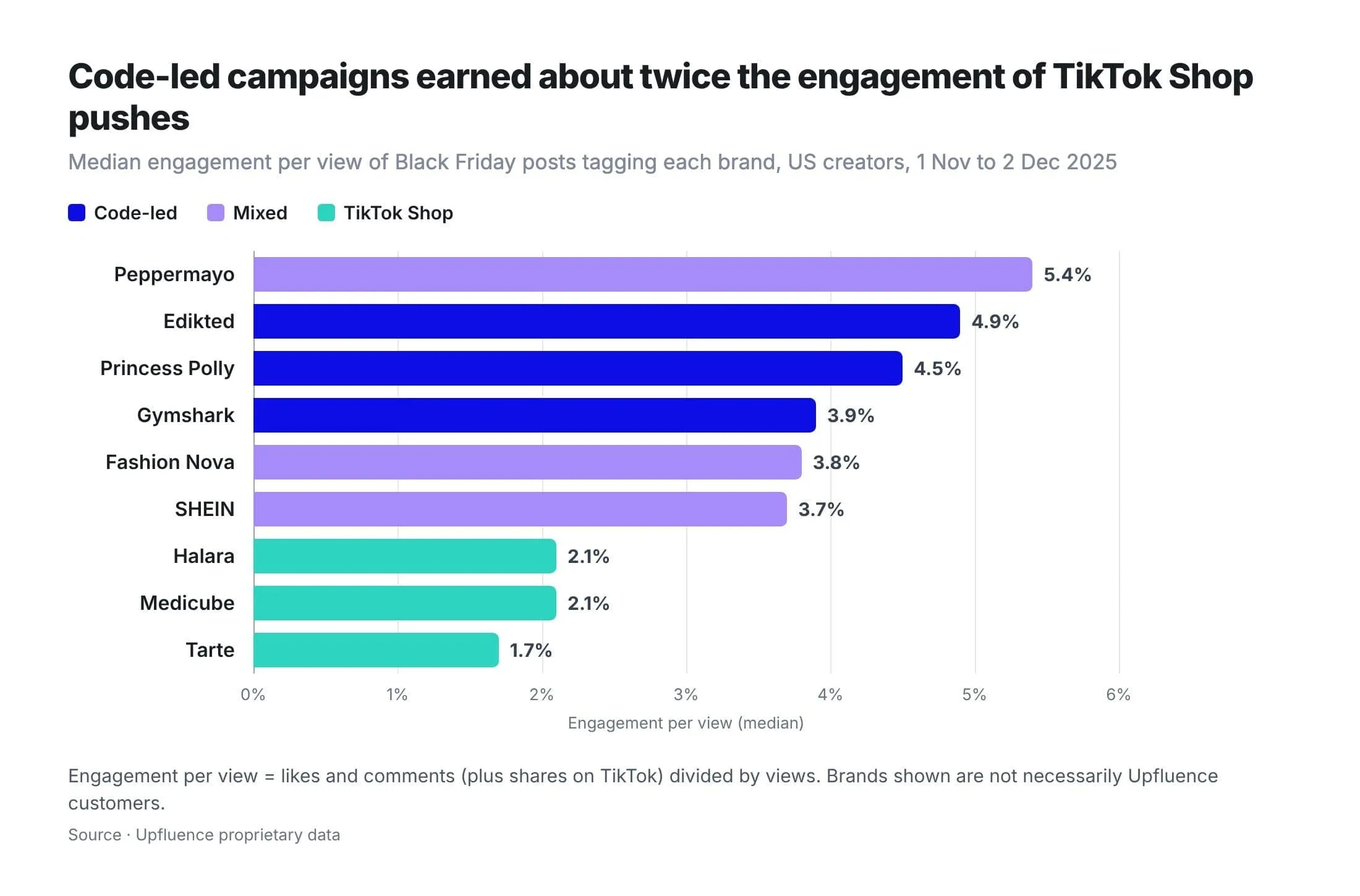
The digital marketing landscape for the recent Black Friday and Cyber Monday (BFCM) period was defined by a significant shift in consumer preference toward authentic, creator-led content over traditional brand-centric deal announcements. According to a comprehensive analysis of approximately 508,000 posts by United States creators across Instagram, TikTok, and YouTube, the most successful campaigns were those that prioritized engagement through micro-influencers and immersive content formats. While fast-fashion giant SHEIN dominated the market in terms of sheer volume, smaller fashion labels such as Peppermayo, Edikted, and Princess Polly secured the highest engagement rates, demonstrating that reach and resonance are increasingly divergent metrics in the influencer economy.
The study, which tracked data from November 1 to December 2, 2025, highlights a growing trend: the "micro-influencer advantage." Brands that leveraged creators with fewer than 100,000 followers saw significantly higher interaction levels. This was particularly evident in the fashion sector, where Peppermayo, Edikted, and Princess Polly achieved median engagement per view rates ranging from 4.5% to 5.4%. In contrast, brands that relied heavily on massive creator counts or automated TikTok Shop listings often struggled to maintain viewer attention, with some engagement rates dipping as low as 1.5%.
Quantitative Breakdown of the Black Friday Creator Economy
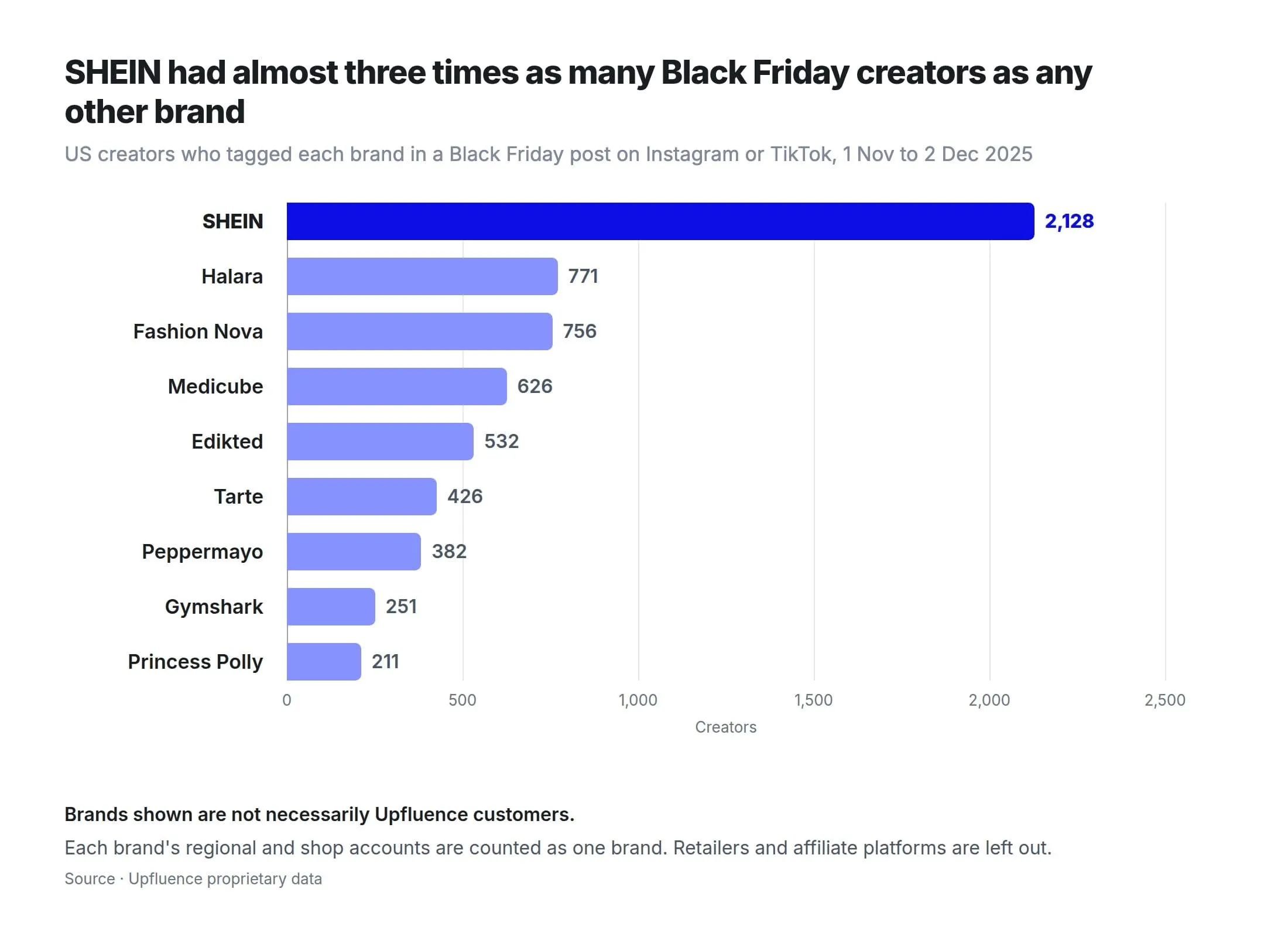
The scale of influencer participation during the holiday season reached unprecedented levels. SHEIN emerged as the leader in creator acquisition, with 2,128 US-based creators tagging the brand in Black Friday-related content. This volume was nearly triple that of its nearest competitor, Halara, which engaged 771 creators. Other major players included Fashion Nova (756 creators), Medicube (626), and Edikted (532).
However, the data indicates that high volume does not always translate to high-quality engagement. SHEIN’s massive campaign resulted in a median engagement per view of 3.7%. While respectable, this figure was bolstered primarily by the brand’s smaller creators. Creators with fewer than 100,000 followers tagging SHEIN earned 1.7 times the engagement per view compared to those with larger followings. This phenomenon suggests that as a creator’s audience grows, the perceived personal connection—and thus the influence over purchasing decisions—may dilute, especially during high-noise periods like Black Friday.
The disparity in performance was even more pronounced when examining content formats. The highest-performing brands shared two critical strategic elements: a reliance on creators under the 100,000-follower threshold and a focus on "try-on," "outfit," or "haul" videos. For Peppermayo and Edikted, 82% of their participating creators fell into the small-creator category. Furthermore, approximately one-third of their total posts featured immersive content where the product was actively used or worn, rather than simply displayed.
Chronology and Content Evolution: From Teasing to Conversion
The timeline of Black Friday campaigns has expanded significantly, moving away from a single-day event toward a month-long strategic rollout. Analysis of the 2025 season shows that successful brands utilized a phased approach:
- The Early Phase (November 1 – November 15): Brands like Tarte and SHEIN began their pushes early. Tarte launched the #tarteholidaychallenge, with 74% of its related content going live before Black Friday week. This phase focused on building "Big Deal Energy," a tactic historically championed by brands like Gymshark to create anticipation.
- The Mid-Month Saturation (November 16 – November 23): This period saw the rise of gift guides and unboxing videos. Dior Beauty utilized this window for its high-end advent calendar unboxings, prioritizing product prestige over discount-heavy messaging.
- The Peak and Late Push (November 24 – December 2): While many brands peaked early, Edikted successfully employed a "late push" strategy. Only 19% of its creator posts appeared before Black Friday week. By concentrating its efforts during the actual sale window and providing creators with personal discount codes, the brand maintained a high engagement rate of 4.9% despite the intense market noise.
Content Format Analysis: What Held Consumer Attention
The study categorized over half a million posts to determine which formats resonated most with audiences on different platforms. The results were definitive: "showing" outperformed "telling."
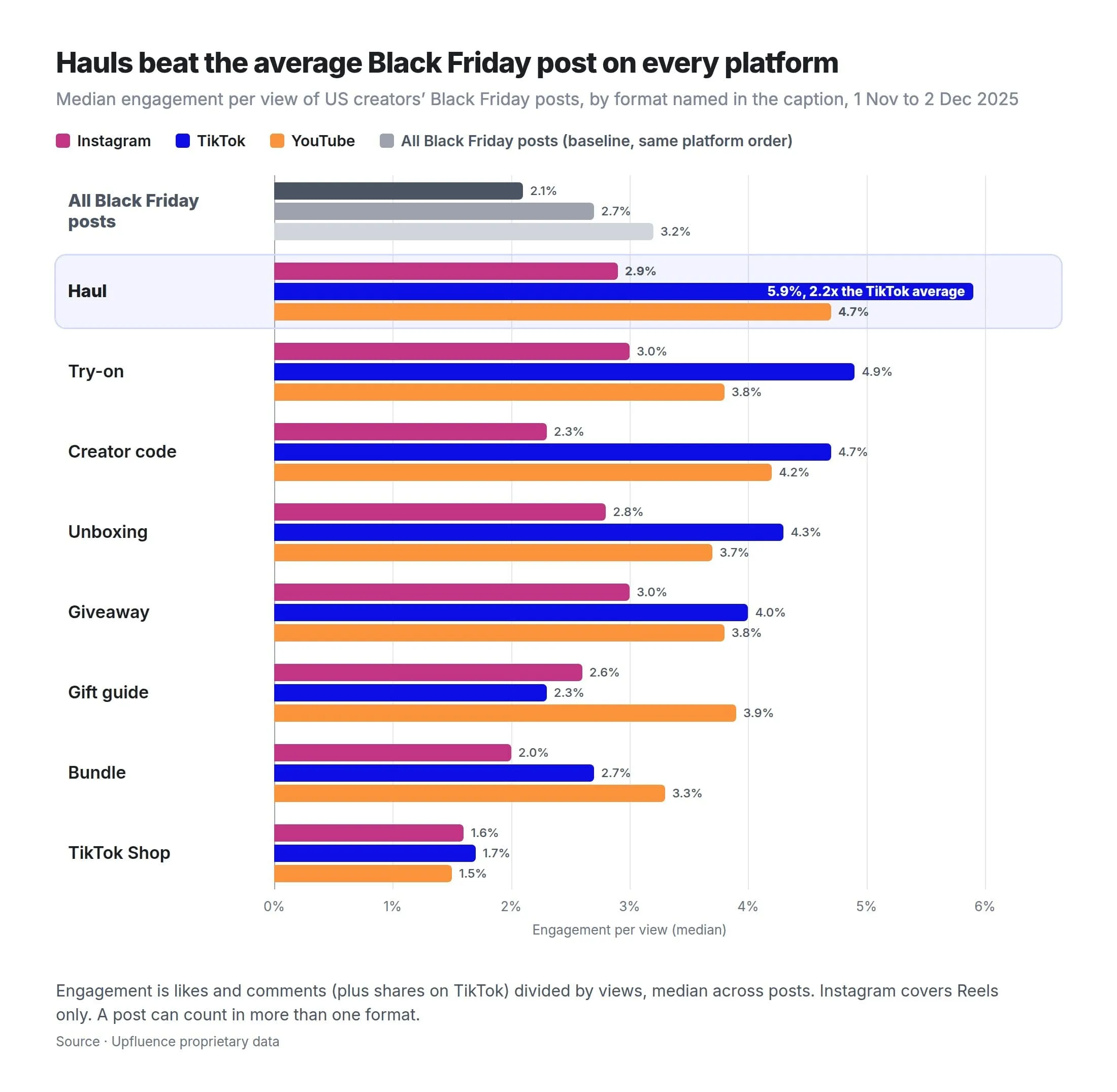
- Hauls and Try-Ons: On TikTok, haul videos achieved a staggering 5.9% median engagement per view, more than double the platform’s average for Black Friday content (2.7%). Try-ons followed closely at 4.9%. These formats provide social proof and allow consumers to visualize products in a real-world context.
- Unboxings: This format remained a staple for luxury and beauty brands. Dior’s use of unboxing for its advent calendar leveraged the sensory appeal of the product. Unboxings outperformed platform averages across the board, reaching 4.3% on TikTok and 2.8% on Instagram.
- Personalized Codes: The use of creator-specific discount codes was a major driver of both engagement and trackable sales. Posts featuring a creator code saw 4.7% engagement on TikTok. Brands like MyProtein took this a step further by offering "stacked" codes, where a creator’s personal discount was added on top of existing sitewide sales, providing a powerful incentive for followers to shop through specific influencer links.
- The TikTok Shop Decline: In a notable finding, posts primarily serving as TikTok Shop listings earned the lowest engagement across all platforms. On TikTok, these posts averaged only 1.7% engagement. Analysts suggest that the overtly transactional nature of these posts often leads to "ad fatigue," where users skip content that feels like a standard product listing rather than a creative recommendation.
Strategic Case Studies: Diverse Approaches to the Sale Season
Several brands provided blueprints for how to navigate the competitive holiday landscape through distinct tactical choices.
SHEIN’s Hashtag Uniformity:
SHEIN achieved brand cohesion by mandating specific hashtags across its massive creator network. Nearly 93% of its 4,818 posts used #sheinbigsale, while 79% used #sheinblackfriday. This uniformity allowed the brand to dominate the social conversation and made the campaign easily measurable.
Princess Polly’s Ambassador Loyalty:
Princess Polly focused on its existing ambassador program rather than cold recruiting. By using the #pp_partner tag in 77% of its posts, the brand leveraged established trust. This resulted in a high conversion-oriented environment where 74% of posts mentioned a specific discount code.
L’Occitane’s Curated Gift Guides:
L’Occitane opted for a more editorial approach, using creators to curate holiday gift guides. This strategy performed particularly well on Instagram, where gift guides earned a 2.6% engagement rate, comfortably above the platform’s 2.1% average for the season. This approach softened the "hard sell" of Black Friday, positioning the brand as a solution for holiday gifting.
Compliance and Ethical Standards in Creator Marketing
As the volume of sponsored content surged, regulatory compliance remained a focal point. In the United States, the Federal Trade Commission (FTC) requires clear disclosure of paid relationships. The data shows that brands are taking these requirements seriously; 75% of Black Friday posts tagging SHEIN included the #ad disclosure. Industry experts emphasize that transparent disclosure does not hinder engagement; rather, it builds long-term trust with an increasingly savvy consumer base that expects honesty regarding brand partnerships.
Implications for the Future of Retail and Influencer Strategy
The results of the 2025 Black Friday season offer several critical takeaways for marketing teams planning for future retail holidays. First, the "scale at all costs" model is being challenged by a "quality of connection" model. While SHEIN’s ability to mobilize thousands of creators is impressive, the higher engagement rates of Peppermayo and Edikted suggest that smaller, more targeted campaigns can yield better returns on attention.
Second, the data reinforces the necessity of creative freedom for influencers. Briefs that demand rigid product listings or scripted deal announcements are failing to capture the interest of modern consumers. Instead, brands are finding success by providing creators with the products and the codes, then allowing them to integrate those elements into their own unique styles—whether through a chaotic clothing haul or a meticulously styled "outfit of the day" (OOTD) video.
Finally, the role of tracking technology has become indispensable. The shift toward personal discount codes and affiliate-led models allows brands to move beyond "vanity metrics" like likes and views, moving instead toward a direct understanding of how each creator impacts the bottom line. As social commerce continues to evolve, the integration of entertainment and utility—often referred to as "shoppertainment"—will likely become the standard for all major retail events.
In conclusion, the most successful Black Friday creator campaigns of the recent season were those that treated influencers as creative partners rather than mere distribution channels. By focusing on small creators, prioritizing immersive video formats, and ensuring clear paths to conversion through personalized codes, brands were able to cut through the digital noise and build meaningful connections with holiday shoppers.


 Lina Hope

 Iffa Jayyana