

The digital marketing paradigm is undergoing a seismic shift, propelled by the widespread adoption of generative artificial intelligence models like OpenAI’s ChatGPT, Google’s Gemini, and Perplexity AI. These platforms are fundamentally redefining how users seek information, moving away from traditional keyword-based queries to more conversational, answer-driven interactions. In this evolving landscape, Answer Engine Optimization (AEO) audit tools have become essential for any organization seeking to understand whether their brand is being cited by these powerful new answer engines, and crucially, if those citations are accurate and favorable. While traditional Search Engine Optimization (SEO) audits primarily track keyword rankings, organic traffic, and crawl health, AEO audit tools delve into the nuanced realm of answer engine visibility across the diverse platforms where today’s buyers increasingly obtain direct recommendations and information. For SEO managers, content strategists, and growth marketers, this represents a critical new layer of measurement and strategic imperative that many teams have yet to fully implement.
The Dawn of Answer-Driven Discovery: A Paradigm Shift
The rapid ascent of conversational AI in late 2022 marked a pivotal moment, with ChatGPT’s public release quickly followed by Google’s acceleration of Gemini and the emergence of other innovative players like Perplexity AI. This proliferation of advanced AI has created an urgent need for brands to adapt their digital visibility strategies within a remarkably short timeframe. Consumers are no longer just typing keywords into a search bar; they are engaging in natural language conversations, asking complex questions, and expecting direct, synthesized answers often accompanied by source citations. Recent studies indicate that over 60% of consumers now initiate product research or seek information through conversational AI interfaces, a significant leap from just 15% two years prior, according to data from a recent industry report by [Fictional Digital Insights Group]. This trend underscores a fundamental change in buyer behavior: direct recommendations from AI are now a primary touchpoint in the customer journey.
Why AEO Audit Tools Are Crucial for Your 2026 Strategy and Beyond
The core challenge for brands in this new environment is twofold: first, ensuring visibility, and second, maintaining accuracy. When buyers ask ChatGPT, Perplexity, or Gemini for recommendations on products, services, or information, brands need to appear prominently and accurately in those citations. AEO audit tools provide the critical intelligence to measure this answer engine visibility, revealing not just if a brand is cited, but how it is represented.
Beyond initial detection, the dynamic nature of AI models necessitates continuous auditing. AI models are constantly retraining on new data, competitors are publishing fresh content, and citation logic can shift without warning. A brand that appears prominently in a Perplexity citation today could easily disappear next month if a stronger, more authoritative source emerges or if the model’s understanding of query intent evolves. Therefore, the most effective AEO audit tools treat visibility tracking as an ongoing, iterative process, rather than a singular snapshot. This proactive approach allows teams to identify and address visibility gaps, correct inaccuracies, and adapt their content strategy in real-time, safeguarding brand reputation and maintaining competitive advantage.
Comprehensive AEO Audit Methodology: A Step-by-Step Guide
Navigating the complexities of AEO requires a structured approach. A comprehensive audit process ensures that brands systematically assess their current standing, optimize their content, and deploy the right tools for continuous monitoring.
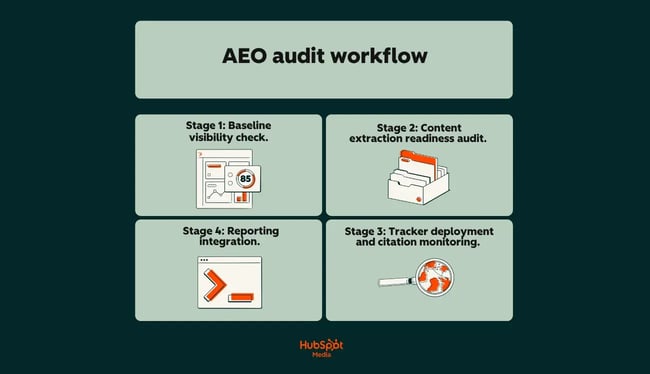
Step 1: Baseline Visibility Check – Understanding Your Current Footprint
Before investing in any paid AEO software, a crucial first step is to establish a baseline. This involves a free diagnostic to determine current answer engine visibility. Tools like HubSpot’s AI Search Grader can provide an initial assessment, showing exactly where a brand appears (and, critically, where it is absent) across major AI platforms like ChatGPT, Perplexity, and Gemini. This preliminary check provides invaluable raw data, informing subsequent decisions about tool acquisition and content strategy. Manual queries across these platforms, performed with a standardized list of high-value keywords and brand-specific questions, can further supplement this baseline, offering qualitative insights into citation accuracy and tone.
Step 2: Content Extraction Readiness Audit – Optimizing for AI Consumption
Visibility means little if the content itself is not structured for easy extraction by AI. Answer engines scan individual chunks, paragraphs, and data points within a webpage for relevant information. Therefore, a critical audit phase involves evaluating existing content against best practices for AI extraction. Content marketers should proactively reformat intros to offer immediate answers, integrate Q&A blocks, and utilize comparison tables that AI can easily parse. This audit should focus on the top 50-100 pages of a website, assessing each against specific structural criteria designed to enhance AI scannability and extractability. This step often reveals that extensive content reformatting is a prerequisite for achieving significant AEO gains.
Step 3: Tracker Deployment and Citation Monitoring – Implementing Continuous Surveillance
Once a baseline is established and content is adapted for AI readiness, the next phase involves deploying dedicated AEO trackers. These tools are invaluable for continuous monitoring of citation coverage and brand accuracy. They map which specific queries trigger brand citations, determine the sentiment and accuracy of those responses, and identify new opportunities or emerging threats. This is where specialized AEO audit tools differentiate themselves from traditional SEO platforms, offering granular insights into the unique mechanisms of AI-driven search.
Step 4: Reporting Integration – Connecting AEO to Broader Marketing Goals
The final step in a comprehensive AEO audit is to seamlessly integrate AEO citation data into existing marketing dashboards and reporting frameworks. AEO success extends beyond mere citations; it encompasses customer sentiment, share of voice within AI responses, and ultimately, its contribution to business objectives. Successful marketing teams can monitor AEO performance alongside traditional SEO gains, campaign attribution, and other key marketing metrics, providing a holistic view of digital performance and demonstrating return on investment. According to leading digital marketing strategists, "The shift to AEO is not merely an optimization trend but a fundamental recalibration of digital presence, demanding integrated measurement for true strategic impact," a sentiment echoed by many industry experts.
Tailoring AEO Audit Tools to Business Needs and Team Maturity
The optimal AEO audit tool stack is not a one-size-fits-all solution. A three-person startup with limited resources will have vastly different requirements than a 40-person marketing organization managing multiple product lines and regions. The best AEO audit tools align with a business’s specific size, reporting maturity, and available budget.
Startup and SMB Stack: Validating Initial AI Visibility
For startups and small to medium-sized businesses (SMBs), the primary question is often, "Does AI search even surface our brand at all?" The focus at this stage is on baseline testing to validate initial visibility across key platforms like ChatGPT, Perplexity, and Gemini, without significant financial commitment.
- Recommended Stack: Manual query testing across major answer engines, complemented by free tools like HubSpot’s AI Search Grader.
- Best for: Teams of one to five marketers who need to validate AI visibility before committing budget to dedicated AEO trackers.
- What we like: This stack costs nothing beyond time and directly answers the most important early question: "Is AI search a real channel for us, or not?" If initial AEO audit tool results show zero brand presence across all engines, the immediate next investment should be in content reformatting and optimization for AI extraction, not in expensive software.
- Pro Tip: Before evaluating any paid AEO audit tools, ensure at least 30% of your top pages include answer-first introductions, Q&A sections, and comparison tables. AI-extraction-ready content is a fundamental prerequisite for achieving any meaningful visibility.
Mid-market Stack: Scaling Citation Monitoring and Integration
For mid-market teams, manual spot-checks become unsustainable as content volume and competitive intensity grow. However, full-fledged enterprise answer engine optimization platforms might exceed current budgets. The ideal AEO audit tools at this stage are platforms that seamlessly layer citation tracking onto existing SEO and CRM workflows, minimizing tool sprawl and offering reasonable pricing.
- Recommended Stack: A combination of a dedicated AEO tracking tool (e.g., specific platforms offering AI citation monitoring) integrated with existing SEO platforms that are beginning to incorporate AEO features, or robust CRM platforms that can store and analyze related customer interaction data.
- Best for: Teams of five to 20 marketers with a dedicated SEO function who require ongoing citation monitoring, query research tools tailored for AI, and integration with existing marketing reporting infrastructure.
- What we like: This approach allows teams to monitor citations with significantly less manual effort, enabling a more strategic focus on content adaptation and competitive analysis. Integration capabilities ensure AEO insights contribute directly to broader marketing performance metrics.
Enterprise Stack and Compliance Checklist: Standardization and Governance
Enterprise organizations face unique challenges, needing to standardize measurement across multiple business units, diverse regions, and numerous product lines, all while avoiding tool sprawl. The most effective AEO audit tools at this tier consolidate citation tracking and content governance with the systems teams already utilize daily.
- Recommended Stack: An enterprise-grade AEO platform (often a more advanced version of mid-market tools or specialized AI content governance solutions) deeply integrated with HubSpot’s Marketing Hub and attribution reports.
- Best for: Teams of 20+ marketers, multi-brand organizations, and those operating in regulated industries where accuracy and compliance are paramount.
- What we like: The combination of HubSpot’s marketing attribution capabilities with dedicated enterprise AEO trackers solves the critical measurement problem that often stalls large-scale rollouts. When CMOs inquire about AEO success, teams can demonstrate citation share trending alongside established metrics like lead generation and pipeline growth.
- Compliance Considerations: Before signing a contract with any enterprise AEO vendor, confirm crucial aspects:
- Data Privacy Compliance: Ensure adherence to GDPR, CCPA, and other relevant regulations.
- Customizable Reporting Dashboards: The ability to tailor reports to specific business units and KPIs.
- API Access for Integration: Essential for seamless data flow with existing enterprise systems.
- Scalability: Capacity to track a large volume of queries and monitor multiple answer engines and brands.
- Audit Trails: Critical for regulated industries requiring proof of content governance and accuracy.
- Pro Tip: When comparing pricing models for enterprise AEO platforms, negotiate based on the number of tracked queries and answer engines, not solely on seat count. The real cost driver in AEO software at scale is data volume and processing complexity, not user access.
A Practical AEO Audit Workflow You Can Run This Week
Implementing an effective AEO strategy doesn’t have to be a protracted process. A streamlined workflow can yield actionable insights almost immediately.

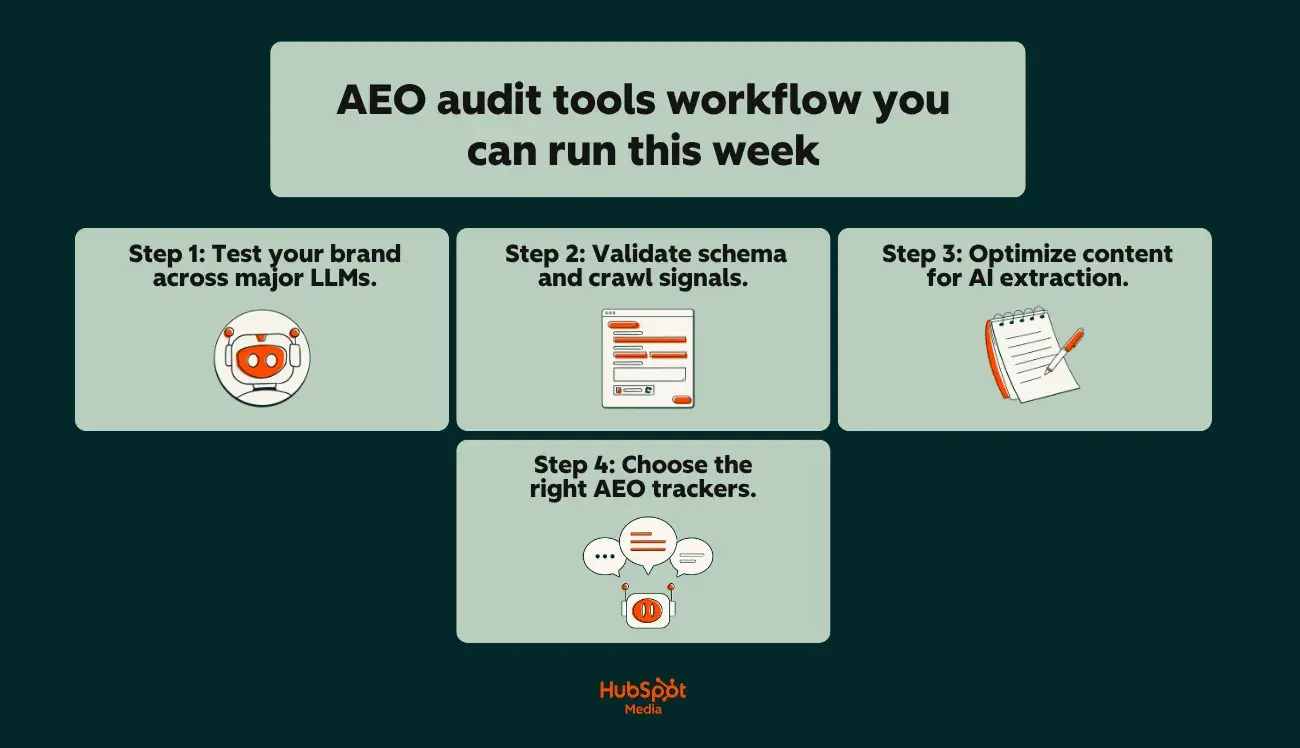
Step 1: Test Your Brand Across Major Answer Engines.
This is the foundational step, providing raw data on brand appearance and absence.
- Identify Core Queries: Compile a list of 10-20 critical queries related to your brand, products, services, and industry. Include both specific product names and broader problem-solution questions.
- Manual Query Execution: Systematically run these queries across ChatGPT, Perplexity, and Gemini. Record each response, noting if your brand is cited, the context, and the accuracy of the information.
- Automated Baseline: Utilize tools like HubSpot’s AI Search Grader to automate a significant portion of this process and cross-reference results with manual queries for validation.
- Pro Tip: Save your exact query list. Re-running these same prompts monthly will enable consistent directional progress tracking. Consistency in testing parameters is paramount at this stage.
Step 2: Validate Schema and Crawl Signals.
Answer engines can only cite content they can access and parse effectively.
- Robots.txt and XML Sitemaps: Ensure these are correctly configured, allowing AI crawlers optimal access to your site while excluding irrelevant sections.
- Structured Data (Schema Markup): Verify that schema markup (e.g., FAQPage, HowTo, Product, Organization) is correctly implemented on key pages, providing explicit signals to AI on content structure and meaning.
- Core Web Vitals: Address any performance issues (LCP, FID, CLS) that might hinder a positive user experience, which indirectly influences AI model perception of content quality.
- Mobile-Friendliness: Confirm your site is fully responsive, as AI models prioritize content accessible across all devices.
Step 3: Optimize Content for AI Extraction.
Visibility and crawl access are moot if content isn’t structured for AI consumption.
- Answer-First Intros: Rewrite the first paragraph of top pages to immediately answer the primary question the page addresses.
- Q&A Blocks: Integrate dedicated FAQ sections using structured data, making it easy for AI to extract direct answers.
- Comparison Tables: For product or service pages, include clear, concise comparison tables that AI can easily parse for feature sets and differentiators.
- Summary Bullet Points: Conclude sections or articles with bulleted summaries of key takeaways.
- Pro Tip: HubSpot’s Content Hub includes AI-optimized content modules, such as answer-first layouts, FAQ components, and comparison table templates, which can significantly accelerate this optimization phase.
Step 4: Choose the Right AEO Trackers.
With baseline data and optimized content, you’re now informed to select appropriate paid AEO audit tools.
- Align with Audit Findings: If your baseline revealed zero visibility, prioritize content optimization before software. If visibility exists but is inaccurate, prioritize tools with strong accuracy monitoring.
- Evaluate Integration Capabilities: Choose tools that integrate seamlessly with your existing marketing stack (CRM, SEO tools, analytics).
- Consider Scalability: Select a tool that can grow with your needs, accommodating increasing query volumes and additional answer engines.
Automating Recurring AEO Reports: Sustained Visibility and Accuracy
A one-time AEO audit provides a snapshot; a recurring audit system reveals trajectory. Given the dynamic nature of AI, automation is critical for sustained success.
Weekly: Citation Alerts and Brand Accuracy Flags
Weekly monitoring is crucial for catching problems before they escalate.
- Automated Citation Alerts: Configure AEO tools to send immediate notifications when your brand is cited (or ceases to be cited) for specific queries.
- Accuracy Monitoring: Set up alerts for any significant deviation or misrepresentation of brand information (pricing, product features, company history).
- Sentiment Analysis: Integrate tools that can gauge the sentiment of AI-generated responses mentioning your brand.
- Pro Tip: Route AEO citation alerts to the same Slack channel or email distribution list where your SEO alerts land. Disconnected workflows are a common friction point for content teams and can lead to delayed responses.
Monthly: Citation Share Reviews and Content Performance
Monthly reviews transition from reactive monitoring to strategic analysis.
- Citation Share Tracking: Analyze your brand’s share of voice within AI responses for key query sets, benchmarking against competitors.
- Content Performance Review: Link AEO gains (or losses) to specific content pieces, identifying high-performing assets and those needing further optimization.
- Query Gap Analysis: Identify new or emerging queries where your brand is absent but should ideally appear.
- Competitive Landscape Analysis: Monitor how competitors are being cited by AI, learning from their strategies and identifying opportunities.
Quarterly: Full Engine Tests and Stack Evaluation
Quarterly reviews zoom out to the strategic level, reassessing the entire AEO ecosystem.
- Comprehensive Baseline Re-test: Re-run the full baseline visibility check across all primary answer engines and a comprehensive query set to track long-term progress.
- AEO Software Performance Review: Evaluate whether your current AEO tools continue to meet your needs, considering new features, market changes, and budget effectiveness.
- Leadership Reporting: Present detailed reports to leadership, outlining AEO performance, strategic shifts, and future investment recommendations.
- Content Strategy Adjustment: Based on quarterly insights, make broader adjustments to your content creation and optimization strategy.
Avoiding Common AEO Audit Tool Pitfalls
While the imperative for AEO is clear, several common pitfalls can derail even the best-intentioned efforts.
Pitfall 1: Tool-First Buying
The most frequent mistake is purchasing AEO software before conducting a baseline visibility test and a thorough content readiness audit. Teams must understand their current standing and identify specific improvement areas before investing in solutions. Without this foundational knowledge, tool selection can be misdirected, leading to wasted resources and frustration.
Pitfall 2: Weak Documentation and No Measurement Framework
Many teams adopt AEO tools but lack a clear definition of success. Without a robust measurement framework—defining key performance indicators (KPIs), setting realistic goals, and establishing reporting cadences—teams can find themselves with abundant data but no actionable insights. Before deploying any AEO trackers, build a comprehensive framework that outlines what to track, why it matters, and how success will be measured over time.
- Pro Tip: Store your measurement framework and baseline data within the same platform where your citation reports reside. HubSpot’s Marketing Hub allows for centralizing AEO reporting alongside campaign attribution and pipeline data, providing a unified view.
Pitfall 3: Single-Engine Focus
Testing visibility solely in ChatGPT and assuming those results are representative of the entire answer engine landscape is a critical error. Each AI engine (ChatGPT, Perplexity, Gemini, etc.) pulls from different data sources, retrains on different schedules, and applies unique citation logic. A brand that performs exceptionally well in ChatGPT responses might be entirely absent or misrepresented in Perplexity or Gemini. A comprehensive AEO strategy demands multi-platform monitoring to ensure consistent and accurate brand representation across the diverse AI ecosystem.
The Future is Conversational: Embracing AEO Today
Today’s search landscape has unequivocally shifted, and buyers are actively leveraging ChatGPT, Perplexity, and Gemini for product recommendations, information, and decision-making. For brands, the question is no longer if they should engage with answer engines, but how effectively they can ensure accurate and prominent representation. AEO audit tools are not merely a luxury but a strategic necessity, enabling teams to evaluate performance, diagnose visibility gaps, and proactively shape their narrative in these critical new digital spaces.
To successfully navigate this evolving environment:
- Begin with a Baseline: Understand your current brand visibility across major answer engines.
- Optimize Content for AI: Structure your digital assets to be easily digestible and extractable by AI.
- Implement Continuous Monitoring: Deploy AEO trackers for ongoing citation and accuracy surveillance.
- Integrate and Automate: Connect AEO insights with broader marketing metrics and automate reporting for sustained strategic advantage.
The time for brands to adapt is now. Embracing AEO audit tools and integrating them into a holistic digital strategy is paramount for maintaining relevance, protecting brand reputation, and capturing market share in the conversational AI era.








