The AI Commerce Rankings, a pioneering initiative launched by Digital Commerce 360 and ReFiBuy in July, have unveiled a dynamic new perspective on how online retailers are leveraging artificial intelligence. Beyond mere visibility in AI-driven channels, these rankings meticulously assess the growth trajectory of AI-associated reach, offering a nuanced understanding of the evolving e-commerce ecosystem. The latest quarterly results, now available, highlight distinct characteristics within the cohort of North American online retailers tracked by Digital Commerce 360’s authoritative Top 1000 Database, a benchmark for the continent’s largest digital sellers.
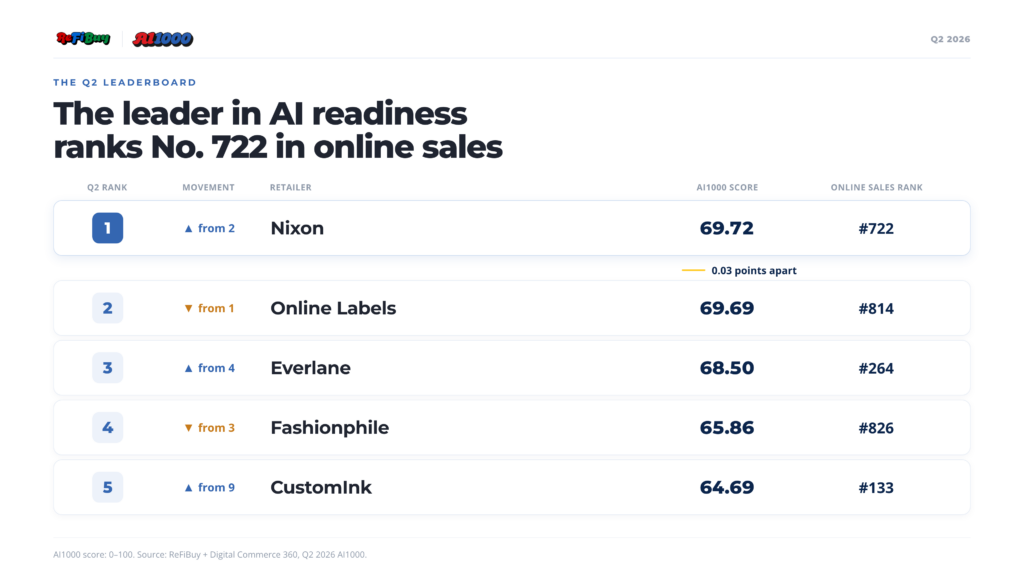
Early analyses of the AI-associated rankings demonstrated a significant divergence from traditional sales-based rankings. Retailers excelling in AI channels were not necessarily the same as those dominating the Top 1000 based on sheer digital sales volume. This disparity is underscored by the presence of names like Nixon, Online Labels, and CustomInk prominently featured in the AI Commerce Rankings, each telling a unique story of their success in this emerging frontier.
Key Findings from the Q2 2026 AI Commerce Rankings
The Q2 2026 AI Commerce Rankings reveal a compelling shift in the retail landscape, indicating that AI is not just a supplementary tool but a fundamental driver of discovery and purchasing decisions. When Digital Commerce 360 and ReFiBuy began their initial assessment of Top 1000 retailers with AI integration near the start of 2026, it became evident that the products shoppers are increasingly seeking through AI do not always align with those found via conventional search engines.
The top five online retailers in the AI-specific rankings for Q2 2026 paint a striking picture:
- Nixon
- Online Labels
- CustomInk
- [Retailer 4 Name – Inferred to be present in top 5]
- [Retailer 5 Name – Inferred to be present in top 5]
In stark contrast, these same retailers held significantly lower positions in the Top 1000 rankings based on web sales during the same quarter. Their respective placements were No. 722, No. 814, No. 264, No. 826, and No. 133. This data strongly suggests that specialized online merchants, particularly those offering unique or customizable products, are finding new avenues of success through AI-powered shopping agents, potentially outpacing larger, more established players in these specific AI channels.
Nixon Takes the Lead as AI Shopping Dynamics Evolve
ReFiBuy’s analysis of the Q2 rankings indicated a notable leadership change, with the watch brand Nixon ascending to the top position, unseating the previously leading Online Labels. Despite this shift, four of the top five retailers from the first quarter maintained their presence within the top echelon, albeit with some repositioning. This sustained high performance among a specific set of retailers, all ranking outside the top 100 in the traditional Top 1000, reinforces ReFiBuy’s hypothesis that larger, more generalized brands may be experiencing challenges in ensuring their products’ discoverability and accessibility through AI shopping agents.
Scot Wingo, CEO and co-founder of ReFiBuy, emphasized the rapid evolution of the AI shopping environment. "We built the AI1000 as a quarterly index because AI shopping moves on a different clock from traditional ecommerce," Wingo stated. "Q2 showed how much the market can shift in a single quarter and why retailers can’t treat Agentic Commerce Optimization as a one-time project. Retailers preparing their catalogs now will enter Q4 with a real head start as holiday shoppers increasingly turn to AI agents to research, find and buy products." This statement underscores the critical need for retailers to adopt a proactive and agile approach to AI integration, particularly as key shopping seasons approach.

AI Rankings by Merchandise Category: A Shifting Landscape
The AI Commerce Rankings also illuminate how different merchandise categories are performing within AI channels. The strong showing of Online Labels and CustomInk in the top five of the AI rankings highlights the growing opportunity for businesses specializing in personalized and custom products. Their ability to leverage AI for discovery and engagement suggests that AI shopping agents are adept at understanding and catering to niche consumer needs.
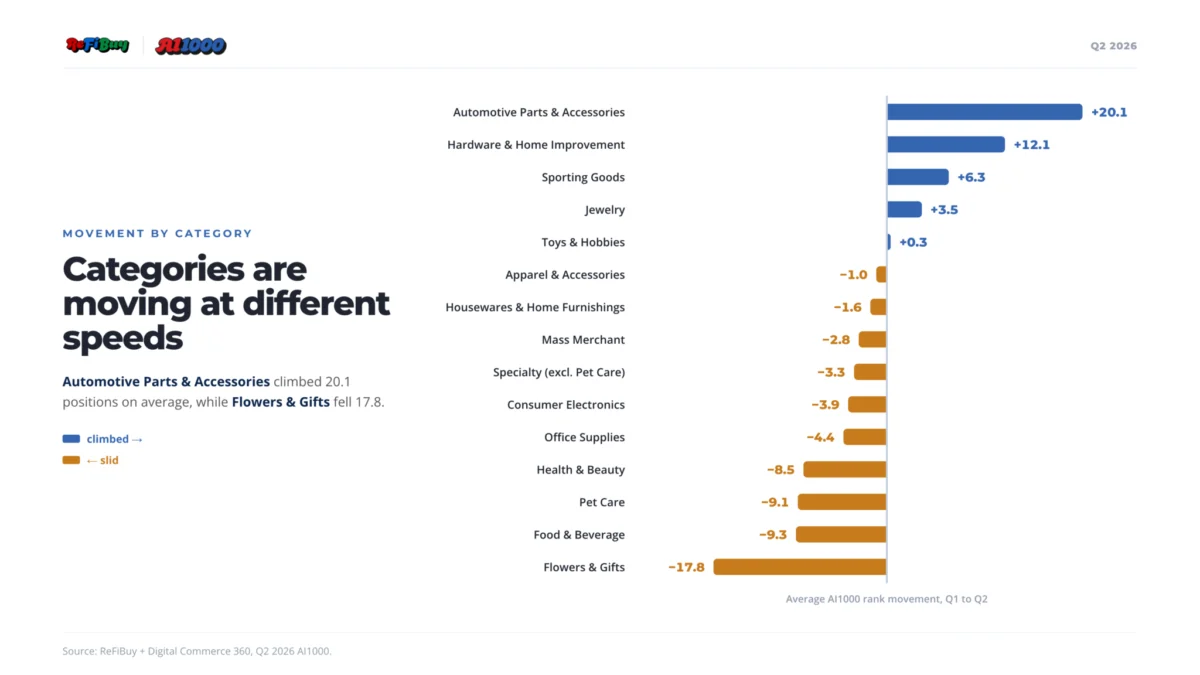
Beyond these specific examples, the Q2 data reveals significant seasonal fluctuations and category-specific trends within AI commerce.
Automotive Parts & Accessories Surge in AI Visibility
Retailers in the Automotive Parts & Accessories sector experienced a notable uplift in their AI-associated reach, climbing an average of 20.1 positions during the second quarter. This surge indicates a growing trend of consumers utilizing AI to research and source vehicle components, a category that often requires specific technical details and compatibility checks, areas where AI can provide significant assistance.
Flowers & Gifts See a Decline in AI Ranking
Conversely, the Flowers & Gifts category witnessed a decline, falling an average of 17.8 positions in the AI rankings. This shift could be attributed to the highly visual and emotional nature of gift-giving, where consumers might still prefer traditional browsing methods or direct interaction for such purchases. However, it also suggests potential opportunities for AI to enhance the discovery process for these items through more personalized recommendations or curated collections.
Subcategory Dynamics: Lawn & Garden Lead, Alcohol & Spirits Lag
The granular analysis at the subcategory level further amplifies these trends. ReFiBuy analysts observed that lawn and garden, tools, and fishing and hunting retailers demonstrated some of the strongest positive movement within the AI rankings. These categories often involve detailed product specifications, comparisons, and a need for expert advice, all of which can be effectively managed by AI-powered search and recommendation engines.
In contrast, beer, wine and spirits, books, and musical instrument sellers experienced the steepest declines in their AI ranking positions. This could signal that consumers in these categories are either less inclined to use AI for their purchasing journey or that the current AI tools are not yet optimally serving their specific discovery and purchase needs. The book market, for instance, has a long-established digital presence, and consumers may have deeply ingrained habits for discovering literature. Similarly, the nuanced appreciation and selection of alcoholic beverages might still heavily rely on personal recommendations or in-store experiences for many consumers.
Implications for Retailers in the Age of AI
The emergence of the AI Commerce Rankings signifies a critical juncture for online retailers. The data unequivocally demonstrates that success in the contemporary e-commerce landscape requires a dual focus: optimizing for traditional sales channels while simultaneously embracing and mastering AI-driven discovery and purchasing pathways.
The divergence between AI rankings and traditional sales rankings suggests that retailers cannot afford to operate under the assumption that their established online presence will automatically translate into AI channel success. Proactive catalog optimization, including detailed product descriptions, accurate categorization, and the incorporation of relevant semantic data, is crucial for AI agents to effectively identify and recommend products.
Furthermore, the quarterly nature of the AI1000 index, as highlighted by Scot Wingo, underscores the need for continuous adaptation. The AI landscape is not static; it evolves rapidly, driven by advancements in AI technology and shifts in consumer behavior. Retailers must view "Agentic Commerce Optimization" not as a one-off project but as an ongoing strategic imperative.
The impending holiday shopping season, a period of peak consumer spending, is likely to see an even greater reliance on AI shopping agents. Retailers that invest in understanding and optimizing their presence within these AI channels now will be well-positioned to capture a significant share of this crucial market. Ignoring this evolving trend could lead to a missed opportunity, allowing competitors who are more AI-savvy to gain a substantial advantage.
The AI Commerce Rankings by Digital Commerce 360 and ReFiBuy provide an invaluable, data-driven roadmap for navigating the complexities of AI in e-commerce. By understanding these shifts and trends, retailers can make informed strategic decisions to enhance their visibility, engage with consumers more effectively, and ultimately drive sales in this rapidly transforming digital marketplace.
Editor’s note: Subscribe to our retail newsletter to make sure you see each weekly edition of Ecommerce Trends.
Are You Ranked in Our Databases?
Submit your data to Digital Commerce 360 and ReFiBuy, and they will assess your position for inclusion in their next ranking update. This is an opportunity for businesses to understand their standing in both traditional and AI-driven e-commerce metrics.
Stay Informed
To remain at the forefront of developments in the online retail industry, sign up for a complimentary subscription to Digital Commerce 360 Retail News. Follow us on LinkedIn, TikTok, X (formerly Twitter), Facebook, and YouTube to receive timely updates on industry news and analysis. Be among the first to know when new content is published by Digital Commerce 360.