Jia Lissa

Content approval, the structured process of reviewing and formally endorsing digital assets before their publication or distribution, stands as a cornerstone of effective and compliant digital strategy in the contemporary media landscape. This crucial procedural layer introduces systematic rigor to the creative journey, meticulously safeguarding against the inadvertent release of content marred by errors such as typographical mistakes, broken hyperlinks, or messaging that deviates from established brand guidelines. Fundamentally, a well-implemented content approval workflow charts a clear, actionable course for every piece of content, from its nascent conceptualization through internal reviews, culminating in a definitive final sign-off by designated stakeholders. This structured progression ensures that content reaches its intended audience with accuracy, consistency, and strategic alignment.
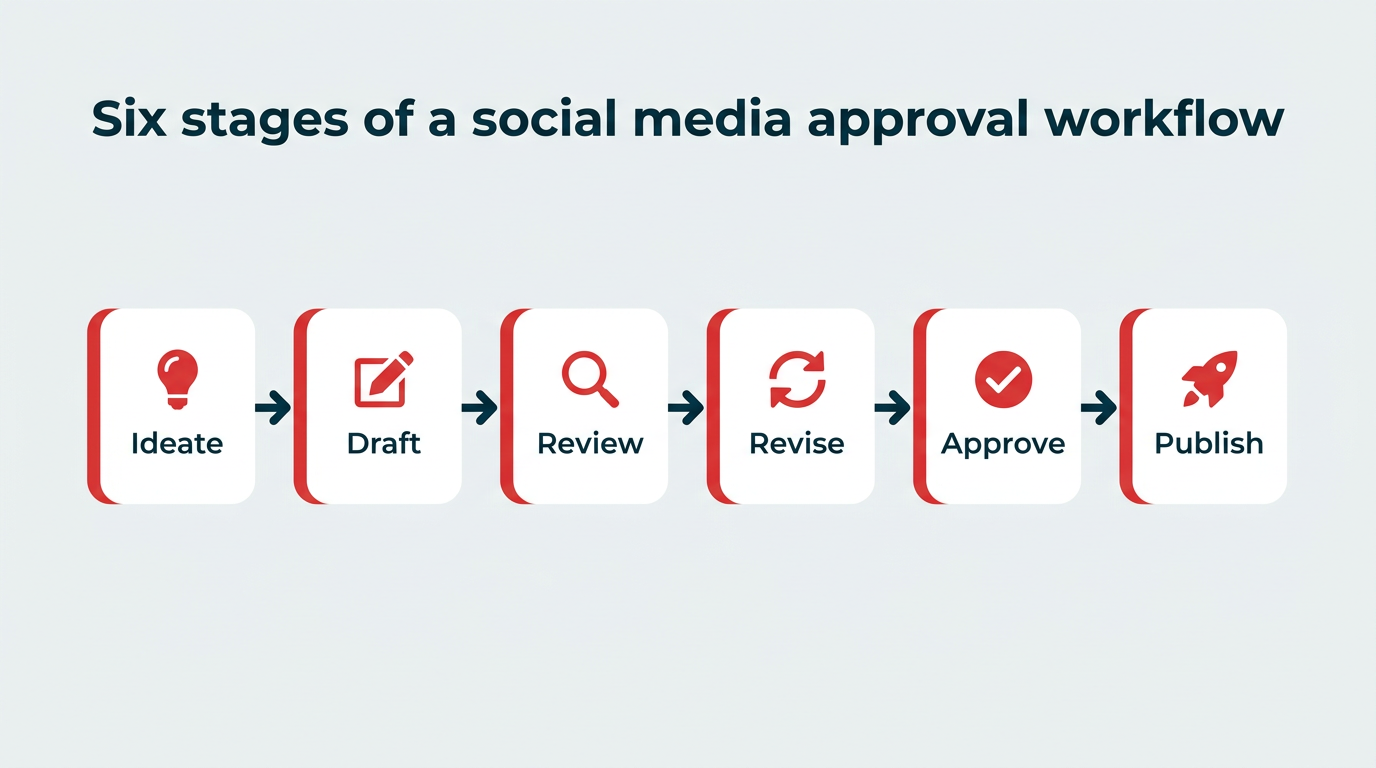
The workflow typically initiates with a draft, meticulously crafted by a content creator or strategist. This draft then embarks on a journey through various internal review stages, which may encompass feedback loops, legal scrutiny, and iterative design adjustments, before ultimately receiving the final imprimatur for release. While the exact sequence can vary, most approval workflows adhere to core stages: ideation, drafting, initial review, revision, final approval, and ultimately, publication. This methodical approach ensures that the right individuals are engaged at the appropriate junctures, fostering a collaborative environment while upholding quality control.
The Evolving Landscape of Content Creation: A Chronological Perspective
The need for sophisticated content approval workflows has evolved dramatically alongside the digital transformation of communication. In the early days of the internet, content production was often a more solitary and less regulated affair. However, the proliferation of websites, followed by the explosion of social media platforms in the 2000s, fundamentally altered the landscape. Brands and organizations transitioned from publishing a handful of carefully curated pieces annually to generating dozens, if not hundreds, of short-form content items weekly. This exponential increase in volume, coupled with the real-time, often ephemeral nature of digital interactions, necessitated a more agile yet robust oversight mechanism.

The mid-2010s witnessed a further escalation of complexity with the rise of global digital marketing campaigns and increasing regulatory pressures, including data privacy laws like GDPR and CCPA, as well as industry-specific compliance requirements in sectors such as finance, healthcare, and pharmaceuticals. These developments underscored the critical importance of legal and regulatory review, transforming content approval from a mere quality check into a vital risk mitigation strategy. More recently, the advent of generative AI tools in the early 2020s has added another layer of urgency. While AI promises unprecedented speed in content generation, it also introduces novel risks such as factual inaccuracies (hallucinations), tone drift, and potential biases, making human oversight and structured approval more indispensable than ever. This chronological progression highlights how content approval has transitioned from an optional best practice to an essential operational imperative.
Deconstructing the Content Approval Process
At its core, content approval provides a clear, traceable path from an initial concept to public dissemination. For social media, this process mirrors the six fundamental stages:
- Ideation: Brainstorming and conceptualizing content themes and topics.
- Drafting: Creating the initial version of the content, including text, visuals, and calls to action.
- Review: Internal stakeholders (editors, brand managers) assess the draft for accuracy, brand voice, and strategic fit.
- Revision: Content creators incorporate feedback and make necessary adjustments.
- Approval: Designated approvers give final sign-off, confirming readiness for publication.
- Publishing: The content is released to the target platform or audience.
While these stages remain constant, the dynamics vary significantly across content types. Social media approval, for instance, operates at a dramatically accelerated pace. Teams often manage dozens of short-form pieces weekly, necessitating a workflow fast enough to align with demanding publishing schedules without becoming a mere formality. Social media also introduces unique considerations: reviewers must evaluate platform-specific formatting (e.g., character limits, image cropping, link previews) before approval. Furthermore, given the interactive nature of social platforms, approvers often sign off on not just the copy but also the timing and overall tone, anticipating real-time audience reactions. Effective social media workflows are pragmatic, accounting for team size, publishing cadence, and stakeholder communication preferences, aiming to facilitate smooth execution and preempt last-minute disruptions.

Beyond social media, these principles extend to a wide array of digital assets, including website copy, blog posts, email marketing campaigns, product pages, and multimedia content like videos and design files. The core stages rarely change; what shifts are the number of reviewers, the expected turnaround times, and the depth of technical, legal, or specialized review required for each specific asset type. While social media often highlights workflow friction due to its volume and speed, the structural, role-based, and tooling advice remains universally applicable across the broader spectrum of digital content production.
The Imperative for Structure: Why Robust Workflows are Non-Negotiable
Implementing a robust content approval workflow is not merely a bureaucratic exercise; it is a strategic imperative that underpins brand integrity, operational efficiency, and legal compliance.
-
Catching Errors and Maintaining Brand Consistency: In a fast-paced digital environment, errors are easy to overlook. Typos, broken links, or off-brand language can swiftly erode credibility. A multi-stage review process provides essential layers of scrutiny, with multiple sets of eyes significantly reducing the likelihood of such mistakes. Moreover, when diverse team members contribute content, a shared approval system acts as a central arbiter, ensuring that all published material consistently reflects the established brand voice and messaging, regardless of the individual creator. This is equally vital for nascent startups and multinational corporations alike.
-
Enhancing Efficiency and Resource Optimization: A clear, documented workflow dramatically reduces wasted time. Teams spend less time chasing approvals, deciphering conflicting feedback, or making last-minute, reactive edits. According to Forrester’s 2025 B2B Content Survey, inefficient content creation and review processes represent the primary challenge for content decision-makers. By streamlining the path from draft to publish, a well-defined workflow enables teams to allocate their resources more effectively, focusing on creation and strategy rather than administrative overhead. A unified calendar view, for example, allows teams to track content status (pending, approved, scheduled) across multiple social accounts, providing invaluable clarity and control.
-
Mitigating Risk and Ensuring Compliance: For organizations operating in regulated industries (e.g., finance, healthcare, pharmaceuticals) or those subject to stringent data privacy laws, an approval workflow serves as a critical safety net. It ensures that all public-facing content adheres to legal requirements, industry standards, and internal policies, thereby significantly reducing the risk of regulatory fines, legal challenges, and reputational damage. An audit trail, logging every review and approval, becomes an indispensable asset in demonstrating due diligence.
-
Facilitating Feedback and Continuous Improvement: A well-designed workflow inherently builds in opportunities for constructive feedback. Reviewers can offer insights that refine content quality, optimize messaging, and ensure alignment with strategic objectives before publication. This iterative feedback loop fosters a culture of continuous improvement, allowing teams to learn and adapt with each content cycle.
-
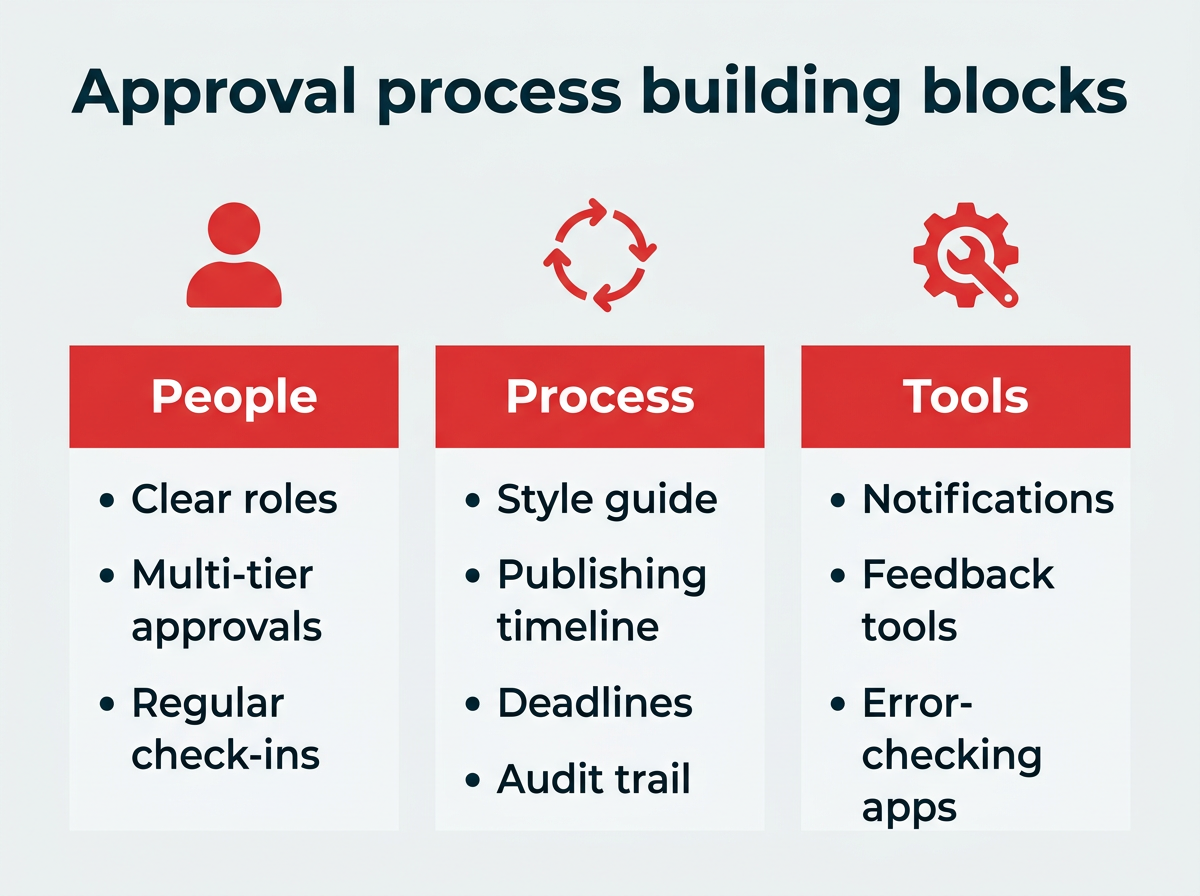
Supporting Enterprise Scale and Governance: For large enterprise teams managing multiple brands, regions, or product lines, approval workflows are foundational for maintaining control and consistency at scale. They provide risk mitigation through standardized checks, offer comprehensive audit trails for accountability, facilitate faster onboarding by clearly delineating processes, and serve as a crucial component of crisis prevention by ensuring sensitive content undergoes rigorous review.
Navigating Workflow Architectures: A Typology of Approval Models
Not all teams require an identical approval structure. The optimal workflow type is contingent upon factors such as team size, content volume, and the level of oversight required.
-
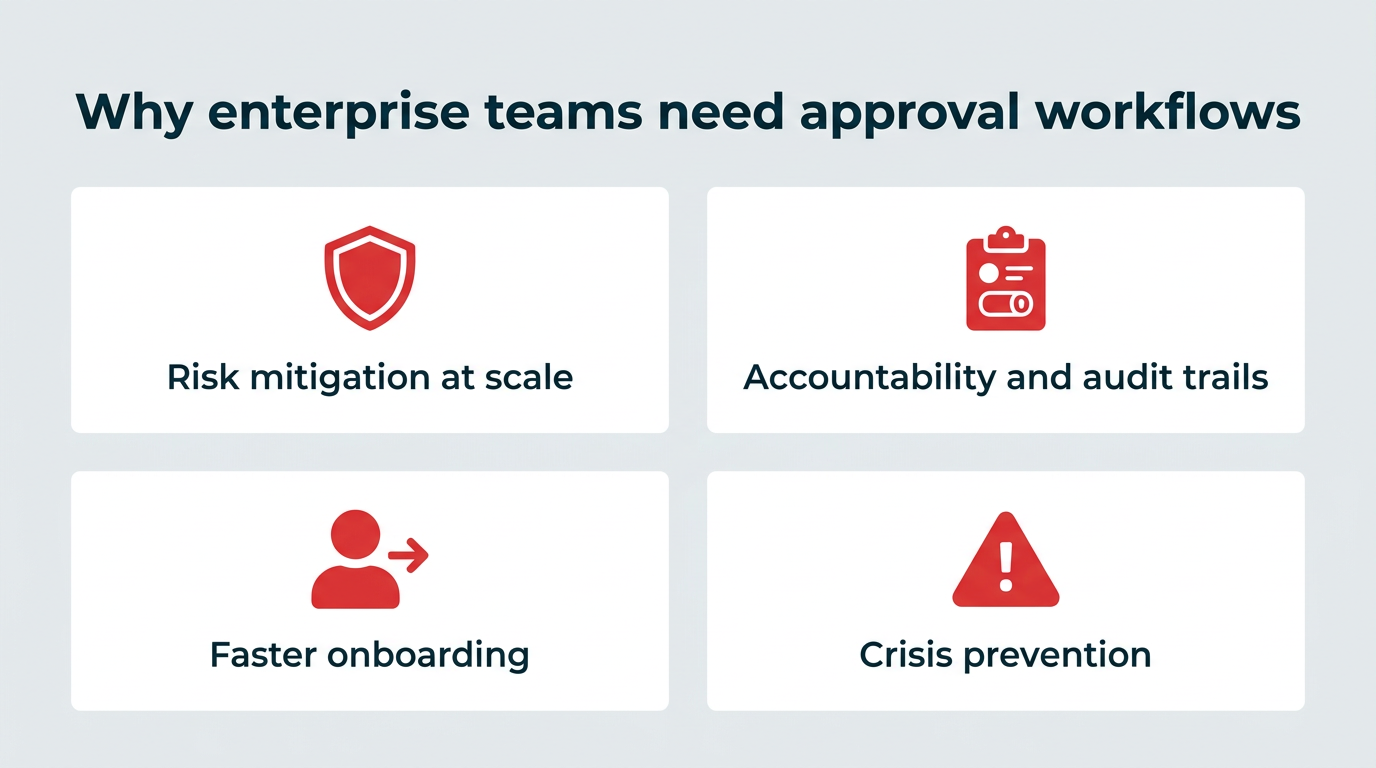
Linear Approval: This is the simplest model, where content progresses sequentially through one reviewer at a time. For example: Creator → Editor → Brand Lead → Publish. Each stakeholder reviews and then passes the content to the next in a fixed order.
- Best for: Small teams, low-volume publishing schedules.
- Typical Reviewers: 1-2.
- Speed: Fast (if reviewers are responsive).
- Compliance Suitability: Low to moderate.
-
Tiered (Multi-level) Approval: This workflow incorporates multiple layers of sign-off. Content might require approval from a team lead, then a compliance officer, and finally a senior approver before going live. This structure is prevalent in enterprise organizations and highly regulated industries. Tools like Hootsuite’s multi-level approval feature support this by allowing configuration of second and third tiers of approvers.
- Best for: Enterprise, regulated industries.
- Typical Reviewers: 2-4.
- Speed: Moderate.
- Compliance Suitability: High.
-
Parallel Approval: In this model, multiple reviewers assess content simultaneously rather than in sequence. For instance, a legal reviewer, brand manager, and regional lead might all receive a draft concurrently and provide feedback within the same window. This significantly accelerates turnaround times, making it ideal for large teams with several stakeholders needing input on each post. A key trade-off is the potential for conflicting feedback, necessitating a designated final decision-maker to resolve disagreements.
- Best for: Large teams, multiple stakeholders.
- Typical Reviewers: 2-5 (simultaneous).
- Speed: Fast.
- Compliance Suitability: Moderate to high.
-
Conditional (Exception-based) Approval: This advanced workflow routes content through different approval paths based on predefined criteria, such as content type, platform, specific campaign, or perceived risk level. For example, a routine organic post might only need a single-step approval, while a high-stakes paid campaign launch or crisis communication triggers a multi-tier review involving legal and senior leadership. This model is common in complex enterprise environments managing multiple brands or regions, where applying uniform scrutiny to all content would create unnecessary bottlenecks.
- Best for: Multi-brand or multi-region organizations.
- Typical Reviewers: Varies by content type.
- Speed: Varies.
- Compliance Suitability: High.
-
Hybrid Approval: Many enterprise teams adopt a hybrid approach, combining elements from the above models. This might involve linear approval for routine content, parallel review for major campaign launches, and conditional routing for compliance-sensitive posts. The efficacy of a hybrid system hinges on clear documentation of which path applies to which content type, eliminating ambiguity for the team.
- Best for: Complex enterprise environments.
- Typical Reviewers: Varies.
- Speed: Varies.
- Compliance Suitability: High.
Common Pitfalls: Why Approval Processes Often Fail
Even with the best intentions, content approval workflows can break down, transforming a system meant to streamline operations into a source of frustration and delay.
-
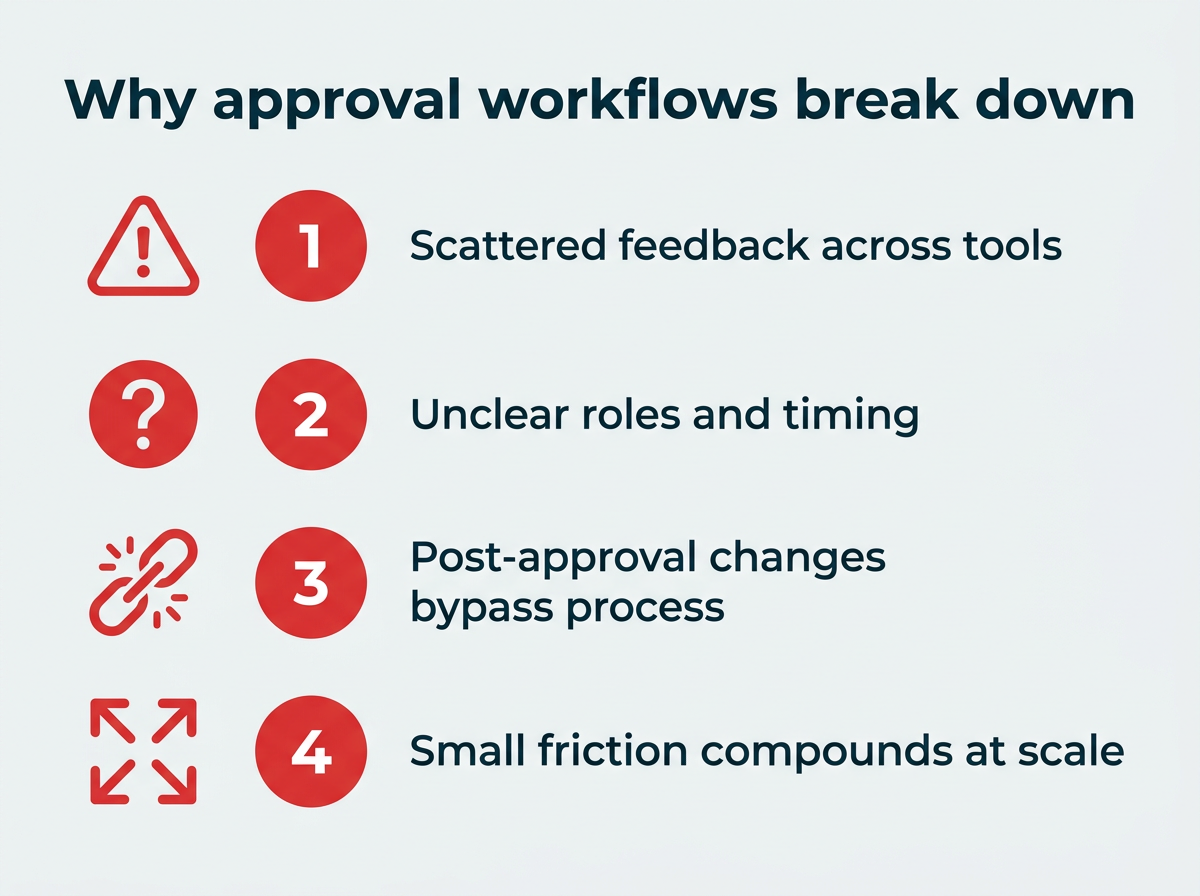
Scattered Feedback: One of the most common workflow killers is fragmented communication. When feedback is dispersed across emails, Slack messages, Google Doc comments, and other channels, critical notes inevitably get lost or overlooked. This leads to missed edits, duplicated efforts, and significant frustration, undermining the very purpose of a centralized review. Centralizing feedback within a dedicated platform is crucial to eliminate this friction.
-
Ambiguous Roles and Timelines: A lack of clarity regarding who reviews what, in what sequence, and by when, inevitably creates bottlenecks. Content can languish unreviewed for days because stakeholders are unaware it’s their turn, or multiple individuals might redundantly review the same draft, potentially offering conflicting feedback. Clearly defined roles, responsibilities, and strict deadlines are essential to keep the workflow moving efficiently.
-
Post-Approval Modifications: Making changes to content after it has received final approval is a significant risk, particularly in regulated industries where unapproved alterations can lead to severe legal and compliance repercussions. Even in less regulated environments, last-minute changes can introduce errors that the initial review process was designed to catch. Any modification after sign-off should ideally trigger a re-entry into the approval chain, or at least a documented fast-track re-approval for minor edits, to maintain accountability and integrity.
-
Compounding Friction at Scale: What might be a minor inconvenience for a small team can escalate into chaotic inefficiency at an enterprise level. A slight delay in a single approval, when multiplied across dozens or hundreds of posts, multiple social accounts, and diverse regions, quickly snowballs into significant operational gridlock. At scale, unclear escalation paths, inconsistent approval criteria across different brands or departments, and a lack of centralized visibility into content status can lead to widespread chaos. Solutions like bulk approval features, which allow approvers to sign off on batches of related content, become vital to manage volume effectively. The solution isn’t just better tools, but workflows designed specifically for the volume and complexity an organization truly faces.
Building a Resilient Content Approval Workflow: A Step-by-Step Methodology
Constructing a content approval workflow that withstands real-world publishing demands involves a systematic approach:
-
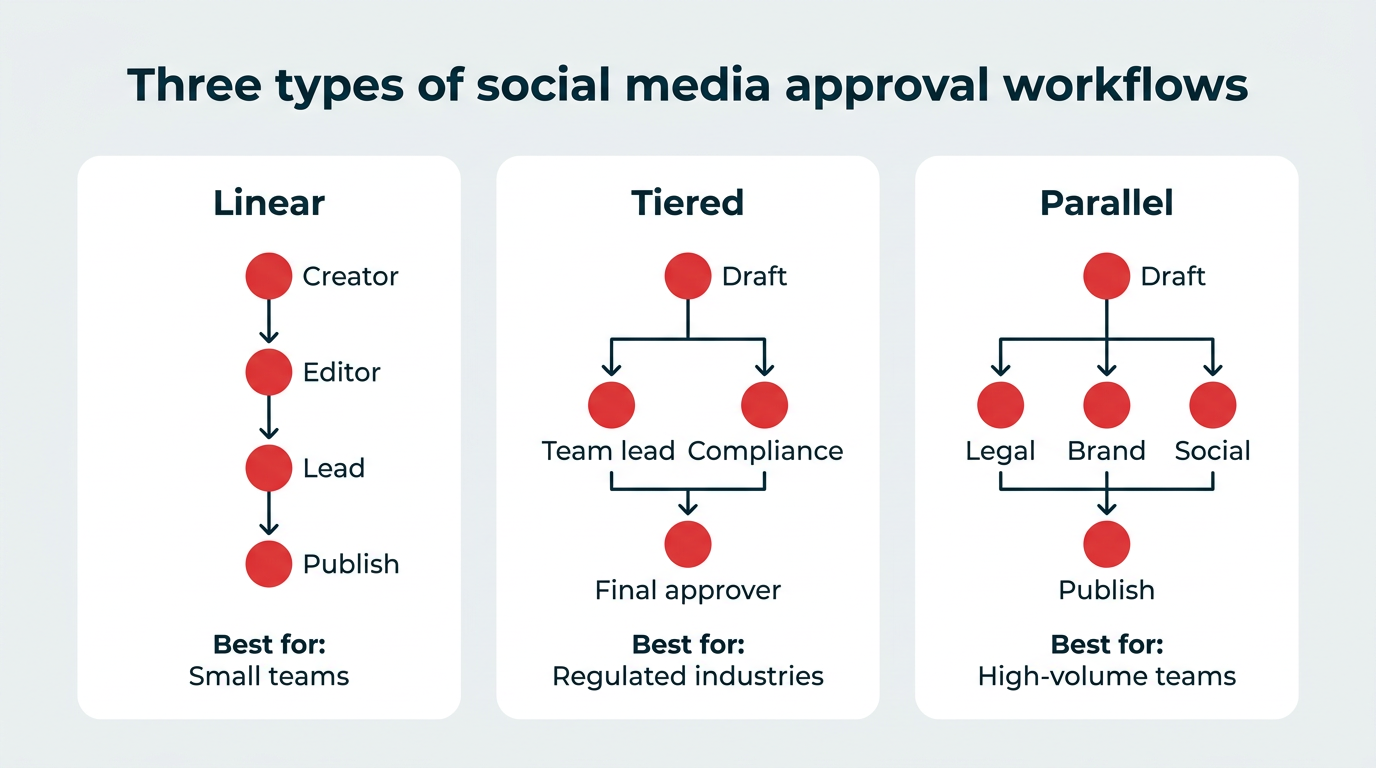
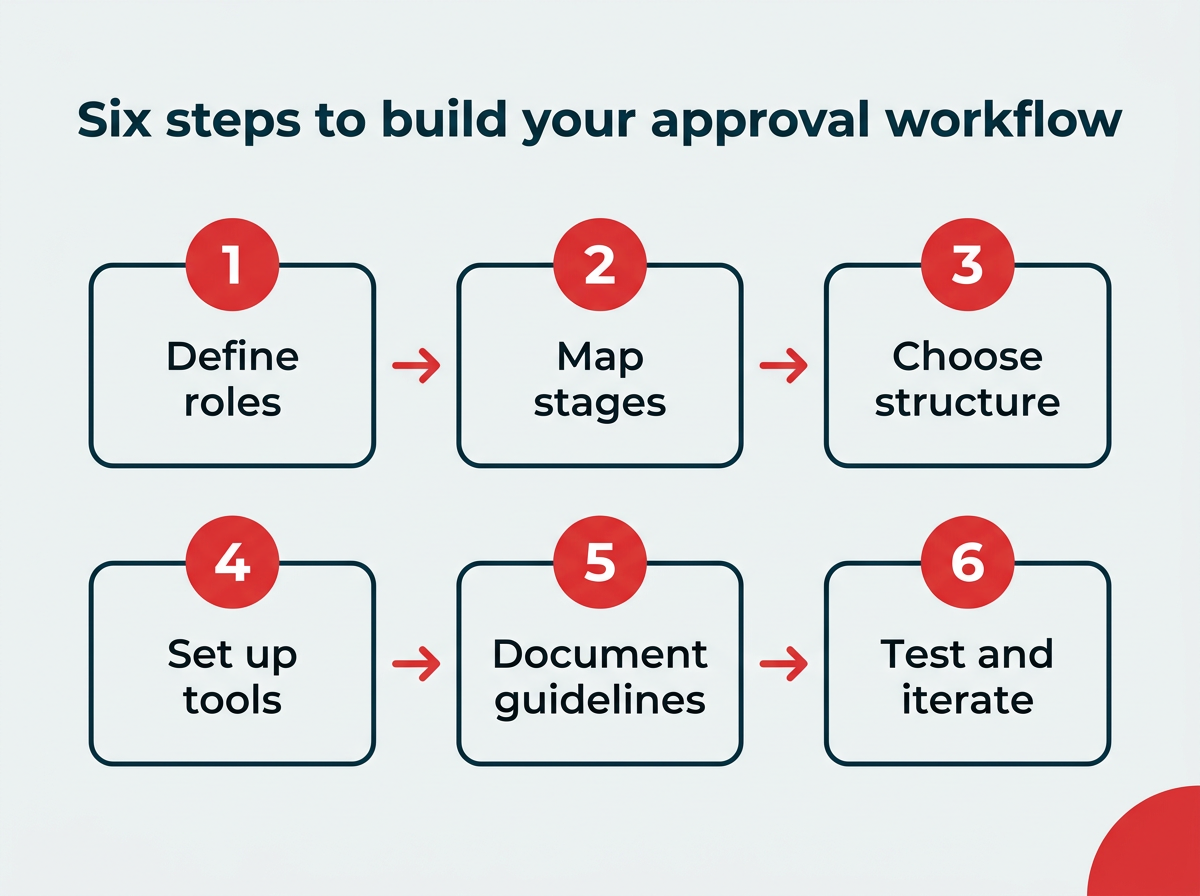
Define Roles and Responsibilities: Clarity here is paramount. Every individual involved must understand their specific role before any content is drafted. Common roles include:
- Content Creator: Drafts the content.
- Editor: Reviews for grammar, style, tone, and adherence to brand guidelines.
- Brand Manager/Marketing Lead: Ensures strategic alignment and brand consistency.
- Legal/Compliance Officer: Reviews for regulatory adherence and risk mitigation.
- Final Approver: Gives the ultimate sign-off for publication.
- Enterprise teams often require role-based permissions to ensure only authorized users can advance content or publish it, preventing accidental releases and maintaining workflow integrity.
-
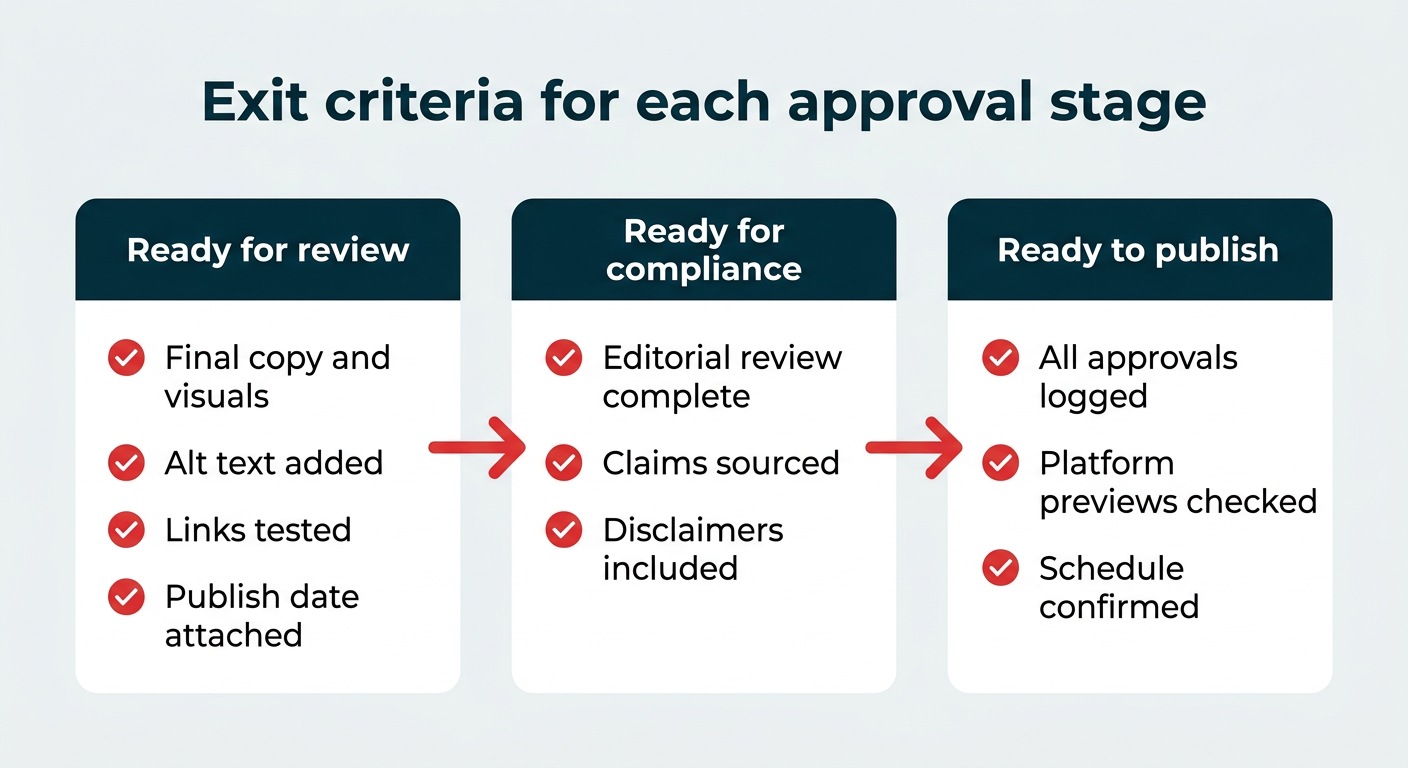
Map Your Content Workflow Stages: Utilize the six-stage model (ideate, draft, review, revise, approve, publish) as a foundation, then customize it to your team’s unique requirements. Some teams might need an additional "compliance review" stage, while others may merge "review" and "revise" into a single iterative loop. Crucially, document the expected turnaround time (Service Level Agreement or SLA) for each stage. For instance, drafts might be due 48 hours before publication, reviews completed within 24 hours, and revisions returned the same day. These SLAs establish a shared pace and keep the workflow dynamic. Additionally, define clear entry and exit criteria for each stage. For example:
- Ready for Review: Draft includes all required assets (copy, image, link), aligns with the brief, and has been self-edited.
- Ready for Compliance: Content adheres to brand guidelines and initial marketing strategy.
- Ready to Publish: All feedback incorporated, legal approval secured, and final sign-off given.
These criteria act as a "contract," ensuring drafts meet a minimum standard before consuming reviewer time.
-
Choose Your Approval Structure: Select the workflow type (linear, tiered, parallel, conditional, hybrid) that best aligns with your team’s profile. Small teams with low volume might opt for linear, while enterprise organizations in regulated industries would lean towards tiered or conditional models. Referencing the comparative analysis of workflow types can help in this decision.
-
Set Up Your Tools and Permissions: Centralizing approvals within a single platform is arguably the most significant efficiency gain. Prioritize tools that offer:
- Configurable role-based permissions.
- Predefined approval chains.
- Automated notifications for pending reviews.
- Platform-specific content previews.
- Audit trails.
- Content locking after approval.
When configuring the tool, also establish clear feedback standards. Reviewers should provide specific, actionable comments directly within the platform, rather than vague notes scattered across disparate communication channels.
-
Document Guidelines and Share with Your Team: Create a concise, one-page document outlining your brand guidelines, approval criteria, escalation paths, and turnaround SLAs. This should complement a formal social media policy, providing both operational and governance guardrails. Clearly define escalation rules, including naming backup approvers and specifying triggers for automatic escalation (e.g., missed SLAs). For time-sensitive content, delineate who has authority for expedited approvals and how such instances are logged. This document should be a cornerstone of onboarding and regularly revisited.

-
Test, Measure, and Iterate: No workflow is perfect on its initial implementation. Pilot the process for a few weeks, meticulously tracking key metrics such as average time from draft to publish, identifying stages where delays consistently occur, and noting the number of revision rounds. Data-driven insights from this testing phase will highlight bottlenecks and inform necessary adjustments to roles, SLAs, or tools, fostering continuous improvement.
Best Practices for Sustainable Content Approval Workflows
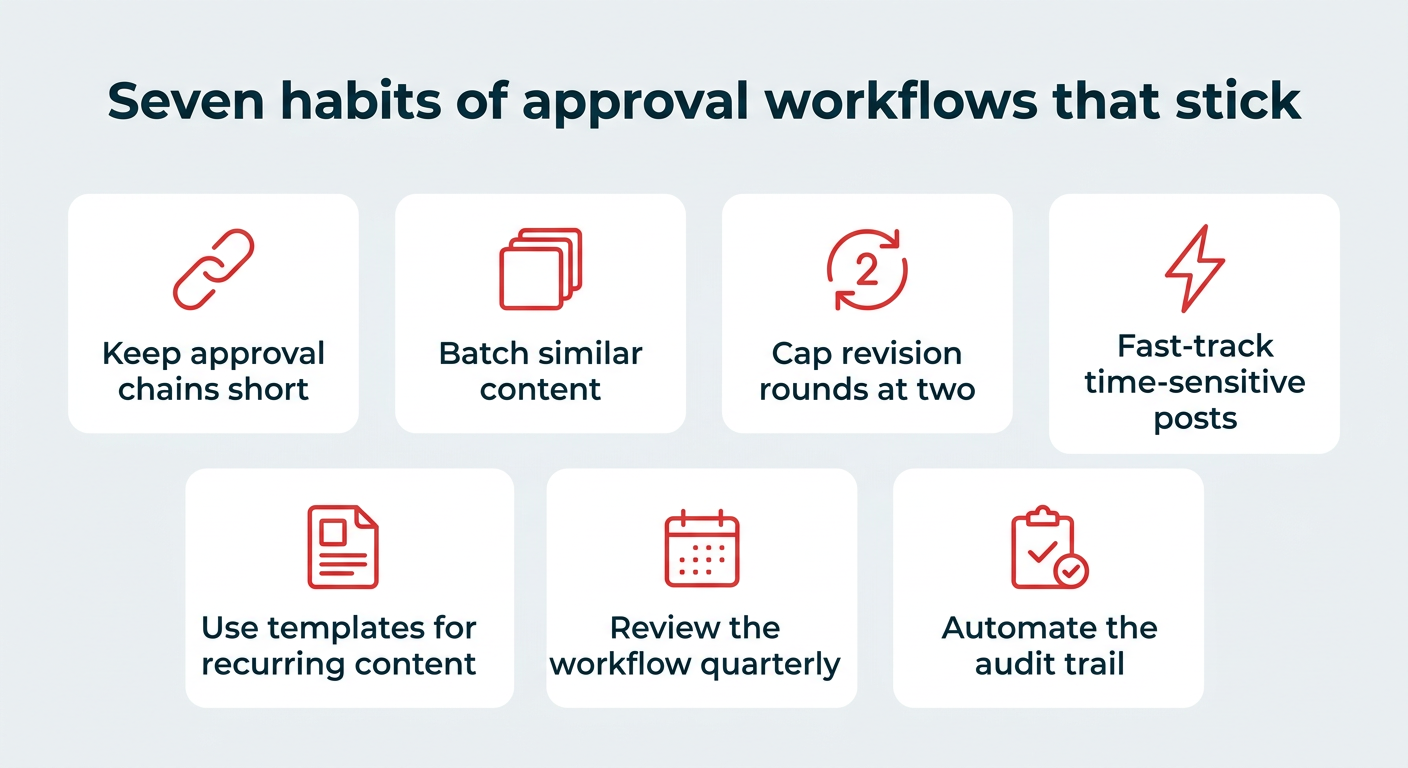
The most effective content approval workflows are those that are judiciously designed, adding only as much process as the inherent risk demands. Key habits distinguish sustainable workflows from those that teams circumvent:
- Keep Approval Chains Short: Minimize the number of required approvers to expedite the process.
- Provide Feedback Early and Clearly: Address issues at the earliest possible stage and offer specific, actionable comments.
- Define Clear Entry/Exit Criteria: Ensure content meets predefined standards before advancing to the next stage.
- Automate Notifications and Audit Trails: Leverage technology to alert reviewers and automatically log every action for accountability.
- Enable Bulk Approval: Allow approvers to review and sign off on multiple related posts simultaneously, especially for campaigns.
- Designate Backup Approvers: Prevent bottlenecks by having alternate approvers available.
- Establish a Fast-Track Path for Urgent Content: Create a documented, expedited process for time-sensitive content, ensuring accountability even with speed.
- Lock Approved Posts: Prevent unauthorized changes to content once it has received final sign-off.
- Regularly Review and Optimize: Continuously evaluate workflow performance and make data-driven adjustments.
Ultimately, the best practice is to design the workflow around your highest-risk content, then create more streamlined and faster paths for all other content types.
The AI Frontier: Integrating AI-Generated Content into Approval Workflows
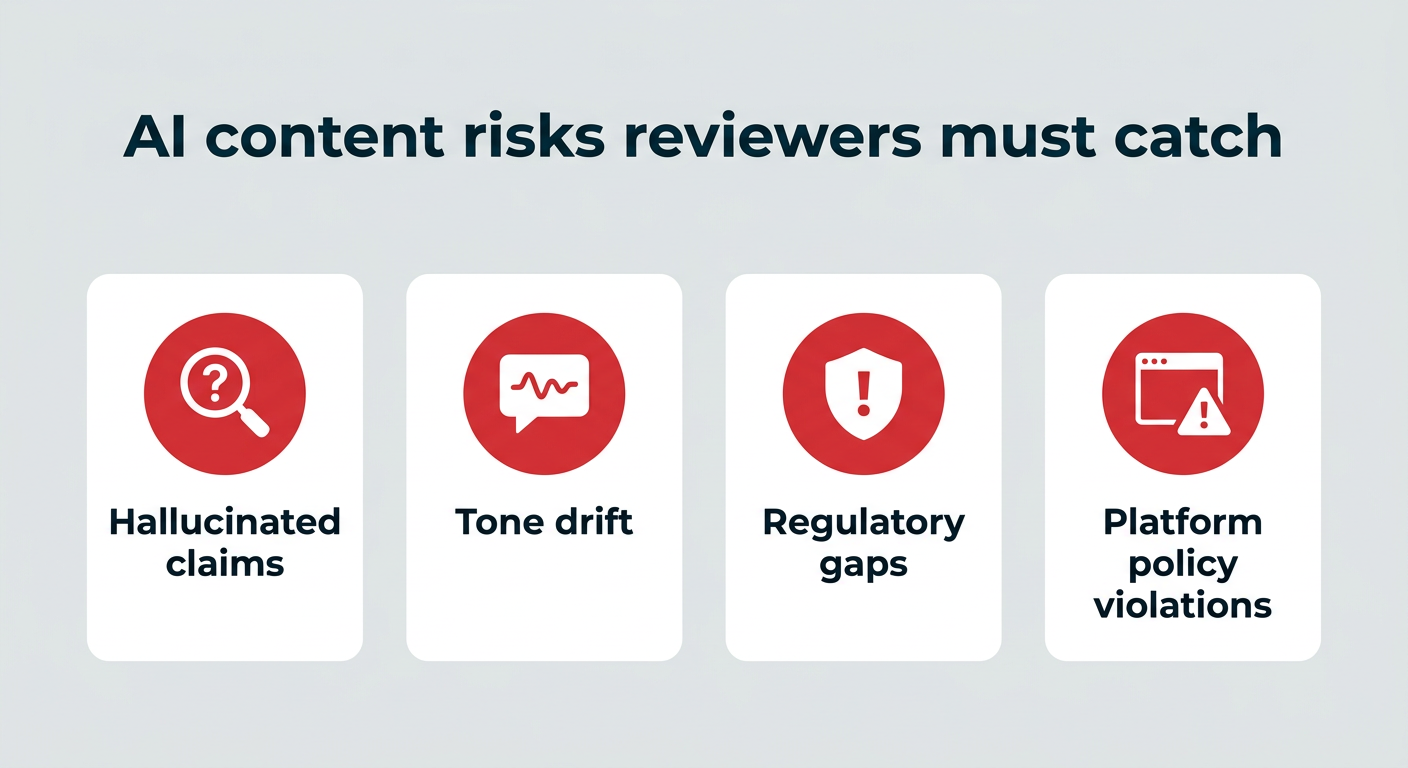
The rapid integration of AI into content creation necessitates a thoughtful approach to approval. AI-generated content, despite its speed, must traverse the same rigorous approval workflow as human-created content. In regulated industries, it often warrants an additional checkpoint due to unique risks. As 52% of martech leaders are already piloting agentic content production, the volume of AI-assisted drafts reaching reviewers will only increase. However, AI-generated content is prone to confident but potentially untrue errors, demanding heightened scrutiny for:
- Hallucinated Claims: Factual inaccuracies or fabricated information.
- Tone Drift: Deviation from the established brand voice or desired emotional resonance.
- Regulatory Gaps: Failure to comply with legal or industry-specific regulations.
- Platform Policy Violations: Content that contravenes the guidelines of social media or other distribution platforms.
- Bias and Ethical Concerns: Inadvertent perpetuation of biases present in training data.
Practically, flagging AI-drafted content within the workflow alerts reviewers to scrutinize accuracy and sourcing more intensely than tone or typos. Some teams have adopted a mandatory fact-check step for any AI-assisted draft before editorial review, a small investment compared to the cost of issuing corrections or managing reputational damage. Tools that seamlessly integrate AI-assisted drafting into governed workflows, like Hootsuite Social OS, offer the benefit of speed in creation without compromising essential oversight and compliance.
Choosing the Right Tools for Enhanced Workflow Efficiency
Selecting the appropriate technology is pivotal for an effective content approval workflow. Tools vary widely in their capabilities, making it essential to prioritize features critical for enterprise teams:
- Customizable Approval Chains: Ability to define multi-tier, conditional, or parallel approval paths.
- Role-Based Permissions: Granular control over who can create, edit, approve, or publish.
- Automated Notifications: Alerts for pending approvals, feedback, or status changes.
- Centralized Feedback: A single place for all comments and revisions.
- Content Previews: True-to-platform previews for accurate visual assessment (especially for social media).
- Audit Trails: Automatic logging of all actions and changes for accountability and compliance.
- Content Locking: Preventing unauthorized edits after approval.
- Bulk Approval Capabilities: Efficiently approve multiple related pieces of content.
- Calendar View: Visual representation of content schedules and approval statuses.
- Integration with AI Tools: Seamlessly incorporating AI-assisted drafting into governed workflows.
These features typically manifest across three categories of tools:
-
Social Media Management Platforms (e.g., Hootsuite Social OS):
- Strengths: Approval chains directly tied to publishing, platform-specific previews, integrated calendar visibility, post-locking.
- Best for: Teams publishing high volumes of social content across multiple accounts or regions.
-
Project Management Tools (e.g., Asana, Trello, Monday.com):
- Strengths: Task assignment, deadline tracking, broad visibility across various content types.
- Best for: Mixed content operations where social media is one workstream among many.
-
Dedicated Approval Software (e.g., ProofHub, Aproove):
- Strengths: Granular markup on assets, robust version control, sophisticated external stakeholder review.
- Best for: Design-heavy or agency workflows requiring client sign-off on creative assets.
Many enterprise teams adopt a hybrid tool strategy, often combining a social media management platform for direct publishing approvals with a project management tool for upstream planning and broader content oversight. The critical challenge to avoid in such a setup is splitting feedback across both platforms, which negates the benefits of centralization.
Hootsuite Social OS exemplifies a comprehensive solution, integrating content creation, approval, and publishing into a unified environment. It eliminates fragmented communication by centralizing all reviewer needs—draft, visuals, publish date, platform preview—within a single view. Users can configure approval chains per social account, leave direct feedback, and benefit from post-approval locking. Crucially, the platform provides robust governance through role-based permissions and automatic audit trails. Its ability to integrate AI-assisted drafting into these governed workflows means organizations can leverage speed without sacrificing essential oversight, making it a powerful asset for enterprises managing complex, multi-brand, or multi-region social media strategies.


 Layla Zulfa

 Nila Kartika Wati