rifanmuazin
The digital marketing landscape, increasingly competitive and data-driven, places an unprecedented premium on the quality and integrity of customer data. Imagine the scenario: a meticulously crafted email campaign, brimming with strategic intent and creative flair, is launched with high expectations. Yet, instead of the anticipated surge in engagement and conversions, the sender is met with a deluge of bounce notifications, a stark reminder of the pervasive challenge of data decay. This frustration is a familiar reality for countless marketing professionals who grapple with the exponential growth of contact databases and the inherent complexities of maintaining their cleanliness. Automated email list validation emerges not merely as a convenience but as a proactive, scalable solution to this critical problem, fundamentally shifting the paradigm from reactive list cleanups to an always-on defense mechanism that safeguards deliverability, protects sender reputation, and ultimately bolsters the bottom line.
This comprehensive exploration delves into the mechanics of automated email verification, uncovers the multifaceted and often hidden costs associated with compromised data, and provides a structured, step-by-step framework for implementing a strategy designed to keep email lists pristine and marketing efforts maximally effective.
Understanding Automated Email List Validation
Email marketing continues to assert its dominance as one of the most potent tools in a marketer’s arsenal. Projections from industry analysts indicate a robust 15.92 percent compound annual growth rate (CAGR) for the email marketing market between 2024 and 2030, underscoring its enduring efficacy and strategic importance. A pivotal accelerator of this growth and its associated opportunities is automation, particularly in the realm of data hygiene.
Email list validation automation leverages advanced technology to systematically and continuously verify the authenticity and deliverability of email addresses within a database. This capability transcends the limitations of traditional, one-time list scrubbing, which offers only a snapshot of data quality at a specific moment. Instead, automation seamlessly integrates with existing data workflows, acting as a perpetual security checkpoint for customer relationship management (CRM) systems and other marketing platforms. It automatically flags invalid, risky, or dormant email addresses before messages are dispatched, effectively preventing them from ever entering or remaining in active campaign segments. Much like airport security rigorously screens every passenger and piece of luggage, automated validation meticulously scrutinizes every email address—whether newly acquired or long-standing—ensuring that only legitimate, engaged contacts populate the system, thereby protecting sender reputation around the clock.
This continuous verification process employs a suite of checks, including syntax validation, domain existence verification, mailbox existence checks, and even real-time analysis for disposable email addresses or known spam traps. The goal is not just to identify obvious errors but to proactively mitigate risks that could harm deliverability and campaign performance.
The Evolving Landscape of Email Marketing and Data Challenges
The journey of email marketing from its nascent stages to its current sophisticated form has been marked by continuous innovation and escalating challenges. Early email marketers faced simpler deliverability hurdles, but as the volume of commercial email surged, so did the sophistication of spam filters and the stringency of email service provider (ESP) policies. What began as basic sender reputation metrics evolved into complex algorithms that assess a multitude of factors, including bounce rates, spam complaint rates, engagement metrics, and the presence of spam traps.
This evolution has made data hygiene not merely a best practice but a fundamental requirement for market access. Regulatory frameworks like the General Data Protection Regulation (GDPR) in Europe, the California Consumer Privacy Act (CCPA) in the United States, and the global CAN-SPAM Act further underscore the importance of accurate, consent-based data. Sending emails to invalid addresses not only wastes resources but can also lead to non-compliance penalties, emphasizing the multifaceted nature of the data quality challenge. The average rate of data decay, estimated to be between 20-30% annually due to job changes, domain expirations, or user abandonment, highlights the transient nature of email addresses and the critical need for continuous validation.

The Tangible and Intangible Costs of Neglected Data
A neglected or "dirty" email list carries a significant burden of costs, both direct and indirect, that can severely undermine marketing performance, erode brand trust, and negatively impact overall business results. These costs extend far beyond the immediate inconvenience of bounce notifications:
- Diminished Sender Reputation and Deliverability: Email Service Providers (ESPs) like Gmail, Outlook, and Yahoo closely monitor sender behavior. High bounce rates, particularly hard bounces (indicating a permanent delivery failure), are red flags that signal a poor sender reputation. Even a consistent bounce rate exceeding 2% can trigger closer scrutiny, while rates above 5% can lead to blacklisting or automatic routing of legitimate emails to spam folders. Once a sender’s reputation is damaged, recovery is a protracted and arduous process, impacting all subsequent email communications.
- Wasted Marketing Spend and Skewed ROI: Every email sent to an invalid address represents a wasted resource. This includes not only the direct cost per email charged by many marketing platforms but also the lost opportunity cost of reaching a potential customer. When a significant portion of a list is undeliverable, the calculated ROI of email campaigns—often lauded as generating an exceptional $36 for every dollar spent—becomes artificially inflated and misleading, hindering accurate performance assessment and strategic allocation of budget.
- Inaccurate Analytics and Impaired Decision-Making: A dirty list pollutes marketing analytics. Open rates, click-through rates, and conversion rates become unreliable indicators of campaign effectiveness when they are skewed by a large number of undeliverable messages. This statistical noise can lead to misinformed strategic decisions, causing marketers to prematurely abandon effective strategies or double down on underperforming ones due to a distorted perception of reality.
- Operational Inefficiencies and Resource Drain: Manual data hygiene, whether through periodic batch cleaning or ad-hoc efforts, is an incredibly time-consuming and labor-intensive process. Marketing and sales operations teams spend valuable hours exporting, cleaning, and re-uploading CSV files, diverting their focus from higher-impact strategic initiatives. The potential for human error in manual processes also introduces further risks to data integrity.
- Brand Erosion and Customer Trust Issues: Sending emails to non-existent addresses can inadvertently lead to "spam trap" hits, which are email addresses specifically set up by ESPs to catch spammers. Hitting a spam trap can severely damage a sender’s reputation. Furthermore, repeated attempts to send to invalid or unresponsive addresses can frustrate legitimate subscribers if the system mistakenly categorizes them or if customer service interactions are based on outdated contact information, eroding trust and perception of professionalism.
- Compliance Risks: As mentioned, global data protection regulations mandate that businesses maintain accurate and current data. Sending unsolicited or non-compliant emails, even due to outdated information, can lead to significant fines and legal repercussions, adding a layer of compliance risk to neglected data hygiene.
Strategic Imperatives: The Business-Critical Benefits of Automation
Implementing an automated email list validation strategy fundamentally shifts an organization’s approach from a reactive, defensive posture to a proactive, offensive one, generating compounding value that extends far beyond a merely clean list.
1. Protect and Build Your Sender Reputation
Your sender reputation is arguably the most valuable asset in email marketing, directly determining whether your messages land in the inbox or are relegated to the spam folder. ESPs meticulously monitor metrics such as bounce rates, spam complaint rates, and engagement levels. By automatically identifying and removing invalid, non-existent, or risky email addresses, automated validation drastically reduces negative signals. This proactive stance cultivates trust with email providers, leading to significantly improved inbox placement rates and ensuring that your carefully crafted messages consistently reach their intended audience. A robust sender reputation also acts as a buffer against minor fluctuations in engagement, providing greater resilience in dynamic marketing environments.
2. Maximize and Prove Campaign ROI
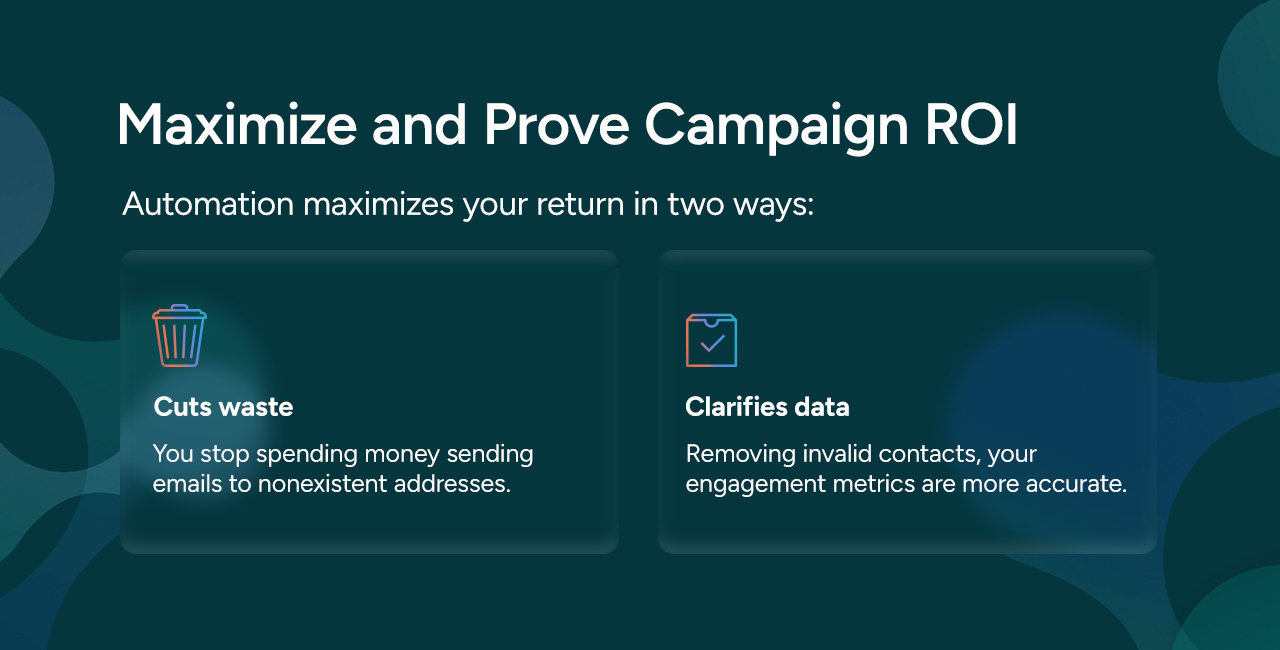
While email consistently delivers an exceptional return on investment, often cited around $36 for every dollar spent, this impressive figure is contingent upon messages actually reaching the inbox. Automated validation maximizes this return in two critical ways. Firstly, by minimizing bounces and ensuring higher deliverability, it guarantees that marketing spend is directed towards genuine, reachable contacts, eliminating wasted resources. Secondly, with cleaner data, campaign metrics become highly accurate, allowing marketers to precisely measure the true impact of their efforts, attribute conversions correctly, and demonstrate a clear, undeniable ROI to stakeholders. This accuracy empowers data-driven optimization and more efficient budget allocation.
3. Enhance Personalization and Segmentation
Effective marketing thrives on reliable, granular data. Consider a re-engagement campaign targeting customers who haven’t made a purchase in six months. If 20% of this segment consists of invalid or inactive addresses, the campaign’s true performance will be distorted, potentially leading to the erroneous abandonment of an otherwise effective strategy. Automated email verification ensures the foundational integrity of your segments. By providing a clean, verified dataset, it enables highly accurate analysis, precise segmentation, and truly personalized communication strategies, leading to higher engagement rates and more relevant customer experiences. This precision is vital for advanced marketing tactics like dynamic content and customer journey mapping.
4. Drive Radical Efficiency for Marketing and Sales Operations
The manual processes associated with data hygiene—exporting large CSV files, running them through external tools, cleaning them, and then re-uploading—are notoriously time-consuming and prone to error. This administrative burden detracts from the strategic work that marketing and sales operations specialists are hired to do. An automated verification process liberates these teams from mundane data scrubbing tasks, allowing them to focus on high-impact strategic initiatives. For organizations leveraging platforms like Salesforce, this translates into a significant game-changer. Teams can trust that the data within their CRM is reliable, facilitating more accurate lead routing, dependable reporting, and precise forecasting, thereby enhancing overall operational agility and effectiveness.
5. Secure Your Email List at the Point of Entry
Real-time automation functions as an indispensable gatekeeper for your database. By integrating a verification API (Application Programming Interface) at every point of data capture—from newsletter signup forms and content download gates to demo request forms and e-commerce checkout pages—organizations can drastically reduce the ingress of bad data. This acts as the critical first line of defense against common data pollution sources such as typographical errors, fake email addresses, and bot-driven signups that frequently employ invalid or disposable addresses to inflate lists or exploit systems. Implementing real-time verification ensures that data quality is maintained from the very moment of acquisition, preventing issues before they even arise.
Implementing a Robust Automation Strategy: A Phased Approach
Building and sustaining a robust email list validation strategy requires a structured, multi-step framework.
Step 1: Audit Your Current Email List and Identify Goals
Before deploying any new solution, a thorough assessment of existing list management practices is paramount. Conduct a comprehensive health check on your current email list. Utilize existing analytics to pinpoint segments characterized by persistently high bounce rates, low engagement, or elevated spam complaint metrics. Define clear, measurable success metrics for your organization. Is the primary goal to reduce overall bounce rates by a specific percentage? Is it to clean a particular legacy list that has not been touched in years? Or perhaps to improve the average open rate across all campaigns? Establishing these baselines is crucial for accurately measuring the ROI and impact of the automation solution later on. This initial audit provides a clear picture of the scale of the problem and helps prioritize efforts.
Step 2: Choose the Right Email Verification Service
The selection of an email verification vendor is a critical decision. Prioritize accuracy, speed, and security above all else. A low-cost tool that frequently generates false positives (incorrectly flagging valid emails as invalid) can lead to significant lost revenue by preventing communication with legitimate customers. Conversely, a tool that misses invalid emails perpetuates the problems it’s meant to solve. Look for a secure, scalable solution that offers:
- Industry-leading accuracy: Minimizing false positives and false negatives.
- Real-time verification capabilities: Essential for point-of-entry validation.
- Comprehensive reporting and analytics: To monitor performance and identify trends.
- Robust API for seamless integration: Compatibility with existing marketing and sales platforms.
- Strong data security and privacy protocols: Ensuring compliance with regulations like GDPR and CCPA.
- Excellent customer support: For smooth implementation and ongoing optimization.
- Ability to identify various risk types: Including disposable emails, spam traps, and role-based emails.
Step 3: Integrate with Your Marketing and Sales Stack
True automation necessitates seamless integration between your chosen verification tool and your existing marketing and sales ecosystem. For existing historical data, connect the verification tool directly to your CRM (e.g., Salesforce, HubSpot) and Email Service Provider (ESP). Schedule periodic bulk verifications to proactively address ongoing data decay. For new data acquisition, implement the verification API directly into your web forms (e.g., landing pages, signup forms). This real-time, "type-ahead" verification allows users to correct typos before submission, immediately rejecting clearly invalid addresses and significantly improving the quality of incoming leads. This dual approach ensures both historical data cleansing and continuous ingress protection.
Step 4: Monitor and Refine
Implementation is not a one-time event but the beginning of an ongoing process. Regularly review the verification reports and analytics provided by your service. Are you observing an unexpected increase in invalid emails originating from a particular lead source or campaign? Is a specific web form disproportionately attracting bot traffic or disposable email addresses? Leverage these actionable insights to continuously refine your lead acquisition strategies, tighten your list capture rules, and optimize your overall data hygiene protocols. Continuous monitoring allows for agile adjustments, ensuring the system remains efficient and effective against evolving threats to data quality. This iterative process of monitoring, analyzing, and refining is key to long-term success.
The Broader Impact: Data Governance and Customer Trust
Beyond the immediate operational and financial benefits, automated email list validation contributes significantly to broader data governance initiatives and strengthens customer trust. In an era where data breaches are common and privacy concerns are paramount, demonstrating a commitment to accurate, respectful data handling is a powerful brand differentiator. Companies that prioritize data hygiene are inherently more compliant with privacy regulations, reducing legal exposure and fostering a reputation for ethical data stewardship. This commitment extends to the customer experience: by ensuring communications reach legitimate, interested parties, businesses avoid irritating non-existent users and instead focus on building genuine relationships with their actual audience. This proactive approach to data quality is a cornerstone of responsible marketing and a vital component of sustainable business growth.
Industry Perspectives and Expert Insights
Marketing analysts consistently underscore the foundational role of data quality. "The integrity of an email list is directly correlated with campaign success and long-term brand equity," states a representative quote from a leading digital marketing consultancy. "In today’s hyper-competitive landscape, marketers cannot afford to base their strategies on flawed data. Automation is no longer a luxury but a necessity for maintaining competitive advantage." Data privacy advocates further emphasize that proactive data hygiene is not merely a marketing tactic but a fundamental aspect of ethical data stewardship, aligning business practices with consumer expectations for privacy and respect. Companies that have successfully transitioned to automated verification report tangible improvements, including significant reductions in bounce rates (often by 10-15% within the first few months), improved open rates, and more accurate campaign attribution, validating the strategic investment.
Conclusion
In the dynamic and fiercely competitive realm of digital marketing, email list validation automation has transcended its status as a mere technical convenience to become an indispensable necessity for protecting revenue, preserving sender reputation, and ensuring the long-term viability of email marketing programs. By embedding automated hygiene into core data workflows, businesses can effectively prevent the insidious infiltration of bad data, ensuring that their marketing efforts are precisely targeted towards real, engaged individuals. This strategic shift not only optimizes operational efficiency and maximizes campaign ROI but also fortifies brand trust and upholds crucial data governance standards.
The era of reactive, periodic list cleanups is rapidly receding, replaced by a continuous, intelligent defense mechanism. Organizations poised for sustained growth and market leadership recognize that investing in automated email list validation is not an expense, but a critical investment in the future of their digital engagement and overall business health.