
 rifanmuazin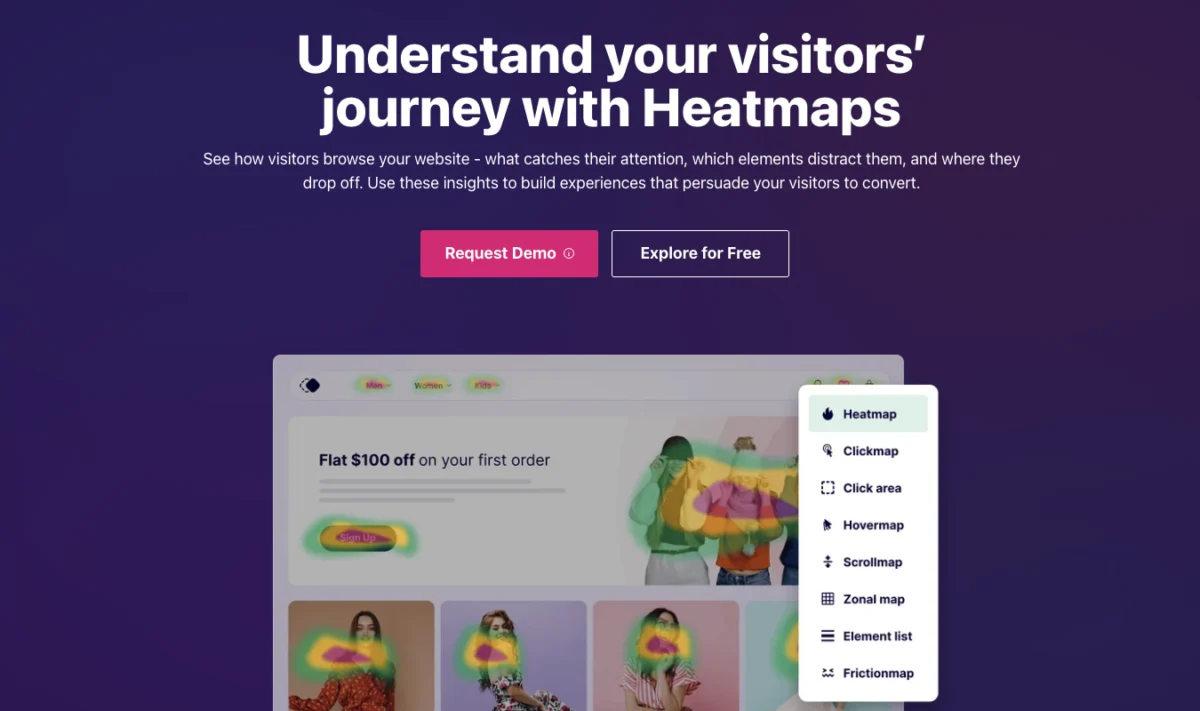
The landscape of digital experience optimization has reached a significant turning point as two of the industry’s most prominent players, AB Tasty and VWO, move toward a combined platform model. This strategic consolidation marks a major shift in the software-as-a-service (SaaS) sector, specifically within the realms of conversion rate optimization (CRO) and feature management. While the two entities are in the process of merging their operational strengths, they currently maintain distinct product experiences, each catering to specific organizational workflows and technical requirements. AB Tasty has historically positioned itself as a robust solution for integrated marketing and product team experimentation, whereas VWO has built its reputation on the seamless integration of behavioral analytics with testing capabilities.
The Evolution of the Digital Experience Market
To understand the significance of the AB Tasty and VWO merger, one must look at the trajectory of the experimentation market over the last decade. In the early 2010s, A/B testing was largely a specialized task relegated to data scientists or high-level developers. As the digital economy expanded, the demand for "no-code" or "low-code" solutions grew, allowing marketing teams to take the lead on front-end optimizations.
However, as websites evolved into complex web applications, the need for server-side testing and feature flagging became paramount. Companies like Optimizely shifted toward the enterprise level, leaving a competitive middle-to-upper-market gap that AB Tasty and VWO successfully filled. The current move to combine these platforms suggests a market demand for a "total experience" suite—one that provides the behavioral "why" (analytics) alongside the experimental "how" (testing and rollouts).
Comparative Core Capabilities: Experimentation and Testing
At the heart of both platforms is the ability to run controlled experiments to determine which version of a digital asset performs best. Both AB Tasty and VWO support a comprehensive suite of testing types, including standard A/B tests, A/B/n tests, split URL testing, and multivariate testing (MVT).
AB Tasty distinguishes itself through its architectural approach to experimentation. The platform bifurcates its services into two distinct layers: client-side web experimentation and server-side feature experimentation. The client-side tools are optimized for marketing teams, allowing for rapid changes to headlines, layouts, and call-to-action (CTA) buttons via a visual editor. Conversely, the server-side capabilities are engineered for product and engineering teams, enabling them to test actual product logic and deep-seated features rather than just cosmetic variations.
VWO takes a more integrated approach, treating experimentation as a byproduct of behavioral insight. While it offers a similar range of testing types and a powerful visual editor, VWO’s primary differentiator is its "SmartStats" tool. This feature utilizes Bayesian statistics to provide users with a clearer understanding of the probability of a specific variation outperforming the control. VWO’s workflow is designed to be cyclical: a team identifies a friction point via a heatmap, formulates a hypothesis, launches a test, and validates the result—all within a single interface.
Behavioral Analytics: The "Why" Behind the Data
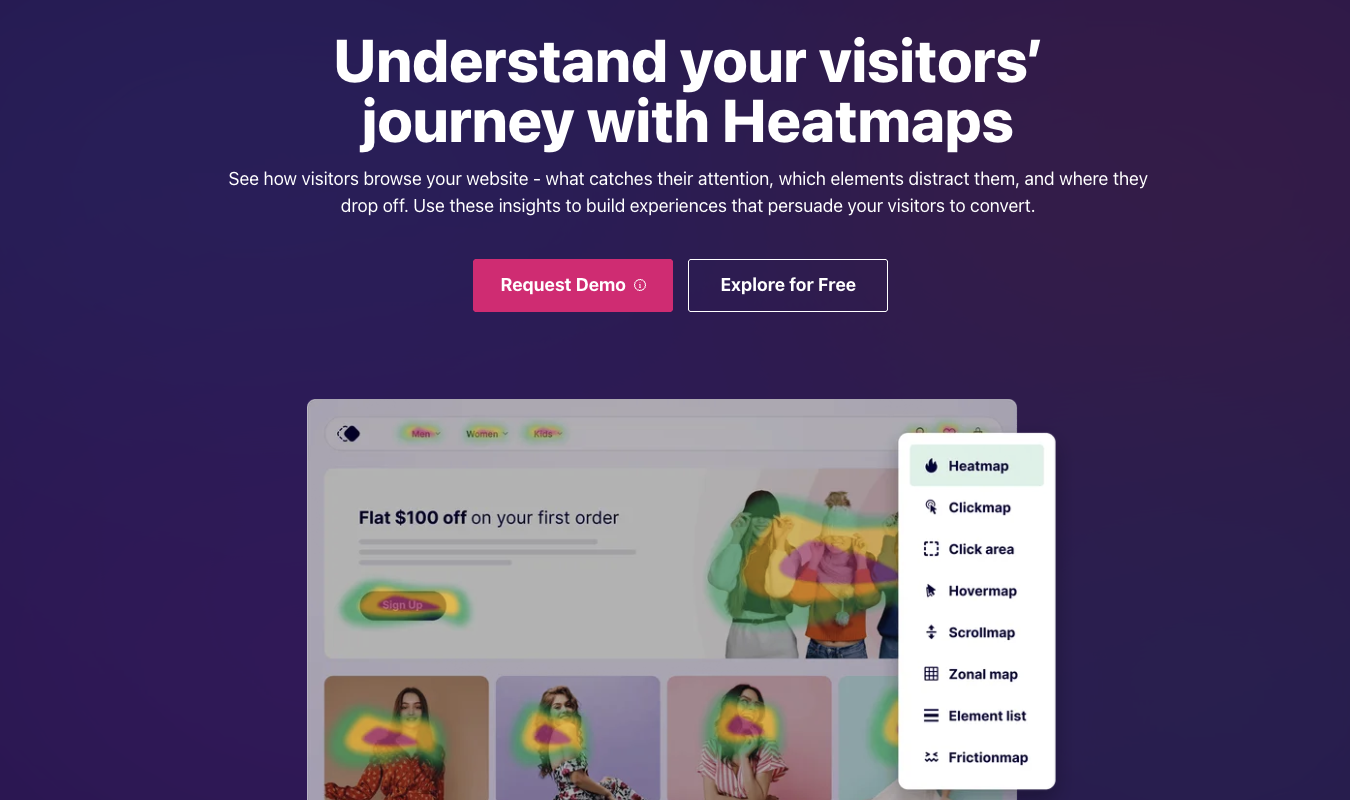
The most striking contrast between the two platforms lies in their native analytics capabilities. VWO was built with a philosophy that data without context is incomplete. Consequently, the platform includes a full suite of behavioral analytics tools, such as:
- Heatmaps: Visual representations of where users click, scroll, and hover.
- Session Recordings: Playbacks of individual user journeys to identify moments of frustration or confusion.
- Conversion Funnels: Detailed tracking of user drop-off points throughout a multi-step process.
- Form Analytics: Insights into which specific fields in a lead form or checkout process are causing users to abandon the task.
AB Tasty does not offer these tools natively. Organizations utilizing AB Tasty typically rely on third-party integrations with tools like Hotjar, Contentsquare, or VWO itself to gain behavioral context. For teams that prioritize having all their data under one roof, VWO’s built-in analytics provide a significant advantage in terms of speed-to-insight.
Feature Management and Progressive Rollouts
As software development moves toward continuous integration and continuous deployment (CI/CD) models, feature flagging has become a critical requirement for enterprise-level organizations. In this category, AB Tasty holds a notable lead over VWO’s current independent offering.
AB Tasty’s dedicated Feature Experimentation & Rollout product allows engineering teams to decouple code deployment from feature release. This enables several advanced workflows:
- Progressive Releases: A feature can be released to 5% of the audience, then 20%, and eventually 100%, based on performance monitoring.
- Targeted Rollouts: Specific features can be enabled only for certain user segments, such as "Beta Testers" or "Premium Subscribers."
- Instant Rollbacks: If a new feature causes a spike in error rates or a drop in conversions, it can be disabled instantly without requiring a fresh code deployment.
VWO offers feature management capabilities, but they are often perceived as less mature than AB Tasty’s specialized system. VWO’s server-side testing is highly effective for validating UX changes at a deeper level, but it lacks some of the granular administrative controls found in AB Tasty’s rollout management suite.
Personalization and Audience Segmentation Strategies
Both platforms recognize that the "one-size-fits-all" approach to web design is obsolete. Personalization is now a baseline expectation for digital consumers.
AB Tasty treats personalization as a core pillar of its platform. It provides a highly structured environment where teams can create dynamic widgets and utilize advanced triggers based on real-time behavior. A key feature in AB Tasty’s personalization engine is its campaign prioritization control. In complex environments where multiple experiments and personalizations are running simultaneously, AB Tasty allows administrators to set "collision" rules. This ensures that a single user is not overwhelmed by conflicting messages, maintaining a coherent and professional user experience.
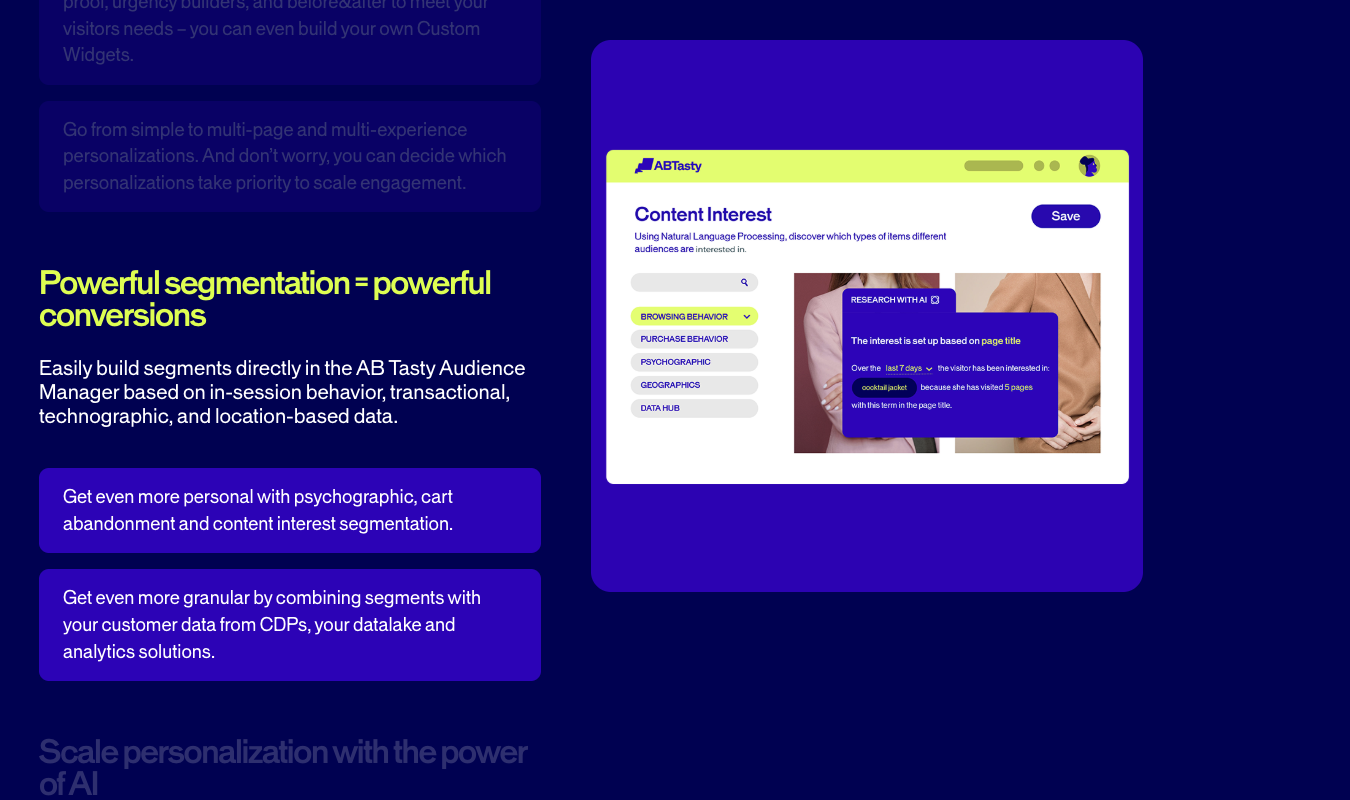
VWO approaches personalization as a component of its broader optimization suite. It excels at leveraging the data gathered from its "Insights" module to fuel personalized experiences. Because VWO has direct access to session recordings and survey data, the platform can create highly specific segments based on how users have interacted with the site in the past.
Surveying and Visitor Feedback Mechanisms
Direct user feedback is the final piece of the optimization puzzle. VWO offers a robust, standalone survey product that supports advanced logic, branching, and various template styles. These surveys can be triggered at specific points of friction, such as when a user shows "exit intent" on a high-value page.
AB Tasty offers more lightweight feedback tools. While it can deploy NPS (Net Promoter Score) and CSAT (Customer Satisfaction) prompts, these are generally viewed as support features for experimentation campaigns rather than a comprehensive research tool. For organizations that require deep qualitative research, VWO’s survey module provides a more professional-grade solution.
Pricing Models and Business Value Analysis
Neither AB Tasty nor VWO publishes fixed pricing, as both operate on an enterprise-grade sales model. However, their pricing structures reflect their different philosophies.
- AB Tasty: Typically employs a bundled pricing model that highlights its three main pillars: experimentation, personalization, and rollouts. This is often preferred by large organizations looking for a predictable, all-in-one cost for their product and marketing teams.
- VWO: Utilizes a modular pricing model. Organizations can choose to pay only for the modules they need, such as VWO Testing, VWO Insights, or VWO Personalize. This flexibility makes VWO attractive to mid-market companies or those who are just beginning their optimization journey.
Industry Implications and the Broader Impact
The convergence of AB Tasty and VWO is a clear indicator that the market for digital experience optimization is maturing. The "best-of-breed" approach—where a company might use five different tools for testing, analytics, and feedback—is being replaced by a preference for "best-of-suite" solutions. This consolidation reduces the "data silo" effect, where different teams are looking at different sets of numbers.
For the end-user, this merger likely means a more powerful, unified dashboard that combines AB Tasty’s superior rollout controls with VWO’s industry-leading behavioral analytics. Competitors in the space, including smaller niche players and larger enterprise suites like Adobe Target, will likely feel pressure to further integrate their own offerings to match the breadth of the combined AB Tasty-VWO entity.
Final Assessment: Strategic Recommendations
Choosing between the two platforms currently depends on the primary objectives of the organization.
Choose AB Tasty if:
- Your organization has a heavy focus on product-led growth and requires advanced feature flagging.
- You need to coordinate complex, overlapping experiments across marketing and engineering teams.
- You prioritize a structured, enterprise-grade workflow for feature rollouts.
Choose VWO if:
- You require a "single pane of glass" that includes heatmaps, recordings, and surveys alongside testing.
- You are a marketer or CRO specialist who needs to understand the qualitative "why" behind user behavior.
- You prefer a modular pricing approach that allows you to scale your toolset as your needs grow.
As the integration of these two platforms continues, the distinction between them will likely blur, eventually resulting in a single, comprehensive market leader for digital experience optimization. For now, businesses should evaluate their immediate technical needs and team workflows to determine which of these two industry giants provides the most immediate path to increased conversions and improved user satisfaction. Organizations seeking a more accessible entry point into this space may also consider alternatives like Crazy Egg, which offers a streamlined suite of heatmaps and A/B testing tools designed for rapid deployment and high ROI.








