rifanmuazin
The marketing landscape is undergoing a profound transformation, marked by a significant evolution in how organizations approach Artificial Intelligence. The conversation has moved beyond the adoption of individual AI tools to a more strategic consideration of AI systems and autonomous agents. This shift signifies a maturing understanding of AI’s potential, moving from point solutions to integrated intelligence capable of performing tasks, learning from data, and operating with a degree of independence within defined parameters.
This evolving perspective was recently highlighted in an analysis that explored the potential architecture of an AI-enhanced marketing organization. This prior examination mapped AI agents to core marketing functions, including content creation, demand generation, social media management, and analytics, envisioning how these intelligent entities could integrate into existing departmental structures. However, the practical realities for many Chief Marketing Officers (CMOs) present a more nuanced path forward.
The Pragmatic Reality: Integrating AI into Existing Structures
For most marketing leaders, a complete overhaul of their organizational charts is not an immediate possibility. Existing budgetary cycles, established reporting lines, and teams already operating at full capacity create significant inertia. Consequently, the prevailing imperative is to begin adopting AI within the current organizational framework. This approach allows for a phased integration, enabling teams to experiment with AI agents, build internal confidence, and demonstrate tangible operational improvements before embarking on potentially disruptive structural changes.
Why a Full Org Chart Redesign Remains Elusive for Many CMOs
Despite the clear potential of AI, the process of redesigning roles and reporting structures is inherently time-consuming. Several practical constraints contribute to this reality. Budgetary allocations are typically set months or even a year in advance, making immediate shifts in resource allocation challenging. Furthermore, established reporting hierarchies and team compositions are deeply entrenched, and altering them often involves complex human resource considerations, change management processes, and potential resistance. Teams are frequently operating at peak capacity, leaving little room for extensive strategic planning and implementation of large-scale organizational restructuring.
Given these constraints, the most effective strategy for many organizations involves operational integration. The critical question becomes: "Where within our existing workflows can AI agents alleviate operational friction and enhance efficiency?" This question serves as a foundational principle for a more accessible and impactful AI adoption.
Leveraging AI Within the Existing Marketing Framework
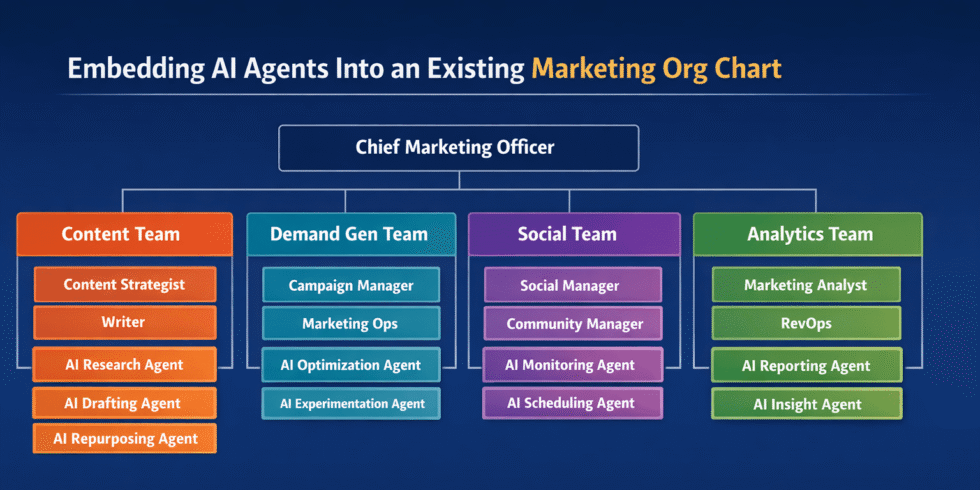
The focus for immediate AI integration often centers on core marketing functions that already possess well-defined, repeatable workflows. These include content creation, demand generation, social media management, and analytics. By embedding AI agents into these areas, organizations can unlock immediate value without requiring a complete reimagining of their departmental structures.
The objective here is not to replace human roles but to augment the capabilities of existing teams. Consider the role of a content strategist. Their responsibilities typically encompass research, editorial planning, drafting, editing, and distribution. An AI agent does not need to assume the entirety of this role to be beneficial. Instead, it can be strategically deployed to assist at specific junctures within the workflow.
For instance, an AI research agent can proactively gather competitive intelligence and identify relevant keyword opportunities ahead of a campaign launch, significantly streamlining the initial research phase. A drafting agent can then generate a preliminary version of a blog post or landing page, reducing the time spent on initial content generation. Furthermore, a content repurposing agent can automatically transform long-form content into concise social media posts or email snippets, maximizing content reach and efficiency. In this scenario, the content strategist retains ownership of the overarching narrative, brand voice, and final output, while the operational burden associated with routine tasks is substantially diminished.
This pattern of AI-powered augmentation extends across other key marketing functions. Demand generation teams, for example, often dedicate considerable time to monitoring campaign performance, identifying optimization opportunities, and conducting A/B testing. AI agents can provide invaluable support by continuously analyzing campaign data, suggesting strategic experiments, and even dynamically adjusting budgets within pre-defined parameters, thereby optimizing campaign effectiveness and resource allocation.
Similarly, analytics teams frequently expend significant hours compiling reports that may only be reviewed briefly by executives. AI agents can automate the generation of key performance indicator (KPI) dashboards, provide concise summaries of performance insights, and proactively flag anomalies, allowing human analysts to focus on deeper interpretation and strategic recommendations rather than routine data aggregation.
In each of these instances, AI agents are designed to function within the established organizational structure, acting as collaborators and force multipliers for existing roles, rather than as replacements. This approach empowers human team members to concentrate on higher-level strategic initiatives, quality assurance of AI-generated outputs, and critical gatekeeping functions before content is published or decisions are finalized.
Designing AI Agents Around Specific Workflows
A systematic approach to AI integration involves designing agents that are specifically tailored to individual stages within a defined workflow. Taking content creation as a simplified example, a typical workflow might include stages such as:
- Ideation and Research: AI agents can assist in identifying trending topics, analyzing competitor content, and suggesting relevant keywords.
- Drafting and Content Generation: Agents can produce initial drafts of articles, social media posts, or ad copy based on provided prompts and data.
- Editing and Refinement: AI tools can assist with grammar checks, style consistency, and even suggest improvements for clarity and engagement.
- Distribution and Promotion: Agents can help schedule posts across various platforms, identify optimal posting times, and even suggest targeting parameters for paid promotion.
Each of these stages presents a clear opportunity for automation or intelligent assistance. Rather than attempting to implement a single, monolithic AI system for an entire team, organizations can deploy smaller, specialized agents that address specific needs within individual workflow steps. This modular approach offers several distinct advantages. It allows for the gradual introduction of automation, ensuring that teams can adapt at their own pace. It maintains clear lines of human oversight, preventing unintended consequences. Crucially, it fosters experimentation without disrupting established operational processes. Most importantly, it helps employees perceive AI as a collaborative partner rather than a threat to their roles.
At Heinz Marketing, for instance, the organization has actively developed an internal library of AI agents. These agents are meticulously designed to support distinct marketing workflows, ranging from initial research and content generation to comprehensive campaign development and ongoing optimization. This practical application exemplifies the benefits of a targeted, workflow-centric AI integration strategy.
The Three Stages of AI Autonomy in Marketing
The successful integration of AI agents into marketing operations often progresses through distinct stages of autonomy, allowing organizations to scale their AI adoption responsibly.
The initial stage is assistive. In this phase, AI agents function primarily as recommendation engines or content generators, producing outputs such as insights, suggestions, or preliminary drafts. These outputs are then subjected to human review and refinement. Many marketing teams begin their AI journey at this level because it introduces minimal operational risk while simultaneously yielding immediate productivity gains. This hands-on approach allows teams to become familiar with AI capabilities and build confidence in its application.
The second stage is collaboration. Here, AI agents take on more substantial portions of work. This could involve generating complete drafts of articles, preparing comprehensive reports, or proposing detailed campaign optimization strategies. However, human approval remains a critical checkpoint before any actions are finalized or implemented. This collaborative stage allows for greater efficiency gains as AI handles more complex tasks, while still ensuring human oversight and strategic direction.
The third and most advanced stage is controlled autonomy. At this level, AI agents are empowered to execute certain tasks automatically, operating within clearly defined guardrails and predefined parameters. Examples of this include the automated adjustment of paid media bids within a fixed budget range, the automatic generation and distribution of routine performance reports, or the scheduling of social media content based on pre-approved calendars and engagement metrics. This level of autonomy requires robust governance and rigorous testing to ensure reliability and prevent unforeseen issues.
The progression through these stages is not always linear, and organizations may find themselves operating at different autonomy levels for different AI applications. The key is to adapt the level of autonomy based on the complexity and criticality of the task, the maturity of the AI system, and the organization’s risk tolerance. Moving too quickly can introduce significant risks, while moving too slowly can limit the potential impact and competitive advantage. Therefore, a gradual and iterative approach to increasing AI autonomy is often the most effective strategy.
Introducing AI Without Compromising Governance
As AI agents become more deeply embedded in daily marketing operations, the critical aspect of governance comes to the forefront. This involves addressing fundamental questions, such as:

- Accountability: Who is ultimately responsible for the output of an AI agent? Is it the agent itself, the team that deployed it, or the individual overseeing its operation?
- Data Privacy and Security: How is sensitive customer and company data protected when used by AI agents? Are there clear protocols for data handling and anonymization?
- Bias Mitigation: What measures are in place to identify and address potential biases in AI algorithms and their outputs?
- Compliance: How do AI-generated content and automated processes align with regulatory requirements, industry standards, and brand guidelines?
Addressing these questions proactively is essential to avoid confusion, mitigate risks, and build trust internally. Effective governance does not necessarily require heavy bureaucracy. In most cases, it involves the clear definition of operational guardrails. For instance, organizations might mandate human review for any customer-facing content generated by AI, while allowing automated reporting or campaign monitoring to operate with a higher degree of independence. Establishing these boundaries not only builds internal confidence in AI systems but also ensures that these powerful tools operate responsibly and ethically.
Key Metrics for Measuring AI Success in Marketing
When introducing AI agents, success should not be solely measured by the volume of output produced. The true value often lies in improvements to operational efficiency and the enhancement of strategic capacity. CMOs should prioritize metrics that reflect these tangible benefits. These may include:
- Reduced Campaign Cycle Time: The speed at which marketing campaigns can be conceptualized, launched, and optimized.
- Faster Content Production: The efficiency gains in creating and distributing marketing collateral.
- Improved Experimentation Velocity: The ability to rapidly test hypotheses and iterate on campaign strategies.
- Increased Strategic Capacity: The amount of time teams can dedicate to higher-level thinking, innovation, and complex problem-solving, as opposed to manual, repetitive tasks.
These indicators often reveal the profound impact of AI integration long before direct revenue attribution becomes evident. Moreover, demonstrating these operational efficiencies and strategic benefits is crucial for securing buy-in and continued investment from executive leadership, including the CEO.
The Evolution from Embedded Agents to an AI-Enhanced Organization
The strategic embedding of AI agents into an existing organizational chart serves as the foundational step toward a more comprehensive transformation into an AI-enhanced organization. As AI becomes more proficient, certain workflows will naturally become highly automated, while others will continue to rely on uniquely human skills such as creativity, empathy, and complex strategic judgment. This evolution may also lead to the emergence of new roles focused on AI orchestration, performance monitoring, and the refinement of AI governance frameworks. Over time, these cumulative changes will organically reshape the fundamental structure of the marketing organization.
For most CMOs, the most prudent path forward involves starting with existing, well-defined workflows. The focus should be on introducing AI where it can demonstrably reduce friction and enhance efficiency, allowing the organization to evolve and adapt organically from that point.
| Stage | What Happens | Example |
|---|---|---|
| Workflow Support | AI assists with specific, discrete tasks. | Drafting initial content, generating reports. |
| Role Augmentation | AI supports and enhances the execution of entire roles. | Continuous campaign monitoring and analysis. |
| Operational Integration | AI becomes a seamless part of established workflows. | Automated optimization of ad spend. |
| Structural Evolution | The organizational chart itself begins to adapt. | Emergence of AI-enhanced teams and new roles. |
The future marketing organization is almost certainly destined to be a hybrid model, skillfully blending human creativity, strategic insight, and AI-powered execution. This synergy promises to unlock unprecedented levels of performance and innovation.
For organizations keen on exploring how AI agents can be effectively integrated into their current marketing structures, the insights gained from practical application are invaluable. Teams that have been actively developing and testing these systems internally are well-positioned to offer guidance. Emailing a dedicated contact, such as [email protected], can provide access to this accumulated knowledge and experience, fostering a more informed and strategic approach to AI adoption.