rifanmuazin
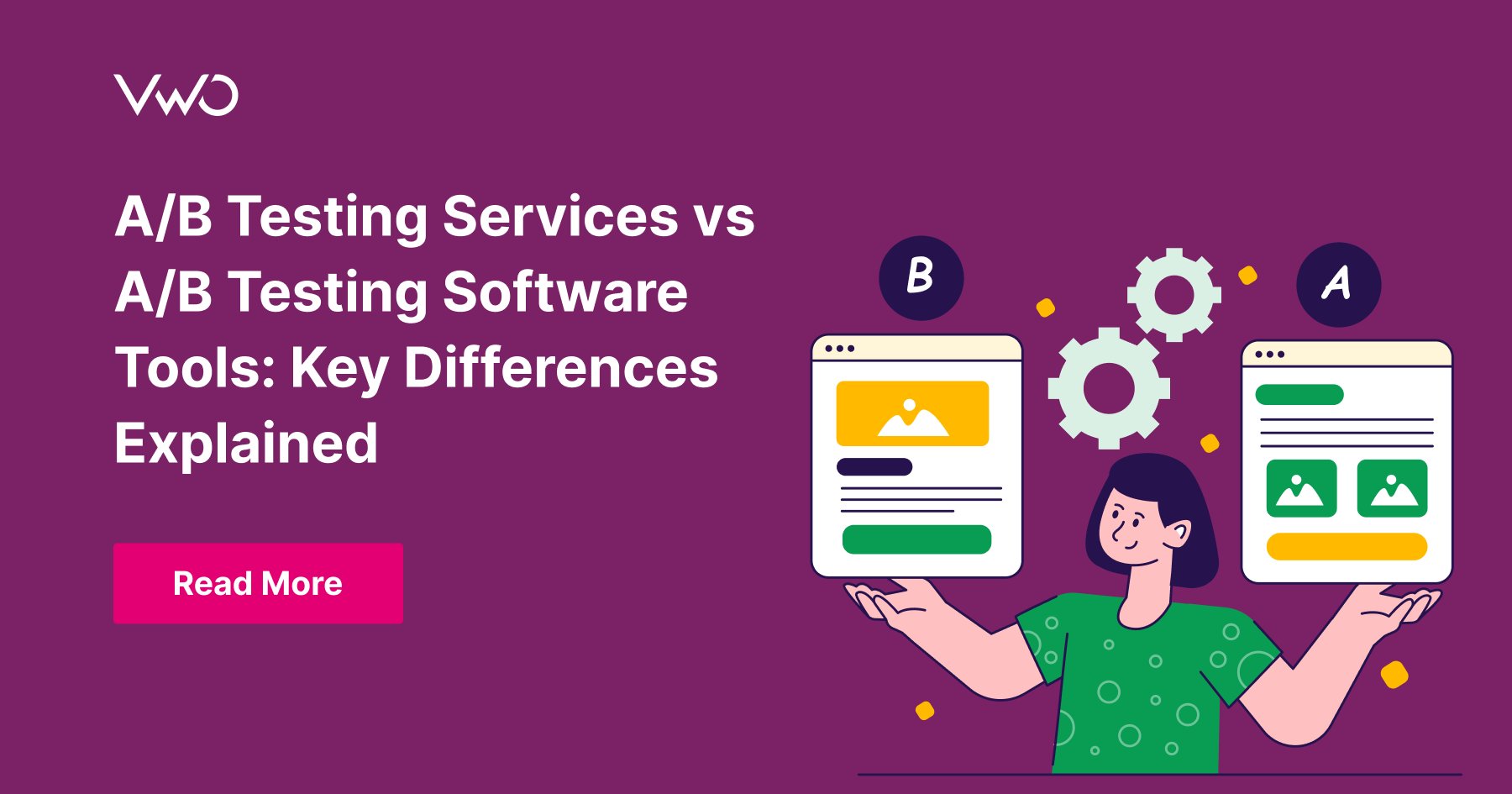
In the current digital economy, the ability to optimize user experience through data-driven experimentation has transitioned from a competitive advantage to a fundamental business requirement. Organizations seeking to enhance their conversion rates and product-market fit typically find themselves at a strategic crossroads: whether to invest in internal experimentation software or to engage the expertise of external A/B testing services. While software tools empower teams to manage experiments internally, prioritizing control and scalability, services offer an expert-led, turnkey solution that prioritizes speed and immediate results. The decision between these two models fundamentally shapes an organization’s long-term data strategy, operational velocity, and institutional knowledge.
The Evolution of Digital Experimentation
The history of A/B testing has evolved significantly since its early adoption by tech giants like Google and Amazon in the early 2000s. Initially, experimentation was a resource-heavy endeavor requiring deep statistical knowledge and significant engineering support. The subsequent emergence of SaaS-based experimentation platforms, such as VWO, democratized access to these methodologies. Today, the landscape is divided between those who view experimentation as a core internal competency and those who treat it as a specialized service to be procured.
For organizations managing high volumes of monthly tracked users (MTU) across web, mobile, and server environments, the question is no longer whether to run experiments, but who should own the "experimentation engine." Internal ownership allows for continuous testing across marketing, product, and engineering teams. Conversely, outsourcing to a Conversion Rate Optimization (CRO) agency provides a ready-made process for companies that lack the immediate headcount or technical infrastructure to sustain an in-house program.
Strategic Comparison: Internal Software vs. External Services
To determine the appropriate path, organizations must evaluate several strategic factors that impact the efficacy and return on investment (ROI) of their experimentation efforts.
1. Ownership and Institutional Knowledge
Software tools facilitate a fully internal experimentation culture. Over time, this builds a repository of insights regarding user behavior that remains within the company. When an organization uses an external service, the core expertise often resides with the agency. While the company receives the results of the tests, the nuanced understanding of why certain variations succeeded may be lost once the contract concludes.
2. Scalability and Platform Coverage
In-house software allows for broad scalability across various platforms, including web, mobile apps, and backend server environments. Scaling an internal program depends primarily on team capacity. In contrast, the scalability of a service model is often dictated by the agency’s bandwidth and the specific scope defined in a retainer agreement.
3. Experimentation Velocity
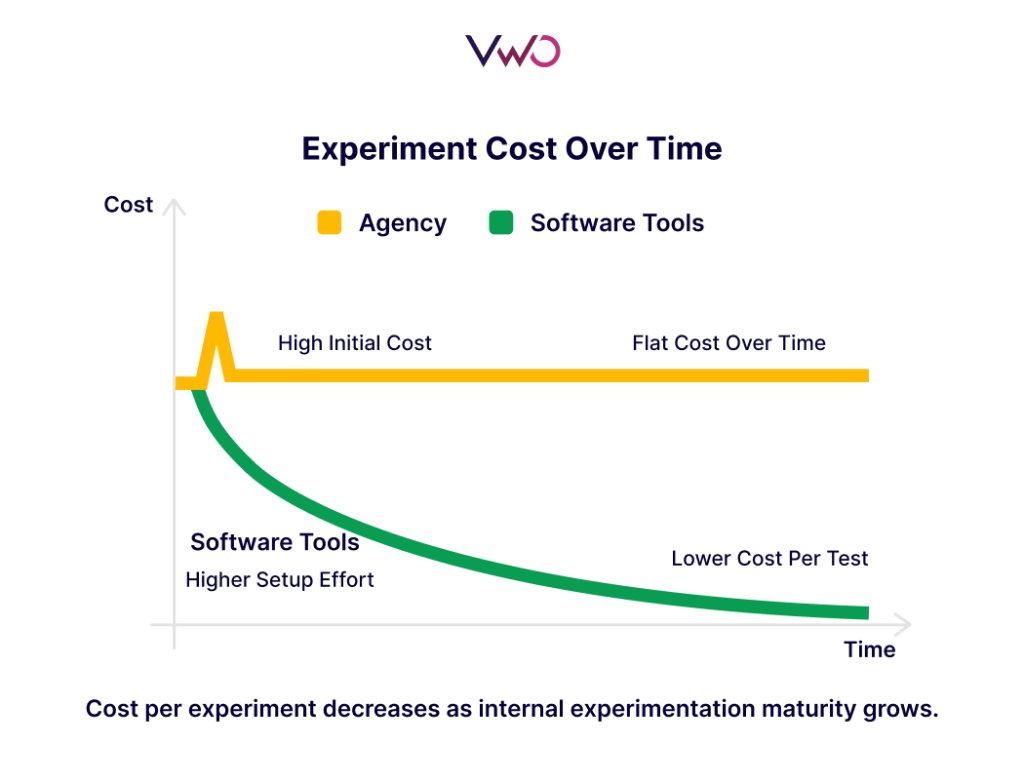
Agencies typically offer a faster "time to market" for the initial batch of experiments because they bring established frameworks and specialized roles, such as dedicated developers and designers. However, as internal teams mature in their use of software tools, their velocity often surpasses that of an agency. In-house teams can iterate in real-time without the lag of external communication cycles or sprint dependencies.
4. Data Governance and Security
For industries such as FinTech, Healthcare, and E-commerce, data sovereignty is a critical concern. Internal software tools provide full access to raw experimentation data and unified reporting. This ensures compliance with global regulations like GDPR and CCPA. While agencies use these same tools, the data access is sometimes mediated, and the organization must ensure the agency’s workflows align with internal security protocols.
The Technical Infrastructure of Modern Software Platforms
Modern experimentation platforms have evolved into sophisticated feature management systems. For a mature growth team, these tools do more than just split traffic; they serve as a safeguard for product releases.

Controlled Innovation and Feature Management
Advanced platforms provide more than simple visual editors. They include feature flags, remote configuration, and server-side testing capabilities. This allows engineering teams to manage "canary releases"—rolling out new features to a small percentage of users before a full launch. If a performance degradation is detected, a "kill switch" can be activated immediately, de-risking the innovation process.
Behavioral Contextualization
A significant advantage of integrated software is the ability to merge quantitative test results with qualitative behavioral analytics. By integrating heatmaps and session recordings directly with test variations, teams do not just see which version "won"; they observe the specific user friction points that influenced the outcome. This creates a holistic view of the customer journey.
The Role of Artificial Intelligence
The integration of Artificial Intelligence (AI) is the latest frontier in experimentation software. Tools like VWO Copilot utilize machine learning to automate hypothesis generation, summarize complex session recordings, and suggest real-time personalization strategies. This lowers the barrier to entry for smaller teams, allowing them to execute sophisticated tests that previously required a team of data scientists.
The Case for A/B Testing Agency Services
Despite the benefits of internal tools, many organizations find that hiring an agency is the most pragmatic route to success, particularly in the early stages of digital maturity.
Immediate Access to Specialized Talent
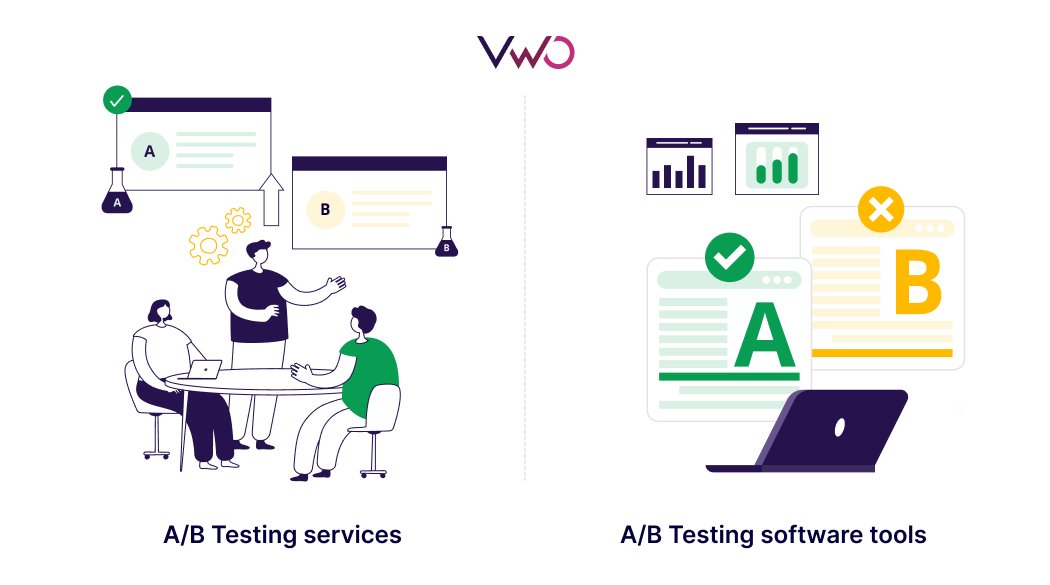
A professional CRO agency provides a "squad" of experts, including strategists, UI/UX designers, front-end developers, and statistical analysts. This eliminates the need for the organization to recruit and train these specialized roles, which can take months or years to perfect.
Organizational Enablement and ROI Proof
Agencies are often hired to demonstrate the value of experimentation to skeptical stakeholders. By delivering high-impact "wins" early in the engagement, they build the organizational "appetite" for data-driven decision-making. This often serves as a bridge to eventually building an in-house team.
Strategic Prioritization
For companies with seasonal traffic or limited data sets, every experiment counts. Agencies bring cross-industry experience that helps in prioritizing high-probability hypotheses, ensuring that limited traffic is not wasted on low-impact tests.
Decision Framework: Choosing the Right Model
Organizations should evaluate their position based on the following four pillars:
I. Traffic Volume and Consistency
High-traffic environments favor software tools because the volume allows for simultaneous testing and rapid statistical significance. Low-traffic or highly seasonal businesses may benefit more from an agency’s ability to design "big swing" experiments that extract value from smaller cohorts.
II. Technical Complexity
If the roadmap involves complex server-side changes, algorithm testing, or cross-device journeys, an agency can provide the necessary dev-ops support. However, if the goal is to empower marketing teams to make agile changes to landing pages, a visual-editor-based software tool is more efficient.

III. Budgetary Structure
Software typically operates on a subscription model, where the cost-per-test decreases as the team becomes more proficient. Agencies operate on retainers, which represent a higher upfront cost but include the labor of execution.
IV. Compliance and Industry Regulation
Highly regulated sectors often lean toward software tools to ensure that sensitive user data never leaves their controlled environment and that all experimentation logs are available for internal audits.
Industry Perspectives and Real-World Impact
Lucia van den Brink, Founder of The Initial, emphasizes the psychological impact of ownership in experimentation. According to van den Brink, when experimentation is owned internally rather than outsourced, it empowers designers and developers to verify their own ideas, leading to a more innovative culture where teams feel they have a direct influence on the product’s direction.
A practical example of this in action is the case of Vandebron, a Dutch green energy provider. The company utilized VWO to consolidate its tech stack, combining user behavior analytics with A/B testing. By identifying a specific friction point in the date-of-birth field of their registration form through session recordings, they were able to test a simplified input method. The result was a 16.3% increase in sign-up conversions. This success was driven by the team’s ability to act quickly on internal data without waiting for an external partner’s intervention.
The Hybrid Model: A Scalable Compromise
For many enterprise-level organizations, the most effective strategy is a hybrid approach. In this model, the organization invests in a robust experimentation platform to ensure long-term data ownership and infrastructure stability. Simultaneously, they retain an agency to provide high-level strategy and execution support. This allows the internal team to learn best practices from the agency while maintaining control over the tools and data. As the internal team’s maturity grows, the agency’s role shifts from execution to high-level consulting, eventually allowing for a full transition to in-house management.
Conclusion and Future Outlook
The choice between A/B testing services and software tools is not merely a budgetary decision; it is a choice about the future of an organization’s digital agility. Software tools provide the infrastructure for a compounding "interest" on institutional knowledge and technical capability. Services provide the "fuel" to jumpstart a program and achieve immediate performance benchmarks.
As AI continues to simplify the technical hurdles of experimentation, the trend is increasingly moving toward internal ownership. However, the human element—strategy, empathy, and creative hypothesis generation—remains the most critical component of any optimization program. Whether managed by an internal team or an external partner, the most successful organizations will be those that treat experimentation not as a series of isolated tests, but as a continuous, fundamental process of learning and adaptation.

 Dwi Wanna
 Reynand Wu