
 rifanmuazin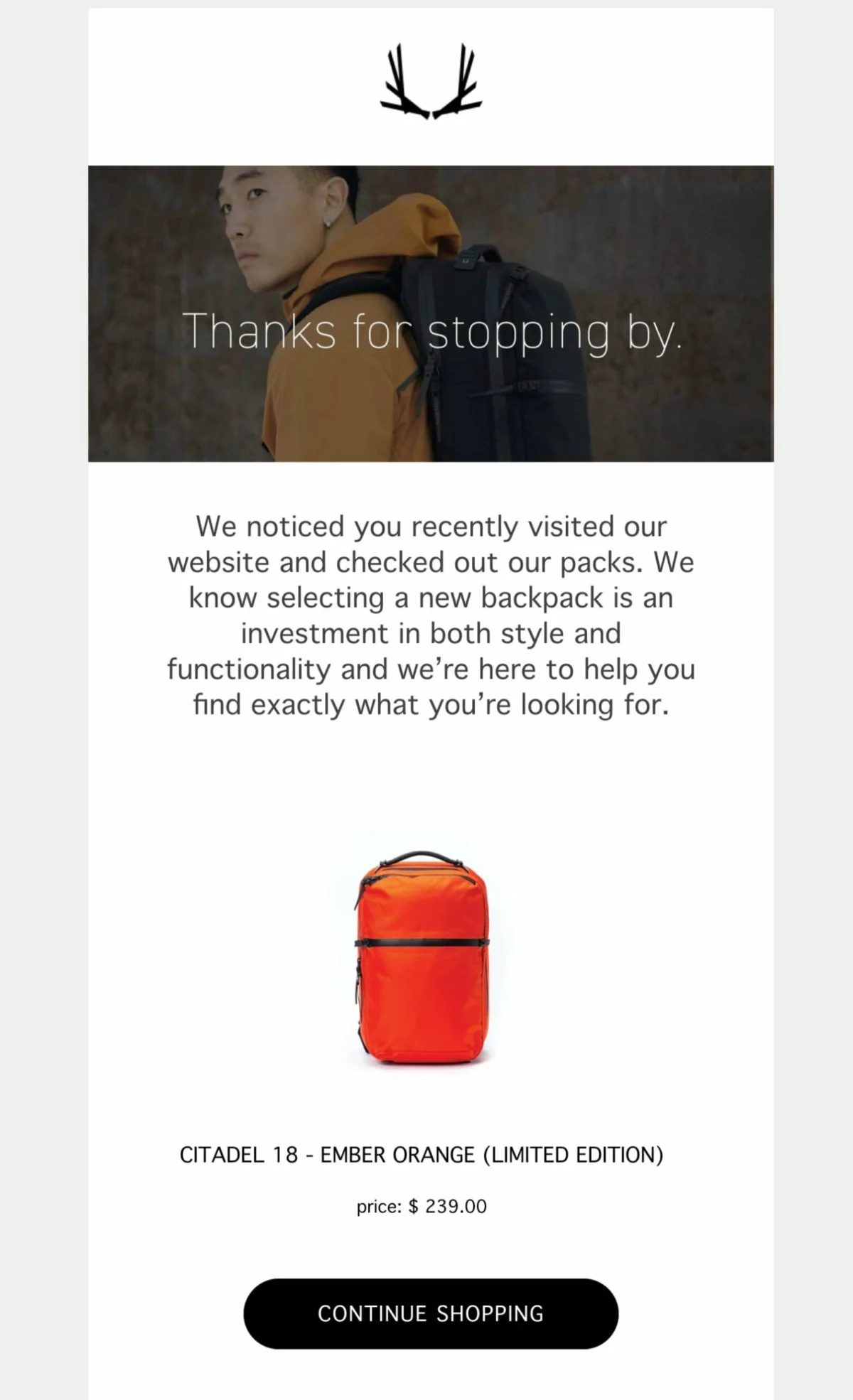
In the competitive landscape of modern e-commerce, every visitor to an online store represents a potential revenue opportunity. However, a significant percentage of these visitors depart without making a purchase, often without even adding items to their shopping carts. This phenomenon, known as browse abandonment, poses a critical challenge for retailers. The strategic deployment of browse abandonment emails has emerged as a powerful tool to re-engage these early-stage shoppers, transforming fleeting interest into concrete sales.
An Omnisend report from 2026 highlights the burgeoning effectiveness of these targeted communications, indicating a robust 42.16% open rate and an impressive 10.68% click-to-conversion rate for browse abandonment emails. These figures underscore the growing recognition among e-commerce businesses of the value in nurturing customer interest long before it matures into a purchase intent. Unlike traditional cart abandonment emails, which target customers at the very end of the sales funnel, browse abandonment emails intervene much earlier, offering a crucial chance to re-capture attention and guide shoppers further along their purchasing journey.
Understanding the E-commerce Customer Journey: Differentiating Abandonment Types
The online shopping experience is multifaceted, with customers exhibiting varying levels of intent at different stages. To effectively re-engage, it is essential to distinguish between the various forms of abandonment:
- Browse Abandonment: This occurs when a known subscriber visits an online store, views specific products or categories, and then leaves the site without adding any items to their cart. This indicates an exploratory phase with relatively low buying intent. The customer might be window shopping, researching, or simply browsing for inspiration.
- Product Abandonment: This is a more specific form of browse abandonment, triggered when a shopper exits after spending time on a particular product page but doesn’t add it to their cart. This indicates a medium level of intent, as the customer has shown specific interest in an item.
- Cart Abandonment: This represents the highest level of purchase intent. It happens when a customer adds items to their shopping cart but leaves the site before completing the checkout process. These customers are typically very close to conversion, making cart abandonment emails some of the most lucrative re-engagement messages.
While cart abandonment emails often boast higher conversion rates due to the advanced stage of customer intent, browse abandonment emails are vital for their ability to cast a wider net and engage a larger audience earlier in the funnel. The Omnisend 2026 report provides a comparative overview of various email automation types, illustrating the distinct roles each plays:

| Email type | Open rate | Click-to-sent | Conversion rate | Click-to-conversion |
|---|---|---|---|---|
| Product abandonment | 41.48% | 5.45% | 0.74% | 13.65% |
| Welcome | 33.79% | 3.78% | 2.00% | 52.98% |
| Abandoned cart | 35.75% | 3.84% | 1.51% | 39.46% |
| Browse abandonment | 42.16% | 5.49% | 0.59% | 10.68% |
| Cross-sell | 42.09% | 2.93% | 0.75% | 25.50% |
| Lapsed purchase | 33.00% | 1.96% | 0.52% | 26.74% |
These figures reveal that while browse abandonment emails have a lower direct conversion rate (0.59%) compared to abandoned cart (1.51%) or welcome (2.00%) emails, their significantly higher open rate (42.16%) and click-to-sent rate (5.49%) indicate strong initial engagement. This early engagement is crucial for reducing reliance on costly paid retargeting ads and fostering a deeper connection with potential customers before they forget the brand. The overall click-to-conversion rate of 10.68% for browse abandonment suggests that a substantial portion of those who click through ultimately convert, highlighting the effectiveness of these emails in guiding undecided shoppers.
Strategic Implementation: Crafting Effective Browse Abandonment Emails
The success of a browse abandonment email hinges on its ability to feel relevant, helpful, and inspiring, rather than intrusive. E-commerce strategists emphasize several best practices to maximize their impact:
- Timeliness is Key: The first browse abandonment email should ideally be sent within one to four hours of the visitor leaving the site. This short window capitalizes on the recency of their browsing session, ensuring the products are still fresh in their mind. Delaying too long risks the customer forgetting their interest or finding an alternative.
- Personalization and Segmentation: Leveraging customer data for personalization is paramount. This includes dynamically inserting the specific products or categories the customer viewed, addressing them by name, and even tailoring recommendations based on their browsing history. Segmentation allows for further refinement, enabling retailers to send different messages based on the type of product viewed (e.g., high-value items vs. clearance).
- Clear Call to Action (CTA): Every email must feature a prominent and unambiguous CTA button that directs the customer back to the product page or a curated collection. Phrases like "Shop Now," "Take Another Look," or "Continue Browsing" are effective.
- Value Proposition and Incentives: For customers who need an extra nudge, a small incentive can be highly effective. This could include a limited-time discount, free shipping, or a reminder of the product’s unique benefits. However, it’s advisable to reserve stronger incentives for later emails in a sequence, or for higher-intent abandonment types like cart abandonment.
- Social Proof and Urgency: Integrating elements of social proof, such as customer reviews, ratings, or testimonials, can build trust and encourage conversion. Creating a gentle sense of urgency, by mentioning low stock levels or trending popularity, can prompt immediate action without appearing overly aggressive.
- Optimized for Mobile: Given the prevalence of mobile shopping, all browse abandonment emails must be responsively designed to display correctly and function seamlessly on smartphones and tablets.
The Multi-Stage Flow: A Sequence for Sustained Engagement
Industry best practices suggest that an ideal browse abandonment email flow typically comprises one to three emails, strategically spaced over one to five days to engage subscribers without overwhelming them.
- Email 1 (1-4 hours after abandonment): A simple, friendly reminder of the viewed products. The tone is light and helpful, offering an easy path back to the site.
- Email 2 (24-48 hours later): If the first email doesn’t convert, this follow-up can introduce additional value. This might include social proof (e.g., "See why others love this product!"), alternative product recommendations, or addressing common questions related to the product category.
- Email 3 (3-5 days later): This final email in the sequence can introduce a subtle sense of urgency or a small incentive, such as a limited-time discount or free shipping offer, to encourage a decision. This email should also provide customer service contact information for any lingering questions.
Anatomy of Success: Analyzing Real-World Examples
Leading brands have mastered the art of browse abandonment emails, demonstrating how creativity and strategic messaging can transform casual browsing into completed purchases.
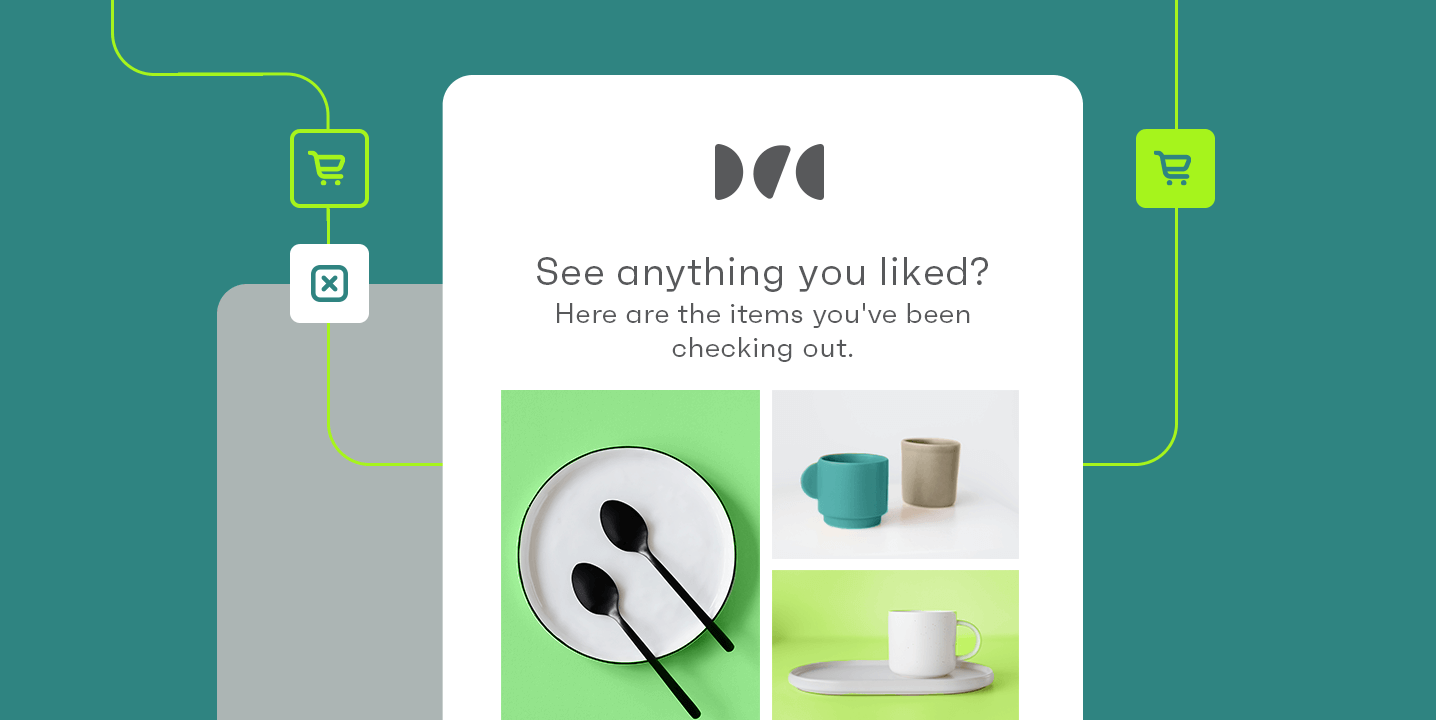
- Timex: Exemplifies simplicity and elegance. Its "See something you like?" headline, paired with clean layouts and high-quality product images, offers an inviting nudge rather than a hard sell. Clear "Shop Now" CTAs and category links efficiently guide the customer.
- Alyaka: Successfully creates urgency with "going fast" messaging, leveraging FOMO (Fear Of Missing Out). Its minimalistic design keeps the focus squarely on the product, enhancing the persuasive impact.
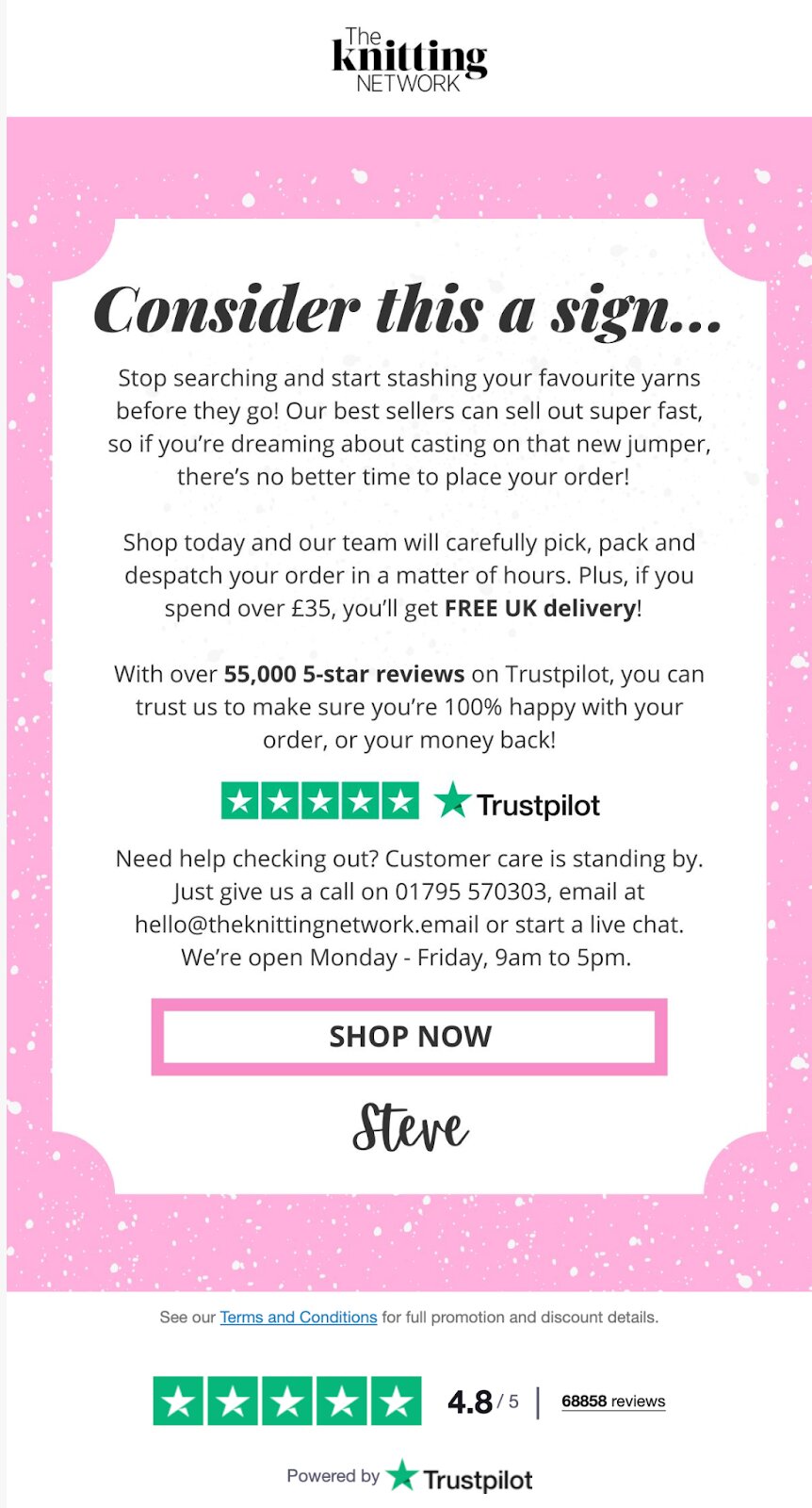
- The Knitting Network: Adopts a warm, personal tone with headlines like "Consider this a sign…" and integrates practical incentives like free shipping. Highlighting Trustpilot reviews adds a crucial layer of social proof, building customer confidence.
- Koio: Uses aspirational copy ("Endlessly Versatile Picks") and lifestyle photography to make products feel desirable. A highly visible "SHOP WITH FREE SHIPPING" CTA button transforms a potential hesitation into an irresistible offer.
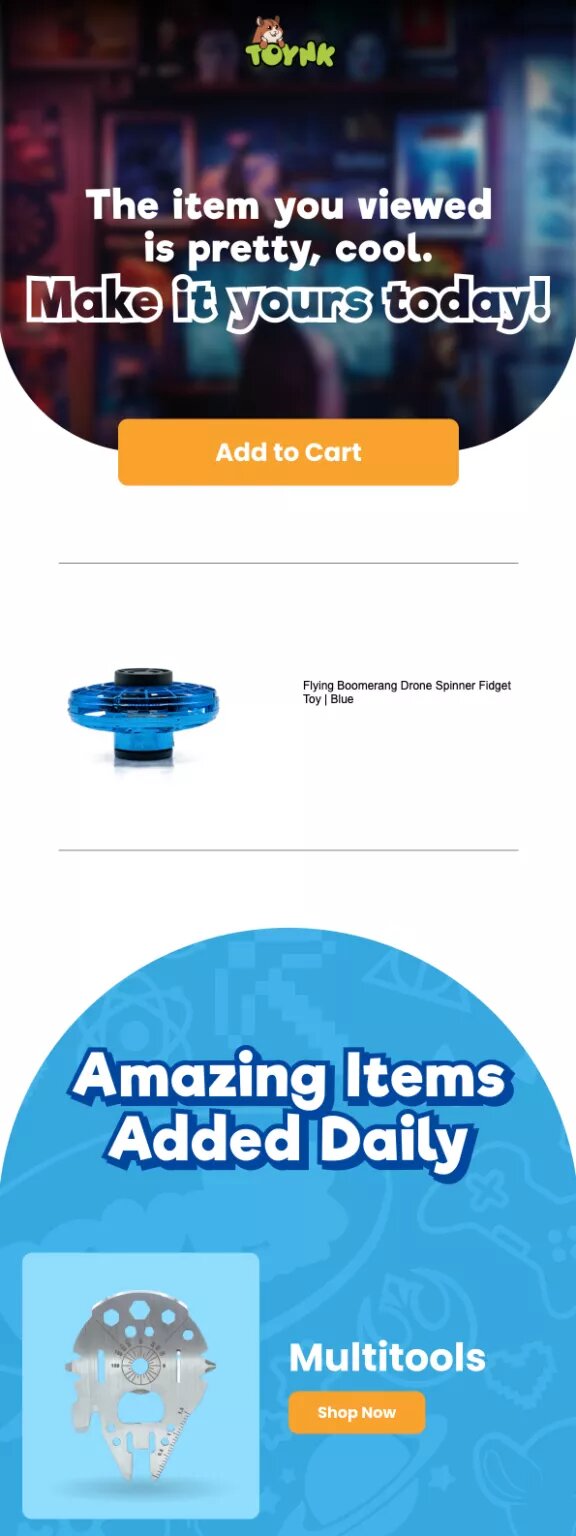
- Toynk: Embraces a bright, colorful, and playful brand identity. Its subject line, "The item you viewed is pretty cool," sparks curiosity, while "Make it yours today" provides a direct and compelling call to action, fitting its target audience.
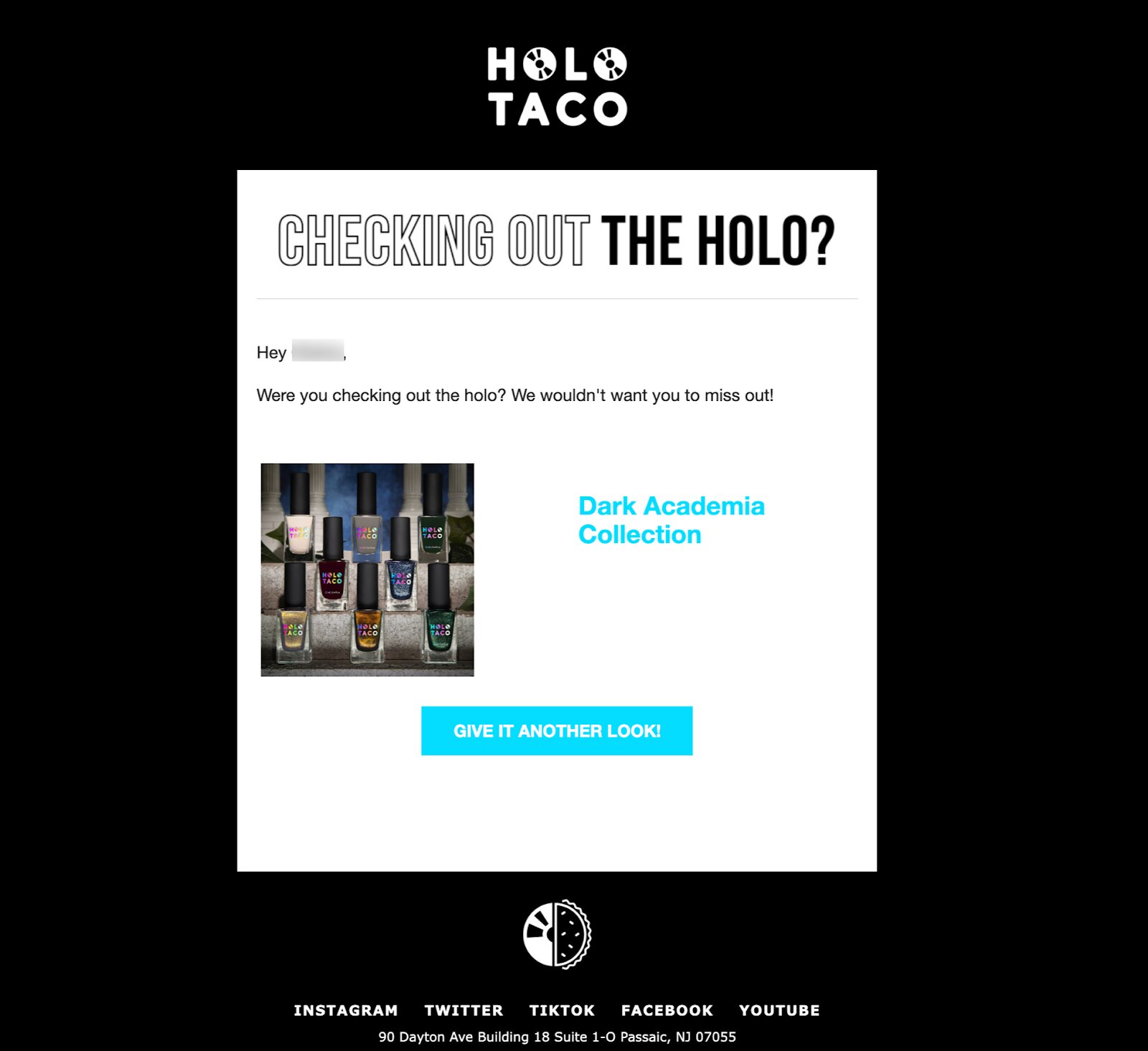
- Holo Taco: Demonstrates effective personalization by using the customer’s name and a playful, on-brand headline ("Checking out the holo?"). Directly showcasing the viewed collection with a vibrant "Give it another look!" CTA maximizes conversion potential.
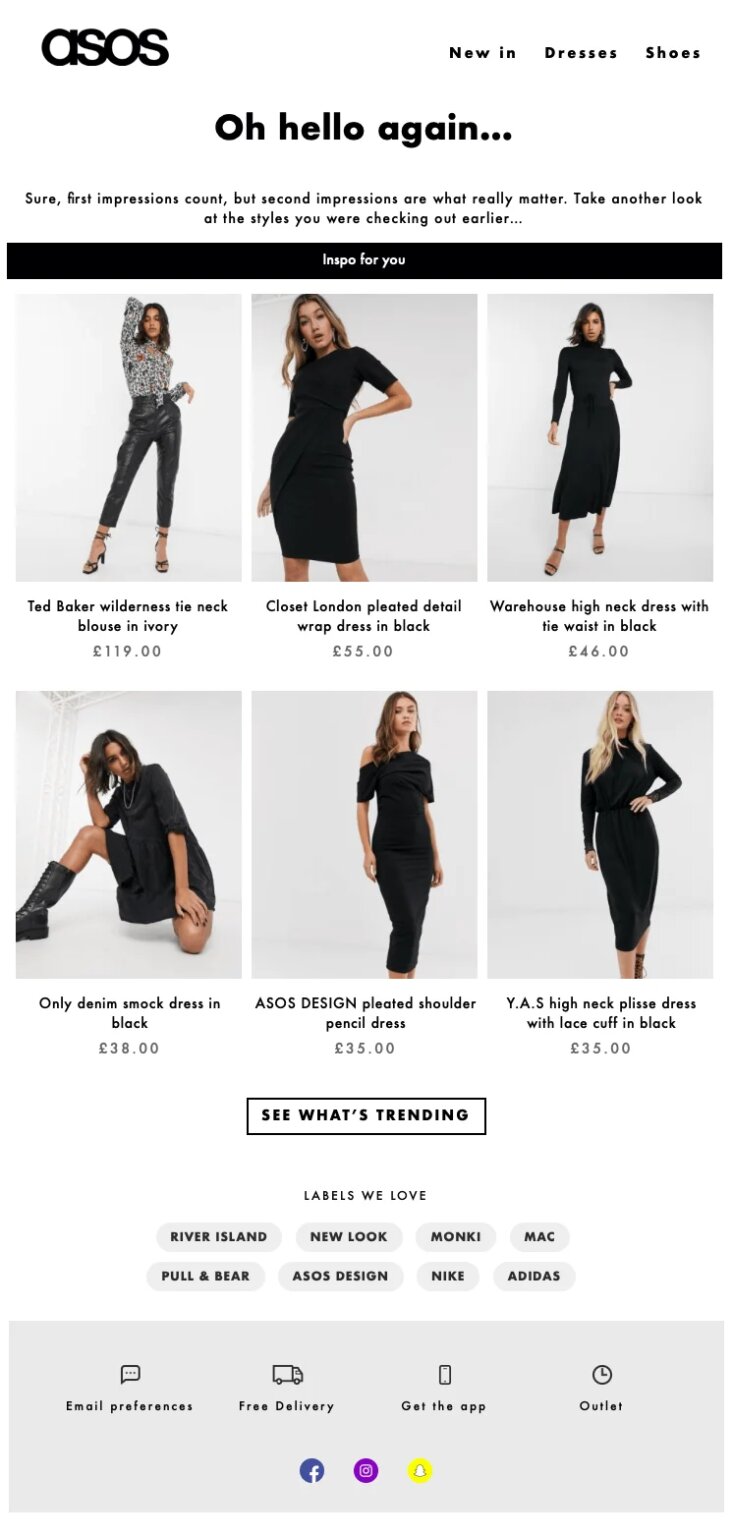
- ASOS: Stands out with its relaxed and friendly "Oh hello again…" approach, complemented by attractive visuals. Offering a list of popular brands beneath the viewed items broadens the re-engagement opportunity, catering to diverse interests.
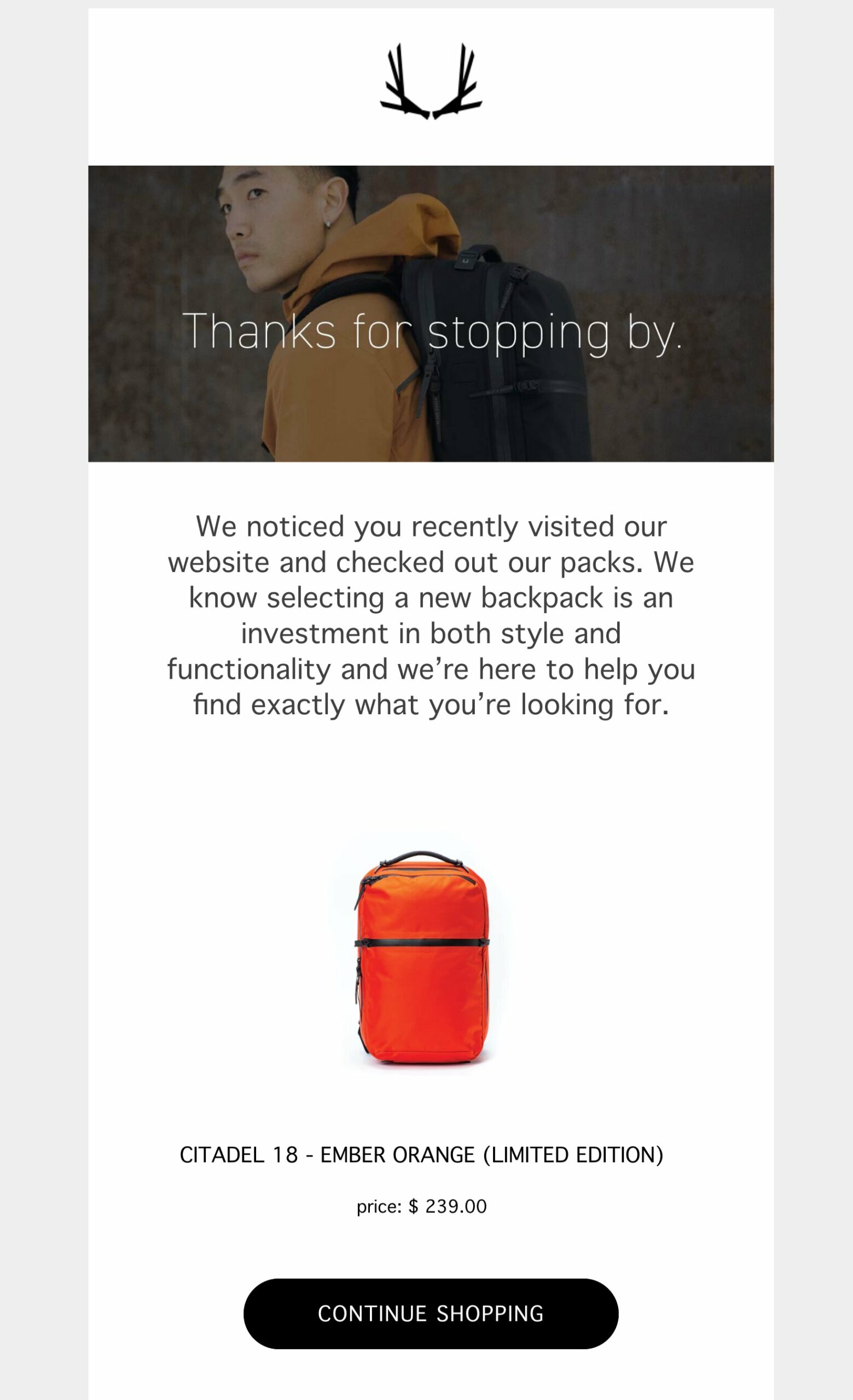
- Black Ember: Prioritizes helpfulness over direct sales. Its "Thanks for stopping by" opener and copy emphasizing the investment value of a good backpack provide genuine support, adding value beyond a simple product reminder.
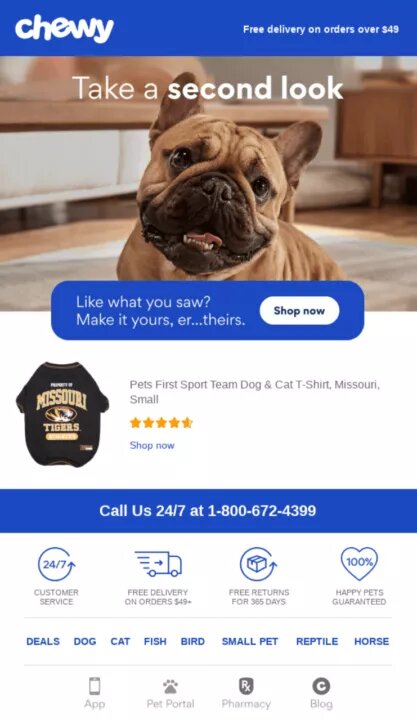
- Chewy: Expertly taps into customer emotions with a cute pet hero image and humorous copy ("Make it yours, er…theirs"). Comprehensive support options, guarantees, and diverse category links (DOG, CAT, FISH, BIRD) create a reassuring and engaging experience.
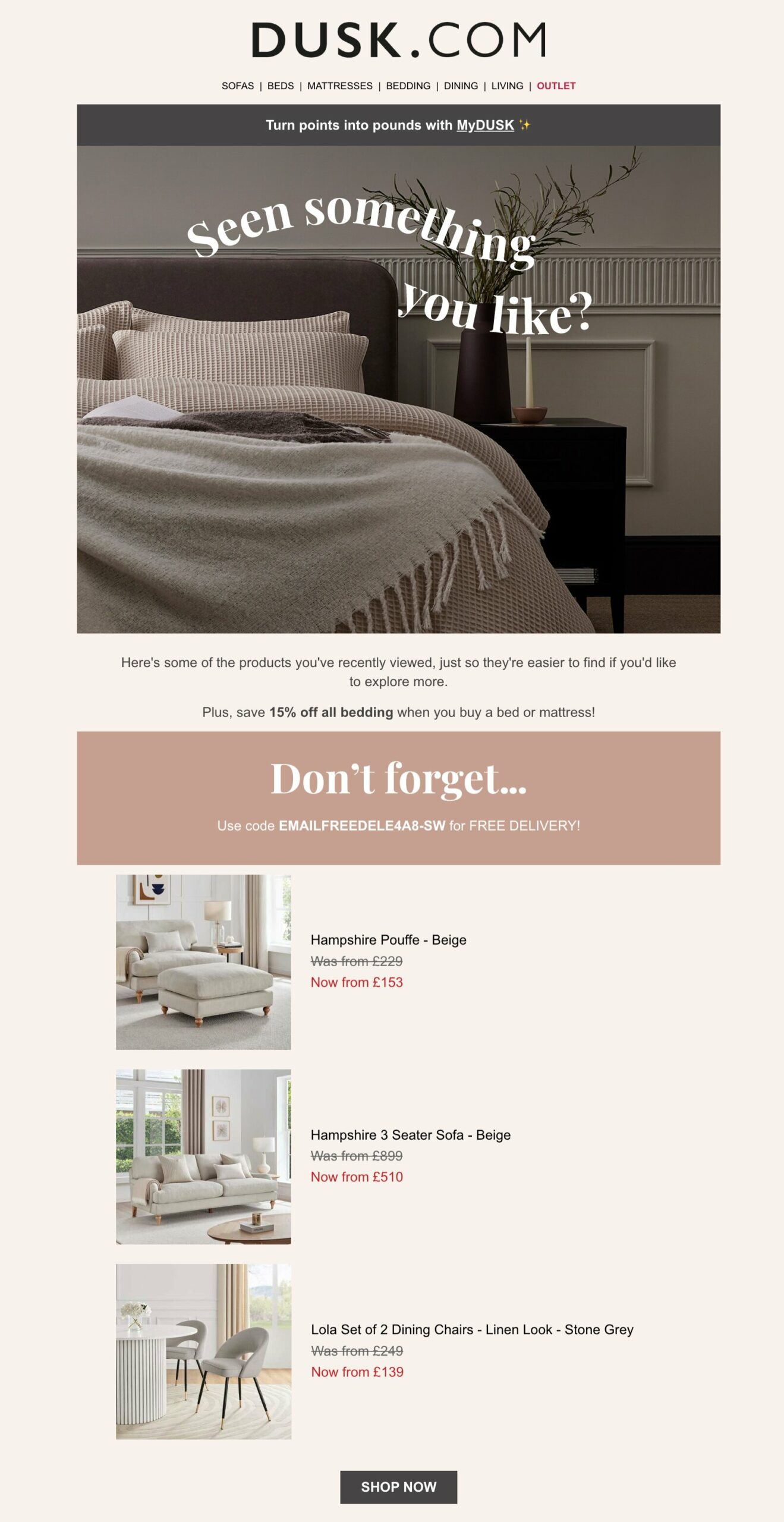
- Dusk: Combines a friendly inquiry ("Seen something you like?") with explicit value reinforcement, including price savings, a 15% discount, and a free delivery code. This multi-layered incentive strategy effectively reduces purchase friction.
- Rael: Infuses personality with a cheeky headline, "We Saw You Checking Us Out 😉," and prominently displays a free shipping offer. Showcasing the viewed product alongside related recommendations provides multiple pathways to re-engagement.
These examples underscore that while the core objective is consistent, the approach can vary significantly based on brand identity, product type, and target audience.
Crafting Effective Subject Lines: The Gateway to Engagement
The subject line is the gatekeeper of the email, determining whether the message is opened or ignored. Effective browse abandonment subject lines are typically short, clear, personalized, and compelling, designed to spark curiosity or highlight value.
Categories of effective subject lines include:
- Curiosity and Soft Nudge: "Still thinking it over?", "Something caught your eye…", "Worth a second glance?" These gently remind without being pushy.
- Flattery and Personalization: "You’ve got great style, [Customer Name]," "This [Product name] feels very ‘you’," "This one’s got your name on it 🏷️." These make the recipient feel valued and understood.
- FOMO / Urgency: "Don’t let [Product name] slip past you!", "Almost gone… still interested?", "Stock is low on the items you browsed." These motivate immediate action.
- Social Proof: "This [Product name] is trending now 🔥", "People love what you saw ❤️", "See why others love it!" These build trust and confidence by highlighting popularity.
Best practices for subject lines include keeping them concise (5-7 words, under 40 characters for mobile readability), using personalization tokens (like customer names or product details), and employing questions or emojis to increase engagement and curiosity. Utilizing tools like Omnisend’s subject line tester can help optimize these crucial elements before deployment.
Technological Foundations: Implementing Automation Workflows
Setting up a browse abandonment email flow does not require extensive technical expertise, thanks to modern email marketing platforms like Omnisend. These platforms track visitor behavior using cookies and user data, automatically triggering messages based on predefined rules.
The process typically involves:
- Defining the Trigger: Configure the automation to activate when a tracked visitor views a product or category page and subsequently leaves the site without adding anything to their cart. Advanced triggers can even filter based on specific URLs (e.g., "URL contains ‘sale’").
- Building the Workflow: Utilize pre-built browse abandonment automation workflows or create custom flows tailored to specific brand needs. This involves adding email messages, setting delays between emails (e.g., 1 hour for the first, 24 hours for the second), and integrating SMS or push notifications for a multi-channel approach.
- Setting Exit Conditions: Crucially, implement exit conditions to prevent over-messaging. If a customer places an order, adds a product to their cart, or starts checkout, they should automatically exit the browse abandonment flow to avoid receiving irrelevant follow-ups. This ensures a seamless and non-intrusive customer experience.
Omnisend’s intuitive interface, with its visual workflow builder, significantly simplifies this process, allowing marketers to quickly launch and customize campaigns without a steep learning curve.
The Synergistic Approach: Combining Abandonment Flows
While browse abandonment emails are powerful on their own, their effectiveness is amplified when integrated into a comprehensive automation strategy that includes product abandonment and cart abandonment flows. This synergistic approach ensures that customers are re-engaged at every critical juncture of their buying journey, maximizing the chances of conversion. By addressing different levels of intent with tailored messages, businesses can create a more resilient and profitable e-commerce ecosystem.
Case Studies and Real-World Impact
The tangible benefits of well-executed browse abandonment strategies are evident in numerous success stories:
- Dukier: This pet accessory brand achieved a remarkable 525% revenue growth from email marketing, with browse abandonment automation playing a significant role. By localizing cart recovery messages across five languages, Dukier attained a 48.4% open rate and a 2.8% conversion rate, demonstrating the power of tailored communication.
- Bowy Made: The luxury baby brand generates an impressive 70% of its revenue from email automations. Its pre-purchase flows, including browse abandonment, product abandonment, and cart recovery, collectively contribute five figures monthly, underscoring the substantial financial impact of a holistic abandonment strategy.
These examples highlight that browse abandonment is not merely a theoretical concept but a proven driver of measurable revenue growth and enhanced customer engagement.
Future Outlook and Continuous Optimization
As the e-commerce landscape continues to evolve, the importance of sophisticated email marketing automations, particularly browse abandonment flows, will only grow. The increasing adoption of Artificial Intelligence (AI) in marketing promises even greater levels of personalization, allowing brands to predict customer intent with higher accuracy and deliver hyper-relevant content at optimal moments.
Continuous A/B testing, data analysis, and iterative refinement of email content, timing, and incentives are essential for sustained success. By staying attuned to customer behavior and leveraging advanced marketing technologies, businesses can transform fleeting browsing sessions into enduring customer relationships and consistent revenue streams. The proactive engagement offered by browse abandonment emails is not just a best practice; it is a fundamental pillar of modern e-commerce success, ensuring that no potential sale is left unpursued.









