Asep Darmawan
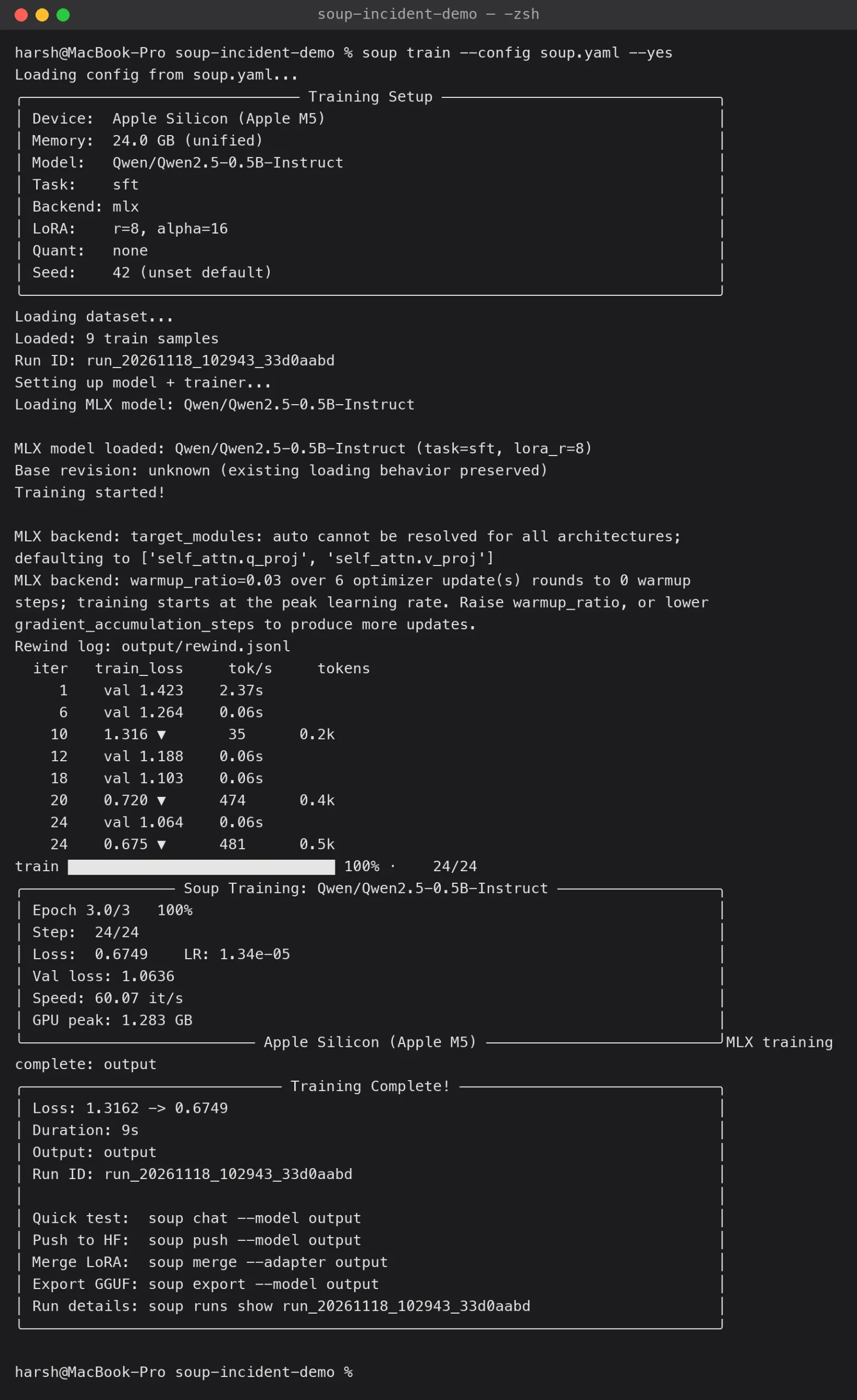
The rapid evolution of Small Language Models (SLMs) has transitioned from a theoretical curiosity to a practical necessity for engineering teams seeking to automate internal workflows without incurring the high latency or privacy risks associated with cloud-based APIs. In a recent technical demonstration, developers have successfully utilized Soup, an emerging open-source command-line interface (CLI) tool, to fine-tune a lightweight model for the highly specific task of generating standardized incident status updates. By leveraging Low-Rank Adaptation (LoRA) on Apple Silicon hardware, specifically an M5-based MacBook with 24 GB of unified memory, the experiment demonstrated that even a 500-million parameter model can be trained in under ten seconds to adhere to rigid corporate communication protocols.
The Strategic Shift Toward Localized Intelligence
As organizations scale, the consistency of internal communication becomes a critical factor in operational efficiency, particularly during high-pressure scenarios such as system outages. A common friction point in DevOps and Site Reliability Engineering (SRE) involves the variability of status updates shared in team channels. While one engineer might provide a detailed log analysis, another might offer a vague timeline. To solve this, many teams are turning to fine-tuned AI to act as a "formatting layer."
The move toward local fine-tuning is driven by three primary factors: data sovereignty, cost predictability, and the specialized nature of corporate dialects. Using public models like GPT-4 for every minor internal formatting task is often seen as overkill, both in terms of cost and computational resources. Furthermore, sending sensitive internal incident logs to third-party providers raises compliance concerns. The emergence of tools like Soup represents a democratization of machine learning, allowing individual developers to customize models on consumer-grade hardware.
Technical Foundation: Low-Rank Adaptation and the Qwen Architecture
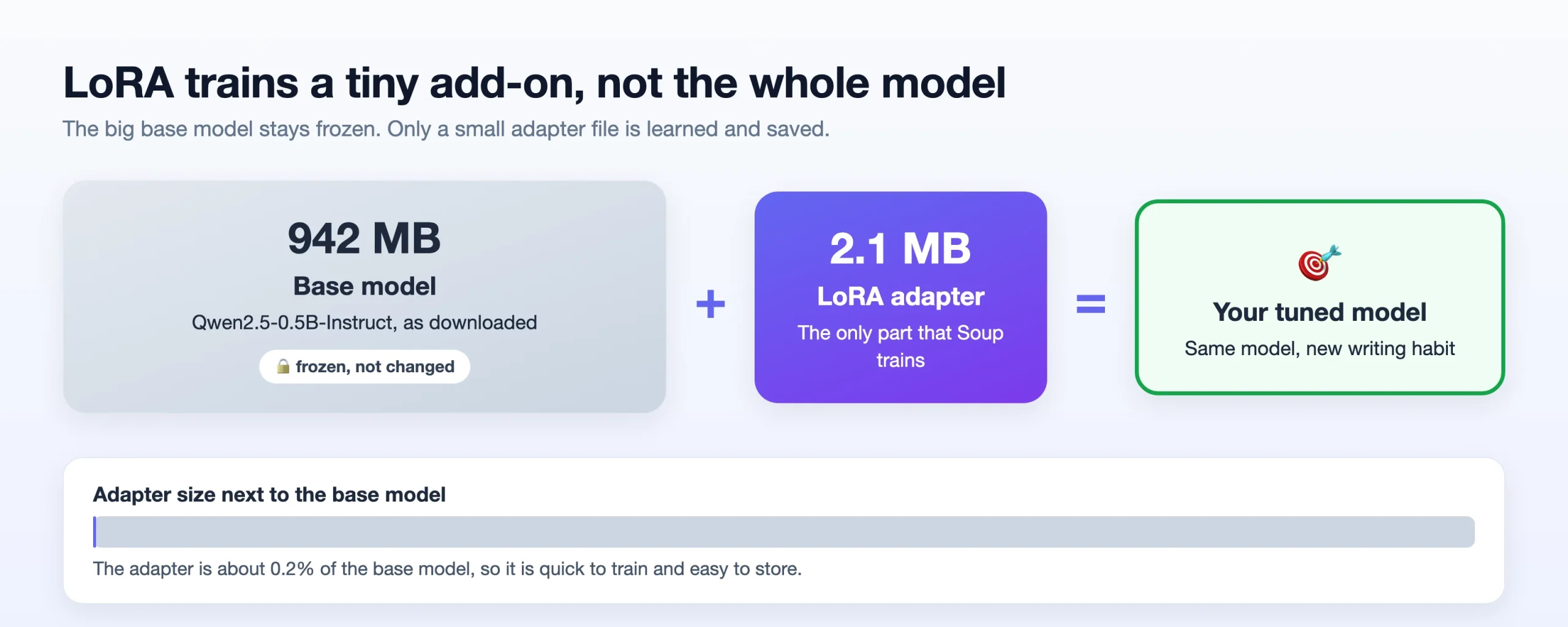
The core of this technical workflow relies on the Qwen2.5-0.5B-Instruct model, a highly efficient base model released under the Apache-2.0 license. Despite its small size, the Qwen architecture has demonstrated significant "reasoning" capabilities relative to its parameter count. To customize this model without retraining all 500 million parameters—a process that would be computationally prohibitive on a laptop—the Soup framework utilizes Low-Rank Adaptation (LoRA).
Developed by researchers in 2021, LoRA operates on the principle that the change in weights during model adaptation has a "low intrinsic rank." In practical terms, this means that instead of modifying the massive weight matrices of the base model, developers can train a tiny "adapter" file. In the documented experiment, this adapter was a mere 2.1 MB. During inference, this adapter is layered over the frozen base model, steering its output toward the desired format—in this case, a three-line structure consisting of "STATUS," "IMPACT," and "NEXT."
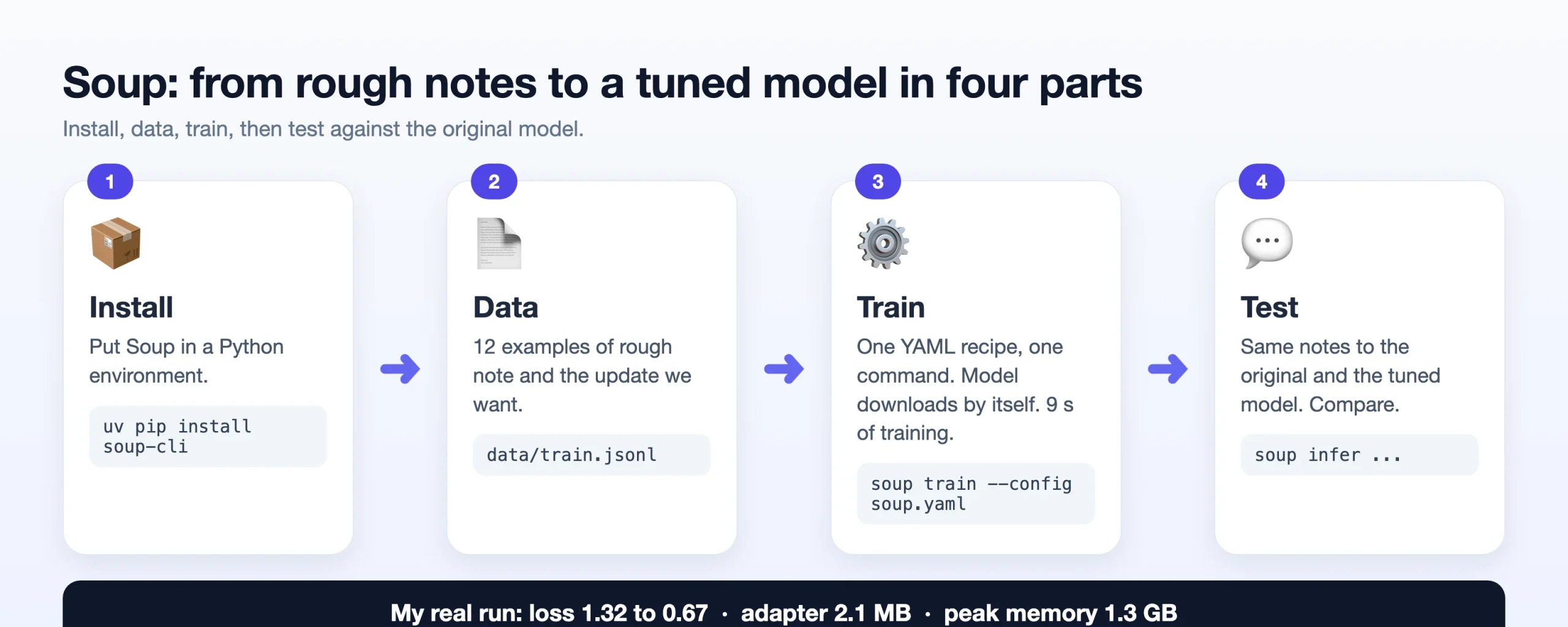
Chronology of the Fine-Tuning Workflow
The implementation of a standardized incident update writer follows a rigorous four-part chronology, moving from environment preparation to comparative analysis.
Phase 1: Environment Configuration and Tooling
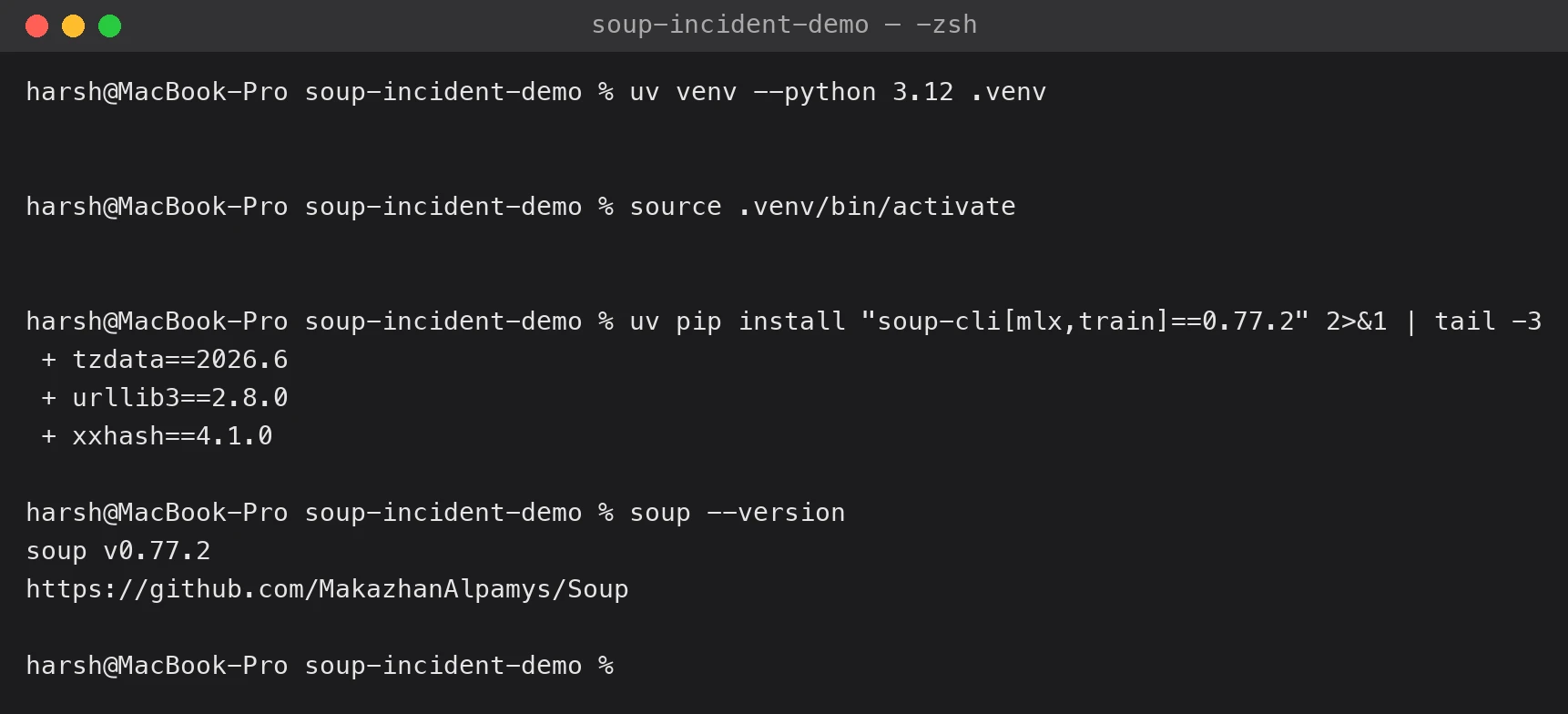
The process begins with the establishment of a controlled Python environment (versions 3.11 through 3.13). The Soup CLI is installed via the uv or pip package managers. For Apple Silicon users, the installation requires specific MLX dependencies, a framework designed by Apple’s machine learning research team to provide high-performance arrays on macOS. The initial setup ensures that all subsequent operations remain entirely on-device, requiring no external API keys or subscription services.
Phase 2: Synthetic Data Engineering
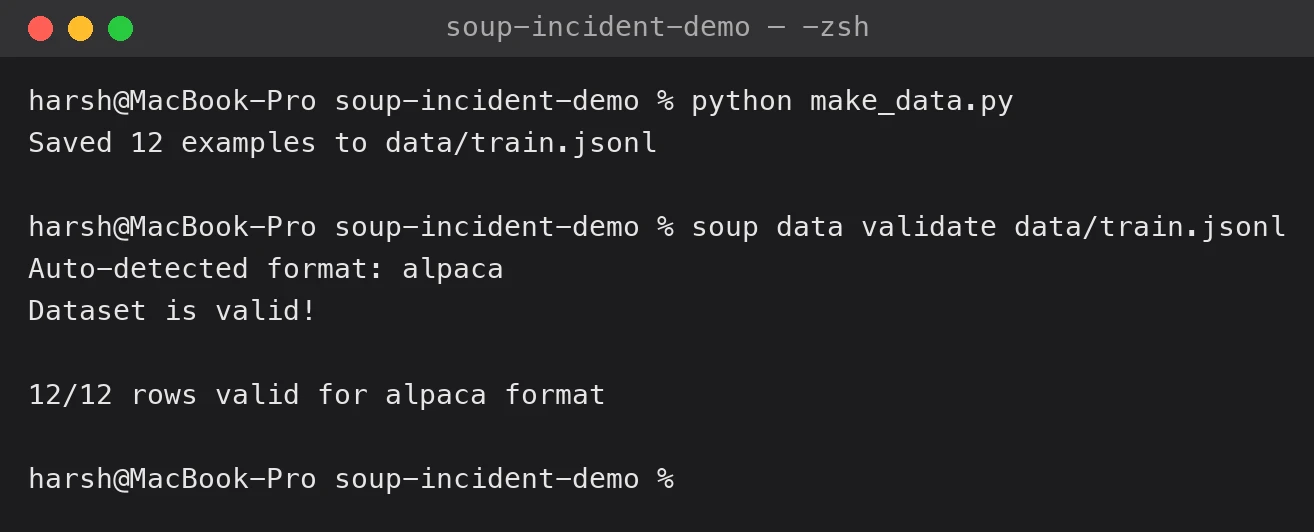
Fine-tuning is only as effective as the data provided. For this experiment, a synthetic dataset was constructed using the Alpaca format—a common standard for instruction-tuning. The dataset consisted of twelve high-quality examples pairing "rough notes" (e.g., "Checkout errors up; investigating; checking gateway logs") with "gold standard" outputs. The outputs were strictly formatted to three lines, explicitly forbidding the invention of Estimated Times of Arrival (ETAs) or unverified causes. This "small data" approach highlights a shift in AI training: quality and specificity often outweigh sheer volume when the goal is stylistic adherence rather than general knowledge.
Phase 3: The Recipe-Driven Training Process
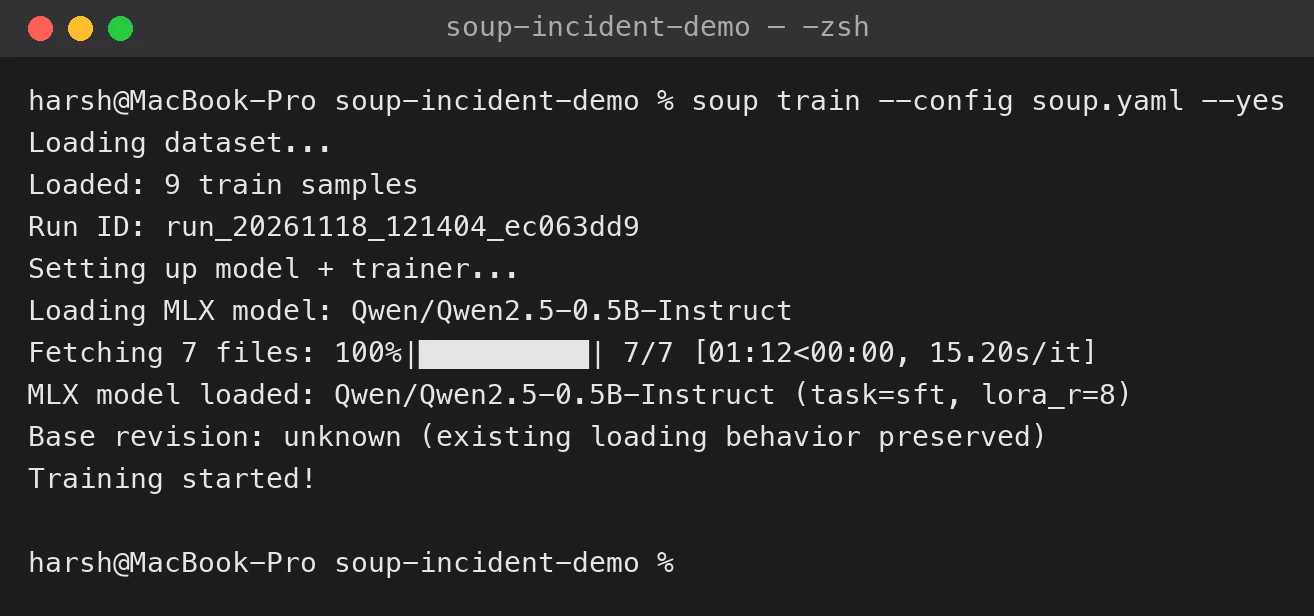
The Soup framework simplifies the training process through a single YAML "recipe" file. This configuration defines the base model, the training backend (MLX for Mac), and the hyperparameters. Key parameters included three training epochs and a learning rate of 0.0002.
The training phase itself is remarkably swift. On the M5 MacBook, the model processed the twelve examples in approximately nine seconds. The "loss" metric—a mathematical representation of the model’s error—dropped from 1.3162 to 0.6749, indicating that the model was successfully identifying the patterns in the training data.
Phase 4: Comparative Inference and Validation
The final stage involves a side-by-side comparison between the original Qwen model and the newly "tuned" version. Using a set of test prompts the model had never seen before, the experimenters measured formatting accuracy and factual integrity.
Data-Driven Results: Base Model vs. Tuned Model
The results of the test provided quantifiable evidence of the fine-tuning’s effectiveness. When presented with a note regarding a billing dashboard slowdown, the base model produced a verbose, Markdown-formatted response that included unrequested headers and speculative details. Conversely, the tuned model adhered to the three-line format in 75% of the initial test cases.
| Metric | Original Model | Tuned Model (3 Epochs) | Tuned Model (10 Epochs) |
|---|---|---|---|
| Exact 3-line Format | 0/4 | 3/4 | 4/4 |
| Valid Status Usage | 0/4 | 1/4 | 3/4 |
| Hallucination Rate | 75% | 0% | 0% |
The data suggests that while the base model is "smarter" in a general sense, it is too "helpful," often inventing details like "Success" or "Low Impact" to satisfy the prompt. The tuned model, however, learned the "habit" of brevity and factual restraint.
Industry Implications and Expert Analysis
The success of this experiment underscores a broader trend in the tech industry: the "unbundling" of large models. Rather than using one massive model for everything, companies are increasingly deploying "forests" of small, specialized models.
Industry analysts suggest that the ease of use provided by tools like Soup, Axolotl, and LLaMA-Factory will lead to a surge in internal-only AI tools. "The real work is no longer in the code of the training algorithm," one observer noted. "The real work is in the curation of the training examples. We are moving from the era of the ‘Model Architect’ to the era of the ‘Data Curator’."
The use of Apple Silicon in this context is also significant. By utilizing the unified memory architecture of the M-series chips, developers can bypass the need for expensive NVIDIA data-center GPUs for small-scale tasks. This allows for a decentralized development cycle where an engineer can prototype, train, and test a specialized tool during a morning coffee break.
Limitations and Future Considerations
Despite the impressive speed of the Soup framework, the experiment also highlighted the limitations of "few-shot" fine-tuning. With only twelve examples, the model occasionally mixed up labels or dropped lines. When the training was extended to ten epochs, the training loss fell to 0.10, but the validation loss remained stagnant, a classic sign of "memorization" or overfitting.
For production-grade reliability, developers are advised to:
- Increase Dataset Diversity: Include "edge cases" where the input note is missing information to see how the model handles ambiguity.
- Implement Rigorous Testing: Use a "hold-out" set of prompts that the model never sees during training to ensure it has learned the rule, not just the examples.
- Instruction Consistency: The experiment found that the model performed best when the same instruction used during training was included in the final prompt, suggesting that the "adapter" is highly sensitive to context.
Conclusion
The demonstration of the Soup framework on Apple Silicon provides a blueprint for the future of specialized enterprise AI. By reducing the distance between having a set of examples and having a functional, local model, the barrier to entry for custom AI has effectively vanished. While twelve examples are sufficient to teach a style or a format, the journey toward a truly dependable model remains a discipline of data quality and honest validation. As SLMs continue to shrink in size while growing in capability, the ability to "teach" a model a team’s specific habits on a standard laptop will likely become a baseline skill for the modern software engineer.


 Azzam Bilal Chamdy
 Siti Muinah