Ali Ikhwan
A comprehensive analysis of 100 million headlines by BuzzSumo reveals a significant evolution in what captures audience attention on social media platforms like Facebook and Twitter. Building upon a seminal 2017 study, this updated research, spanning 2019-2020 data, highlights profound shifts in effective headline strategies, influenced by algorithmic advancements, changing audience preferences, and the ever-growing volume of online content. Publishers and content creators must adapt to these new realities to ensure their content stands out in a crowded digital landscape.
The Enduring Power of Headlines in a Dynamic Digital Age
Headlines are far more than mere titles; they serve as critical gateways to content, functioning as subject lines, social media posts, and video titles. They are the initial touchpoints designed to connect with an audience, pique curiosity, inform, and ultimately drive engagement. However, the art and science of crafting compelling headlines have grown increasingly complex. Algorithms now heavily influence content visibility, competition for attention is fiercer than ever, and audiences demand higher standards of relevance and utility. To navigate this intricate environment, BuzzSumo undertook an extensive deep dive into its vast index, analyzing 100 million headlines to uncover the latest trends and best practices. This research was also enriched by insights from leading marketing experts, providing a multi-faceted view of the findings.
A Retrospective: The 2017 Landscape of Headline Engagement
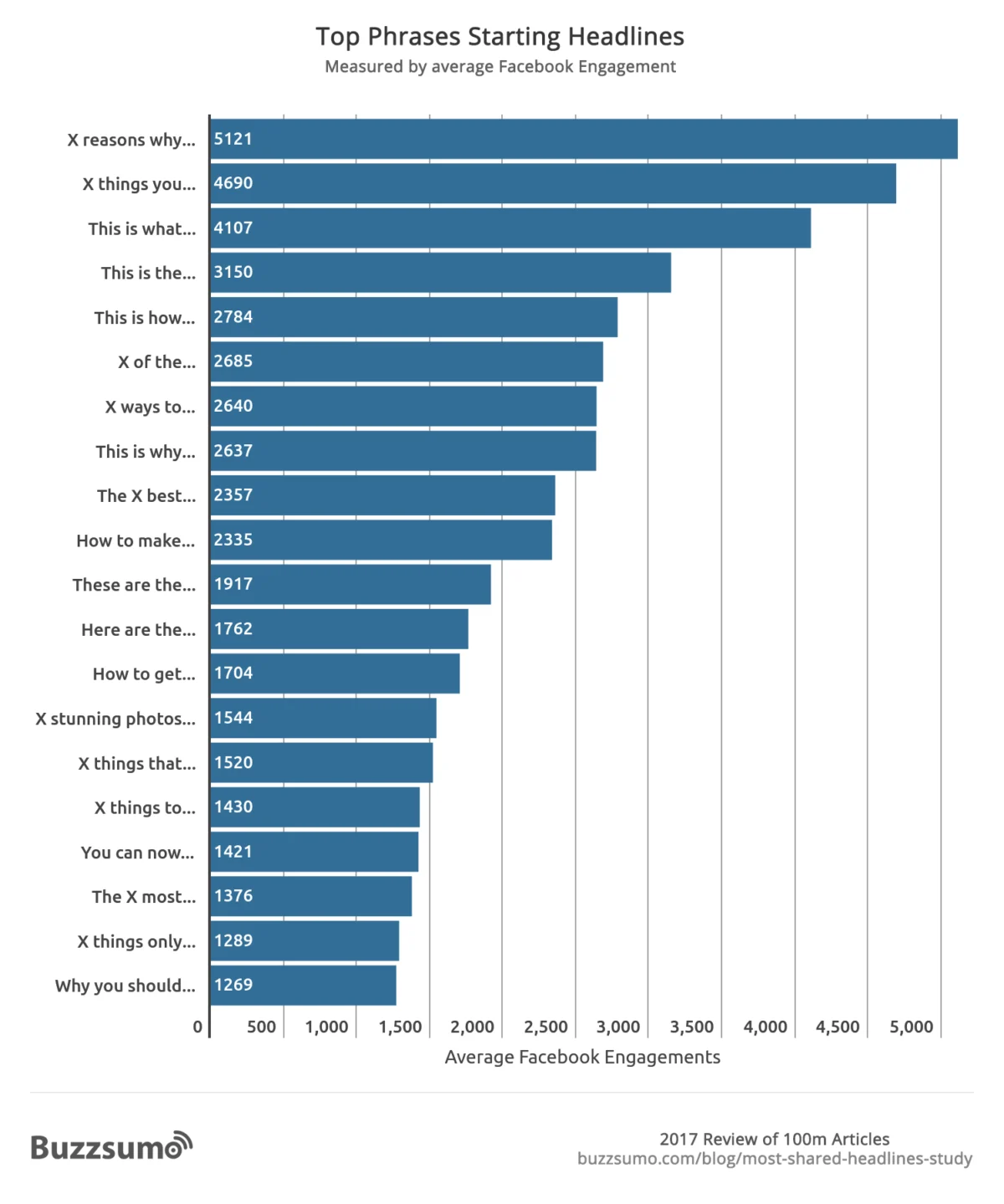
The updated 2019-2020 analysis draws a sharp contrast with BuzzSumo’s original 2017 study, co-founded by Steve Rayson. In 2017, the digital landscape favored distinct headline types, particularly on Facebook. The most powerful three-word phrase, or trigram, was "will make you," which garnered more than double the engagements of the next most popular phrase. This phrase often preceded emotional appeals, promising readers a direct, often emotional, impact from the content (e.g., "will make you cry," "will make you smile").
Beyond overt emotional triggers, curiosity and voyeurism were strong drivers. Phrases like "are freaking out" or those hinting at an unfolding event (e.g., "what happened next") capitalized on readers’ desire for novel or surprising information. Quizzes also flourished, with headlines such as "Can We Guess Your Real Age?" or "Only X in Y People Can Identify These…" appealing to self-discovery and a sense of challenge. Tribal headlines, like "25 Things Only Teachers Will Understand," fostered a sense of community and identity, encouraging shares within specific demographic groups.
In terms of length, the 2017 study found that longer headlines performed better, with an optimal length of approximately 15 words and 95 characters. This suggested that more descriptive and detailed headlines were effective in conveying value. For numbers, "10" was the undisputed champion in listicles, followed by "5," "15," and "7," indicating a preference for moderately sized lists.
However, even in 2017, changes were on the horizon. Facebook had already begun demoting "clickbait" headlines, specifically those that exaggerated or withheld information (e.g., "what happened next" style). This initial algorithmic shift laid the groundwork for the more pronounced changes observed in the subsequent years.
The Shifting Tides: Headline Evolution from 2017 to 2019-2020
The most striking revelation from the updated analysis is the near-total transformation of effective headline strategies. The 2019-2020 data shows a 100% difference in the top 20 headline phrases on Facebook compared to 2017, and a significant change on Twitter with only two phrases remaining consistent. This stark divergence can be attributed to several factors: algorithmic maturity, evolving audience preferences, and a changing publisher landscape.
- Decline of Emotional and Clickbait Content: Overtly emotional or sensational headlines, once dominant, are now largely obsolete. Phrases like "will melt your heart" or "are freaking out" have all but vanished from the top-performing lists. Even "will make you," the 2017 powerhouse, saw its top headline shares plummet from 1.7 million to just 143,000. Facebook’s ongoing algorithmic refinements, starting in 2017 and continuing into 2018 (prioritizing trustworthy news) and 2020 (boosting original and authoritative reporting), have effectively culled this content style. The only remaining vestige of emotional appeal is through exaggerated phrases referencing exceptional content, such as "one of the most beautiful."
- Farewell to Quizzes and Tribalism: The popularity of quizzes and tribal headlines has also waned considerably. Phrases like "can we guess" or "only X in Y" content, once common, are now rare. This suggests a shift away from light, identity-based content towards more substantive and informative narratives, aligning with platforms’ efforts to promote quality over virality.
- Conciseness Reigns Supreme: Headlines have become noticeably snappier. The ideal length has shrunk from 15 words and 95 characters in 2017 to a more concise 11 words and 65 characters in the 2019-2020 study. This trend reflects an increasing demand for "speed to insight" in an era of content overload. With online content volume increasing by 64% since 2016, readers crave headlines that quickly convey value and get straight to the point.
- Homogenization Across Platforms: A notable development is the increased similarity in effective headline phrases across Facebook and Twitter. In 2017, only one phrase was common between their top 20 lists. By 2019-2020, eight phrases overlapped, marking a jump from 2.5% to 20% similarity. This suggests that certain universal principles of engagement are emerging, making it possible for some headlines to perform well on both networks.
- Shifting Engagement Metrics: While effective phrases have become more similar, overall engagement patterns have diverged. The most engaging Facebook trigram in 2019-2020 ("of the year") garnered 26,702 average shares – a threefold increase compared to Facebook’s top phrase in 2017. Conversely, Twitter shares for top phrases decreased by nearly four times over the same period, despite stable monthly active users. This indicates a potential dilution of average shares on Twitter due to a greater variety of headline styles or a general decline in content sharing on that platform.
Key Insights from the 2019-2020 Headline Analysis
The updated BuzzSumo research offers actionable insights for content creators seeking to optimize their headlines for maximum engagement.
- Optimal Headline Length: The sweet spot for engagement on both Facebook and Twitter is 11 words and 65 characters. This length allows for specificity and detail without overwhelming the reader, catering to the modern audience’s preference for concise information. Outdated advice advocating for extremely short headlines (e.g., six words) no longer holds true.
- The Magic of Numbers: The number 10 remains the "magic number" for listicles, driving the most engagement. Beyond 10, single-digit numbers from three to 10 consistently perform best on social media. Interestingly, larger double-digit numbers like 15 and 20, which were popular in 2017, have fallen out of favor, again signaling a preference for shorter, more digestible lists and quicker insights.
- Facebook’s Engagement Drivers: Instruction and Hyperbole:
- Instructional Headlines: These are the new champions on Facebook. Phrases like "you need to," "you should," "you must," "need to know," and "what to do" generate high engagement. These headlines often leverage a sense of FOMO (Fear Of Missing Out) or promise essential, concise information. Examples include "Everything you need to know about washing your hands to protect against coronavirus."
- Hyperbolic Headlines: Exaggerated statements and superlatives still capture attention. Phrases such as "one of the most," "of the most," "X of the," and "of the best" are highly successful. These often precede superlative adjectives like "most beautiful" or "greatest."
- Ranking & Newness: Phrases like "of the year" (for awards/rankings) and "in X years" (for unprecedented events, often part of "for the first time in X years") are also top performers, indicating a desire for recognition and novelty.
- Starting and Ending Phrases: Headlines starting with numbers (listicles) remain popular. "How to" phrases are highly effective at the beginning, reflecting a keen audience interest in learning. Time-centric phrases (e.g., "of the year," "in 2020," "in 2021") are dominant at the end, often reflecting topical events or predictions.
- Twitter’s Engagement Drivers: Curiosity and Immediacy:
- Curiosity: Headlines that hint, tease, or question something tend to perform exceptionally well on Twitter. "The future of" was the top three-word phrase, indicating a strong interest in forward-looking, analytical content.
- Research & Reports: Words like "study" and "report" at the beginning of headlines signify that Twitter users are keen on data-backed content.
- Immediacy and Reactivity: Phrases ending in specific years (e.g., "in 2020") or indicating current developments are highly engaging, underscoring Twitter’s role as a platform for real-time news and current affairs.
- Crossover Phrases for Dual-Platform Success: Eight of the top 20 headline phrases and ten of the top starting phrases demonstrated effectiveness across both Facebook and Twitter. Instructional phrases (e.g., "need to know," "what to do") are particularly successful on both platforms, suggesting a universal appeal for utility-driven content.
Expert Perspectives and Broader Implications
Industry leaders have weighed in on BuzzSumo’s findings, underscoring the report’s significance and offering strategic advice:
- Heidi Cohen, Chief Marketing Officer of Actionable Marketing Guide, notes that the study reflects key changes in customer behavior due to the pandemic, emphasizing the need for marketers to focus on core marketing basics and adapt to evolving customer needs. She also previously highlighted the opportunity for B2B marketers to stand out by incorporating emotional elements.
- Julian Shapiro, Founder of Demand Curve, lauded the report as "one of the highest signal-to-noise reports on content marketing," recognizing BuzzSumo’s unique ability to gather such data.
- Rand Fishkin, Founder of SparkToro, stressed the value for content creators, strategists, and marketers in understanding what works today versus the past. He affirmed that the research "mythbusts" certain long-held beliefs about clickbait and emotional triggers, while illuminating the nuances of effective strategies.
- Ross Simmonds, Founder of Foundation, found it "fascinating" to see the mainstream adoption of "click friendly" instructional copy (like "you need to" or "you should"), highlighting the enduring importance of human psychology and the "fear of missing out" (FOMO) in driving engagement.
- Brian Dean, Founder of Backlinko, observed the "huge shift" on Facebook from BuzzFeed-style clickbait to instructional headlines, concluding that "today’s Facebook users need to know that the content is going to teach them something new."
- Amanda Milligan, Marketing Director at Fractl, found the "instructional" trend "fascinating" and attributed it to a growing desire to learn from experts. She suggested that such language inherently demonstrates authority, encouraging brands to leverage their expertise through this content style.
The implications of this research are profound. The shift away from overtly emotional and tribal content towards more instructional, informative, and concise headlines reflects a maturing digital audience that values utility, authenticity, and clear takeaways. Social media algorithms, particularly Facebook’s, have played a critical role in shaping this evolution by actively demoting sensationalism and prioritizing credible sources. This has led to a landscape where news publishers with authoritative content now gain preferential treatment.
For content creators, the message is clear: focus on providing value. Headlines should clearly communicate what readers will learn or gain, be specific, and avoid vague clickbait. While there’s a growing convergence in effective strategies across platforms, understanding the unique nuances of each network (e.g., Twitter’s appetite for research and real-time updates) remains crucial for maximizing reach.
Methodology and Practical Application
BuzzSumo’s updated study analyzed 100 million article headlines published between 2019 and 2020. To ensure robust findings, the data was rigorously cleaned, including the exclusion of "topic" trigrams and the inclusion of only one headline trigram/phrase per domain to prevent popular sites from skewing results. Engagement was measured by average median shares across Facebook and Twitter.
For those inspired to conduct their own analysis, BuzzSumo’s Content Analyzer offers powerful tools. Users can search for specific phrases (e.g., "need to know") to identify top-performing headlines, analyze share counts, backlinks, evergreen scores, and even identify top sharers. Advanced search functions allow for analysis of trigrams, starting/ending phrases, and specific words, enabling a granular understanding of headline performance across different languages, domains, and journalistic contexts.
Conclusion
The landscape of headline engagement is in constant flux, shaped by technological advancements and evolving human psychology. BuzzSumo’s extensive analysis provides an invaluable roadmap for content creators, illustrating a decisive shift from emotional, clickbait-driven tactics to a preference for informative, instructional, and concise headlines. By understanding these data-backed principles, publishers can craft headlines that not only attract attention but also resonate with discerning audiences, ultimately driving meaningful engagement in an increasingly complex digital world. The emphasis is no longer just on capturing a click, but on conveying tangible value and building trust from the very first word.


 Neng Nana
 Azzam Bilal Chamdy