Neng Nana
The digital marketing landscape is currently undergoing its most significant transformation since the inception of the commercial search engine, as generative artificial intelligence fundamentally alters the path from consumer curiosity to brand conversion. While traditional search engine optimization (SEO) has historically focused on securing a position within a list of "ten blue links," the emergence of AI-driven discovery engines—such as Google’s AI Overviews, ChatGPT, and Perplexity—is forcing a paradigm shift. For modern marketers, the challenge is no longer merely appearing in search results; it is the complex task of converting traffic that arrives with a much higher level of pre-informed intent.
The Evolution of Discovery: A Chronology of Search Technology
To understand the current shift, one must look at the progression of search technology over the last two decades. In the early 2000s, search was transactional and keyword-dependent. A user typed a specific phrase, and the engine matched those characters to indexed web pages. By the mid-2010s, Google’s introduction of RankBrain and BERT moved the needle toward semantic search, allowing engines to understand the context and intent behind words.
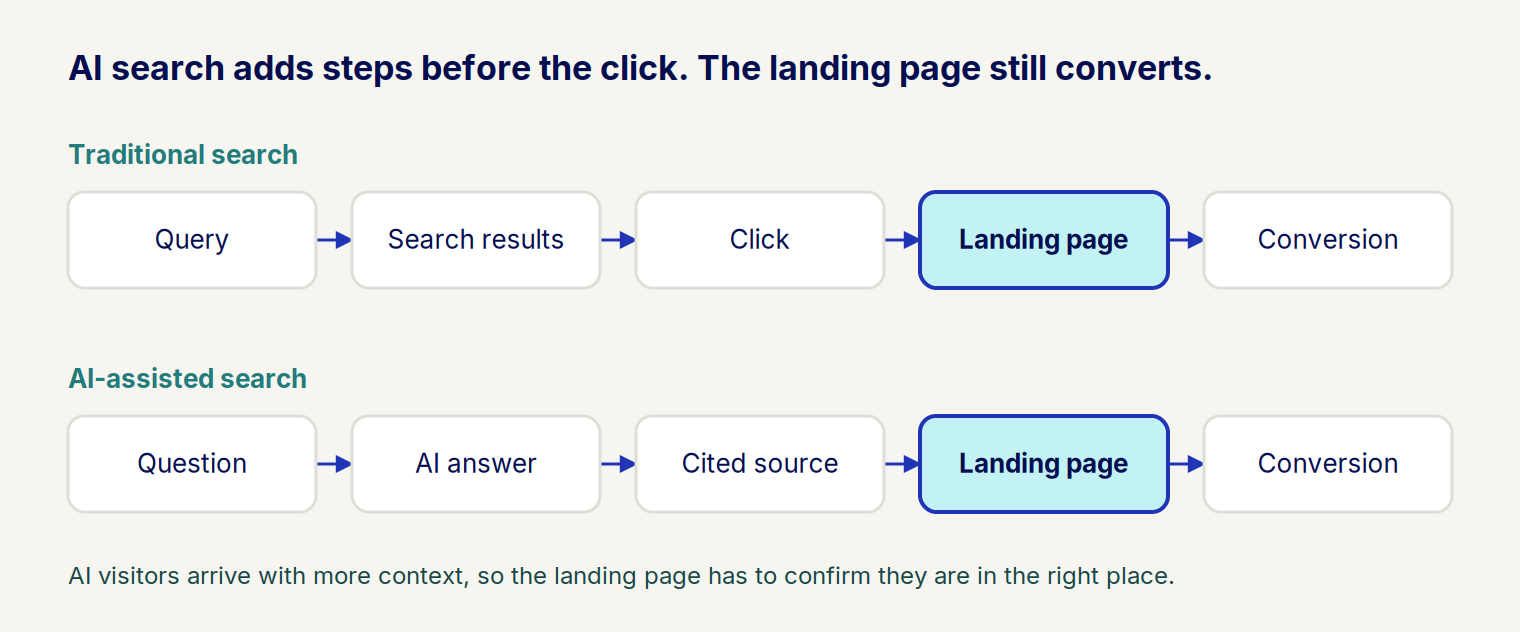
The current era, beginning in late 2022 with the public release of large language models (LLMs), represents the "Synthesis Era." In this stage, search engines do not just point to information; they consume, summarize, and present it. Google’s transition from a search engine to an "answer engine" via its Search Generative Experience (SGE) represents a move toward "query fan-out." This technical process involves the AI running multiple background searches across various subtopics and combining them into a single, cohesive response. Consequently, the user journey has expanded from a linear "Query → Click" model to a sophisticated "Question → Synthesized Answer → Evaluation → Conversion" cycle.
Supporting Data: The Impact of AI on Search Behavior
Recent industry data underscores the urgency of this transition. According to research from Gartner, traditional search engine volume is predicted to drop by as much as 25% by 2026 as consumers migrate toward AI chatbots and virtual assistants for information gathering. Furthermore, data from various SEO tracking platforms suggests that while "zero-click" searches (where the user finds the answer on the results page without clicking a link) are rising, the quality of traffic that does click through has increased.
Studies indicate that users who engage with an AI overview before clicking through to a site spend an average of 30% more time on the landing page compared to traditional search visitors. This suggests that AI is acting as a filter, qualifying leads before they ever reach a brand’s digital storefront. However, this also means that the expectation for the landing page is significantly higher; the visitor is no longer looking for basic definitions but for specific validation of the AI’s synthesized answer.

The Mechanics of "Query Fan-Out" and Brand Visibility
The technical shift to "query fan-out" means that a brand may be discovered not through a direct product search, but as a solution to a peripheral problem. For instance, a user might never search for "enterprise landing page software." Instead, they might ask an AI, "How can I reduce my customer acquisition cost for B2B SaaS?"
The AI, performing a fan-out search, identifies that landing page optimization is a key lever for reducing costs. It then cites specific platforms that provide these services. In this environment, the brand’s content must be structured to answer high-level business problems rather than just targeting high-volume keywords. This has led to the rise of Generative Engine Optimization (GEO) and Answer Engine Optimization (AEO), strategies focused on making content more "digestible" for LLMs.
Technical Foundations: The Vital Role of Structured Data
While much of the discussion around AI search focuses on creative content, the technical infrastructure remains a critical pillar. Structured data, or Schema Markup, has become the primary language through which brands communicate directly with AI crawlers. By using JSON-LD code to define entities—such as Organizations, Products, FAQs, and Local Businesses—marketers provide the "ground truth" that AI systems use to verify their synthesized answers.
Platforms like Instapage have responded to this need by integrating automated schema generators. These tools allow marketers to apply complex organizational and product schemas without manual coding. This technical transparency ensures that when an AI tool like Perplexity or Google’s Gemini searches the web for a source to cite, the brand’s data is presented in a format that is easily verified and highly authoritative.
Industry Reactions and Expert Analysis
The marketing community remains divided on the long-term implications of AI search. Some analysts argue that the "death of the link" is exaggerated, while others suggest that brands that do not adapt will become invisible.
"The goal is no longer to be the first result; it is to be the only answer," says one digital strategy lead at a global ad agency. "When an AI summarizes your brand’s value proposition, your landing page must then act as the physical proof of that summary. If there is a disconnect between what the AI said and what the page shows, the bounce rate will be catastrophic."
The consensus among technical SEOs is that "commodity content"—generic, AI-generated articles that offer no new insights—will lose all value. AI search engines are increasingly programmed to prioritize "information gain," a metric that rewards content providing unique data, first-hand expertise, or original research that cannot be found elsewhere.
The New Job of the Landing Page: Reducing Uncertainty
In the traditional funnel, the landing page was often the first point of education. In the AI-driven funnel, the landing page is the point of evaluation. By the time a visitor clicks a link in an AI overview, they likely already know who the brand is and what it does. They are visiting the site to answer a final, specific question: "Is this actually right for me?"
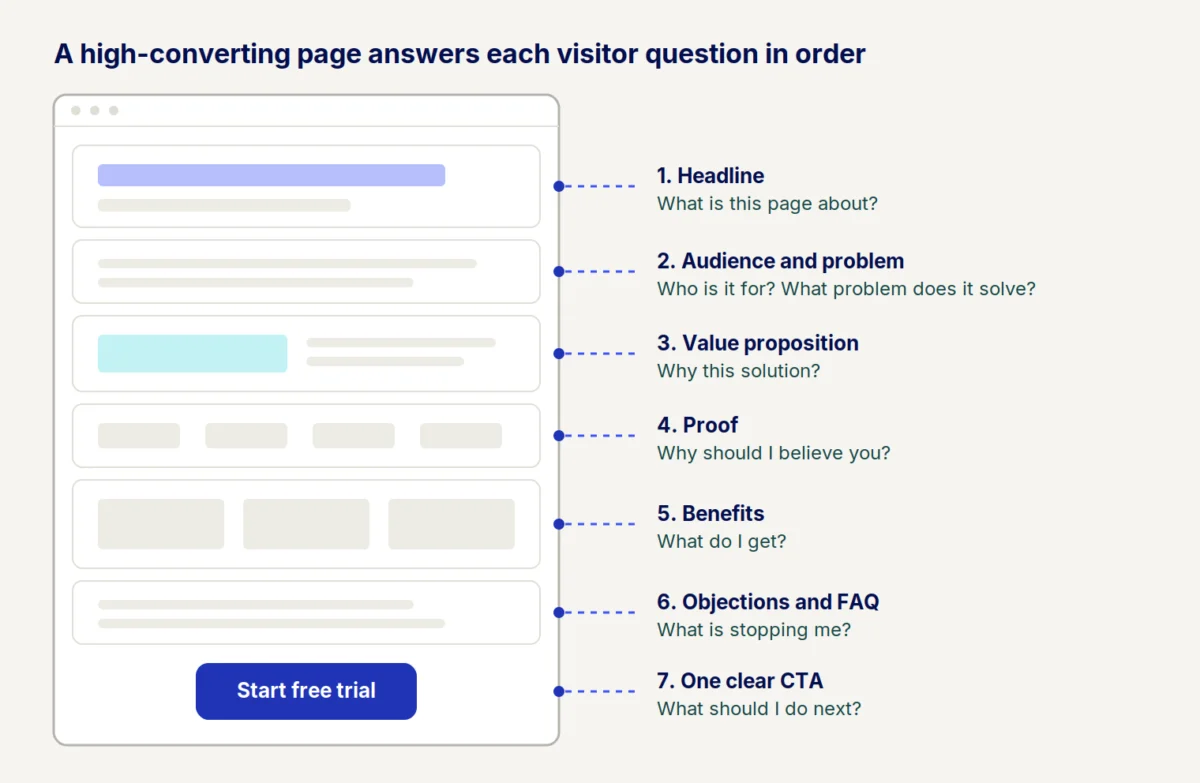
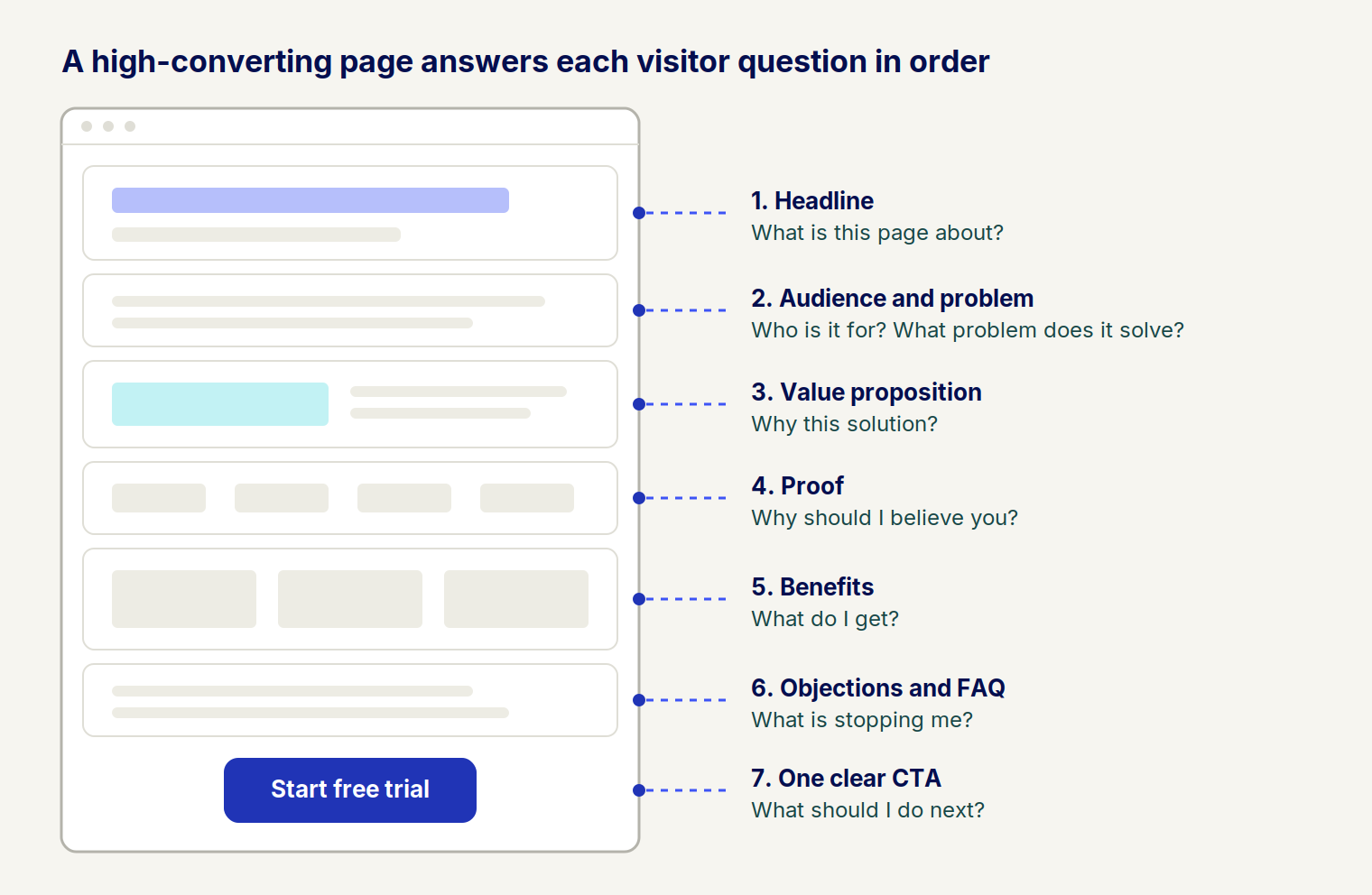
To meet this need, high-converting landing pages in 2024 and beyond must focus on six core elements:
- Immediate Message Match: The headline must directly mirror the specific nuance of the AI query.
- Explicit Value Proposition: Clearly stating what the user gets in exchange for their time or money.
- Visual Evidence: Screenshots, videos, or diagrams that prove the product works as described.
- Social Proof: High-authority testimonials and case studies to build trust.
- Contextual Relevance: Content tailored to the visitor’s specific stage of awareness.
- A Low-Friction Next Step: A clear, singular call to action (CTA).
Strategic Analysis: Personalization at Scale
One of the most significant challenges in the AI era is the diversity of intent. Because AI can lead people to the same product via a thousand different questions, a "one-size-fits-all" landing page is no longer viable. Marketers are increasingly turning to advanced personalization techniques to bridge this gap.
Tools such as "AI Collections" and dynamic personalization allow brands to maintain a single URL that morphs its content based on the visitor’s origin. For example, a visitor arriving from a "how-to" research query might see a page focused on education and long-form evidence, while a visitor arriving from a "competitor comparison" query might see a feature-by-feature breakdown and pricing. This level of agility is becoming the baseline for maintaining high conversion rates in a fragmented search environment.
Broader Impact and Long-term Implications
The shift toward AI search is also blurring the lines between organic and paid media. Traditionally, these were siloed departments. However, as AI search engines begin to integrate ads directly into synthesized answers, the "after-the-click" experience becomes the unifying factor. Whether a visitor comes from a paid AI placement or an organic citation, the landing page’s ability to convert that traffic determines the ROI of the entire marketing stack.
Furthermore, this evolution is forcing a move away from "vanity metrics" like raw traffic or impressions. In an AI-dominated world, visibility is only useful if it leads to pipeline and revenue. Marketers are now being encouraged to track "engagement quality" and "conversion velocity," measuring how effectively they can move a pre-informed visitor toward a final decision.
Conclusion: The Survival of the Useful
As search engines evolve into sophisticated reasoning engines, the fundamental principles of marketing remain the same, even as the tactics shift. The brands that will thrive in the age of AI search are those that prioritize utility over volume.
The strategy that survives algorithm changes is one that focuses on being "the answer" to real-world problems. By combining technical excellence—such as structured data and fast-loading, mobile-optimized pages—with deep personalization and high-quality, original insight, marketers can turn the challenge of AI discovery into a significant competitive advantage. Search technology may get the customer to the door, but the relevance and clarity of the landing page experience will ultimately decide whether they choose to enter.

 Azzam Bilal Chamdy
 Nana Wu