Asep Darmawan
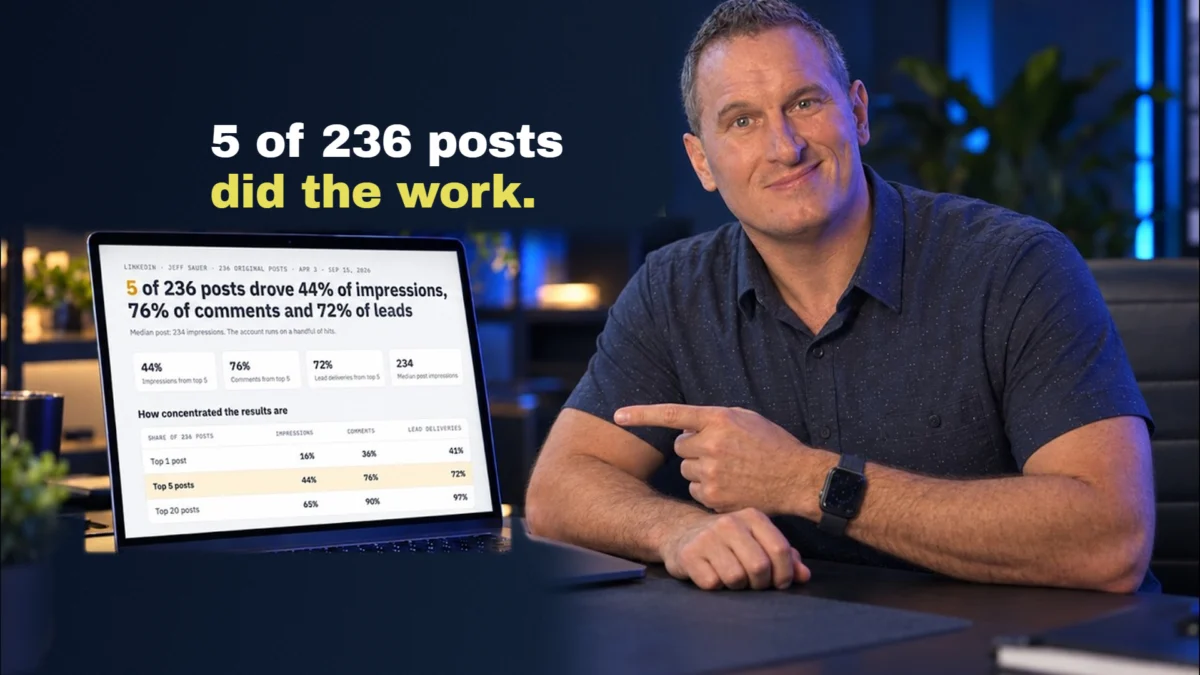
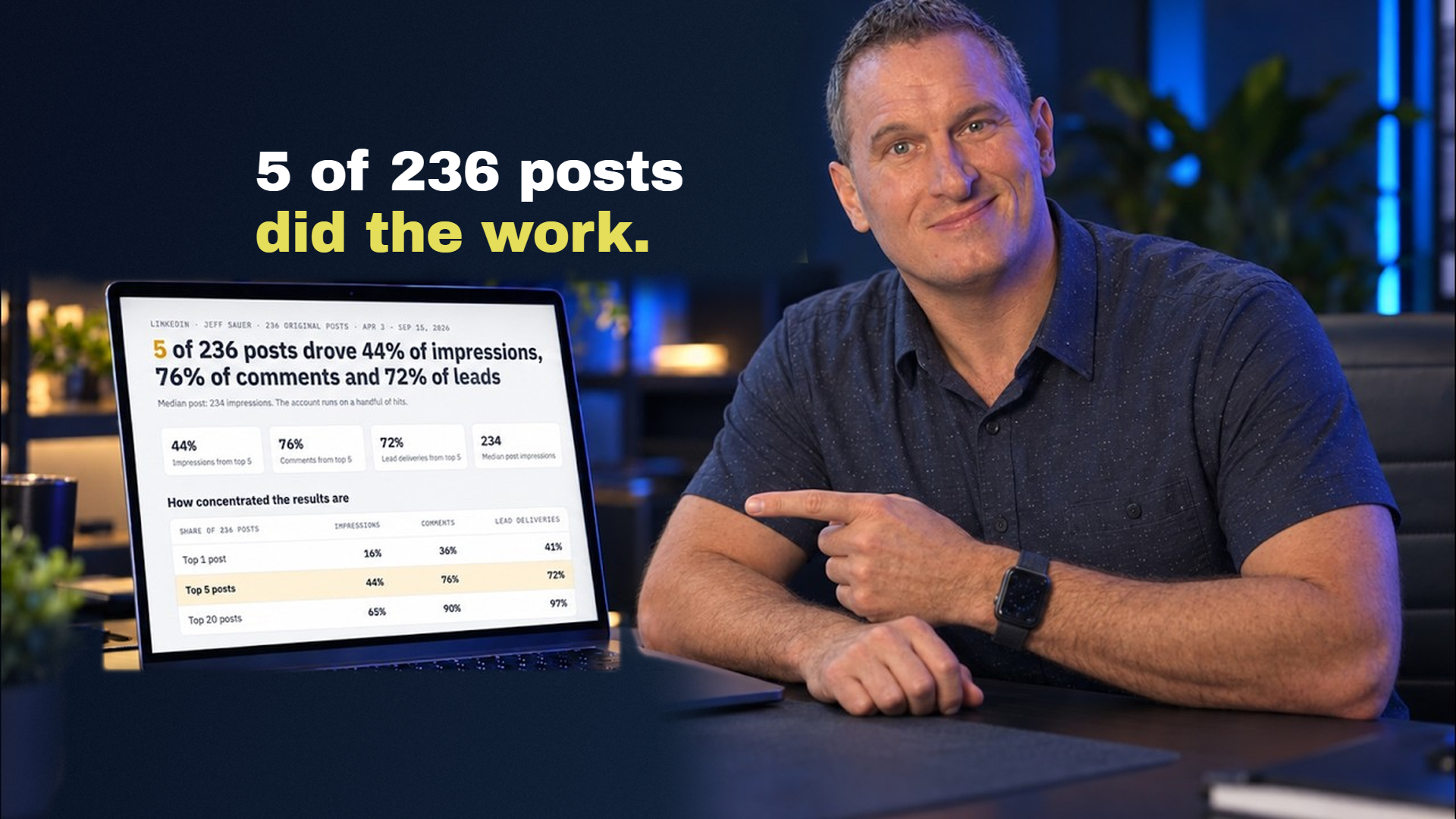
The landscape of social media marketing is undergoing a fundamental shift as digital entrepreneurs move away from manual data entry toward agentic artificial intelligence to decipher platform algorithms. Jeff Sauer, a veteran digital marketer and five-time Inc. 5000 agency founder, recently demonstrated a methodology that utilizes AI automation to bypass the native limitations of the LinkedIn interface. His research revealed that a mere 2.1% of his content—five posts out of 236—generated 44% of total impressions, 76% of comments, and 72% of all business leads. This discovery highlights a growing trend in the "creator economy" where the ability to extract and analyze proprietary data serves as a significant competitive advantage over generalized industry "best practices."
For years, LinkedIn users have struggled with an interface designed primarily for user retention rather than deep performance analysis. While the platform provides basic metrics for individual posts, it lacks native tools for comparative analysis, ranked performance views, or seamless data exportation for individual creators. Sauer’s approach leverages the "computer use" capabilities of modern AI models, such as OpenAI’s ChatGPT desktop application and Anthropic’s Claude Code, to automate the collection of these metrics. By using a browser bridge, the AI acts as a digital agent, navigating the user’s logged-in session to scrape, organize, and rank performance data in a matter of minutes—a task that previously required hours of manual spreadsheet management.
The Evolution of Social Media Analytics and the Rise of Agentic AI
To understand the significance of this development, one must look at the chronology of social media reporting. In the early 2010s, digital marketers relied heavily on third-party tools that utilized Application Programming Interfaces (APIs) to pull data. However, as platforms like LinkedIn and Meta tightened their API restrictions to protect user data and monetize their own analytics suites, individual creators were often left with two choices: pay for expensive enterprise-level software or conduct manual "click-and-copy" data collection.
The emergence of agentic AI in 2024 has introduced a third path. Unlike traditional bots that operate autonomously via backend code, these new AI agents interact with the front-end user interface. By "reading" the screen and mimicking human navigation within a secure, logged-in browser session, these tools allow users to bypass the friction of poorly designed analytics dashboards. This shift represents a broader movement in knowledge work, where approximately 70% of professional tasks involve navigating interfaces and moving data between applications.
Analyzing the Pareto Principle in Professional Content
The data gathered through Sauer’s automated process provides a stark look at the power law distribution of social media reach. In his analysis of 236 posts, the concentration of success was extreme. The fact that five posts drove nearly three-quarters of all leads suggests that for many businesses, high-frequency posting may be less valuable than identifying and "doubling down" on the specific content hooks that resonate with a niche audience.
A critical finding in the research involved the debunking of the "Carousel Myth." Industry reports frequently fluctuate on whether PDF carousels—a popular LinkedIn format—remain effective. Sauer’s automated data extraction showed that out of 13 carousels posted, 12 underperformed significantly. However, one specific carousel, titled the "GTM Cookbook," achieved over 6,600 impressions. The automated analysis allowed for a granular comparison that revealed the differentiator was not the format itself, but the visual "hook" on the cover slide. Without the ability to view these posts side-by-side in a ranked table, a creator might erroneously conclude that carousels are a "dead" format, rather than recognizing that the format requires a specific type of creative execution to succeed.
The Quantitative Impact of Engagement Signals
Beyond simple impression counts, the AI-driven analysis provided a specific valuation for user engagement. By correlating comment volume with total reach, the data suggested that each comment on a high-performing post contributed approximately 45 additional impressions. This metric provides a tangible ROI for the time spent responding to followers.

LinkedIn’s algorithm operates on a "velocity of engagement" principle. If a post receives significant interaction within the first two hours of publication, the system categorizes it as high-quality content and expands its distribution to out-of-network users. Sauer’s methodology included an "AI comment sweep," where the agent identified unanswered comments across multiple posts. This ensures that creators can maintain the engagement momentum required to keep a "hit" post circulating in the feed for several days, rather than letting the engagement signal fade due to inactivity.
Technical Framework: ChatGPT vs. Claude
The implementation of this automation typically follows two distinct technical paths, both of which require the AI to have "vision" or "computer use" capabilities:
The ChatGPT Desktop Workflow
This method utilizes the ChatGPT desktop application combined with a specialized Chrome extension that serves as a bridge. The extension allows the AI to see the active browser window. Because the user is already logged into LinkedIn, the AI does not require password access; it simply reads the data visible on the screen. The user provides a natural language prompt, such as "Go to my recent activity and build a table of my posts from the last seven days ranked by impressions."
The Claude Code Workflow
Anthropic’s Claude Code operates similarly but is often favored by more technical users for its precision in navigating complex web structures. Like the ChatGPT method, it relies on the existing user session, ensuring that no third-party integrations or API keys—which can often be flagged by LinkedIn’s security systems—are necessary.

Security, Ethics, and Platform Terms of Service
A primary concern regarding any form of automation on professional networks is the risk of account suspension. LinkedIn has historically been aggressive in banning "bots" that scrape data at scale or automate mass connection requests. However, industry analysts distinguish between "autonomous bots" and "user-driven AI agents."
The methodology described by Sauer is fundamentally different from traditional scraping. It is a directed, single-user action performed within a visible session that the user monitors in real-time. Because the AI is acting as a "co-pilot" rather than an autonomous script running in the background, it mimics human behavior patterns. Nevertheless, experts advise that users should remain aware of the trade-offs. Granting an AI agent the ability to "see" a browser window means the AI has access to any information visible on that screen. For professionals handling sensitive client data, the use of dedicated, isolated browser profiles for social media analysis is a recommended best practice.
The Broader Impact on Knowledge Work and Data Sovereignty
The implications of Sauer’s research extend beyond LinkedIn marketing. It points toward a future where "data sovereignty"—the ability for individuals to own and analyze their own digital footprint—becomes a primary driver of business growth. In an era where AI-generated content is becoming commoditized, proprietary data is the only remaining "moat" for many service-based businesses.
As AI continues to absorb the "interface navigation" layer of professional work, the role of the digital marketer is shifting from data collector to data strategist. The ability to use a three-minute AI conversation to replace an hour of data entry allows for more frequent experimentation and faster pivots in strategy.

For the broader services industry, this represents a democratization of data science. Previously, only companies with dedicated analytics teams could perform this level of granular performance tracking. Today, any business owner with a basic understanding of AI prompting can gain the same insights. The barrier to entry is no longer technical or financial; it is purely a matter of workflow adoption.
Conclusion and Future Outlook
The findings presented by Jeff Sauer serve as a case study for the practical, non-hype application of artificial intelligence in business. By moving away from general industry "best practices" and toward a systematic analysis of personal data, creators can identify the specific 2% of their efforts that drive nearly 50% of their results.
As LinkedIn and other professional platforms continue to evolve, the gap between creators who post blindly and those who use AI to decode their own performance metrics is likely to widen. The "superhuman" efficiency described by Sauer is not a result of the AI writing the content, but rather the AI handling the logistical friction of data analysis, leaving the human creator free to focus on the high-level creative decisions that the data suggests will be most successful. For those ready to adopt these tools, the next steps involve a shift in mindset: viewing the browser not just as a place to consume content, but as a data-rich environment ready to be harvested by intelligent agents.

 Nila Kartika Wati

 Siti Muinah