Lina Hope

In a move that has sent shockwaves through the global digital marketing industry, two of the largest affiliate networks in the United States, Rakuten Advertising and impact.com, have taken unprecedented disciplinary action against PayPal Honey. The browser extension and coupon aggregator, which was acquired by PayPal in 2020 for approximately $4 billion, has been accused of noncompliance with network policies and engaging in "attribution manipulation." As of mid-January 2026, the service has been terminated from Rakuten’s network and placed under a temporary suspension by impact.com, marking one of the most significant enforcement actions against a major publisher in the history of the partnership economy.
The sanctions follow a series of high-profile investigations into the technical operations of the Honey browser extension. Specifically, reports from investigative researchers, including Ben Edelman and the YouTube-based tech investigator MegaLag, highlighted instances where the extension allegedly bypassed "stand-down" rules designed to protect the commissions of other affiliates. These rules are fundamental to the integrity of the affiliate marketing ecosystem, ensuring that credit for a sale—and the resulting commission—is accurately attributed to the party that truly influenced the consumer’s purchase decision.
Chronology of Enforcement Actions
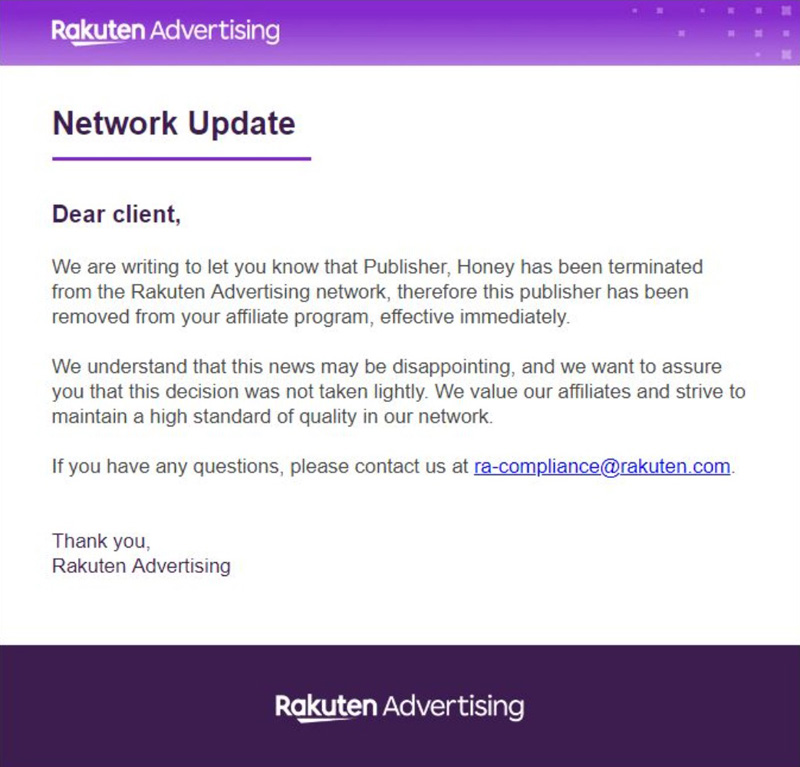
The disciplinary timeline began on Monday, January 12, 2026, coinciding with the opening of Affiliate Summit West, the premier conference for the U.S. affiliate marketing industry. Rakuten Advertising issued a formal announcement stating that Honey had been "terminated from the network." The network characterized the decision as a necessary measure to "maintain a high standard of quality" and protect the interests of advertisers and other publishing partners within its ecosystem.
The timing of Rakuten’s announcement, occurring during a major industry gathering, was widely interpreted by analysts as a strategic move to signal the network’s commitment to compliance and fraud prevention. The news dominated discussions at the conference, highlighting a growing tension between large-scale "toolbar" or "extension" publishers and traditional content creators.
Four days later, on Friday, January 16, impact.com followed suit. The platform revealed that Honey was found to be "out of compliance" with its platform policies. Unlike Rakuten’s outright termination, impact.com opted for a suspension, removing Honey from its "Discovery Marketplace." David A. Yovanno, CEO of impact.com, explicitly cited "attribution manipulation" as the core cause of the suspension, noting that such behavior undermines the foundational trust required for the partnership economy to function effectively.
Understanding Attribution Manipulation and Stand-Down Violations
To understand the severity of these actions, one must look at the mechanics of affiliate attribution. Most modern affiliate programs operate on a "last-touch" or "last-click" model, where the last affiliate to direct a user to a merchant’s site before a purchase is completed receives 100% of the commission.
"Stand-down" rules were established to prevent browser extensions from unfairly overwriting the cookies of previous affiliates. For instance, if a consumer discovers a product through an influencer’s blog and clicks a link to the merchant’s site, a cookie is set to credit that influencer. If that consumer also has the Honey extension installed, the extension is supposed to "stand down" and remain inactive if it detects that another affiliate’s cookie is already present.

The investigations into PayPal Honey alleged that the extension was engaging in "link hijacking" and "concealed violations" of these rules. By firing its own affiliate link even when it was supposed to remain dormant, Honey would effectively "steal" the last-click attribution from content-heavy affiliates like bloggers, review sites, or influencers. This practice not only shifts revenue away from the creators who drove the initial interest but also inflates the perceived value of the extension to the merchant, as the merchant pays a commission for a "referral" that would have happened regardless of the extension’s intervention.
The Investigative Catalyst: Edelman and MegaLag
The regulatory response was largely catalyzed by external audits. Ben Edelman, a well-known researcher specializing in online fraud and affiliate "adware," published an investigation detailing the methods by which Honey allegedly detected "testers" and automated bots to hide its noncompliant behavior. According to Edelman’s findings, the extension utilized sophisticated scripts to determine if its activity was being monitored, only engaging in attribution manipulation when it believed it was being used by a real consumer in a non-monitored environment.
Similarly, the investigator known as MegaLag released video evidence demonstrating the extension’s behavior in real-time. These public disclosures made it increasingly difficult for affiliate networks to ignore the complaints from merchants and smaller publishers who had long suspected that their conversion data was being compromised by automated software publishers.
Broader Industry Implications and Data Analysis
The removal of a $4 billion entity from major networks is a watershed moment for the performance marketing industry. According to data from the Performance Marketing Association (PMA), affiliate marketing is a multi-billion dollar industry that accounts for roughly 15% to 16% of all e-commerce orders in the United States. Within this ecosystem, browser extensions like Honey, Capital One Shopping, and Rakuten’s own extension represent a significant portion of "lower-funnel" conversions.
However, a study conducted by The Affiliate & Partner Marketing Association (APMA) in the UK highlighted the fragility of this model. An independent audit of 30 brands across 10 networks revealed that attribution rules are frequently misunderstood or poorly enforced. The APMA study emphasized the distinction between "stand-down" rules and "soft clicks," arguing that without rigorous network-level policing, the industry risks a "race to the bottom" where technical manipulation outpaces genuine marketing value.
The fallout from the Honey suspension is expected to lead to:
- Increased Scrutiny of Downloadable Software Publishers (DSPs): Merchants are now demanding more transparency regarding how extensions interact with other marketing channels.
- Revised Terms and Conditions: Brands are likely to update their affiliate agreements to include more specific language regarding "last-click theft" and automated link injection.
- Shift in Commission Structures: Some advertisers are moving away from last-click attribution toward "multi-touch" models or "commission splitting" to ensure that top-of-funnel content creators are compensated even if an extension is used at checkout.
Official Responses and Corporate Impact
PayPal, the parent company of Honey, has not yet issued a comprehensive public rebuttal to the specific technical allegations of attribution manipulation, though the company has historically defended its tools as providing value to consumers through savings and rewards. The suspension from impact.com and termination from Rakuten represent a significant blow to Honey’s revenue stream, as these networks house thousands of major retail brands that Honey relies on for affiliate income.
Industry experts suggest that the "temporary" nature of the impact.com suspension suggests a pathway for Honey to return to the platform, provided it implements more rigorous compliance controls and proves that its software adheres to "stand-down" protocols. However, the Rakuten termination appears more final, reflecting a zero-tolerance policy that may force other major publishers to audit their own technical implementations.
Strategic Recommendations for Brand Managers
The Honey controversy serves as a stark lesson for affiliate managers and brand executives. Industry analysts suggest that the event highlights three critical areas of program management:
1. The Necessity of Independent Policing
While networks provide the infrastructure for affiliate tracking, the Honey case demonstrates that they may not always catch violations in real-time. Brand managers are being urged to conduct their own audits and use third-party monitoring tools to ensure that their publishers are adhering to the agreed-upon terms of service.
2. Diversification of the Affiliate Base
A common vulnerability identified in many affiliate programs is an over-reliance on coupon and loyalty extensions. If a program sees a massive drop in revenue after a single publisher like Honey is removed, it indicates a lack of diversification. Analysts recommend a balanced portfolio that includes:
- Content producers and niche influencers.
- Mass media publishers (e.g., New York Times’ Wirecutter).
- Podcasters and video marketers.
- Card-linked offer providers and affinity groups.
3. Technical Literacy in Attribution
The complexity of "soft clicks" and browser extension behavior requires affiliate managers to possess a deeper understanding of web technologies. Relying solely on network reports is no longer sufficient; managers must understand how cookies are set, read, and overwritten within various browser environments.
Future Outlook for the Partnership Economy
As the industry moves through 2026, the focus is expected to remain on "quality over quantity." The aggressive stance taken by Rakuten and impact.com suggests that the era of "growth at any cost" in the affiliate space is ending, replaced by a mandate for transparency and fair play.
The outcome of the PayPal Honey situation will likely set the standard for how other browser extensions operate. If Honey successfully reformats its technology to comply with network standards and regains its status, it could provide a roadmap for "clean" extension-based marketing. If it remains excluded, it may signal the beginning of a broader decline for toolbar-based affiliate models in favor of more authentic, content-driven partnerships.
For now, the affiliate marketing community remains on high alert, watching for the next move from PayPal and the potential for similar investigations into other dominant players in the coupon and cashback sector. The message from the networks is clear: no publisher, regardless of their size or corporate parentage, is above the rules of the ecosystem.


 Evan Lee Salim

 Asro