Laily UPN
The digital landscape is undergoing a profound transformation, with automated bots now representing a significant majority of website traffic. Recent data, as highlighted by NBC News, indicates that bots account for a staggering 57% of all website requests, a figure that underscores a critical challenge for businesses and website administrators: traditional analytics tools are increasingly ill-equipped to differentiate between human visitors and the burgeoning influx of automated agents. This growing gap in understanding is precisely where Microsoft Clarity, a free analytics platform, is emerging as a vital tool, offering unprecedented visibility into the interactions of AI crawlers, search engines, and assistants with online properties.
For years, website owners have relied on tools like Google Analytics to understand their audience – demographics, behavior patterns, and engagement metrics. However, as artificial intelligence rapidly evolves and integrates into web browsing and content creation, these traditional metrics are becoming less comprehensive. The rise of sophisticated AI models capable of scraping vast amounts of data, answering complex queries, and even generating content necessitates a new approach to website analytics. Understanding who is accessing a site, and why, has become paramount, moving beyond the simple question of "how many visitors" to a more nuanced inquiry of "what kind of visitors, and what are their intentions?"
This article delves into the capabilities of Microsoft Clarity’s AI Visibility features, based on an extensive testing period conducted by Brainlabs Digital on their own website. The platform’s ability to dissect bot traffic, analyze AI citations, and connect technical issues to user sessions offers a compelling glimpse into the future of web analytics in an AI-dominated era.
Setting Up AI Visibility Features: A Seamless Integration with Deeper Insights
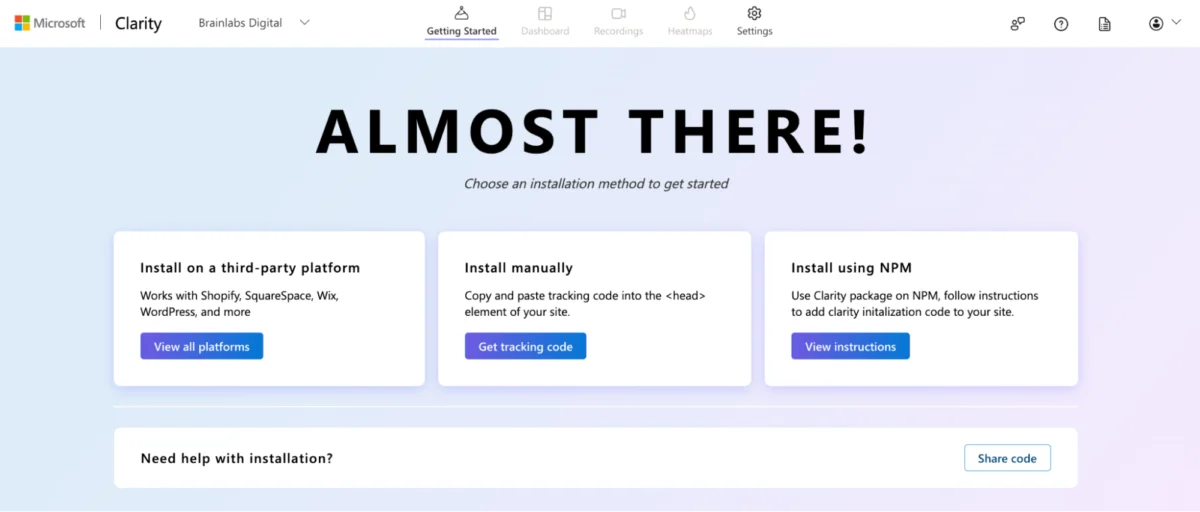
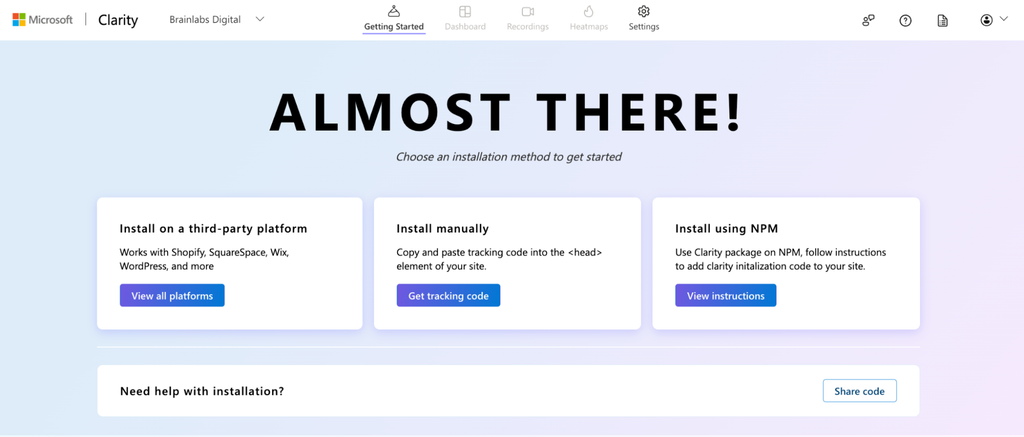
The initial hurdle for many new tools is the complexity of setup. Microsoft Clarity, however, prioritizes user-friendliness. The platform is entirely free to use, and integrating its core functionality is remarkably straightforward. A simple tracking script, easily added to a website, takes mere minutes to implement. For those utilizing popular e-commerce and content management systems, integrations with platforms like Shopify and WordPress further streamline the process, reducing the technical barrier to entry.
While the basic setup is quick, unlocking the full potential of Clarity, particularly its advanced AI visibility features, requires a more deliberate approach. To gain a comprehensive understanding of bot activity, additional integrations become crucial. Brainlabs Digital, for instance, connected their Google Analytics data, a standard practice for most webmasters. However, the truly transformative step involved configuring a WordPress plugin to ingest server-log data. This crucial addition allows Clarity to surface information that would otherwise be buried within complex log files, providing a direct and actionable view of bot behavior.
Microsoft provides extensive setup documentation, guiding users through various installation options and integration pathways. This detailed resource is invaluable for anyone looking to leverage Clarity’s capabilities, ensuring that users can tailor their implementation to their specific website architecture and analytical needs. The platform’s flexibility in this regard is a significant advantage, catering to a wide spectrum of technical expertise.
1. Unmasking the Crawlers: Identifying and Understanding Bot Traffic
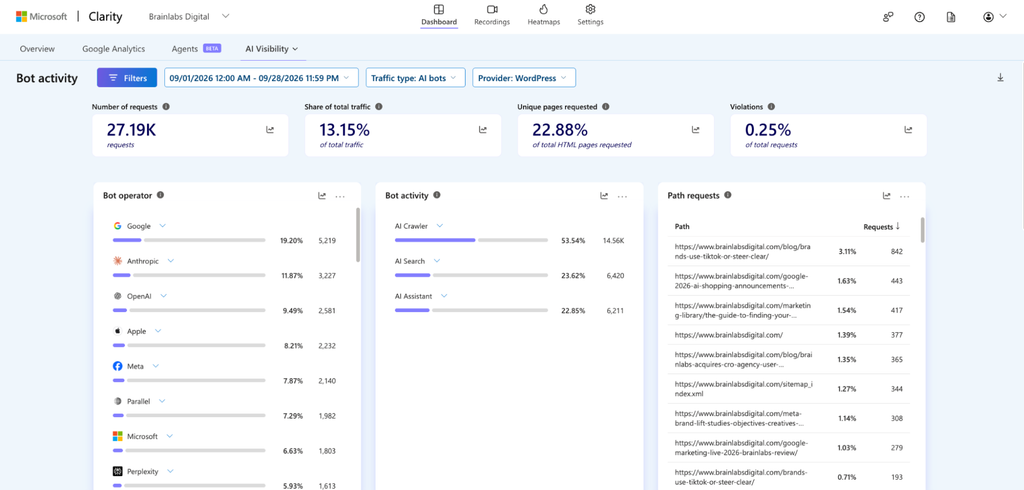
At the heart of Clarity’s AI Visibility features lies the Bot Activity dashboard. This central hub provides a granular breakdown of bot traffic, detailing which bots are visiting, their frequency, and the specific pages they are accessing. Crucially, Clarity categorizes these bots into three distinct types:
- AI Crawlers: These bots are designed to systematically scan and index websites, gathering data for large language models (LLMs) and other AI applications. They are the digital equivalent of researchers meticulously cataloging information.
- AI Search Bots: Distinct from general crawlers, these bots are specifically focused on collecting data for AI-powered search engines or features that provide direct answers to user queries. Their activity is often more targeted, seeking out information relevant to specific search intent.
- AI Assistants: This category encompasses bots that directly interact with users or websites on behalf of AI assistants. This could include bots performing tasks, gathering information for personalized responses, or facilitating user interactions with AI services.
These distinctions are not merely academic; they carry significant analytical weight. A bot accessing a website doesn’t automatically signify direct user interest in a brand or that its content is being actively incorporated into AI-generated answers. Understanding the purpose behind the bot’s visit provides a critical starting point for interpreting the data. For example, an AI crawler might be gathering general information about an industry, while an AI search bot might be looking for specific product details to answer a user’s query.
During their testing period, from September 1 to September 28, 2026, Brainlabs Digital observed a substantial volume of AI bot requests. Clarity recorded approximately 27,190 such requests, constituting 13.15% of the traffic analyzed within that specific dashboard. Delving deeper into the composition of this AI traffic, AI crawlers were the most prevalent, accounting for 53.54% of the requests. AI Search and AI Assistant activity followed, representing 23.62% and 22.85% of the AI bot traffic, respectively.
Prominent entities like Google, Anthropic, and OpenAI were identified as frequent visitors within the dashboard. However, the volume of requests from each varied considerably, offering insights into their specific data-gathering priorities and the scope of their AI development. This level of detail allows businesses to move beyond a generic understanding of bot traffic to a more strategic assessment of how different AI entities are interacting with their digital assets.
What Happens After a Bot Visits? Decoding the Scrape-to-Referral Ratio
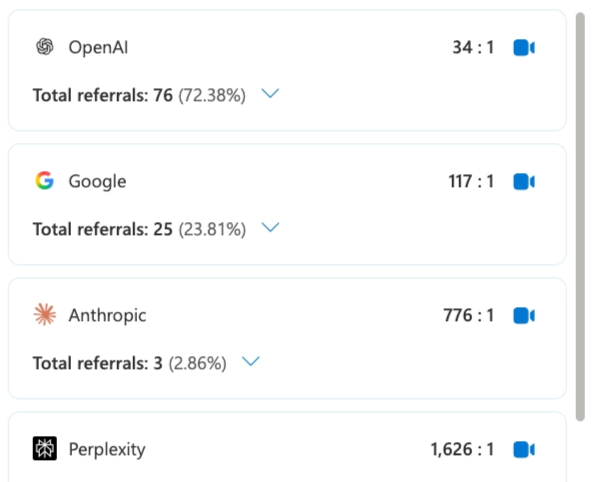
Beyond simply identifying bots, Clarity offers metrics that attempt to quantify the value or impact of their visits. The scrape-to-referral ratio is a particularly illuminating metric. It compares the volume of AI scraping activity with the number of actual referral visits generated from AI platforms. This helps to gauge whether bot activity is translating into tangible engagement.
Across the testing period, Brainlabs Digital reported an average scrape-to-referral ratio of 90:1, with a total of 105 referrals. However, this average masked significant variations between different AI platforms. OpenAI, for instance, exhibited a ratio of 34:1 with 76 referrals, suggesting a higher propensity for its scraping activity to lead to direct traffic. Google, on the other hand, had a ratio of 117:1 with 25 referrals, indicating a potentially broader scraping effort with fewer direct referral outcomes. Anthropic’s data showed a ratio of 776:1 with only three referrals, pointing to a more selective or perhaps less effective referral strategy during the observed period.
It’s crucial to interpret these numbers with caution. A high scrape-to-referral ratio doesn’t automatically equate to a "better" outcome. Referral traffic is only one indicator of a platform’s influence. The true value lies in understanding how these interactions contribute to broader business objectives. Brainlabs Digital wisely treats this ratio as one data point among many, integrating it with their existing traffic, conversion, and visibility data. It serves as an input for a more holistic analysis, rather than a definitive measure of qualified clicks.
2. AI Citations and Topic Insights: Measuring Brand Authority in the AI Era
The proliferation of AI-generated content has raised concerns about accuracy, attribution, and brand representation. Microsoft Clarity’s Topic Insights feature, currently in beta, directly addresses these concerns by allowing users to define specific topics and track how often their website is cited when AI platforms respond to related prompts. This capability is invaluable for understanding brand authority and content dissemination within the AI ecosystem.
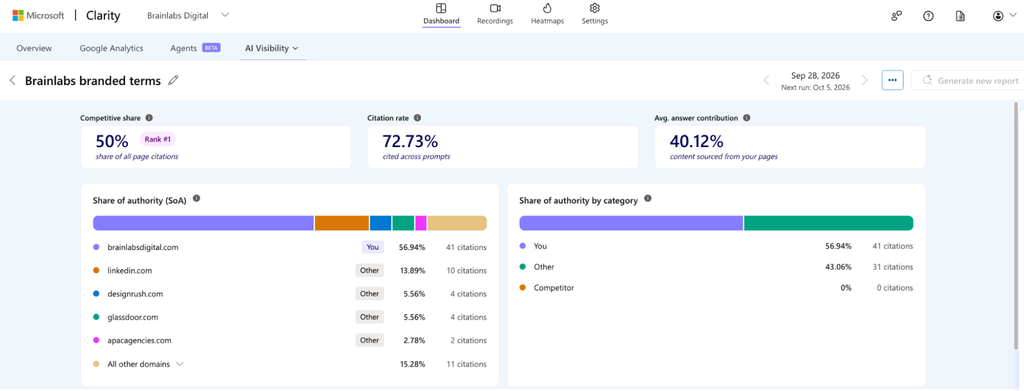
For branded terms – queries that specifically mention Brainlabs – Clarity demonstrated a citation rate of 72.73% across the tracked prompts. Furthermore, their competitive share of these citations stood at 50%, indicating a strong presence within AI-generated answers for their own brand. The site earned 41 citations, with 56.94% of those appearing in the "share of authority" breakdown. This suggests that when AI models are discussing topics related to Brainlabs, their content is recognized and cited, contributing to their perceived expertise.
While strong branded term results are often expected for established companies, the more insightful findings emerged from non-branded prompts. When analyzing broader queries that did not explicitly mention Brainlabs, the platform identified gaps in AI measurement and agentic enablement – two key service areas that Brainlabs aims to be recognized for. This proactive identification of content gaps is a powerful application of AI Visibility tools, enabling businesses to strategically address areas where their expertise might be underrepresented in AI-generated responses.
It’s important to acknowledge the current limitations of the Topic Insights feature. As a beta product, it requires user input for prompt generation, and users are restricted to tracking a maximum of 15 prompts per topic. This means the accuracy and relevance of the results are heavily dependent on the quality and comprehensiveness of the prompts chosen. While the "grounding queries" in the Citations tab offer a starting point, they primarily reflect where content already exists, potentially overlooking areas of significant absence. Therefore, continued prompt research, competitive analysis, and ongoing validation of Clarity’s reports remain essential. Brainlabs’ recent publication of their "State of AI Visibility report" further elaborates on their sophisticated approach to prioritizing and scoring prompts, underscoring the necessity of a robust strategy in this evolving field.
3. Connecting Technical Issues to Real Sessions: Bridging the Gap Between Errors and User Experience
While Clarity’s AI-focused features are groundbreaking, its more established analytics capabilities also offer significant value. The platform adeptly combines Core Web Vitals, JavaScript errors, and behavioral signals such as dead clicks, rage clicks, and excessive scrolling. The key innovation here is the direct link these metrics have to corresponding session recordings. This allows for a seamless transition from identifying a technical issue to understanding the precise user experience at the moment of that issue.
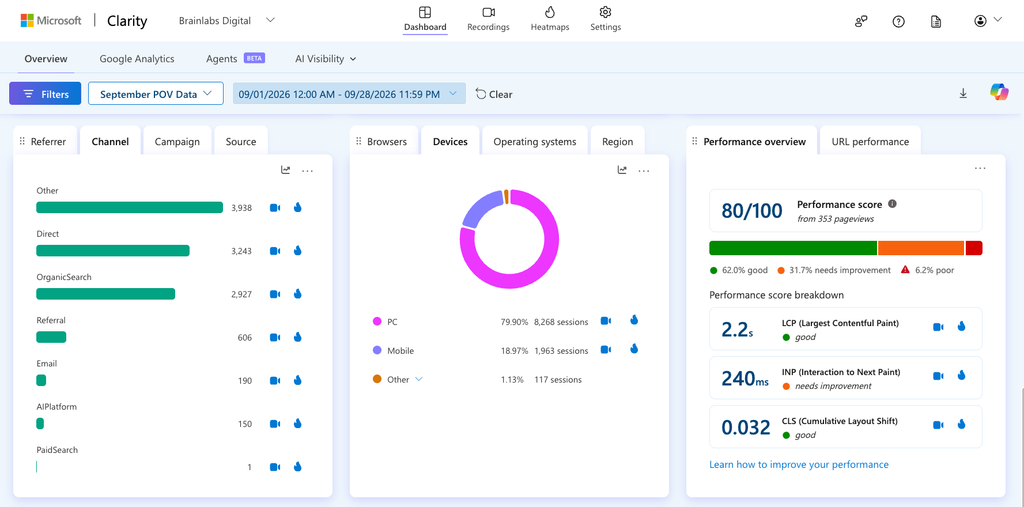
During the testing period, the performance overview for Brainlabs’ site scored 80 out of 100 across 353 pageviews. While this was a relatively small sample, it provided a valuable snapshot. The Largest Contentful Paint (LCP) was rated as good at 2.2 seconds, indicating fast loading of the primary content. However, the Interaction to Next Paint (INP), at 240 milliseconds, was flagged as an area needing improvement, suggesting potential delays in user interaction responsiveness. Concurrently, 6.75% of sessions exhibited dead clicks – instances where users clicked on non-interactive elements – and 2.92% involved quick backs, where users immediately navigated away from a page.
The session recordings associated with these metrics transform abstract performance data into tangible user narratives. An error report might simply state that something is broken, but a session recording shows what the visitor was doing when it broke, and the impact it had on their journey.
A particularly illustrative example was found on the client feedback page. Brainlabs operates under a culture code of "Feedback is a Gift," making a malfunctioning feedback form a critical issue to address swiftly. Clarity surfaced a session where a client encountered repeated JavaScript errors and made multiple attempts to submit feedback. While this single session might not represent a widespread trend, it provided an exact location and context for the problem, enabling immediate troubleshooting and resolution. This ability to connect technical anomalies to specific user actions is invaluable for optimizing user experience and ensuring that critical website functionalities are performing as intended.
Expanding the Measurement Stack: Clarity’s Role in a Holistic Analytics Strategy
After several weeks of comprehensive testing, Microsoft Clarity has proven to be a valuable addition to Brainlabs Digital’s measurement stack. While Google Analytics remains the central pillar of their reporting, and existing AI visibility tools like Ahrefs, Peec.ai, and seoClarity continue to provide essential organic performance context, Clarity offers distinct advantages. Its most significant contributions lie in its detailed insights into bot activity and its unique ability to connect site errors directly to real user behavior.
The AI visibility landscape is still in its nascent stages, with many features undergoing continuous development. Consequently, the quality of data and the depth of insights derived from these tools are heavily dependent on careful configuration, the clarity of analytical objectives, and the meticulous interpretation of results. Brainlabs also noted that some of the most valuable information often resides a few clicks beyond the primary dashboards, necessitating a degree of proactive exploration to fully grasp the platform’s capabilities.
For marketers and website administrators considering Microsoft Clarity, the platform is certainly worth exploring, especially given its free accessibility. The most effective approach, according to Brainlabs, is to begin by clearly defining the questions they aim to answer, identifying any gaps in their current measurement toolkit, and then strategically connecting the relevant data sources. A thorough understanding of what each dashboard measures and how it contributes to the overall analytical picture is paramount. In an era where the digital ecosystem is increasingly shaped by artificial intelligence, tools like Microsoft Clarity are not just beneficial but essential for navigating the complexities of website traffic, understanding user behavior, and maintaining a competitive edge. The AI invasion is here, and understanding its nuances is no longer optional – it’s a strategic imperative.

 Dwi Wanna