Ammar Sabilarrohman
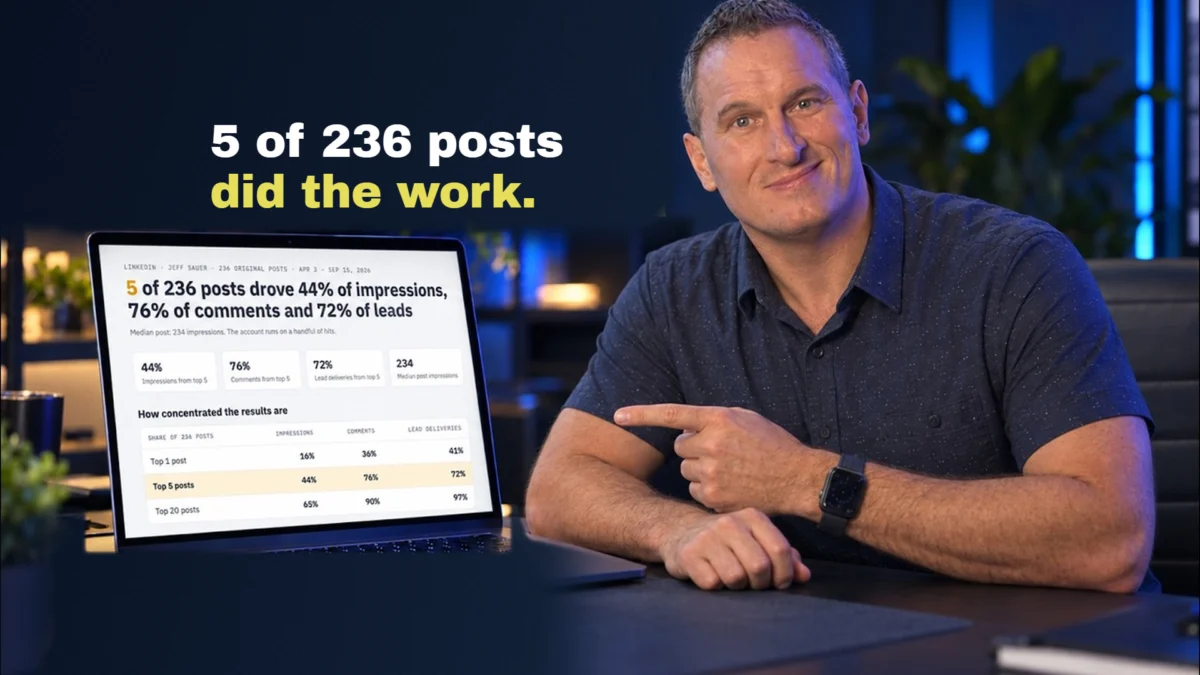
The landscape of digital professional networking is undergoing a significant transformation as business owners and marketing experts shift from manual data entry to AI-driven automation to decode platform performance. Recent findings from veteran digital marketer Jeff Sauer, a five-time Inc. 5000 agency founder, reveal a stark disparity in content performance on LinkedIn, where a mere 2% of posts can drive nearly half of a user’s total reach and over 70% of their business leads. This data underscores a growing movement among high-level practitioners to move away from generic "best practices" in favor of proprietary data analysis facilitated by emerging artificial intelligence agents.
The Inefficiency of Native Platform Analytics
For years, LinkedIn has maintained an interface optimized for user retention and continuous scrolling rather than deep analytical oversight. While the platform provides basic metrics for individual posts, it lacks a comprehensive, ranked view that allows users to compare performance across weeks or months without significant manual effort. Business owners seeking to identify patterns in their content strategy have historically been forced to click through individual posts one by one, manually transcribing figures into spreadsheets—a process that is both time-consuming and prone to human error.
Sauer’s research suggests that this lack of transparency is not accidental but rather a structural feature of the social media ecosystem designed to keep creators focused on the act of posting rather than the results of their efforts. For the busy executive or agency owner, the cost of manual data collection often outweighs the benefits, leading to "blind posting"—a strategy where content is produced based on intuition or general trends rather than hard evidence of what resonates with a specific audience.
The Pareto Principle in Digital Content Performance
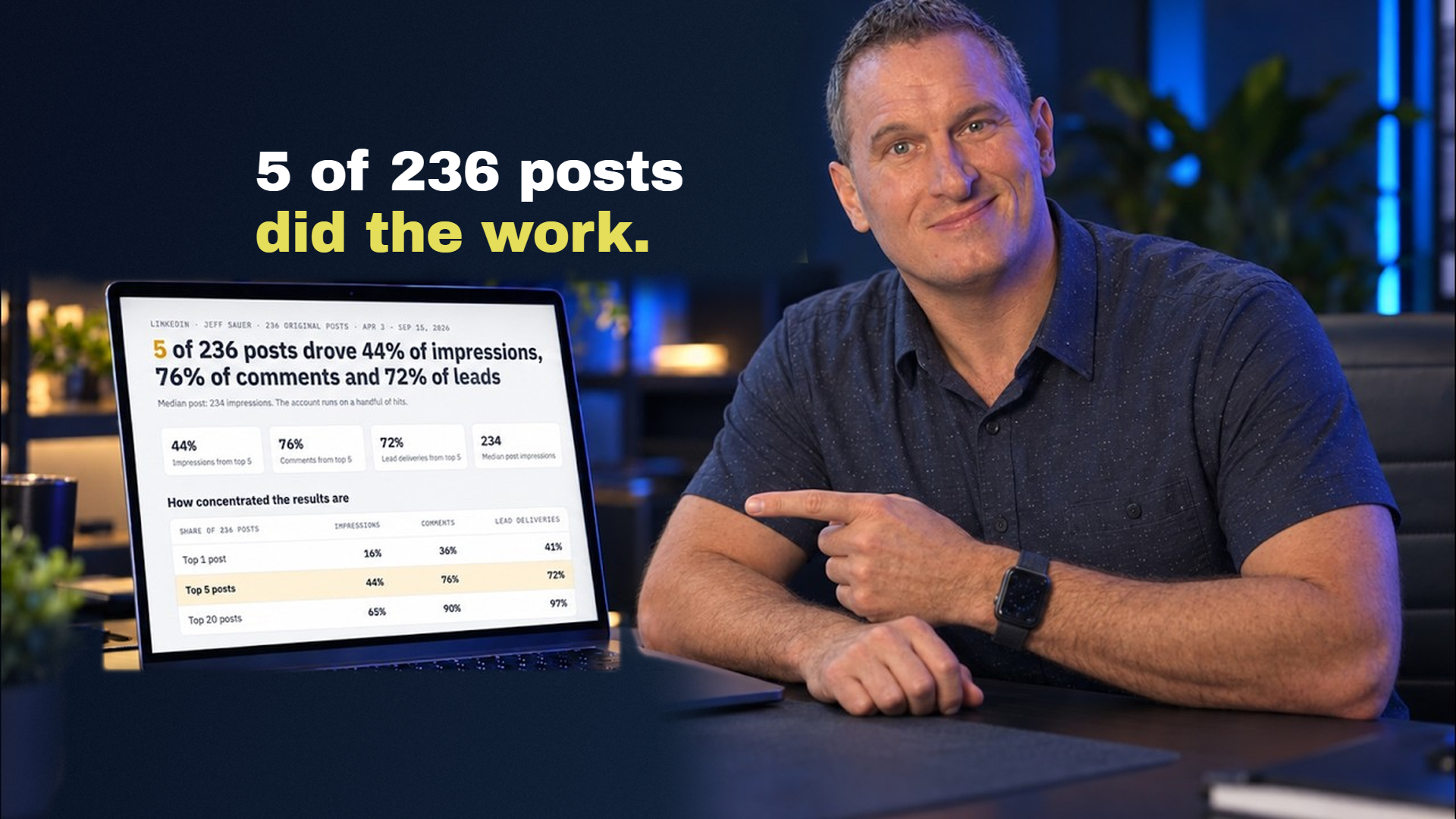
Through the application of AI automation, Sauer analyzed a dataset of 236 original LinkedIn posts. The results provided a concrete example of the Pareto Principle, or the 80/20 rule, applied to social media. Out of the 236 posts analyzed, only five were responsible for 44% of total impressions, 76% of all comments, and 72% of all business leads.
This concentration of value suggests that for most professional creators, the vast majority of their output serves as a baseline, while a tiny fraction of "hit" content drives the actual business objectives. The challenge for marketers has always been identifying these hits in real-time. By using AI to scrape and rank this data in under three minutes, creators can now pivot their strategies weekly, doubling down on the formats and topics that have already proven successful within their unique ecosystem.
Debunking Industry Myths Through Proprietary Data
One of the most significant advantages of automated data analysis is the ability to challenge prevailing industry narratives. A common sentiment in digital marketing circles is that certain formats, such as carousels (PDF slide decks), have lost their effectiveness due to algorithmic shifts. However, Sauer’s data-driven approach revealed a more nuanced reality.
Upon analyzing his own account, Sauer found that while twelve out of thirteen carousel posts underperformed, one specific carousel achieved 6,634 impressions—an outlier that significantly outperformed his average text posts. Further analysis, facilitated by AI, identified that the success was not due to the format itself but to the specific "hook" on the cover slide. This insight illustrates a critical point in modern marketing: global "best practices" are often inferior to local, proprietary data. What may be "dead" for the general population could be a primary lead generator for a specific niche, provided the execution is refined.

The Mechanics of AI-Driven Browser Automation
The technical breakthrough enabling this level of rapid analysis is the advent of "AI agents" and "computer use" capabilities within models like OpenAI’s ChatGPT and Anthropic’s Claude. Unlike traditional third-party tools that require complex API (Application Programming Interface) integrations and often face restrictions from LinkedIn’s security protocols, these AI agents operate within the user’s existing browser session.
By utilizing the ChatGPT desktop app or the "Claude Code" environment alongside browser extensions, the AI can essentially "see" the screen and navigate the interface as a human would. This allows the AI to:
- Access the user’s activity page while leveraging the existing login session.
- Read and extract impression counts, comment numbers, and engagement rates.
- Organize this unstructured data into a ranked table or spreadsheet.
- Perform "comment sweeps" to identify unanswered queries that could further boost algorithmic reach.
This method bypasses the need for sharing login credentials with third-party apps, as the AI acts as an extension of the user’s own physical interactions with the computer.
The Algorithmic Impact of Early Engagement
A key finding from the automated data pull was the quantifiable value of a single comment. Sauer’s analysis indicated that on high-performing posts, each comment translated to approximately 45 additional impressions. This creates a compounding effect: early engagement signals the LinkedIn algorithm that the content is high-value, prompting the system to distribute it to a wider audience, which in turn generates more comments.

This "early signal" is often manufactured through strategic tagging of relevant parties. Sauer observed that posts featuring tags of individuals who actively engaged within the first hour of posting had a significantly higher probability of becoming a "hit." The AI’s ability to quickly identify which posts are receiving this early traction allows business owners to prioritize their own engagement efforts, ensuring no comment goes unanswered on a post that the algorithm is currently favoring.
Security Considerations and the Frontier of AI Agents
While the efficiency gains of AI automation are undeniable, the transition to AI agents acting on behalf of users raises important security and ethical considerations. Granting an AI the ability to navigate a browser means the model can theoretically access any information visible on the screen. Sauer notes that for many, this level of access may be uncomfortable, and he emphasizes that this is a "contained action" where the user should ideally monitor the AI as it works.
However, he distinguishes this from "botting." Traditional bots operate autonomously and at scale, which often triggers LinkedIn’s anti-spam filters. In contrast, using an AI agent to pull one’s own stats or manage comments is a targeted, human-initiated task that mimics natural user behavior. As AI continues to evolve, the industry is likely to see a shift toward these "superhuman" workflows, where the AI handles the 70% of knowledge work consisting of interface navigation and data movement, leaving the final 30%—strategic decision-making and creative direction—to the human expert.
The Strategic Shift in Knowledge Work
The broader implication of this technology is the democratization of high-level data science for small business owners. Previously, the ability to perform deep-dive sentiment analysis and engagement tracking was reserved for large corporations with dedicated analytics teams or expensive software subscriptions. Today, a three-minute conversation with a standard AI model can yield the same results.

The competitive edge in the modern services business is no longer the tools themselves, as access to ChatGPT and Claude is nearly universal. Instead, the "proprietary edge" lies in the data itself. In an era where AI can generate infinite amounts of generic content, the only way to stand out is to use AI to analyze what is uniquely working for a specific brand and audience.
Conclusion and Future Outlook
The integration of AI into the daily workflow of digital professionals marks the end of the "manual era" of social media management. As demonstrated by Jeff Sauer’s findings, the ability to quickly identify the 2% of efforts that drive 70% of results is the difference between a business that scales and one that stagnates in the noise of the feed.
For professionals looking to implement these strategies, the roadmap involves moving beyond the web-based chat interface and toward integrated desktop applications that can interact with the browser. By systematically pulling monthly performance data, identifying outliers, and using AI to manage the resulting community engagement, business owners can transform LinkedIn from a time-consuming social chore into a precision-engineered lead generation engine. The barrier to entry is no longer technical expertise; it is the willingness to adopt a data-centric mindset in an increasingly automated world.

 Pevita Pearce