Siti Muinah

A profound transformation is reshaping how individuals seek and consume information online, with social media platforms increasingly functioning as sophisticated search engines. This paradigm shift, driven largely by younger generations, necessitates a re-evaluation of digital strategy for brands and content creators. Platforms such as TikTok, Instagram, LinkedIn, YouTube, Pinterest, and Reddit are no longer merely social networking sites; they are active discovery hubs where users input queries to find specific content, products, services, and communities, moving beyond passive algorithmic feeds. This emergent behavior represents a fundamental departure from traditional web search engines like Google and Bing, demanding a distinct approach to content optimization and visibility.

The Evolving Landscape of Digital Information Seeking
For decades, traditional search engines, primarily Google, have been the undisputed gatekeepers of online information. Users would type keywords into a search bar, and algorithms would surface web pages, articles, and structured data based on relevance, authority, and backlinks. However, a new generation of digital natives is rewriting these rules. Pew Research Center data from 2024 highlights that 90% of U.S. teens utilize YouTube, while 63% are active on TikTok. A significant one-in-five teens report being almost constantly on these platforms, establishing them as routine entry points for information. As Gen Alpha enters their teenage years, they bring similar expectations, preferring curated, visually-rich, and easily digestible results from trusted creators and brands.

This shift in user behavior has prompted social platforms to invest heavily in advanced search capabilities. TikTok, Instagram, and YouTube have rolled out AI-assisted search features, including suggested queries within comment threads, keyword search functionality extending beyond hashtags, and results summarized or grouped by topic. This strategic pivot by platforms underscores the growing importance of active discovery, elevating search from a secondary feature to a core surface for user engagement and content delivery. Consequently, social search now often outperforms traditional search for users seeking to discover, evaluate, and save information seamlessly on mobile devices.
Fundamental Differences: Social Search vs. Traditional Search
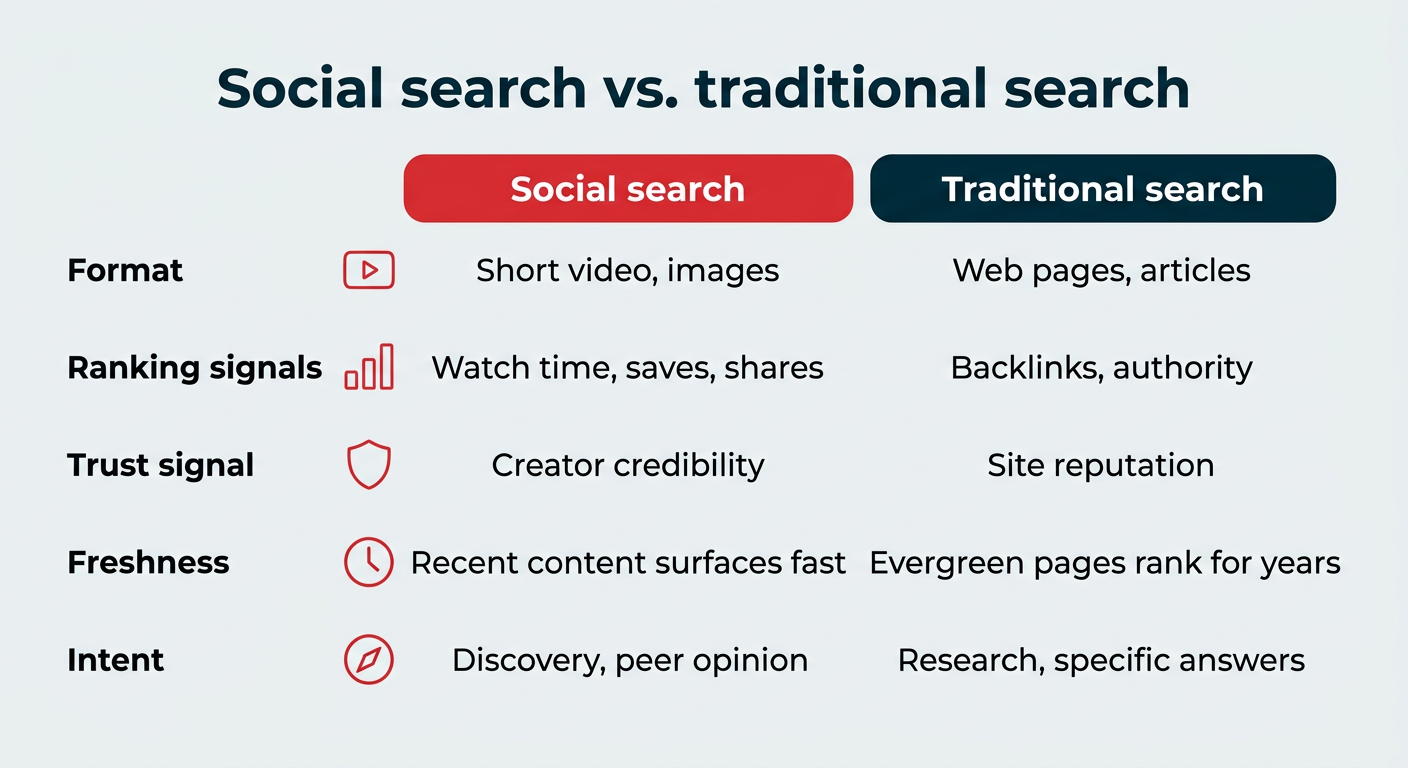
While both social and traditional search engines aim to connect users with relevant information, their underlying mechanisms, ranking signals, and user intents diverge significantly. Understanding these distinctions is crucial for effective digital strategy.
On traditional platforms like Google, content ranking is largely determined by factors such as inbound links, domain authority, and the precise matching of keywords within a website’s content. The emphasis is on established credibility and comprehensive information housed on websites.

Conversely, social media search engines prioritize creator-driven content and engagement. A post’s visibility on TikTok or Instagram is influenced by keywords embedded in captions, on-screen text, and audio transcripts. Crucially, engagement metrics such as watch time, saves, shares, and comments play a pivotal role. The algorithms also heavily personalize results based on an individual user’s past viewing behavior. This system allows even nascent accounts to outrank established ones if their content resonates strongly with the audience, fostering a dynamic environment where freshness and virality hold significant sway.
A comparative analysis reveals further disparities:

- Dominant Format: Social search leans heavily into short-form video, images, and interactive comment threads. Traditional search focuses on web pages, articles, and structured data.
- Main Ranking Signals: Social platforms prioritize keywords (in various forms), watch time, saves, shares, and comments. Traditional engines rely on backlinks, domain authority, and on-page relevance.
- Trust Signal: Social search often hinges on creator credibility and social proof (e.g., number of followers, engagement). Traditional search emphasizes site reputation and academic/professional citations.
- Personalization: Social search is intensely personalized, shaped by individual viewing and interaction history. Traditional search offers moderate personalization, influenced by location and search history.
- Freshness Bias: Social platforms exhibit a strong bias towards recent content, which can surface rapidly. Traditional search offers a mixed bias, where evergreen content can rank for years.
- Typical Intent: Social searchers are often in a mode of discovery, seeking inspiration, peer opinions, or immediate answers. Traditional searchers typically engage in research, transactional queries, or seek specific, authoritative answers.
It is important to note that these two systems are not entirely separate; they often feed into each other. Social posts from platforms like TikTok, Instagram, Reddit, and LinkedIn are regularly indexed by Google and can appear prominently in traditional search results. This means a single, well-optimized social post has the potential for dual visibility, enhancing its reach and longevity. Therefore, a holistic strategy does not involve choosing one over the other but rather integrating both, recognizing that traditional SEO caters to users with defined needs, while social search captures them earlier in the decision-making process.
Platform-Specific Search Optimization Strategies

The mechanics of social search vary considerably across platforms, necessitating tailored optimization approaches.
- TikTok: With over 3 billion daily searches, TikTok’s search engine processes captions, on-screen text, audio transcripts, and even comments to categorize video content. The platform actively promotes search behavior through suggested queries under videos and in comment threads. Its foray into selling search ads further solidifies its position as a search engine. To optimize, creators should verbally state keywords in videos, display them on screen, and incorporate them into captions.
- Instagram: Instagram’s search now operates on plain keywords, moving beyond just hashtags and account names. Searches for terms like "sourdough starter" will yield accounts, Reels, and posts, with Reels frequently dominating results. The Explore tab serves as an additional discovery surface, personalizing content based on user engagement. Effective optimization involves crafting captions, alt text, and on-screen text that accurately describe content using language users would employ in a search.
- LinkedIn: As a professional networking platform, LinkedIn’s search revolves around people, companies, and content. It heavily leverages profile and page fields; job titles, skills, headlines, and company descriptions significantly influence search visibility. For B2B marketers, LinkedIn search is a critical pipeline tool, enabling buyers to research vendors and individuals. Comprehensive completion of all profile fields with industry-standard terminology is paramount.
- YouTube: Functioning much like a traditional search engine for video content, YouTube’s rankings are influenced by titles, descriptions, video chapters, and transcripts. Crucially, watch time determines content retention in search results.
- Pinterest: This platform operates as a visual search engine, primarily for planning and purchase intent. Boards, pin titles, and descriptions are vital for discoverability, connecting users with aspirational and actionable content.
- Reddit: Reddit has gained significant search momentum, partly due to Google’s prominent indexing of Reddit threads for opinion and review queries. While direct optimization of threads is limited, brands can monitor relevant subreddits and engage authentically to build presence and insight.
Strategic Imperatives for Brands in 2026

The ascendance of social search fundamentally alters how brands connect with audiences, influencing discovery, word-of-mouth amplification, and even traditional search results. With 73% of Gen Zers citing social media as their primary source for new product information, neglecting social SEO is no longer an option.
Driving Brand Awareness:
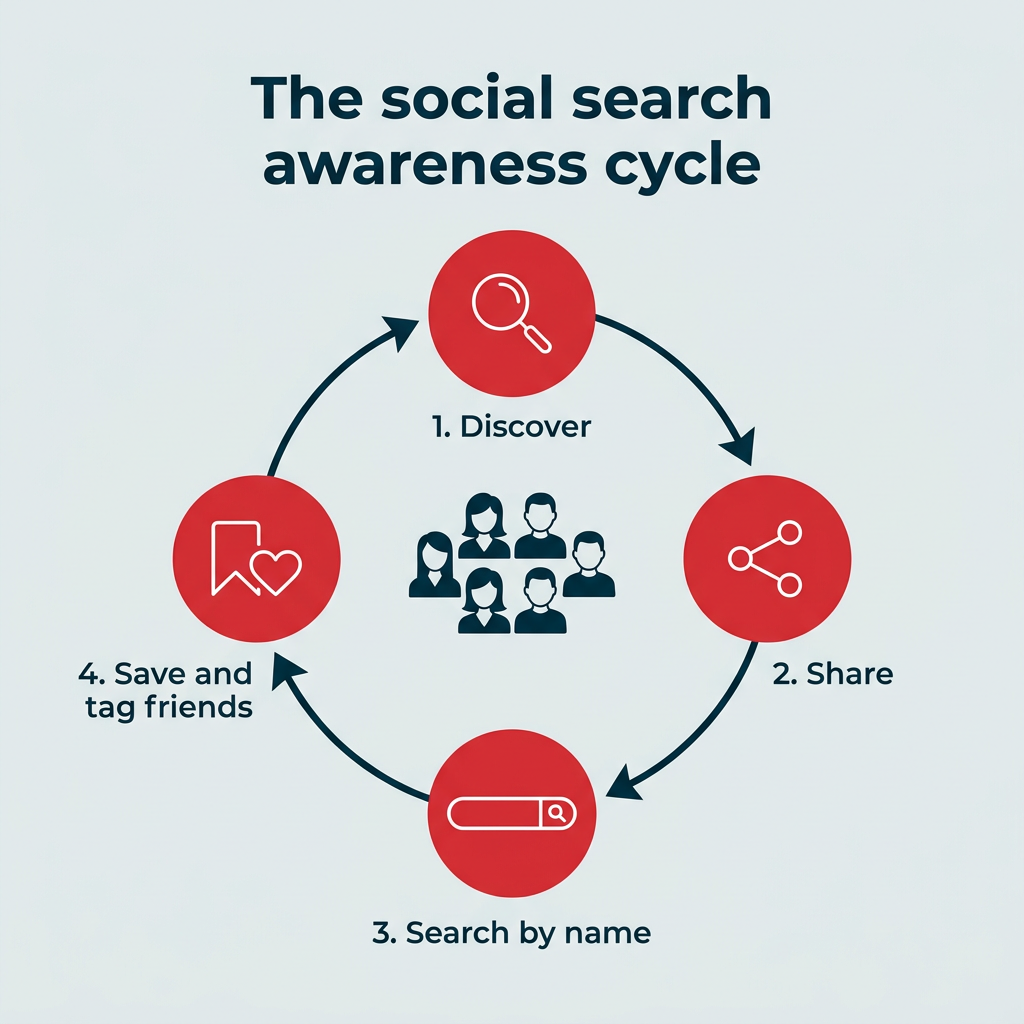
Social search plays a crucial role in building brand awareness, even among individuals who may not actively use social platforms for search. Consider the anecdote of a Gen X marketer advised by a Gen Z bartender to search TikTok for New York city recommendations, leading to the discovery of Summit One Vanderbilt. This illustrates a multi-layered awareness cycle:

- Digital natives discover brands through social media search or algorithmic content delivery.
- They share this information with their peers and older generations.
- This word-of-mouth generates brand-name searches on social platforms, surfacing both official and user-generated content (UGC).
- Engaged social searchers like, save, and tag friends, perpetuating the cycle.
Moreover, well-tagged TikTok and Instagram content is increasingly indexed by Google, providing an additional layer of visibility long after it leaves the social feed.
Fueling Competitive Intelligence:
Social search offers invaluable insights for competitive analysis. By regularly searching for industry-specific keywords and competitor brand names, businesses can identify emerging rivals, monitor their content strategies, and uncover popular hashtags and terms they are leveraging. Tools like Hootsuite’s analytics allow for competitive benchmarking, tracking up to 20 competitors to identify opportunities and threats. This real-time intelligence reveals audience conversations, content gaps, and successful engagement tactics within a given niche.
Monitoring Brand Mentions and Audience Insights:
Consistent social listening, powered by social search, provides a rich vein of actionable data. It helps brands understand public perception, sentiment, common questions, product feedback, and competitive positioning. By analyzing the language used by target audiences (e.g., "dupe for" indicating pricing concerns, or "how to export from" highlighting documentation gaps), brands can tailor content, address pain points, and even identify potential influencers or brand advocates for partnerships and user-generated content campaigns. Tailoring social search efforts to specific audience demographics (e.g., TikTok for Gen Z, LinkedIn for B2B) maximizes relevance and impact.
Optimizing Content for Enhanced Social Search Visibility
A strategic approach to content optimization is paramount for rising to the top of social search results.

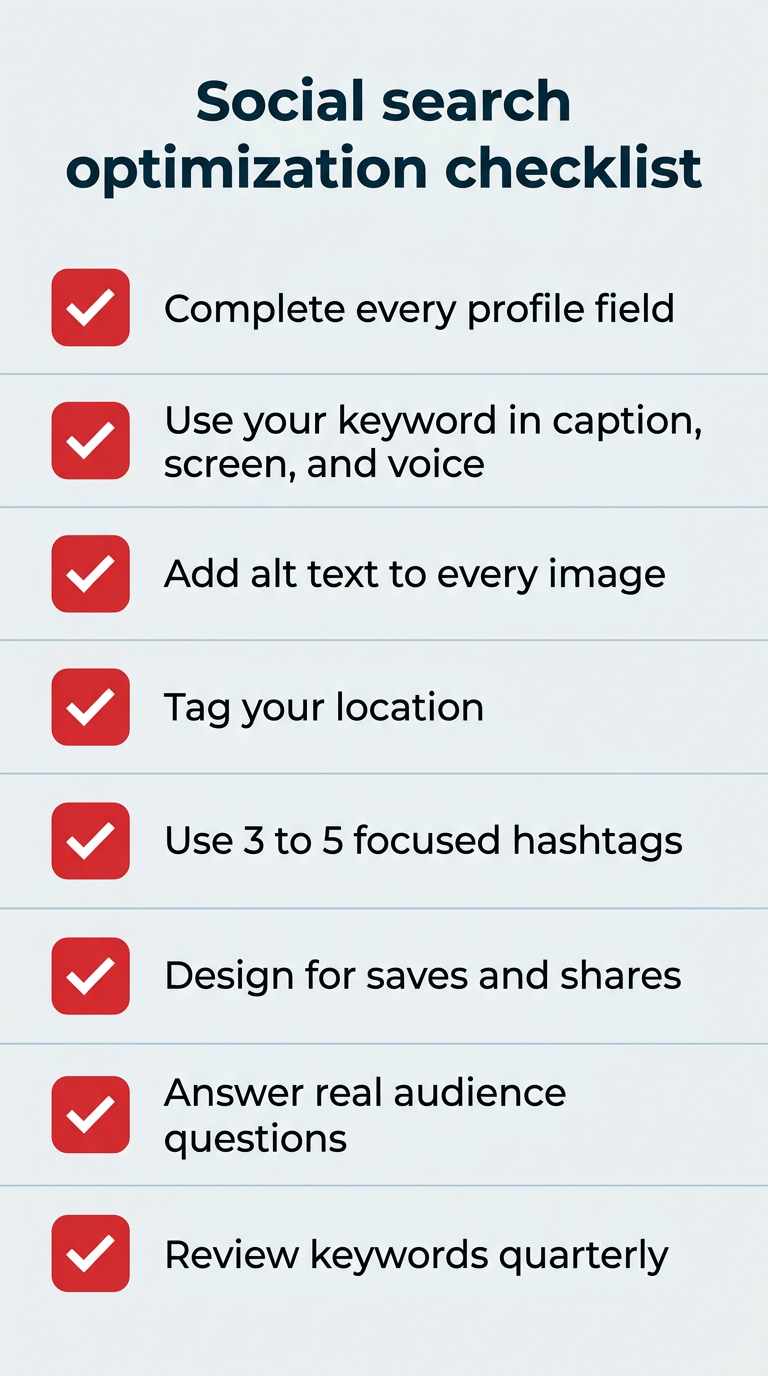
- Optimize Your Profile for Search: Your social media profile is a foundational asset. Ensure your name, handle, bio, and "About" sections are rich with relevant, descriptive keywords. Complete all available fields, including category, location, and contact information, and for professional platforms like LinkedIn, detail job titles and skills. The language used should mirror how your target audience searches.
- Use Keywords Naturally in Posts and Captions: Integrate relevant keywords seamlessly into your content. For video, this means incorporating them into captions, on-screen text, and spoken audio, as platforms transcribe content. Prioritize natural language that reflects user queries rather than internal product jargon (e.g., "waterproof hiking boots" over "all-weather trail footwear system").
- Leverage Location Tags, Hashtags, and Engagement Signals: Location tagging is an underutilized feature, particularly on TikTok, Facebook, and Instagram, enabling content to reach local or travel-planning audiences. Alt text, primarily an accessibility aid, also serves as an additional opportunity to describe content for algorithms. While hashtags remain useful for categorization, their role has narrowed; three to five specific, relevant tags are more effective than a multitude of broad ones. Crucially, engagement signals such as saves, shares, comments, and watch time are powerful indicators to platforms that content is valuable and relevant, significantly influencing its ranking.
Tools for Comprehensive Social Search and Monitoring
Navigating the fragmented social search landscape often requires a combination of tools.

- Lumen in Hootsuite Social OS: This integrated insights and listening application within Hootsuite provides essentials for social search. Its Quick Search feature helps discover trending topics, brands, and events globally, while deeper functionalities offer personalized insights into brand mentions, competitor activities, and keyword tracking across conversations. Being part of a unified social operating system streamlines the process from discovery to publishing.
- Google Advanced Search: Despite the rise of social search, Google remains a powerful tool. Its advanced search capabilities, including Boolean operators (AND, OR, NOT), site filters, and date ranges, can effectively pinpoint social content indexed by Google. For instance, searching
[influencer name] (site:instagram.com | site:facebook.com | site:tiktok.com)can reveal an influencer’s presence across multiple platforms. - Social Searcher: This multi-platform tool offers a free tier for quick spot checks of mentions, hashtags, and username searches across a selection of social networks and web sources. A paid premium subscription expands coverage and adds email alerts, serving as a reasonable tool for rapid cross-platform insights.
- Lumen by Talkwalker (Enterprise): For organizations with extensive monitoring needs, Lumen by Talkwalker offers an enterprise-grade solution. It monitors over 30 social networks and 150 million websites globally, providing visual and audio listening capabilities, historical data stretching back five years, and API access. Its AI can interpret human emotions, identify influential creators, and offer crisis management tools by flagging anomalies in social data.
Privacy and Ethical Considerations in Social Media Search
While searching publicly available social content constitutes legitimate research, the collection, storage, and utilization of this data are subject to platform rules and evolving privacy laws. Key considerations include:
- Data Collection Compliance: Adherence to the terms of service of each social platform and relevant data protection regulations (e.g., GDPR, CCPA).
- Public vs. Private Content: Distinguishing between publicly shared information and private communications, and respecting user privacy boundaries.
- Transparency and Consent: Ensuring that users are aware their public data may be used for analysis, and where applicable, obtaining explicit consent.
- Ethical Data Use: Avoiding the use of collected data for manipulative purposes, stereotyping, or discriminatory practices.
- Data Security: Implementing robust measures to protect collected data from breaches or unauthorized access.
- Legal Consultation: Engaging legal or compliance teams before scaling up monitoring activities to ensure all practices align with current regulations.
Conclusion: The Enduring Significance of Social Search
The evolution of social media platforms into robust search engines marks a pivotal moment in digital discovery. This transformation, driven by user preference and technological advancements, firmly establishes social search as an indispensable component of any comprehensive digital strategy. For brands, this means an ongoing commitment to understanding platform-specific algorithms, optimizing content for active queries, and leveraging social listening for competitive intelligence and audience insights. The convergence of social and traditional SEO is no longer a future trend but a present reality, requiring continuous adaptation, strategic investment, and an ethical approach to data utilization to effectively engage and grow audiences in the dynamic digital landscape.


 Jia Lissa

 Neng Nana