Muslim

The affiliate marketing landscape experienced a significant shift this month as PayPal Honey, one of the most prominent players in the digital coupon and rewards space, was removed from two of the largest affiliate networks in the United States. Rakuten Advertising and Impact.com, which facilitate billions of dollars in annual e-commerce transactions, took decisive action against the browser extension following allegations of non-compliance and unethical attribution practices. This development comes six years after PayPal’s landmark $4 billion acquisition of Honey, a deal that at the time represented the largest acquisition in the payment giant’s history and signaled a major push into the "top-of-funnel" shopping experience.
The removals were precipitated by high-profile investigations that raised questions about the technical operations of the Honey browser extension. Specifically, reports from investigative researcher Ben Edelman and technical analyst MegaLag provided evidence suggesting that Honey may have been engaging in "attribution manipulation." These investigations alleged that the extension was circumventing "stand-down" rules—industry-standard protocols designed to ensure that browser extensions do not overwrite the tracking cookies of other affiliates who had already introduced a customer to a brand. By allegedly ignoring these rules, Honey was accused of "hijacking" commissions that rightfully belonged to other content creators, influencers, and publishers.
A Chronology of Network Actions
The timeline of Honey’s removal unfolded during one of the busiest weeks for the performance marketing industry, coinciding with Affiliate Summit West, the premier North American conference for the sector. The timing of the announcements served to amplify the impact across the professional community.
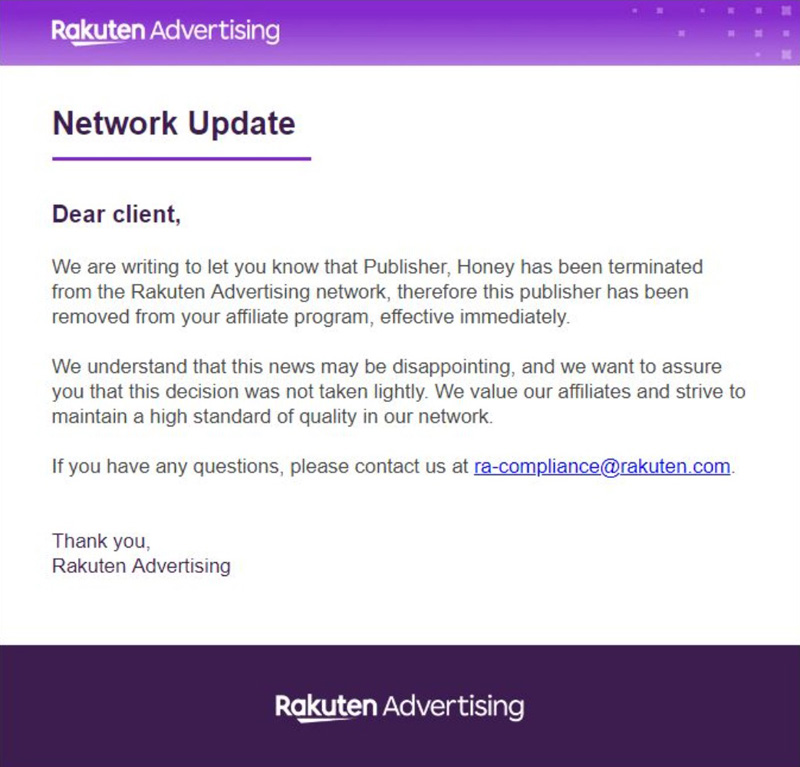
On Monday, January 12, Rakuten Advertising issued a formal announcement stating that Honey had been "terminated from the network." In its communication to advertisers and partners, Rakuten framed the move as a necessary measure to "maintain a high standard of quality" within its ecosystem. Unlike a temporary suspension, the language used by Rakuten suggested a definitive break, signaling that the network’s compliance team had found sufficient evidence of policy violations to warrant a full removal.
Four days later, on Friday, January 16, Impact.com followed suit. The network confirmed that Honey was found to be "out of compliance" with its platform policies. David A. Yovanno, CEO of Impact.com, addressed the situation by highlighting that the behavior in question undermined the fundamental trust required for a healthy "partnership economy." Impact.com specifically cited "attribution manipulation" as the primary driver for its decision. While Impact.com’s action was characterized as a removal from its "Discovery Marketplace" and a suspension rather than a permanent termination, the move effectively halted Honey’s ability to recruit new brand partners through the platform’s primary interface.
The Technical Catalyst: "Stand-Down" Violations and Link Hijacking
To understand the severity of these network actions, one must look at the mechanics of affiliate attribution. Most modern affiliate programs operate on a "last-touch" model, where the final affiliate to provide a tracking link before a purchase is made receives the full commission. This model is vulnerable to exploitation by browser extensions that can "fire" a click at the final moment of checkout, even if the customer was already referred by another source.

To prevent this, industry leaders established "stand-down" rules. These rules require that if a user reaches a merchant site through a different affiliate’s link, a browser extension must remain inactive. It should not offer coupons or activate a rewards button if doing so would overwrite the existing affiliate’s cookie. The investigations by Ben Edelman and MegaLag suggested that Honey employed sophisticated methods to bypass these detections, essentially concealing its activity to ensure it captured the "last click" regardless of the customer’s actual path to the site.
The implications of "concealed violations" are particularly damaging to the industry. When an extension hides its behavior, it prevents affiliate managers from accurately auditing their traffic. This leads to a scenario where brands pay commissions to Honey for sales that were already "won" by other publishers, effectively paying twice for the same conversion or diverting funds away from content creators who provided the actual value in the discovery phase.
Broader Industry Context and the APMA Audit
The controversy surrounding Honey is not an isolated incident but rather a flashpoint in a long-standing debate over the value of downloadable software publishers (DSPs). The Affiliate & Partner Marketing Association (APMA) recently conducted an independent audit in the United Kingdom to address these exact concerns. The audit examined 30 brands across 10 networks to evaluate how attribution rules—specifically stand-down protocols and "soft click" technologies—were being enforced.
The APMA’s findings highlighted the complexity of the issue, noting that while technology exists to regulate browser extensions, enforcement is often inconsistent. The study provided seven recommendations for the industry, emphasizing the need for greater transparency and more robust policing by both networks and individual brand managers. The Honey incident validates the APMA’s concerns, proving that even multi-billion-dollar entities are subject to scrutiny when their technical practices conflict with ecosystem integrity.
Strategic Implications for Affiliate Program Management
For affiliate managers and e-commerce directors, the Honey suspension offers several critical lessons in risk management and program health. Experts at AM Navigator and other leading consultancies suggest that relying solely on network-level compliance is no longer a viable strategy for major brands.
1. The "One Bad Apple" Effect
The presence of a non-compliant affiliate can have a toxic effect on an entire program. High-quality content publishers, such as niche bloggers and major media houses, often utilize sophisticated policing tools to see which other affiliates are active in a program. If they detect the presence of a "cookie stuffer" or an extension known for attribution manipulation, they may choose to abandon the program entirely. They recognize that their efforts to drive original traffic will likely be "stolen" at the checkout page, making the partnership unprofitable for them.
2. The Necessity of Independent Policing
While networks like Rakuten and Impact.com have compliance departments, their primary focus is often on network-wide policy violations rather than the specific Terms and Conditions (Ts & Cs) of an individual brand. Furthermore, networks may face a conflict of interest when dealing with high-volume affiliates that generate significant transaction fees. Brand managers are encouraged to perform their own audits, using third-party monitoring tools to ensure that extensions are respecting stand-down rules in real-time.
3. The Risk of Over-Generalization
Despite the actions against Honey, industry analysts caution against banning all browser extensions or software-based affiliates. Not all tools engage in deceptive practices; many provide legitimate incremental value through loyalty rewards or unique user experiences. The key is individual evaluation rather than categorical exclusion. By understanding the technical nuances of each partner, managers can foster a diverse ecosystem without exposing themselves to fraud.
The Importance of Base Diversification
Perhaps the most significant takeaway from the PayPal Honey fallout is the danger of affiliate concentration. Audits of many underperforming affiliate programs reveal a common "all-eggs-in-one-basket" scenario, where more than 80% of revenue is driven by a handful of coupon or loyalty extensions. When a major player like Honey is removed, these programs face an immediate and devastating revenue collapse.
To build a resilient program, brands are advised to diversify across a wide spectrum of affiliate types. A healthy 2026-ready affiliate strategy should include a mix of at least several of the following 28 categories:
- Content and Discovery: Content producers, mass media publishers, podcasters, and video marketers.
- Niche and Influence: Social media influencers, bloggers, and online communities/forums.
- Technological Solutions: Card-linked offers, post-checkout solutions, and retargeting tools.
- Loyalty and Niche Groups: Affinity groups, charities/fundraisers, and closed-user-group (CUG) solutions.
- B2B and Professional: Consultants, educators, and service providers.
- Search and Direct: Paid search affiliates (with strict trademark rules), email marketers, and brand advocates.
By spreading recruitment efforts across these diverse channels, brands ensure that the loss of a single large partner—no matter how significant—does not cripple their performance marketing channel.
Conclusion: A Turning Point for Transparency
The removal of PayPal Honey from Rakuten and Impact.com marks a pivotal moment for the affiliate marketing industry. It serves as a reminder that even the largest and most well-funded players are not immune to the rules of the ecosystem. As the "partnership economy" continues to mature, the emphasis is shifting away from raw volume and toward "incremental value"—the proof that an affiliate actually influenced a customer’s decision to buy, rather than simply appearing at the moment of payment.
For PayPal, the suspension of Honey represents a significant PR and operational challenge. Having invested $4 billion into the platform, the company must now navigate a landscape where its primary growth engine is being questioned by the very networks that facilitate its revenue. For the rest of the industry, this event is a call to action: a mandate for better policing, clearer attribution rules, and a commitment to the fair play that allows the affiliate model to thrive. Moving into the latter half of the decade, the brands that succeed will be those that prioritize transparency and diversity over the easy, but often illusory, wins provided by non-compliant software.


 Nila Kartika Wati

 Ali Ikhwan