Dwi Wanna
A common misconception in the world of e-commerce and business growth is that scaling inevitably requires a proportional increase in headcount and marketing expenditure. However, a closer examination of highly profitable businesses reveals a compelling counter-narrative: operational leanness and strategic financial management often serve as more potent drivers of profitability than aggressive marketing campaigns. This article delves into the strategies employed by successful business owners who prioritize efficiency and fiscal intelligence, demonstrating how these "unsexy" levers can yield significantly higher returns and reduced stress.

The traditional business growth playbook often emphasizes expanding revenue through increased sales, which in turn necessitates a larger team to handle operations and a more substantial marketing budget to drive that revenue. This linear progression, while intuitive, can lead to what is colloquially termed "growth for growth’s sake," where increased revenue does not translate into proportionally higher profits, and operational complexity becomes a significant burden. The experience of a small business owner, who wishes to remain anonymous but whose story has resonated within industry circles, exemplifies this dilemma. This individual managed a team of 35 employees, operating a business with solid revenue streams. Despite this apparent success, profitability remained consistently tighter than desired, and the owner experienced chronic stress due to the demands of managing such a large workforce, a task that consumed considerable time and energy on top of the core business operations.
In response to this persistent challenge, the owner made a series of strategic and often difficult decisions. The business transitioned to a remote operational model, outsourced its warehousing and fulfillment to a third-party logistics (3PL) provider, and significantly restructured its workforce. The majority of full-time employees were replaced by a more agile team of freelancers and independent contractors. The outcome of these changes was a dramatic transformation: the business now operates with just one full-time employee and a team of eight contractors. This leaner structure has resulted in unprecedented profit margins and a significant reduction in the owner’s stress levels. This anecdotal evidence challenges the prevailing notion that scaling automatically equates to increasing headcount.

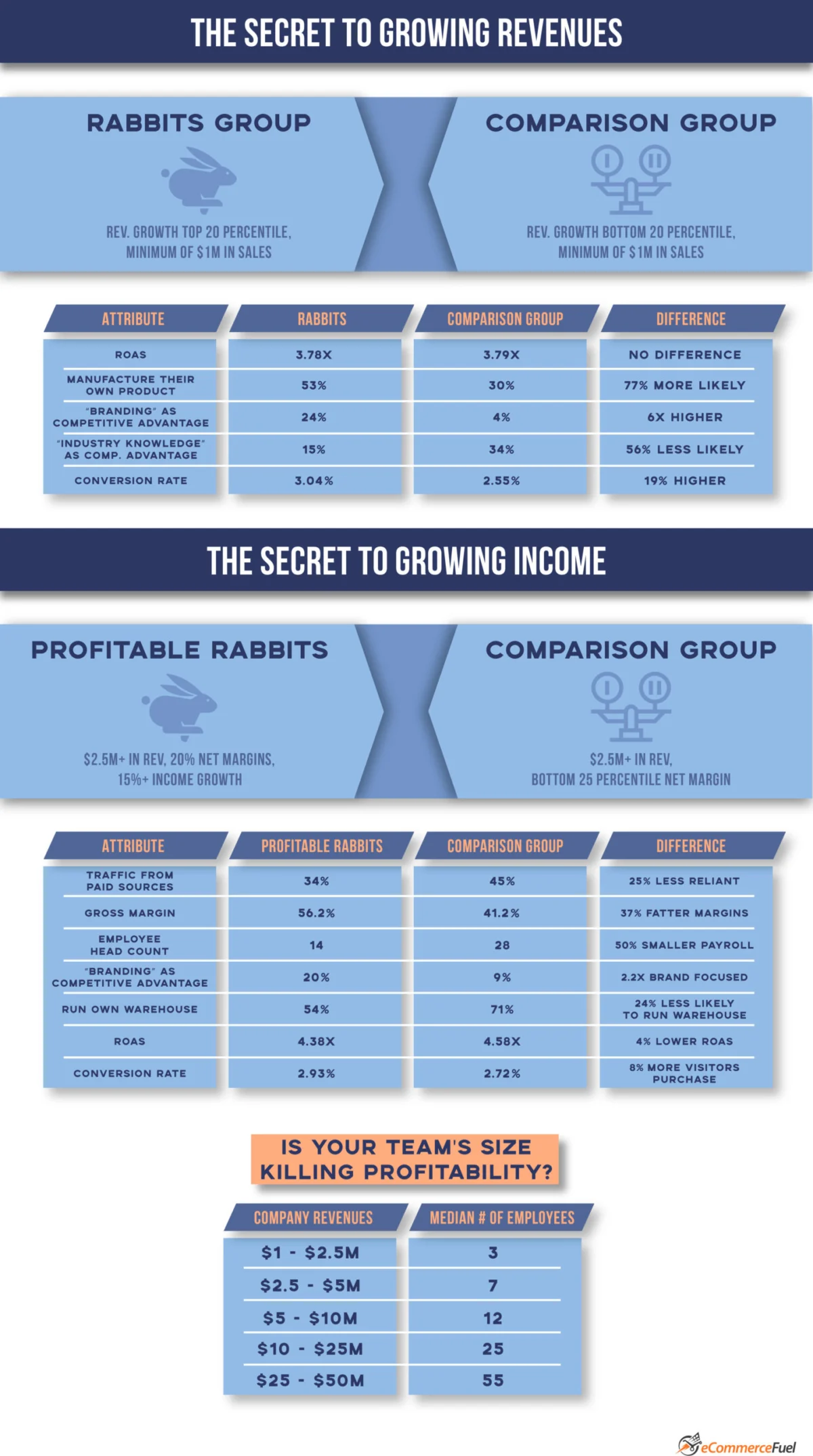
Further substantiating this perspective, research conducted by eComFuel, an organization that analyzes e-commerce business performance, provides empirical data. A comprehensive study of hundreds of businesses revealed that the primary differentiator between highly profitable and struggling ventures was not marketing prowess. The study found negligible differences in Return on Ad Spend (ROAS) between top and bottom performers. Businesses excelling in profitability were not necessarily more adept at leveraging platforms like Facebook Ads or SEO. Instead, the key differentiator was operational efficiency.
The research highlighted two critical findings: top-performing businesses maintained payrolls that were, on average, half the size of their less profitable counterparts. Furthermore, these successful ventures were 25% more likely to outsource their warehouse operations and were 25% less reliant on paid traffic for customer acquisition. This data strongly suggests that "operational leanness" is a more decisive factor in achieving profitability than sophisticated marketing tactics. The implications are profound: businesses that focus on optimizing their internal processes and external dependencies can achieve superior financial results, even with a less aggressive marketing approach.

The concept of "lean" in business extends far beyond simply reducing headcount. It encompasses a holistic review of all operational overheads. This includes scrutinizing expenses such as maintaining large, underutilized office spaces, particularly in the post-pandemic era where remote work has become more prevalent. Similarly, the cost of operating in-house fulfillment centers can often be higher than partnering with specialized 3PLs, which can offer economies of scale and more efficient logistics. Hidden costs also lurk in subscription-based software services (SaaS) that auto-renew, accumulating unnoticed over time. A critical filtering mechanism for identifying areas of potential leanness is to assess what functions are truly core to a brand’s unique value proposition. For instance, if a brand’s competitive advantage lies in its distinctive product design, retaining in-house design talent might be justifiable. However, if the core competency is not packing and shipping, then outsourcing fulfillment becomes a logical step towards greater efficiency. Successful business owners are not merely cutting costs indiscriminately; they are making deliberate decisions about where to allocate resources based on strategic importance.
The pursuit of operational leanness and enhanced profitability often necessitates engaging in "hard conversations," a concept often discussed in leadership circles. These are the difficult discussions that leaders frequently postpone until faced with an unavoidable crisis, such as an economic downturn, cash flow shortages, or a critical decline in profitability that threatens the business’s survival. However, the owners who consistently achieve high profits are those who proactively initiate these conversations. They engage in rigorous self-assessment, questioning the necessity of certain roles, evaluating the true value of recurring software subscriptions, and identifying potential areas for significant cost reduction. For example, a business owner might ask, "Do we truly need this position, or was it an impulse hire driven by a feeling of busyness?" or "Are we paying for this tool out of necessity or simply out of habit?" By posing these questions and acting upon the answers, they implement strategic cuts not out of desperation, but as a deliberate measure to optimize performance.

Beyond operational efficiency, a second, often overlooked lever for enhancing profitability lies in strategic tax planning. Many business owners, much like the anonymous store owner in the initial anecdote, tend to view taxes as a fixed cost, a percentage of income to be paid without much deeper consideration. However, a closer examination reveals that highly profitable individuals often pay a significantly lower effective tax rate than their peers, not through illicit means, but through intentional and strategic financial planning.
Consider a comparative scenario involving two hypothetical e-commerce owners, each generating $2.5 million in revenue and $250,000 in profit, with identical personal circumstances (married with three children) and drawing the same salary. Assuming a marginal tax rate of approximately 30%, one owner (Owner A) might pay $75,000 in taxes annually. The other owner (Owner B), however, strategically manages their tax liabilities and pays only $21,000, a difference of $54,000 per year. This substantial disparity is achieved through a series of deliberate actions:

- Profit Sharing Contributions: Owner B contributes $45,000 to retirement accounts through profit-sharing plans, exceeding standard 401(k) limits. This yields approximately $13,500 in annual tax savings.
- Appreciated Stock Donations: Instead of donating cash to charities, Owner B donates stock that has appreciated in value. This strategy allows them to avoid capital gains tax on the stock’s growth and still receive a full deduction for its fair market value, saving approximately $3,500 annually.
- Maximized Health Savings Account (HSA): Owner B contributes the maximum family limit of $8,500 to their HSA. Funds in an HSA offer triple tax advantages: tax-deductible contributions, tax-free growth, and tax-free withdrawals for qualified medical expenses, resulting in savings of roughly $2,550.
- Paying Children for Work: Owner B employs their three children for legitimate tasks within the business, paying each $7,000 annually. These payments are deductible for Owner B and are invested by the children into Roth IRAs, allowing for tax-free growth over decades. This strategy generates savings of approximately $6,300.
- Inventory Donations: Owner B identifies $60,000 worth of slow-moving inventory. Instead of liquidating it at a loss, they donate it to a qualified charity, claiming a deduction at its fair market value. This single action can generate significant tax savings, estimated at $18,000 in this scenario, and is a massively underutilized strategy in e-commerce.
The reason these tax-saving opportunities often remain invisible to many business owners is the fragmented nature of tax reporting. Personal returns, business filings, brokerage statements, and payroll tax reports are often handled separately, precluding a comprehensive view of an individual’s overall tax liability. Without a consolidated dashboard, business owners may not fully grasp their total tax expenditure, nor consider avenues for reduction. While Owner A might have a competent accountant who ensures compliance, such accountants may not proactively identify and suggest these strategic tax-saving strategies. They process information rather than proactively strategize.
A simple test to evaluate one’s tax advisor is to consider when they last proactively offered a strategic suggestion. If the accountant’s role has been limited to answering questions and filing returns, it may indicate a passive approach. While this ensures accuracy, it can lead to significant missed opportunities, as demonstrated by the $54,000 difference in tax liability between the two hypothetical owners. The key differentiator is not complexity, but intentionality. If a CPA is not actively bringing forward innovative ideas, it may be time to seek a professional who will.

In conclusion, while marketing efforts and customer acquisition strategies rightfully receive considerable attention in the business world, the owners who achieve exceptional profitability often focus on two less glamorous, yet profoundly impactful, levers: operational leanness and strategic tax planning. By optimizing their workforce, outsourcing non-core functions, scrutinizing overheads, and proactively managing their tax liabilities, these entrepreneurs ensure they retain a significantly larger portion of the revenue they generate. This approach underscores the principle that while acquiring new customers is important, keeping more of what is already earned often represents a more effective and sustainable path to long-term financial success and reduced business stress.


 Nila Kartika Wati

 Reynand Wu