Siti Muinah

The affiliate marketing industry, a multi-billion dollar ecosystem built on the principles of performance-based partnerships, was sent into a state of flux during the second week of January 2026. In a series of rapid developments that have sent ripples through the digital commerce sector, PayPal Honey—the coupon-aggregating browser extension acquired by PayPal for $4 billion in 2020—has been removed or suspended from two of the most prominent affiliate networks in the United States: Rakuten Advertising and impact.com. These actions follow intensive investigations into the extension’s technical operations, specifically regarding attribution manipulation and the violation of industry-standard "stand-down" protocols.
The removals represent a significant turning point for the industry, marking one of the first times a major, multi-billion-dollar publisher has been held to such high-profile account for non-compliance. The fallout from these decisions is expected to reshape how brands interact with browser extensions and how affiliate networks enforce transparency and trust within their marketplaces.
Background and the Mechanics of the Controversy
To understand the gravity of PayPal Honey’s removal, one must first look at the mechanics of the affiliate marketing "last-click" attribution model. In most modern affiliate programs, the affiliate that provides the final "touch" or click before a consumer completes a purchase is the one that receives the commission. This model creates a competitive environment where publishers strive to be the final step in the consumer journey.
However, browser extensions like Honey operate within the user’s browser itself, allowing them to intervene at the very moment of checkout. To maintain a fair playing field, the industry established "stand-down" rules. These rules mandate that if another affiliate (such as a content creator, blogger, or review site) has already dropped a tracking cookie on the user’s device, the browser extension should "stand down" and not fire its own tracking link. This ensures that the original affiliate—the one who likely did the heavy lifting of introducing the consumer to the product—is not unfairly stripped of their commission.
The catalyst for the current crisis was a series of detailed investigations. Technical analysts and industry watchdogs, most notably the investigator known as MegaLag and the renowned consumer advocate Ben Edelman, produced evidence suggesting that PayPal Honey was engaging in "attribution manipulation." Specifically, the investigations alleged that Honey was violating stand-down rules, effectively "hijacking" the attribution from other affiliates by firing its own links even when other tracking cookies were present, and in some cases, using concealment techniques to mask this behavior from network auditors.
A Chronology of the Removal
The timeline of Honey’s removal unfolded during one of the busiest weeks in the affiliate marketing calendar, coinciding with the Affiliate Summit West conference in Las Vegas.
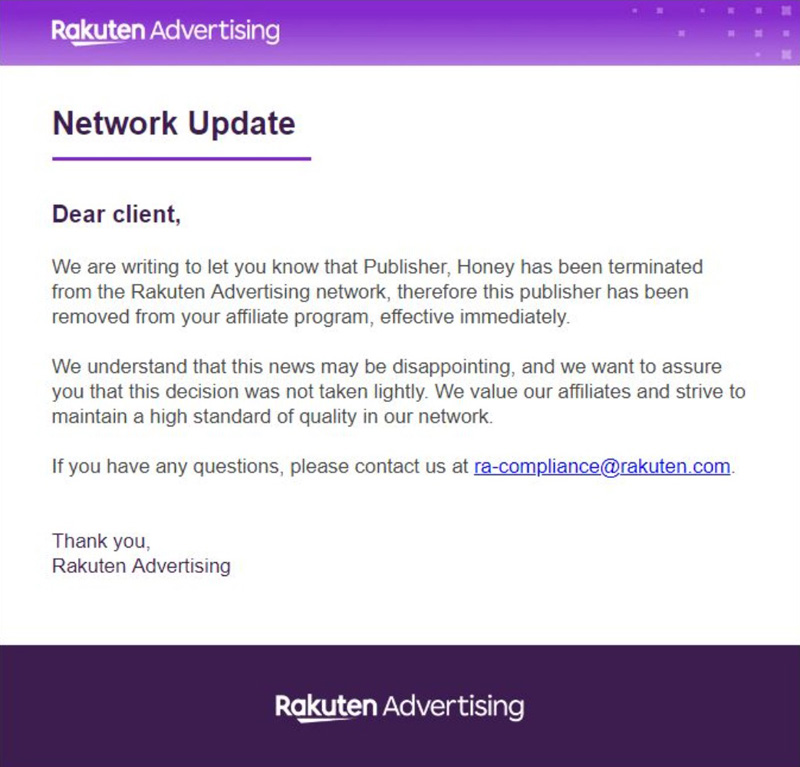
On Monday, January 12, 2026, Rakuten Advertising—a global leader in performance marketing—issued an official announcement stating that Honey had been "terminated from the network." The network’s statement was concise but firm, framing the termination as a necessary measure to "maintain a high standard of quality" within its ecosystem. The timing was noted by many industry insiders as a strategic "PR play," ensuring that the news would be the primary topic of conversation among the thousands of marketers gathered for the summit.

By the end of the week, on Friday, January 16, 2026, the second blow fell. Impact.com, another titan in the partnership management space, announced that Honey was "out of compliance" with its platform policies. David A. Yovanno, CEO of impact.com, explicitly cited "attribution manipulation" as the core reason for the action. While impact.com characterized the move as a suspension from their "Discovery Marketplace" rather than a permanent total removal, the message was clear: the platform would no longer facilitate Honey’s access to its vast network of brands until compliance could be guaranteed.
The Financial Stakes: From Acquisition to Scrutiny
The removal of Honey is particularly noteworthy given its pedigree. When PayPal acquired Honey Science Corp in early 2020 for $4 billion, it was the largest acquisition in PayPal’s history. At the time, Honey boasted over 17 million monthly active users and partnerships with 30,000 retailers. PayPal’s goal was to move further up the "commerce funnel," engaging with consumers during the discovery and deal-seeking phase rather than just at the point of payment.
However, the very features that made Honey valuable—its ability to automatically find and apply coupons—became the source of its regulatory and network-level friction. For merchants, the "incremental value" of coupon extensions has long been a subject of debate. If a customer is already at the checkout page with items in their cart, does the extension actually drive a new sale, or does it simply reduce the merchant’s margin while taking a commission that might have belonged to a content creator?
The 2026 investigations suggested that the problem went beyond mere lack of incrementality. If the allegations of concealment and stand-down violations are accurate, it implies a systematic effort to capture revenue by undermining the technical safeguards of the affiliate networks themselves.
Supporting Data and the APMA Audit
The controversy surrounding Honey does not exist in a vacuum. The Affiliate & Partner Marketing Association (APMA) in the United Kingdom recently conducted an extensive independent audit that sheds light on the technical complexities of these issues. The audit involved 30 brands across 10 different networks and analyzed the behavior of various affiliate types.
The APMA’s findings highlighted a significant distinction between "stand-down" rules and "soft clicks." While many networks have policies in place to prevent extensions from overwriting cookies, the audit revealed that enforcement is often inconsistent. The APMA provided seven key recommendations for the industry, emphasizing the need for better transparency in how browser extensions fire their scripts.
Furthermore, data from the Performance Marketing Association (PMA) suggests that "Downloadable Software Publishers" (DSPs), which include browser extensions, have become a dominant force in the industry. However, this dominance has come at the cost of diversity. In many audited programs, it was found that a single extension could account for upwards of 50% of a program’s total affiliate-referred revenue, creating a dangerous "all eggs in one basket" scenario for brands.
Implications for Affiliate Management and Brand Safety
The removal of PayPal Honey serves as a case study for affiliate managers worldwide. Experts at AM Navigator and other leading consultancies have identified several critical lessons that brands must learn from this event.
1. The "Bad Apple" Effect on Program Health
The presence of a non-compliant affiliate does more than just drain commissions; it actively discourages high-quality content creators from participating in a program. Savvy affiliates, such as major media houses and niche influencers, use sophisticated tools to monitor clickstreams. If they perceive that their commissions are being consistently hijacked by a browser extension, they will often cease promotion or leave the program entirely.
2. The Necessity of Independent Policing
The Honey incident has demonstrated that brands cannot rely solely on affiliate networks to monitor compliance. While networks like Rakuten and Impact eventually took action, investigations by independent parties like Ben Edelman were the primary drivers of the discovery. Brands are now being urged to draft more robust Terms and Conditions (Ts & Cs) and to actively use third-party monitoring tools to verify that their partners are playing by the rules.
3. The Push for Diversification
The sudden removal of a major publisher like Honey can lead to a catastrophic drop in reported revenue for programs that are over-reliant on a single affiliate type. Industry analysts are now pushing for a more holistic approach to recruitment, suggesting that brands explore at least 28 different types of affiliates—ranging from podcasters and sub-affiliate networks to card-linked offers and "Closed User Group" (CUG) solutions—to ensure a resilient and balanced portfolio.
Official Responses and Industry Reactions
While PayPal has remained relatively quiet regarding the specifics of the technical allegations, the move has triggered a broader conversation about the future of browser-based shopping tools. Critics argue that the "convenience" offered by such tools should not come at the expense of transparency.
Representatives from Rakuten Advertising emphasized that their decision was rooted in the integrity of the "partnership economy." By removing Honey, they signaled to other publishers that even the largest players are not exempt from the rules. Impact.com’s leadership echoed this sentiment, stressing that trust is the fundamental currency of affiliate marketing.
On social media and industry forums, the reaction has been a mix of vindication and caution. Many smaller affiliates who felt they had been losing commissions to "cookie-stuffing" extensions for years welcomed the news. Conversely, some agencies expressed concern about the immediate revenue gap the removal would create for their clients, highlighting the painful reality of transitioning away from high-volume, low-incrementality partners.
Analysis of Broader Industry Impact
The PayPal Honey saga is likely to lead to a "great reset" in how browser extensions are treated within the affiliate ecosystem. We can expect several long-term shifts:
- Standardized Stand-Down Protocols: There will likely be a push for industry-wide technical standards that are audited by third parties, ensuring that extensions cannot fire scripts unless specific conditions are met.
- Shift Toward Multi-Touch Attribution: The "last-click" model is under more scrutiny than ever. Networks may accelerate the adoption of multi-touch attribution models that split commissions among all affiliates who contributed to the sale, reducing the incentive for "attribution hijacking."
- Increased Due Diligence in M&A: PayPal’s $4 billion acquisition is now being viewed by some as a cautionary tale. Future acquisitions of affiliate-tech companies will likely involve much deeper technical audits of compliance and "stand-down" behaviors.
As the industry moves through 2026, the removal of PayPal Honey from Rakuten and Impact will be remembered as the moment the "partnership economy" decided to prioritize the quality of the click over the quantity of the conversion. For affiliate managers and brands, the message is clear: transparency and diversification are no longer optional; they are the requirements for survival in a maturing digital marketplace.


 Basiran

 Neng Nana