Nana Muazin

Creative testing has long been a cornerstone of modern advertising, providing valuable insights into which ad variations resonate most effectively with target audiences. However, a critical gap often persists: translating these performance metrics into actionable intelligence that genuinely shapes future creative production. While identifying a “winning ad” is a significant achievement, the true opportunity lies in dissecting why it succeeded, enabling brands to build a more robust and responsive creative strategy. As artificial intelligence accelerates the pace of creative iteration and testing, this fundamental challenge becomes even more pronounced, demanding a more sophisticated approach to learning from every campaign.
The traditional reliance on asset-level comparisons, where entire ads are pitted against each other, offers a superficial understanding of creative effectiveness. A winning advertisement is a complex interplay of numerous elements: the initial hook, the core message, the visual aesthetics, the choice of creator or influencer, the format, and the call to action. When only the overall performance of a complete ad is considered, it becomes exceedingly difficult to pinpoint which specific component was the primary driver of success. This ambiguity hinders the ability to inform subsequent creative briefs with the granular insights needed for continuous improvement. Brands are left with a clear directive on where to allocate their budget for immediate campaigns, but a significant void in understanding the underlying mechanisms of consumer engagement.
The Peril of Treating the Winning Ad as the Sole Insight
The temptation to replicate a successful ad by simply creating more assets that look and feel similar is a common, yet often misguided, strategy. This approach fails to acknowledge that a winning ad’s success may be attributable to a single, powerful element, or a specific combination of elements, that can be isolated and leveraged independently. Without dissecting the ad into its constituent parts, brands risk a superficial replication that doesn’t address the root cause of its performance.
For instance, imagine a scenario where A/B testing reveals that an ad featuring a product close-up in its opening seconds consistently outperforms one that begins with a lifestyle-oriented introduction. Knowing that the product-focused hook is a winner is far more valuable than simply identifying which of the two ads garnered more clicks or conversions. This granular insight empowers creative teams to retain that compelling opening structure while exploring variations in the accompanying message, the choice of influencer, or the format, thereby building upon a proven success factor. This iterative process, grounded in element-level analysis, allows for strategic experimentation rather than blind replication.
The Crucial Distinction: Isolating Variables for Deeper Learning
The critical distinction lies in moving beyond simply identifying the winning ad to understanding the winning elements within that ad. This requires a shift in methodology, from holistic ad comparison to a more granular analysis of individual creative components. By breaking down performance data by specific elements – such as the hook, message theme, visual style, or call to action – brands can begin to identify which creative choices are consistently contributing to desired outcomes and which are less impactful.
This detailed analysis enables a more strategic approach to future creative development. If a particular type of hook, for example, demonstrably captures audience attention more effectively across multiple tests, this becomes a valuable asset for future campaigns. The creative team can then focus their efforts on refining other aspects of the ad, such as the message or visual treatment, around this proven successful hook. This intelligent application of learnings prevents the dilution of effective elements by ensuring they are not inadvertently altered or removed in a wholesale redesign.
The danger of not isolating variables is evident when multiple creative elements are changed simultaneously between testing rounds. If a new ad alters the hook, message, format, and visual treatment all at once, it becomes virtually impossible to ascertain which specific change, or combination of changes, led to any observed performance shift. This lack of clarity perpetuates a cycle of uncertainty, where brands may discard effective elements unknowingly or cling to ineffective ones without realizing it.

Context is King: The Interplay of Elements, Audience, and Platform
While identifying a successful creative element is a significant step, its performance is rarely independent of its context. The same hook, message, or visual approach can yield dramatically different results depending on the target audience, the platform on which it is displayed, and the specific objective of the campaign. Therefore, a comprehensive understanding of creative effectiveness necessitates a deep dive into these contextual factors.
Audience understanding must be woven into the fabric of both the initial creative brief and the subsequent performance analysis. Before any creative work commences, teams must possess a clear picture of the intended audience: their existing perceptions, their unmet needs, and the specific barriers that the creative needs to overcome. Once the creative is live, testing becomes the mechanism to validate whether it is resonating with the intended audience and whether the initial assumptions about them were accurate.
Often, the most illuminating findings emerge from unexpected results. Creative developed for one audience segment might consistently over-index with another, revealing a previously unrecognized audience opportunity. Conversely, a creative approach that has proven successful elsewhere might falter with a new audience if the message fails to address their specific concerns or values, even if the execution itself is technically sound.
This nuanced understanding allows for highly specific learnings: which elements work, for whom, under what conditions, and in relation to which specific objectives. This contextual intelligence is paramount when deciding whether a successful approach can be broadly applied across different audiences or if the next creative brief requires a fundamentally different strategic direction.
Transforming Creative Intelligence into Tangible Production Decisions
A significant hurdle for many brands is the disconnect between possessing useful performance insights and effectively integrating them into the subsequent stages of creative production. It is not uncommon for creative performance reviews to occur late in the campaign cycle, by which time the next brief may already be drafted or the production plan for future assets finalized. By the time the team has a clear understanding of what worked, the window of opportunity to apply those learnings may have already closed.
The key challenge, therefore, is to embed this intelligence into the creative process at an early stage, thereby influencing what actually gets made. This necessitates fostering closer collaboration between creative and media teams, united by a shared understanding of the learning objectives for each campaign. Crucially, the findings from one round of testing must be readily accessible and actively considered when planning the next.
This collaborative approach fundamentally alters the nature of the decisions that creative teams can make. Instead of relying on intuition or generalized best practices, they can draw upon empirical data to guide their creative choices. This shift empowers them to be more strategic and less reactive, ensuring that each new creative output is informed by a rich history of performance data.
To operationalize this consistently, robust systems for capturing and reusing learned insights are essential. Creative elements need to be meticulously tagged, allowing for the comparison of hooks, messages, formats, creators, and audience segments across a multitude of executions. These findings must then be accessible beyond the confines of individual campaigns, enabling the identification of overarching patterns across different channels, markets, and time periods.
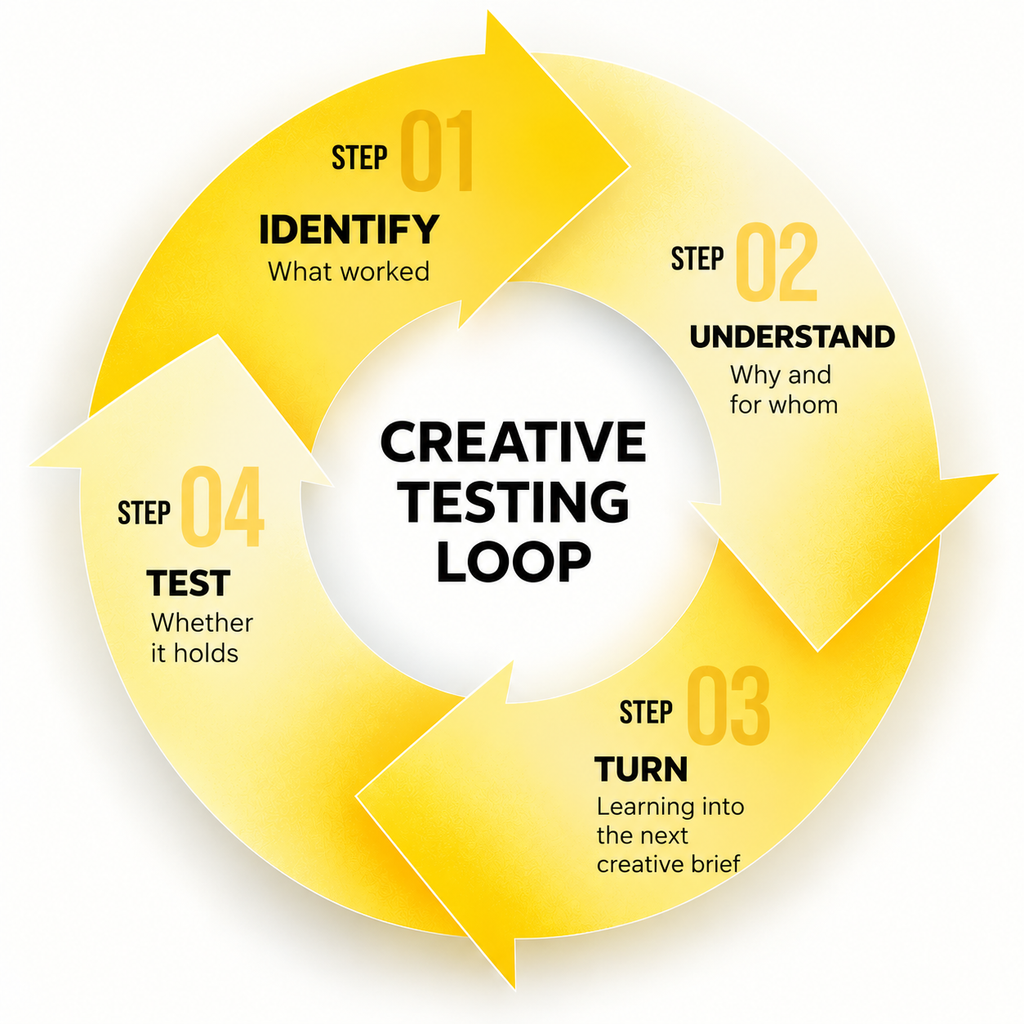
The next creative brief should be a direct beneficiary of this accumulated knowledge. It should begin by posing critical questions: What have we definitively established through previous testing? Which assumptions still require validation? Where are the evident gaps in our current creative portfolio? And what specific knowledge should the next round of creative endeavors aim to uncover? This proactive approach ensures that creative testing becomes a forward-looking driver of innovation, rather than a post-hoc explanation of past performance.
AI as an Accelerator for the Creative Feedback Loop
The advent of artificial intelligence has dramatically amplified the potential of this iterative approach to creative development. Brands can now produce and test an unprecedented volume of creative variations at a speed that was previously unimaginable. A single conceptual idea can be rapidly adapted across multiple formats, target audiences, and product offerings, presenting teams with a wealth of opportunities to test specific elements and build upon accumulated learnings.
However, a mere increase in the volume of creative assets does not automatically translate to enhanced learning. A brand could launch 100 AI-generated assets and identify the top five performers based on return on ad spend (ROAS) without gaining a deeper understanding of the underlying factors that contributed to their success. The true opportunity lies in utilizing this expanded production capacity with deliberate intent. This means retaining a successful hook while experimenting with different messaging strategies, exploring whether a proven concept resonates with a new audience segment, or adapting an effective execution across various placements without compromising the core elements that made it successful.
While AI can significantly accelerate the production and analysis phases, the responsibility for strategic decision-making remains with human teams. Creative teams must still define the crucial questions that warrant investigation, interpret the nuances of audience and cultural context, and ultimately determine how these findings will shape the next creative brief. As production capabilities accelerate, the value of a clear, strategic understanding of what you are trying to learn becomes increasingly paramount.
Building a Purposeful Creative Portfolio
As brands increasingly invest in generating more creative content, the central challenge shifts to directing that effort effectively. A well-designed testing program should equip teams with the knowledge to identify which hooks consistently capture audience attention, which messages resonate most profoundly with diverse demographics, which creators effectively build credibility, and which elements can be seamlessly adapted across different channels without diminishing their impact.
More significantly, these findings should actively inform the direction of future production. If testing reveals that the existing creative portfolio lacks strong audience-specific messaging, requires a different creative format, or needs an entirely new conceptual framework, the subsequent creative brief must reflect these identified needs. Similarly, if a particular creative element consistently drives superior results, teams should possess a clear strategy for extending its value without resorting to mere replication of the same execution.
Creative teams will continue to play an indispensable role in interpreting culture, conceiving innovative ideas, and shaping how a brand presents itself to the world. However, the integration of creative intelligence provides them with more robust evidence upon which to base their decisions, enabling them to allocate their time and creative resources more strategically and effectively.
Ultimately, this is the elevated objective that should guide our expectations of creative testing. We have largely mastered the art of identifying the winning advertisement. The more profound and impactful opportunity lies in harnessing the intelligence gleaned from those successes to strategically define the future needs of a brand’s creative portfolio.

 Sagoh
 Laily UPN