This week’s curated list of new services for merchants includes updates on agentic commerce, product review pages, email marketing, multichannel selling, local commerce, omnichannel marketing, returns management, WordPress development, and cross-border commerce.
The Evolving Landscape of E-commerce: A Week of Strategic Merchant Service Advancements
The e-commerce sector continues its rapid evolution, driven by technological advancements and shifting consumer expectations. This past week has seen a significant influx of new and enhanced services designed to empower merchants across various facets of their operations. From the nascent field of agentic commerce to established needs like multichannel selling and global expansion, businesses are being equipped with tools to navigate an increasingly complex digital marketplace. Key developments highlight the growing influence of artificial intelligence, the imperative for seamless omnichannel experiences, and the ongoing efforts to streamline cross-border transactions and local engagement.
AI-Powered Commerce Takes Center Stage
Artificial intelligence is no longer a future concept but a present reality shaping the e-commerce landscape. This week’s announcements underscore the burgeoning trend of "agentic commerce," where AI agents are designed to proactively assist consumers through the buying journey.
Meta’s Muse AI Agent Integrates with PayPal and Shopify, Ushering in a New Era of Automated Shopping
Meta has partnered with PayPal and Shopify to integrate its personal AI agent, Muse, into their respective platforms. Muse, which has rapidly climbed the ranks of Apple’s App Store, operates by acting on user instructions, allowing shoppers to streamline the purchasing process by minimizing manual steps. This collaboration signifies a pivotal moment for agentic commerce, promising to redefine how consumers interact with online retail.
PayPal’s integration with Muse will support transactions initiated through the AI agent, ensuring a secure and familiar payment experience. Concurrently, Shopify’s collaboration will enable agentic checkout capabilities via Shop Pay, the company’s proprietary payment service. This integration is expected to significantly reduce cart abandonment rates by simplifying the checkout process and allowing AI agents to handle transactional details on behalf of the user. The implications for conversion rates and customer satisfaction are profound, as the friction points in online purchasing are significantly diminished.
The development of AI agents capable of navigating complex purchase flows reflects a broader trend toward personalized and automated customer experiences. As these agents become more sophisticated, their ability to understand nuanced consumer intent and execute multi-step transactions will become a critical differentiator for e-commerce platforms. This move by Meta, PayPal, and Shopify positions them at the forefront of this emerging technology, setting a benchmark for future integrations.
Baselayer Secures $35 Million for Agentic Identity Technology, Fueling AI Agent Growth

Further bolstering the AI agent ecosystem, Baselayer, a company specializing in identity and risk infrastructure, has successfully raised $35 million in a Series A funding round led by M13. Baselayer, which already serves financial institutions and payment companies, is now extending its robust infrastructure to support autonomous AI agents. This funding will be instrumental in developing the secure and reliable identity verification systems that are crucial for AI agents to operate safely and effectively in transactional environments.
The company’s existing partnerships with entities like Fidelity Information Services and Prove Identity demonstrate its established credibility in handling sensitive data. By applying this expertise to the nascent field of AI agents, Baselayer aims to build the foundational trust necessary for these agents to manage financial transactions, authenticate users, and perform other critical functions. This development is vital for the widespread adoption of AI agents, as consumer confidence in the security and integrity of AI-driven transactions will be paramount.
Yuma Launches AI Voice Agent for Live Customer Support Calls, Enhancing Real-Time Issue Resolution
Yuma AI, a customer support platform for e-commerce, has launched Voice AI, an innovative solution that extends its AI support agent’s capabilities to include phone calls. This new offering allows the AI agent to handle live customer support interactions, identify callers, retrieve order history, and execute a range of actions, including address corrections, order cancellations, item removals, refunds, and subscription updates. The AI agent provides verbal confirmation of each change to the customer, ensuring clarity and transparency. All calls are recorded and transcribed, feeding valuable data into the merchant’s helpdesk.
The introduction of Voice AI addresses a critical need for efficient and scalable customer support in the e-commerce space. By automating routine tasks and providing instant resolutions during live calls, businesses can significantly reduce wait times, improve customer satisfaction, and free up human agents to handle more complex inquiries. This technology is particularly impactful for managing high volumes of customer service requests, especially during peak sales periods. The ability of the AI to perform these actions in real-time demonstrates a significant leap in conversational AI’s practical application in customer service.
Expanding Reach and Streamlining Operations: Multichannel and Local Commerce Innovations
Merchants are increasingly seeking ways to connect with customers across a multitude of channels and to enhance their presence in local markets. This week has brought forth several solutions designed to address these critical business needs.
Amazon Launches Multichannel Selling Tools in Seller Central, Unifying External Sales Channels
Amazon has introduced new multichannel selling tools within its Seller Central platform, empowering merchants to manage listings, orders, and profitability across all their external sales channels. Sellers can now connect their accounts from platforms such as eBay, Shopify, TikTok, and Walmart directly to Seller Central, with plans to integrate more channels in the future. A key feature of this new capability is that off-Amazon data remains secure and private, accessible solely to the seller. This move by Amazon aims to consolidate the seller experience, providing a more unified view of sales performance and inventory management, thereby reducing the operational complexity of managing multiple online storefronts.
The ability to integrate diverse selling platforms into a single dashboard represents a significant operational efficiency gain for sellers. It allows for better inventory synchronization, preventing overselling and stockouts across different channels. Furthermore, it provides a consolidated view of sales data, enabling more accurate profitability analysis and informed decision-making. This integration is expected to strengthen Amazon’s position as a central hub for sellers, even as they expand their reach beyond Amazon’s own marketplace.
Merchants Can Now Add Prime Delivery to Their Own Websites Through Amazon’s Multichannel Fulfillment

In a move that further blurs the lines between marketplace and direct-to-consumer sales, Amazon has announced new supply chain services that allow U.S. merchants to offer Prime delivery on their own websites. New and existing Multichannel Fulfillment (MCF) merchants can now add this popular delivery option at no additional cost. Additionally, the MCF Preferred Pricing Program offers merchants savings of 15-25% on fulfillment fees across their own websites, marketplaces, and social channels. This initiative capitalizes on Amazon’s robust logistics network, extending its delivery capabilities directly to merchants’ proprietary online stores.
This offering provides a significant competitive advantage for smaller and medium-sized businesses that may not have the infrastructure to offer fast, reliable shipping on their own. By leveraging Amazon’s fulfillment network and the trusted Prime delivery badge, merchants can enhance their brand perception and customer experience, potentially converting more direct website visitors into loyal customers. The cost savings offered by the Preferred Pricing Program further sweeten the deal, making it an attractive proposition for businesses looking to optimize their logistics costs.
Square Integrates with Apple Business to Enhance Local Merchant Visibility on Apple Maps
Square, a leading point-of-sale platform, has launched an integration that allows its sellers to connect their business locations to Apple Business directly from their Square Dashboard. This integration enables Square sellers to manage their location data across Apple Maps, Siri, Apple Wallet, and other Apple services. Merchants can also add direct action links, such as "Menu," "Order," "Pickup," "Delivery," "Book," or "Schedule Appointment," directly to their Apple Business profiles. This initiative is a significant step towards empowering local businesses to be more discoverable and accessible to consumers using Apple’s widely adopted ecosystem.
For local merchants, visibility on platforms like Apple Maps is crucial for attracting nearby customers. The ability to update business information, offer direct ordering capabilities, and provide clear calls to action directly within the Apple ecosystem streamlines the customer journey and drives in-store or local delivery sales. This partnership highlights the growing importance of digital presence for brick-and-mortar businesses and the role of technology providers in facilitating that presence. The seamless integration with Square’s existing systems means that updating business information is likely to be a low-effort, high-impact activity for merchants.
DoorDash Introduces Brand Center for Advanced Insights and Management on its Marketplace
DoorDash, the on-demand delivery and marketplace platform, has unveiled its Brand Center, a new tool designed to provide merchants with enhanced insights into growth drivers across both digital and physical retail environments. The Brand Center builds upon DoorDash’s advertising tools, offering features that help brands optimize how their products appear on the DoorDash marketplace. Merchants can now identify gaps in their product assortment and content, including missing listings and incomplete product details. Eligible brands gain direct control over product images, descriptions, and category placements, enabling them to better showcase their offerings and engage consumers.
The Brand Center represents a strategic move by DoorDash to offer more sophisticated tools for its merchant partners. By providing deeper insights into marketplace performance and enabling greater control over product presentation, Door Dash aims to foster stronger relationships with brands and drive increased sales. This focus on data-driven insights and merchant empowerment is crucial in the competitive landscape of online marketplaces, ensuring that brands can effectively leverage the platform to reach and convert customers. The ability to directly manage product details is particularly important for maintaining brand consistency and optimizing product discoverability.
Enhancing Customer Engagement and Insights
Understanding and acting on customer feedback is paramount for business success. This week’s announcements reveal advancements in how merchants can gather, analyze, and leverage customer data.
Trustpilot Launches Dedicated Product Review Pages and Brand Intelligence Tools, Boosting AI Search Visibility
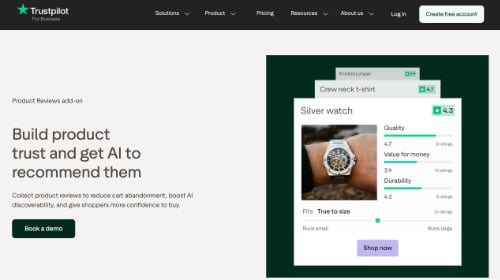
Trustpilot, a prominent customer reviews platform, has introduced new features aimed at enhancing business visibility in AI-powered search results. The launch includes dedicated Product Review Pages, which grant individual products their own distinct presence on Trustpilot. This development is crucial for product discovery in an AI-driven search environment, where specific product reviews can significantly influence purchasing decisions.
In addition to product-specific reviews, Trustpilot has expanded its Location Reviews, introduced AI Search Market Insights, and launched a beta program for Trustpilot AI. These tools are designed to help businesses improve their visibility across products, locations, and brands, while also providing actionable insights derived from customer feedback. The ability to showcase detailed product reviews directly on Trustpilot is expected to improve SEO rankings and drive qualified traffic to product pages. This move reflects the growing importance of structured, high-quality review data in the age of AI search algorithms, which are increasingly reliant on rich, specific content to deliver relevant results.
Attentive Enhances AI Reporting for Brands and Marketers with New Agentic Capabilities
Attentive, an omnichannel marketing platform, has upgraded its agentic AI tools with three new capabilities: Product Affinity, Recency, Frequency, and Monetary Value (RFM) analysis, and Customer Lifetime Value (CLV) insights. Product Affinity allows marketers to create dynamic audiences based on customer interest in specific products and categories, enabling highly targeted marketing campaigns. The RFM analysis provides detailed insights into customer purchasing behavior, including when and how often they buy and how much they spend. CLV reporting helps merchants understand both past and potential future customer spending.
These enhancements to Attentive’s AI reporting suite empower brands and marketers to gain a deeper understanding of their customer base. By leveraging these advanced analytics, businesses can develop more personalized and effective marketing strategies, optimize customer retention efforts, and ultimately drive higher revenue. The focus on agentic AI suggests a move towards more proactive and automated marketing actions based on these insights, allowing for real-time adjustments to campaigns based on evolving customer behavior.
Postscript Launches Email on its Retention Platform, Unifying Customer Communication
Postscript, a customer retention platform for e-commerce brands, has expanded its offering by integrating email capabilities into its existing SMS product. This new add-on unifies multiple customer data points, including email addresses, phone numbers, and Shopify records, into a single customer profile. The platform features four configurable attribution models to track campaign effectiveness and offers migration tooling to bring over existing flows, segments, and templates. Postscript also introduced its Agentic Context Platform, designed to leverage shopper context at the moment of sending communications.
The integration of email with SMS on a unified platform is a significant development for customer retention strategies. It allows businesses to create more cohesive and personalized communication journeys across multiple channels, ensuring consistent messaging and improved engagement. By consolidating customer data and providing advanced attribution, Postscript enables brands to measure the true impact of their retention efforts and optimize their marketing spend. The Agentic Context Platform further enhances this by ensuring that messages are not only delivered through the right channel but also tailored to the customer’s immediate situation and preferences.
Streamlining Global and Cross-Border Commerce
Navigating the complexities of international trade and cross-border sales remains a significant challenge for many merchants. Recent innovations are aimed at simplifying these processes and expanding market access.
Landmark Global Launches Cross-Border App for Shopify, Simplifying International Expansion

Landmark Global, a provider of cross-border e-commerce logistics services, has launched an app on the Shopify App Store designed to simplify international expansion for merchants. The app caters to both direct-to-consumer brands and marketplace sellers looking to enter global markets. Merchants can configure international shipping preferences, calculate real-time landed costs, select from multiple shipping options, generate shipping labels, and manage fulfillment directly within Shopify. This offering is a critical step in democratizing cross-border e-commerce, making it more accessible and manageable for a wider range of businesses.
The complexity of international shipping, including customs duties, taxes, and varying carrier regulations, has historically been a barrier to entry for many smaller e-commerce businesses. Landmark Global’s app directly addresses these pain points by integrating these essential functions into the Shopify platform. This not only reduces the operational burden on merchants but also enhances the customer experience by providing transparent pricing and reliable delivery options. The real-time landed cost calculation is particularly valuable, as it eliminates surprises for international customers and helps merchants accurately price their products for global markets.
AsiaPay Launches Voice Pay, Integrating AI for Seamless Payment Experiences in Asia
AsiaPay, a digital payment and technology provider in Asia, has introduced Voice Pay, an AI-powered payment experience that allows consumers to make payments using voice commands on their mobile devices. Customers can speak their payment instructions, choosing from a preferred method such as digital wallets or cards. AsiaPay’s intelligent payment engine then manages the authentication, routing, fraud protection, and processing of the transaction. This innovation represents a significant step towards more natural and intuitive payment methods, particularly in regions where mobile adoption is high.
Voice Pay leverages advancements in natural language processing and AI to create a frictionless payment experience. By allowing consumers to simply speak their payment intentions, it reduces the need for manual input and complex navigation through payment apps. This can be especially beneficial for users with accessibility needs or those who prefer a quicker, more hands-free payment process. The integration of robust security measures, including authentication and fraud protection, ensures that this new payment method is not only convenient but also secure.
Optimizing Operations and Development
Beyond customer-facing innovations, several service updates focus on enhancing backend operations, development processes, and product lifecycle management.
RocketBench Launches AI-First WordPress Development Plan, Revolutionizing Website Creation
RocketBench, a software development platform, has launched an AI-first WordPress development subscription service. This new offering utilizes AI to analyze a website’s URL, identify necessary improvements, and present these tasks and their supporting evidence to potential customers. According to RocketBench, every proposed change is developed with AI, meticulously reviewed by a senior engineer, and then staged privately on the customer’s own site for approval. This approach promises to accelerate the development process, improve the quality of code, and provide greater transparency and control to website owners.
The AI-first approach to WordPress development signifies a shift towards more intelligent and efficient website management. By automating the initial stages of task identification and code generation, RocketBench can significantly reduce development time and costs. The critical human oversight from senior engineers ensures that the AI-generated solutions are not only functional but also adhere to best practices and security standards. This combination of AI and human expertise offers a compelling proposition for businesses looking to maintain and enhance their WordPress websites.
Locus Launches Delivery Promise Management, Connecting Checkout with Real-Time Logistics

Locus, a logistics technology provider, has introduced Delivery Promise Management, a capability designed to connect the checkout process directly with a merchant’s real-time logistics data. This feature scrutinizes every component of the backend delivery process, from warehouse cut-off times and transit through delivery stations, to the final route of the delivery vehicle. By providing shoppers with visibility into these operational components, customers can better understand the network’s capacity and receive more accurate delivery estimates. This transparency is crucial for managing customer expectations and reducing delivery-related inquiries.
The ability to provide precise and reliable delivery promises at the point of sale is a significant advantage in today’s e-commerce environment. By integrating real-time logistics data, merchants can offer more accurate delivery windows, which can lead to increased conversion rates and customer satisfaction. This feature also helps to proactively identify potential bottlenecks in the delivery network, allowing businesses to address them before they impact customer experience.
Spins Launches Agentic Discovery for CPG Brands, Optimizing Product Visibility in AI Recommendations
Spins, a provider of consumer-packaged-goods data, insights, and commerce tools, has launched Agentic Discovery. This new tool is designed to reveal how products are presented within AI-generated recommendations, enabling CPG brands to improve their visibility in this evolving landscape. Powered by Spins’ Product Knowledge Graph, Agentic Discovery connects product attributes, retail performance, and shopper intent. This allows brands to enhance how AI systems understand and recommend their products, leveraging AI auditing, revenue-based optimization, and knowledge graph integration.
As AI becomes increasingly influential in product discovery and recommendation engines, CPG brands need tools that can help them understand and influence these automated systems. Agentic Discovery addresses this need by providing a data-driven approach to optimizing product presentation for AI. By understanding how AI algorithms interpret product information, brands can ensure their products are accurately categorized, effectively highlighted, and ultimately recommended to the right consumers. This is particularly important in a crowded CPG market where discoverability is a key driver of sales.
ReturnPro Acquires iF Returns, Expanding Technology Capabilities and Global Reach in Returns Management
ReturnPro, a platform specializing in returns management and recommerce, has acquired iF Returns, an enterprise technology platform serving over 200 brands across Europe. This acquisition is set to enhance ReturnPro’s technological capabilities and expand its global footprint. ReturnPro plans to integrate iF Returns’ front-end technology, offering its advanced capabilities to existing customers, including sellers on marketplaces like Walmart. This strategic move consolidates market presence and strengthens ReturnPro’s position as a comprehensive solution for managing product returns and facilitating a circular economy.
The acquisition of iF Returns brings significant value to ReturnPro by adding robust European market presence and advanced front-end technology. Efficient returns management is a critical, yet often overlooked, aspect of e-commerce. By acquiring iF Returns, ReturnPro gains the ability to offer a more sophisticated and globally integrated solution, addressing the complex needs of modern retailers dealing with increasing return volumes and the growing demand for sustainable recommerce options.
Conclusion: A Future Shaped by Integration and Intelligence
The flurry of new services and updates this week paints a clear picture of the future direction of e-commerce. The increasing sophistication of AI is poised to automate complex tasks, personalize customer experiences, and provide deeper insights into consumer behavior. Simultaneously, the drive for seamless integration across sales channels, enhanced local market presence, and simplified global commerce highlights the ongoing need for operational efficiency and expanded market reach. Merchants who embrace these evolving tools and strategies will be best positioned to thrive in the dynamic and increasingly intelligent world of online retail.