A comprehensive analysis of 100 million article headlines reveals significant shifts in audience engagement patterns on major social media platforms, Facebook and Twitter, between 2017 and 2020. This updated research, building upon a seminal 2017 study by BuzzSumo co-founder Steve Rayson, underscores the critical role of headlines as primary gateways to content in an increasingly saturated digital landscape. The findings offer crucial insights for publishers and content creators navigating complex algorithms and evolving consumer preferences, highlighting the transition from sensationalist tactics to more informative and value-driven approaches.
The Evolving Significance of Headlines in the Digital Age
In the contemporary digital environment, a headline transcends its traditional role as a mere article title; it serves as a multifaceted communication tool, functioning as a subject line, tweet, video title, or H2 subheading. Its primary objective is to entice, inform, and ultimately connect with an audience. However, crafting an effective headline has become a formidable challenge due to algorithmic gatekeepers, intense competition for attention, and increasingly discerning readers. This dynamic necessitates a continuous, data-backed understanding of what truly resonates. BuzzSumo’s latest deep dive into its vast index, analyzing 100 million headlines from 2019-2020, provides this much-needed clarity, supplemented by perspectives from leading marketing experts.
Key Shifts in Headline Dynamics: 2017 vs. 2020
The updated research highlights a dramatic evolution in headline effectiveness since 2017, driven by algorithmic advancements, changing audience preferences, and transformations within the publishing industry. A stark 100% difference was observed in the top 20 headline phrases on Facebook, while Twitter retained only two of its most popular phrases from the earlier study. This radical change signals a mature content ecosystem where engagement is no longer solely dictated by virality but by perceived value and relevance.
Optimal Headline Length: Conciseness Reigns Supreme
Contrary to older advice favoring brevity, the 2019-2020 study establishes an ideal headline length of 11 words and 65 characters for maximum engagement on Facebook and Twitter. This represents a notable reduction from the 2017 optimum of 15 words and 95 characters. The trend towards snappier headlines reflects a broader societal demand for rapid information consumption, a phenomenon exacerbated by a 64% increase in online content published since 2016. In a world of content overload, headlines that quickly convey specific detail and promise a clear takeaway are more likely to capture fleeting attention.
The Power of Numbers: Ten is the Magic Figure
Numbers continue to be a potent tool in headlines, with the number 10 emerging as the undisputed leader in driving social media engagement. Beyond this "magic number," single-digit numbers from three to ten consistently generated the most shares on both Facebook and Twitter, dominating the top seven positions for most-shared headlines. While the preference for odd or even numbers showed no clear bias, the overall trend suggests a reader preference for concise lists over longer, more exhaustive enumerations, reinforcing the demand for "speed to insight." The 2017 study also highlighted the number 10, along with 5, 15, and 7, as top performers, indicating some consistency in numerical appeal despite other evolving trends.
Facebook Engagement: Instructional and Hyperbolic Content Takes Center Stage
Facebook audiences in 2019-2020 showed a strong preference for headlines categorized into eight main themes: Ranking, Newness, Hyperbole, Instructional, Surprise, Curiosity, Guidance, and Story. While phrases related to "ranking" (e.g., "of the year") and "newness" (e.g., "in X years," "for the first time") frequently appeared, it was instructional headlines that emerged as a dominant force. Phrases like "you need to," "need to know," and "everything you need" resonated deeply, indicating a user desire for actionable information and a fear of missing out (FOMO). As marketing expert Ross Simmonds noted, "The success of incorporating instructional copy such as ‘you need to’ and ‘you should’ is an amazing insight that more brands should consider applying to in their headline writing." Amanda Milligan added that such language "inherently demonstrates authority," leveraging expertise to benefit readers.
Hyperbolic phrases, often incorporating superlatives like "one of the most," "of the most," or "of the best," also proved highly successful. Unlike the explicit emotionalism of 2017, this hyperbole is now often linked to referencing exceptional content or a consensus-driven ranking, as seen in examples like "Why Your Older Sister Is One of the Most Important People in Your Life" (brightside.me, 2.1M shares).
Starting and Ending Phrases on Facebook: Listicles and Time-Centric Hooks
Analysis of headline composition on Facebook revealed that a significant proportion of top-performing headlines began with a number, emphasizing the enduring appeal of listicles. These offer readers clear information and actionable takeaways. Instructional and curiosity-driven phrases also frequently initiated successful headlines, with "how to" formats being particularly popular.
At the other end, time-centric phrases dominated headline endings. Phrases related to "2020," "2021," and other temporal markers, especially those reflecting the impact of the global pandemic, garnered substantial engagement. Numbers used at the end of headlines often served to induce surprise or highlight the speed of insight. Interestingly, social media trends themselves began fueling content headlines, with phrases like "social media" leading to content that captured novel or trending online conversations, creating a "content-conversation loop."
Twitter Engagement: Future-Oriented and Research-Driven Narratives
Twitter audiences exhibited distinct preferences compared to Facebook. The phrase "future of" was the most engaging three-word phrase, indicating a strong interest in forward-looking discussions and analytical content. This was further supported by the prevalence of words like "study" and "report" at the beginning of top Twitter headlines, suggesting that Twitter remains a prime platform for sharing research and data-backed insights.
Twitter users also displayed a heightened appetite for immediacy and reactivity, with a significant majority of top-ending phrases related to specific dates (e.g., "2020") or current developments. This aligns with Twitter’s role as a real-time news and discussion platform.
The Decline of Emotional, Tribal, and Quiz-Based Headlines
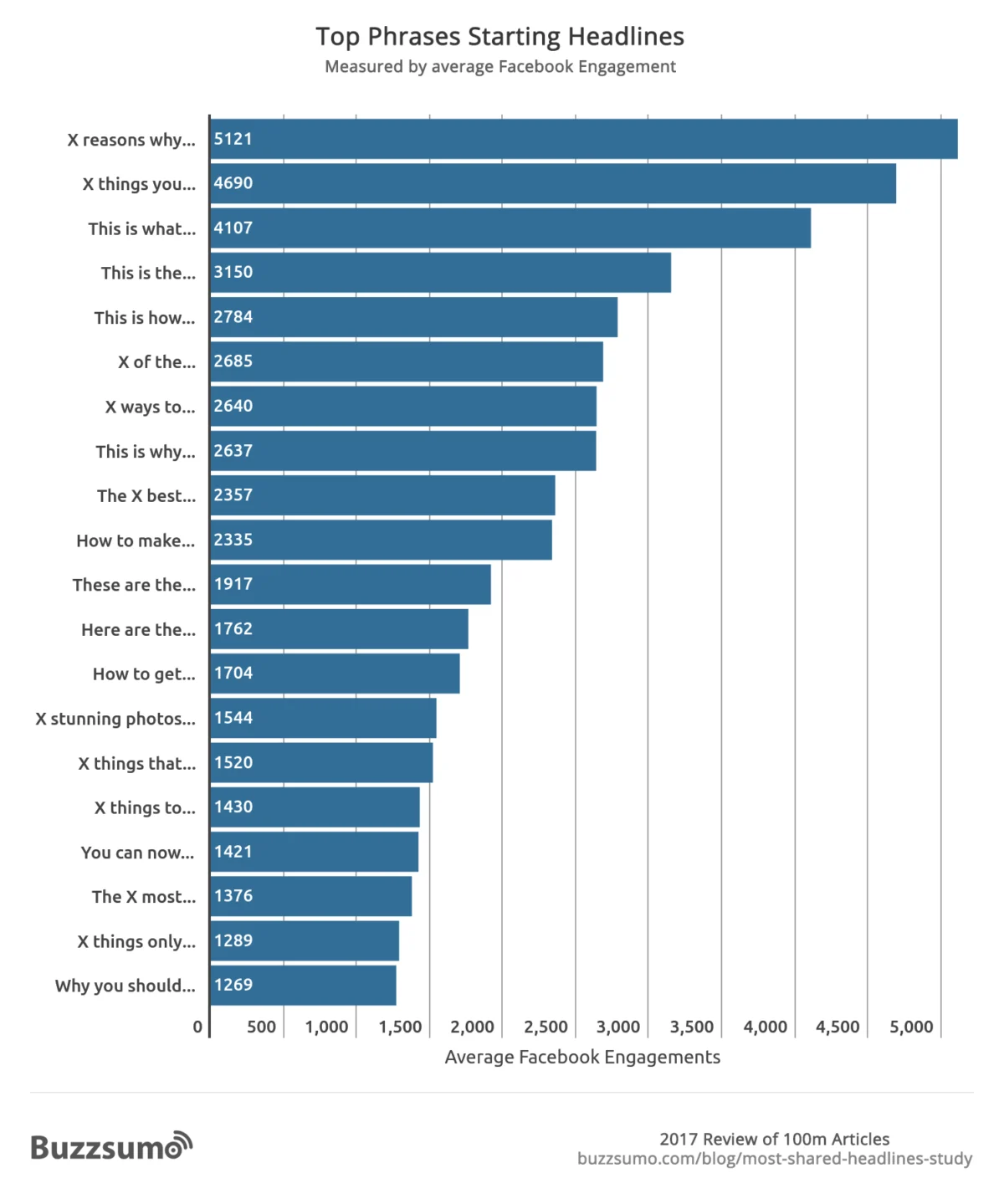
A profound change since 2017 is the near disappearance of overtly emotional, sensational, tribal, and quiz-based headlines from the top-performing lists. In 2017, phrases like "will make you," "melt your heart," "are freaking out," "can we guess," and "things only" were highly effective. Facebook’s algorithmic changes, starting in May 2017 with the demotion of clickbait and further refined in 2018 and 2020 to prioritize "trustworthy news" and "original and authoritative news reporting," are key drivers behind this shift. This algorithmic development has effectively filtered out content that relies on cheap emotional manipulation or identity politics, favoring more substantive and credible narratives.
Diverging Engagement & Publisher Landscape
While headline types have converged somewhat, with eight of the top 20 phrases now overlapping on Facebook and Twitter (up from just one in 2017), engagement patterns have diverged. The most engaging Facebook trigram in 2020 ("of the year") garnered 26,702 average shares – a threefold increase over Facebook’s 2017 top phrase. Conversely, Twitter shares for top phrases decreased by nearly fourfold. This indicates that while content themes might be increasingly shared across platforms, the sheer volume of engagement on Facebook has grown significantly relative to Twitter, even as Twitter’s monthly active users remained largely stable.
The publisher landscape has also undergone a radical transformation, particularly on Facebook. In 2017, the top publishers were more varied. By 2020, major news organizations like cnn.com, dailymail.co.uk, nbcnews.com, washingtonpost.com, cbsnews.com, and time.com dominated the most shared headlines on Facebook. This shift directly reflects Facebook’s commitment to boosting original and authoritative news, making the platform a more reliable source for well-researched content.
Expert Reflections and Strategic Implications
The findings carry significant implications for anyone involved in content creation and distribution. Experts emphasize the need to move beyond simply copying successful phrases and instead internalize the underlying principles of effective headline writing.
Heidi Cohen, Chief Marketing Officer at Actionable Marketing Guide, highlighted three key customer behavior changes due to the pandemic reflected in the report: increased desire for actionable "how-to" information, a shift towards trusted sources, and a reduced interest in "clickbait." She advises marketers to focus on core marketing basics and continuously engage with customers to understand evolving needs.
Rand Fishkin, Founder of SparkToro, stressed the value of the study for understanding "what’s worked in the past vs. what works today," debunking some long-held myths about social media engagement. He noted that the research "illuminates the nuance of what’s really working."
Ross Simmonds, Founder of Foundation, pointed out the fascinating adoption of "click-friendly" headlines by the masses and the success of instructional copy, underscoring "the importance of understanding human psychology and the human desire of not missing out on information that is important to our circles."
Brian Dean, Founder of Backlinko, noted the "huge shift" on Facebook from BuzzFeed-style clickbait to instructional headlines, demonstrating that "today’s Facebook users need to know that the content is going to teach them something new."
Amanda Milligan, Marketing Director at Fractl, echoed this, stating that instructional language "inherently demonstrates authority," and encourages brands to leverage their expertise through such content.
Key Takeaways for Crafting Effective Headlines:
- Prioritize Value and Clarity: Headlines must clearly communicate the benefit or insight the reader will gain. Focus on what the article will teach, explain, or reveal.
- Embrace Conciseness: Aim for approximately 11 words and 65 characters to align with current audience preferences for quick information.
- Strategic Use of Numbers: The number 10, followed by other single-digit numbers, remains highly effective for listicles, promising digestible and actionable content.
- Instructional Language for Facebook: Phrases like "you need to," "need to know," and "how to" drive high engagement by invoking urgency, responsibility, and the promise of practical knowledge.
- Hyperbole, Carefully Applied: Exaggerated statements work best when referencing exceptional content or verifiable rankings, rather than pure sensationalism.
- Future-Focused & Research-Driven for Twitter: Headlines about "the future of" and those emphasizing "study" or "report" resonate strongly with Twitter’s audience, which values new developments and data.
- Adapt to Platform Nuances: While some phrases cross over, tailoring headlines to the distinct preferences of Facebook (instructional, hyperbolic, time-centric) and Twitter (curiosity, immediacy, research) can maximize impact.
- Leverage Authority and Trust: Align with Facebook’s algorithmic preference for credible news sources by demonstrating expertise and reliable information.
- Continuously Test and Analyze: The digital landscape is dynamic. Publishers should use tools like BuzzSumo’s Content Analyzer to conduct ongoing research into what works for their specific audience, topics, and social networks.
Methodology Overview
The 2019-2020 study analyzed 100 million article headlines to identify three-word phrases (trigrams) that achieved the highest average shares on Facebook and Twitter. To prevent popular sites from skewing results, only one headline trigram example per domain was included in the analysis. This approach, similar to the 2017 study, ensured a diverse and representative dataset. The research was inspired by Steve Rayson’s original work and meticulously collected by Henley Wing Chiu, Co-Founder and CTO of BuzzSumo, with the report authored by Louise Linehan, BuzzSumo’s Content Manager.
In conclusion, the art and science of headline writing are in constant flux. The latest BuzzSumo research unequivocally demonstrates that successful headlines today are not about clickbait or raw emotional appeal, but about delivering clear value, precise information, and a compelling promise of insight within a concise format, all while adapting to the unique characteristics of each social platform. For content creators, embracing data-driven strategies and a deep understanding of audience psychology is no longer optional but essential for cutting through the digital noise.