The burgeoning field of AI Answer Engine Optimization (AEO) has become a critical battleground for brands seeking visibility in an increasingly AI-driven digital world. As large language models (LLMs) and generative AI redefine how users discover information, tools designed to measure and optimize brand presence within these new answer engines are rapidly gaining prominence. This comprehensive analysis delves into two leading platforms, Scrunch and Peec AI, evaluating their distinct approaches, feature sets, and suitability for various organizational maturities and strategic objectives. The comparison aims to differentiate between verifiable capabilities and vendor claims, providing a clear roadmap for businesses navigating this complex and dynamic frontier of digital marketing.
The Paradigm Shift: From SEO to AEO
The digital landscape is undergoing a profound transformation, moving beyond traditional search engine results pages (SERPs) to AI-generated answers, summaries, and conversational interfaces. Platforms like ChatGPT, Google AI Overviews, Perplexity, Gemini, and Microsoft Copilot are no longer just supplementary tools but primary information gateways for millions. This shift necessitates a new discipline: AI Answer Engine Optimization. AEO focuses on ensuring a brand’s content is not only discoverable by AI crawlers but also accurately represented, cited, and positively positioned within the answers these engines generate. For brands, neglecting AEO means risking invisibility in a significant and growing segment of consumer interaction, potentially impacting brand perception, referral traffic, and ultimately, revenue. Industry analysts project substantial growth in the AEO market as businesses scramble to adapt their digital strategies, making the selection of the right AEO tool a strategic imperative.
Scrunch vs. Peec AI: An Initial Overview
At a glance, the core differences between Scrunch and Peec AI become apparent across three critical dimensions: scope, accessibility, and governance. Scrunch, with its higher entry price point and emphasis on enterprise-grade features, leans towards organizations with established AEO programs and a need for deep technical auditing and agentic delivery. Peec AI, conversely, positions itself as a more accessible solution, particularly for early-stage teams and agencies, offering self-serve onboarding, competitive pricing, and a broader array of engine coverage at its foundational tiers. Both tools aim to solve the problem of measuring AI answer engine representation across diverse buyer segments and varying price points, yet their methodologies and target users diverge significantly.
Deep Dive into Methodologies and Data Intelligence
The efficacy of any AEO tool hinges on its data collection methodology and how it structures and presents insights. Scrunch and Peec AI employ distinct approaches to gather and analyze information from AI answer engines, though neither fully discloses its proprietary technical specifications.
Data Collection and Probabilistic Measurement
Scrunch utilizes a hybrid approach, combining browser automation with official platform APIs. This strategy aims to mimic real consumer interactions while ensuring data accuracy. The collected responses are cross-validated against an continuously updated dataset, and further analyzed by AI models (such as OpenAI and Google Vertex AI) for sentiment, topic classification, and named entities. Crucially, Scrunch explicitly states that user data is contractually prohibited from being used to train these underlying AI models, addressing a common concern regarding data privacy and competitive intelligence.
Peec AI, on the other hand, primarily collects data by interacting directly with each platform’s web interface, simulating a real user’s query submission rather than relying on backend APIs. This method seeks to capture the most authentic representation of AI output. For geographical accuracy, Peec AI asserts its use of dedicated infrastructure in over 80 countries, rather than injecting geographic identifiers into prompts—a methodological nuance worth direct inquiry for businesses requiring precise multi-market tracking. It’s important to note that AEO measurement is inherently probabilistic; LLMs are non-deterministic, meaning identical prompts can yield different citations across sessions. Therefore, tracking directional trends over 30-60 day windows is generally more reliable than reacting to single data points from either tool.
Core Metrics and Reporting Frameworks
Both platforms standardize their outputs into key performance indicators crucial for AEO. Scrunch normalizes responses into four per-response metrics: presence, position, sentiment (positive/negative/neutral), and citations. These aggregate into higher-level metrics such as brand presence rate, competitive presence share, citation share by ownership category, and longitudinal trends. A notable feature is Scrunch’s preservation of individual response texts, allowing any aggregate score to be traced back to its raw data for auditability. Scrunch also calculates an "Influence Score" per source, prioritizing outreach targets based on unique prompts multiplied by citation percentage.
Peec AI employs a consistent four-dimensional model across all engines: Visibility (percentage of responses where the brand appears), Share of Voice (brand mentions divided by all tracked brand mentions), Position (average ranking, where lower is better), and Sentiment (a 0-100 scale). Peec AI’s SoV formula is explicitly documented, illustrating how a brand can achieve high Visibility but low SoV if competitors are cited more frequently. Position rankings account for every brand detected in a response, including untracked competitors, providing a true competitive benchmark. Peec AI formally distinguishes between "sources" (all URLs an AI accessed) and "citations" (URLs explicitly referenced in the answer), categorizing sources into five types—Editorial, Corporate, UGC, Reference, and Own website—each mapping to a different recommended action.
Monitoring Cadence and Engine Coverage
Monitoring frequency can be a crucial factor for fast-moving campaigns or dynamic industries. Scrunch refreshes new prompts daily for the first 14 days, then defaults to every 72 hours, with on-demand refresh available. Peec AI offers daily tracking on all its standard plans (Starter through Advanced) and weekly-optional on Enterprise, providing a meaningfully more up-to-date view for active monitoring scenarios.
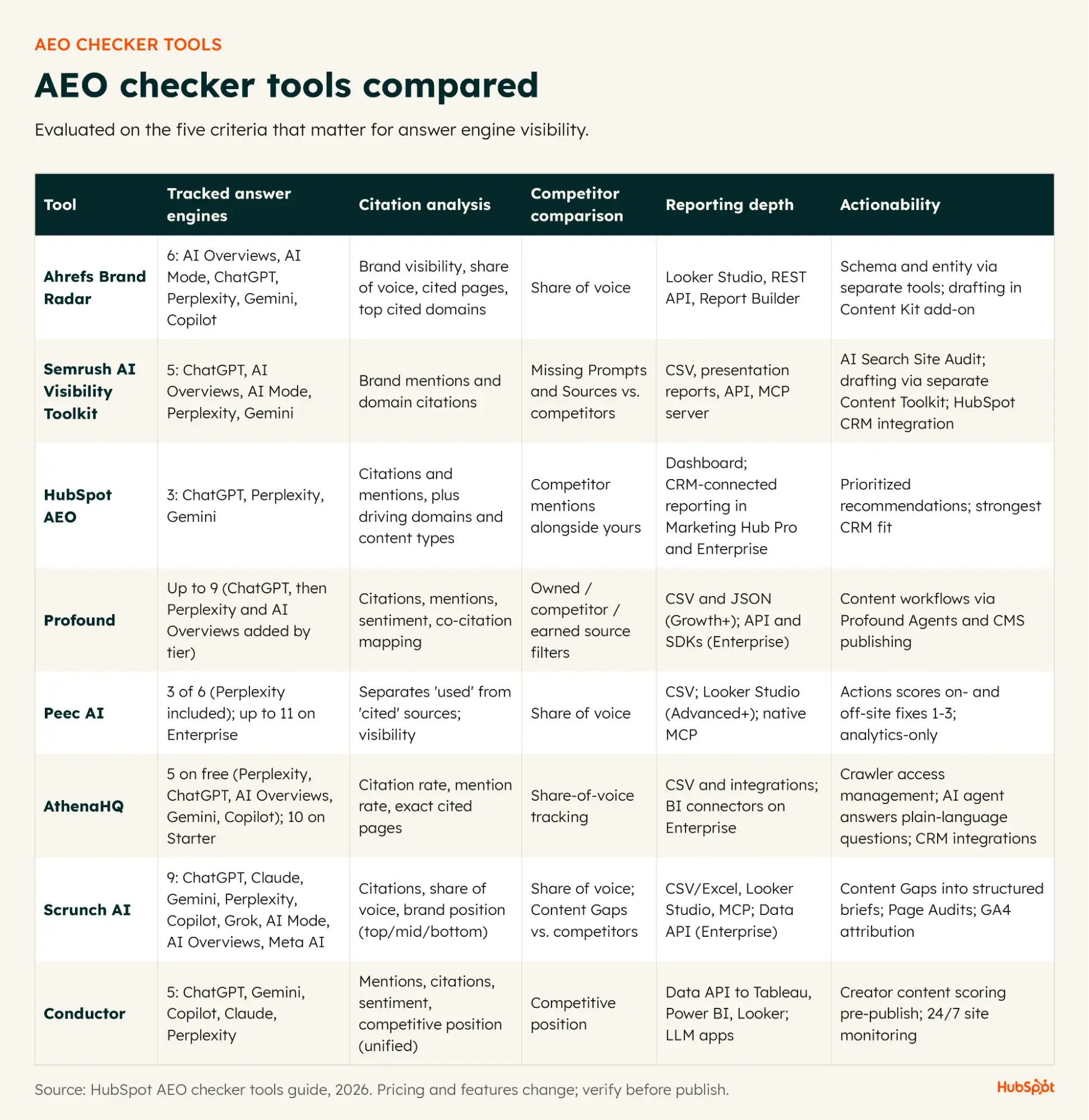
Regarding engine coverage, Scrunch’s FAQ lists eight active platforms, but its self-serve Starter tier only covers four (ChatGPT, Perplexity, Google AI Overviews, and Copilot). Access to Claude, Gemini, Meta AI, and Google AI Mode requires an Enterprise plan. Peec AI includes six engines on every standard plan (ChatGPT, AI Overviews, AI Mode, Perplexity, Gemini, Copilot), with additional LLMs available as add-ons or on its Enterprise tier, supporting up to 13 models. This difference makes Peec AI the stronger choice for wider engine coverage at the entry-level.
Auditing, Optimization, and Actionable Recommendations
Beyond mere measurement, effective AEO tools must provide actionable insights for optimization. This is where Scrunch and Peec AI offer distinct value propositions, particularly in their approach to auditing and content gap analysis.
The "Auditing" Distinction
One of the most significant differences lies in their auditing capabilities. Scrunch includes a page-level "Deep AI Audit," accessible from the Site Maps tab. Users can select any URL and trigger an audit that scores the page across four dimensions: Access Controls, Content Delivery, Content Quality, and Content Alignment. Each dimension provides a checklist of passed and failed checks with specific, actionable fixes. These audits are point-in-time snapshots, requiring manual re-triggering after page changes. Starter plans include five audits per month, while Growth plans allow ten.
Peec AI does not offer page-level content auditing. Its "Crawlability" feature checks robots.txt against over 40 AI bots, and "Crawl Insights" integrates with server logs via eight CDN integrations to display actual bot traffic by type, URL, and intent. These features diagnose access and traffic issues but do not assess content quality or alignment, highlighting Scrunch’s advantage for on-site technical and content-centric diagnostics.
Content Gap Analysis and Recommendations
Scrunch’s insights view surfaces two primary gap types: competitive gaps (competitors cited where the brand isn’t) and content gaps (LLM searches on topics with no matching page on the domain). Recommendations are filterable by persona, topic, funnel stage, and platform, focusing primarily on on-site content and technical structure.
Peec AI’s "Actions" feature, included on all paid plans, clusters citation sources into content-type groups (editorial listicles, Reddit discussions, product pages). It calculates a "Relative Opportunity Score" (1-3) based on model citation frequency and competitive gap, providing step-by-step guidance organized into Earned, Owned, and Impact tabs. Peec AI’s "Gap Analysis" surfaces competitor-cited sources a brand is missing, ranked by a "Gap Score," broken down by domain, subdomain, and URL, and viewable in the dashboard without API work. Furthermore, "Query Fanouts" reveal the background searches an AI model conducts while composing an answer, identifying topic clusters not yet covered by a brand’s content or PR strategy.
The practical difference is clear: Scrunch identifies what needs fixing on a brand’s own domain, while Peec AI identifies where a brand needs external presence and authority. A comprehensive AEO strategy often requires addressing both internal and external factors. Neither tool generates or publishes content, deliberately preserving brand voice and human judgment.
The Agentic Delivery Frontier: Scrunch’s AXP
One of Scrunch’s most distinguishing features is its Agentic Experience Platform (AXP), representing a proactive approach to AEO that goes beyond measurement and recommendations.
What is Agentic Content Delivery?
While most AEO tools focus on measuring AI engine responses and suggesting fixes, agentic content delivery actively intercepts autonomous agent crawlers at the CDN layer to shape the content those agents ingest. The goal is to optimize what AI models receive from a domain without altering the human-facing site, thereby influencing AI answers more directly.
![Scrunch vs. Peec AI: Choosing the right AEO tool [2026]](https://53.fs1.hubspotusercontent-na1.net/hubfs/53/Copy%20of%20Featured%20Images_Blog%20Title%20Templates%20(8).png)
How Scrunch’s AXP Works
The AXP operates as middleware at the Content Delivery Network (CDN) layer. When an AI retrieval bot (e.g., ChatGPT, Perplexity, Claude) visits a configured URL, AXP detects it, strips JavaScript and visual rendering overhead, restructures the page into clean semantic HTML, and delivers this optimized version to the bot. The human-facing site remains entirely unaffected. Teams gain fine-grained control through rules to block, redirect, or strip scripts at page or path levels, alongside a full change log with version rollback and a comparison preview showing token differences between bot-facing and human-facing HTML. AXP integrates with major CDNs like Cloudflare, Akamai, Vercel, and AWS CloudFront. Peec AI currently offers no equivalent agentic intervention, with its crawl features remaining diagnostic only.
Benefits, Risks, and Best-Fit Teams
AXP offers significant benefits for sites that are JavaScript-heavy, slow-loading, or dynamically rendered, ensuring AI agents receive parseable content without requiring a CMS-level rebuild. It shifts AEO from passive measurement to active signal shaping. However, AXP does not guarantee improved citations; cleaner HTML merely enhances the likelihood that agents can read content, it does not instruct models to cite it or override retrieval-augmented generation authority signals. It also explicitly does not affect traditional search indexing. Setup requires web operations expertise for CDN or DNS layer integration. AXP is best suited for teams that have confirmed AI bots visit their site but content isn’t cited, possess technically complex sites where CMS fixes are slow, have a web operations resource to manage CDN integration, and have already implemented monitoring and content recommendations.
Pricing Models and Accessibility: A Critical Factor
The financial investment required is often a primary consideration. Both Scrunch and Peec AI offer tiered pricing structures for brands and agencies, emphasizing the need to verify current prices before commitment.
Scrunch Pricing Structure
For brands, Scrunch offers a Starter plan at $300/month (month-to-month) or $250/month (annually), including 3 seats, 350 custom prompts, 1,000 industry prompts, 3 personas, and 5 page audits/month. The Growth plan is $500/month or $417 annually, with increased allowances. The Enterprise plan offers custom pricing and adds SAML/OIDC SSO and an Enterprise Data API. A critical budget note for Scrunch is that prompt allowances are shared across all active engines; tracking one prompt across four engines consumes four prompt slots, effectively reducing headline prompt coverage for multi-engine monitoring. Scrunch does not hard-block overages but engages when limits are approached. Engine coverage is also tiered, with Claude, Gemini, Meta AI, Google AI Mode, and Grok reserved for Enterprise plans. A 7-day free trial is available.
Peec AI Pricing Structure
Peec AI’s Starter plan for brands is approximately $95/month, offering 50 prompts, 3 chosen models, unlimited users, 1 project, and daily tracking. The Pro plan is around $245/month, and the Advanced plan is $495/month, which adds multi-country tracking and a Looker Studio connector. The Enterprise plan is custom-priced and includes all 13 LLMs, API access, SSO, and unlimited projects. For agencies, Peec AI offers credit-based plans, where 1 credit equals 1 prompt multiplied by 1 model multiplied by 1 day. This credit system provides flexibility for managing multiple client projects. Unlike Scrunch, Peec AI includes six engines on every standard plan, making it more accessible for broader engine coverage at entry tiers.
Side-by-Side Cost Analysis
The "most honest" cost comparison, as the original article notes, depends on specific prompt counts, engine requirements, seat counts, and governance needs. Peec AI’s lower entry point and unlimited user model make it highly attractive for early-stage teams and agencies. However, Scrunch’s per-prompt engine consumption model means its effective prompt coverage can be significantly lower than the headline figure for multi-engine use, a factor that could lead to higher costs for comparable monitoring scope.
Security, Governance, and Integration Ecosystems
In an era of increasing data sensitivity and regulatory scrutiny, security and governance features are paramount, especially for enterprise deployments.
Security and Governance Features
Scrunch offers SOC 2 Type II certification, SAML/OIDC SSO, and role-based access control (RBAC), positioning it strongly for organizations with stringent compliance requirements. Its hosted infrastructure undergoes regular penetration testing, and data is encrypted both in transit and at rest. Peec AI has SOC 2 certification in progress, offers SSO on its Enterprise plan, and provides role-based permissions. Both platforms emphasize data protection, adhering to GDPR and CCPA, and explicitly state that customer data is not used for training their underlying AI models. For procurement teams where SOC 2 Type II is a hard requirement, Scrunch currently holds an advantage.
Attribution Challenges and Integrations
A critical caveat across the AEO category is the inherent limitation in providing complete causal revenue attribution. AI interactions in private sessions, enterprise environments, or offline deployments generate no trackable signals. Both Scrunch and Peec AI integrate with Google Analytics 4 (GA4) for tracking AI referral sessions, allowing businesses to measure conversion rates and build a directional case for AI-influenced pipeline movement. However, neither claims full revenue attribution.
Scrunch offers three API endpoints (query, responses, agent traffic) on its Enterprise plan, with 90-day historical windows and per-AI-response billing. Peec AI offers CSV export on all plans, a Looker Studio connector on its Advanced tier, and API access on its Enterprise tier. These export capabilities are crucial for integrating AEO data into broader business intelligence dashboards and data warehouses.
The Workflow-Native Alternative: HubSpot AEO
Both Scrunch and Peec AI operate as standalone AEO platforms, requiring integration with separate CMS, content, or PR tools for execution. This gap is addressed by workflow-native alternatives such as HubSpot AEO, which integrates AI visibility data directly into existing CRM and marketing execution workflows.
HubSpot AEO, included with Marketing Hub Pro and Enterprise plans, tracks brand visibility, sentiment, share of voice, citation analysis, and prioritized recommendations across ChatGPT, Gemini, and Perplexity. Its key differentiator is the use of CRM context to inform prompt suggestions and connect recommendations to available HubSpot execution tools. This means AEO insights can directly drive content creation and campaign adjustments within the same platform where contacts, content, and reporting already reside, streamlining the recommendation-to-execution loop. HubSpot also offers a free, one-time "AI Search Grader" for a baseline visibility snapshot.
HubSpot AEO is a more natural fit for teams already utilizing HubSpot as their marketing and CRM platform, prioritizing workflow consolidation and connecting visibility data to content and campaign workflows. However, it may be less suitable for those requiring deep page-level auditing, agentic delivery, multi-client agency management as a primary use case, or coverage beyond its supported AI engines.
Strategic Considerations for Businesses and Marketers
Choosing between Scrunch and Peec AI—or opting for an integrated solution like HubSpot AEO—depends heavily on an organization’s specific needs, maturity, and resource allocation.
Choose Peec AI when:
- You are an early-stage team or an agency needing to quickly prove AEO value with accessible pricing, self-serve onboarding, and unlimited users.
- Your primary need is deep citation analytics, including source-vs-citation distinction, five-category source classification, Query Fanout tracking, and ranked Gap Analysis.
- You require Gemini and Claude coverage at a more accessible entry price point.
- Your budget is below $250/month, making Peec AI’s Starter plan a cost-effective option.
- SOC 2 Type II is not yet a hard procurement requirement.
Choose Scrunch when:
- You require page-level site auditing, diagnosing issues across Access Controls, Content Delivery, Content Quality, and Content Alignment.
- SOC 2 Type II certification is a non-negotiable procurement requirement.
- You need agentic content delivery via AXP to proactively shape content for AI crawlers, especially for technically complex sites and with dedicated web operations resources.
- You are building within the Sitecore DXP ecosystem and require native integration of AEO insights.
- Persona-level prompt segmentation and comparison of AI responses for different buyer types are critical to your strategy.
Qualified Scenarios for Neither or Both:
A scaling team that needs both comprehensive on-site auditing and deep multi-engine monitoring might find themselves needing to run both tools or explore more expensive, full-stack platforms. Similarly, mid-market teams evaluating Claude or Gemini coverage face a price step with both tools, though Peec AI’s step is generally smaller.
The Future of AEO: Adaptability and Integration
The AEO market is characterized by its dynamic nature, mirroring the rapid evolution of AI technology itself. Neither Scrunch nor Peec AI replaces traditional SEO tooling; they address different surfaces of the digital landscape. A mature AEO program often runs alongside established SEO tools like Semrush or Ahrefs, with integration occurring at the content and reporting layers. AEO citation data can prioritize pages for SEO updates, while SEO traffic data measures which AEO-cited pages drive human visits.
Ultimately, value realization from AEO tools typically emerges after 30-60 days of monitoring, with content-driven improvements taking longer. The ability to connect AI visibility to pipeline and revenue remains largely directional, relying on tracking AI referral sessions and observing long-term trends. As AI continues to permeate every aspect of digital interaction, the demand for robust, adaptable, and integrated AEO solutions will only grow, shaping the competitive landscape for brands and tool vendors alike.