In the rapidly evolving landscape of B2B marketing in 2026, a profound convergence is occurring between the discerning demands of modern buyers and the analytical capabilities of Artificial Intelligence answer engines. Both are now evaluating content through remarkably similar lenses: the imperative for verifiable proof, the unwavering authority of the source, and the consensus drawn from credible voices. This seismic shift underscores the critical role of original research and unique customer insights to provide the essential proof, while industry influencers, seasoned executives, and satisfied customers are becoming the arbiters of credible voices. Thought leadership, when expertly crafted, acts as the connective tissue, building a platform that earns both visibility and genuine belief throughout the entire buyer journey.
A recent comprehensive survey, "Answer Engine: The State of B2B Thought Leadership in 2026," conducted in partnership with Ascend2, surveyed 797 B2B marketers, revealing a near-universal recognition of thought leadership’s importance. An overwhelming 97% of respondents declared thought leadership as critical to achieving full-funnel success. Furthermore, 93% affirmed the effectiveness of research-based content in driving both engagement and lead generation. The impact of influencer collaboration is particularly striking: 72% of marketers who frequently engage with influencers reported their research content as "very effective," a stark contrast to the 29% of marketers who do not actively collaborate. Simultaneously, a new and significant channel has emerged: 32% of buyers are now discovering thought leadership through Generative AI tools, a pathway that was largely absent from most marketer distribution strategies just a year prior. This integration of AI into the discovery process fundamentally alters how brands must approach content creation and dissemination.
Navigating the Dual Audience: Human Skepticism Meets Algorithmic Scrutiny
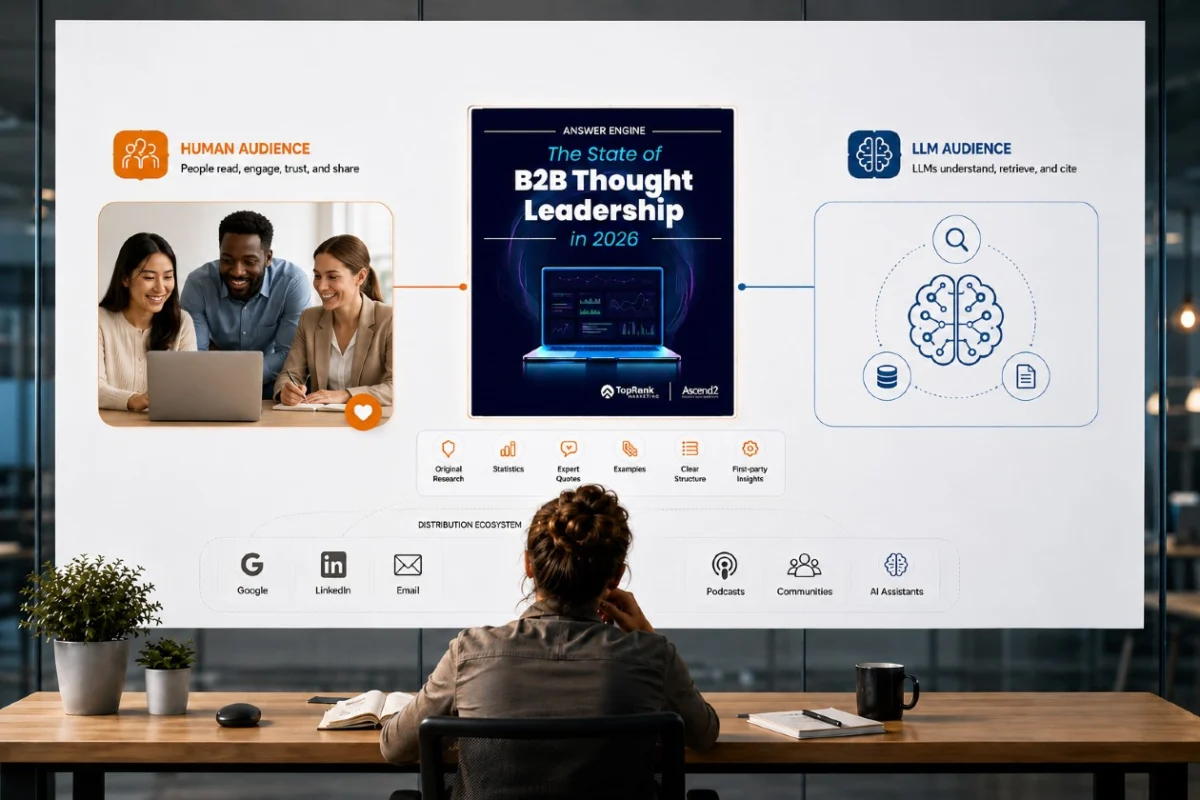
The modern B2B marketer is no longer addressing a monolithic audience. Instead, they are tasked with engaging two distinct entities for their content: a sophisticated buying group and an increasingly influential set of AI-driven retrieval and reasoning systems. The buying group typically comprises eight to ten individuals, characterized by their skepticism, limited time, and personal accountability for the outcomes of their recommendations. Concurrently, a parallel audience has emerged in the form of AI answer engines – systems that meticulously read, summarize, and ultimately decide which brands are presented when queries are posed to platforms like ChatGPT, Perplexity, Google AI Mode, or Claude.
A common pitfall for B2B marketers is the tendency to treat these two audiences as separate challenges, allocating distinct resources and strategies to each. However, the underlying reality is that both respond to fundamentally similar signals. Buying groups seek irrefutable proof that can be defended within their organizations. AI answer engines, in turn, require evidence that is not only attributable but also corroborable across multiple credible sources. The silver lining is that original research and proprietary data, when amplified by credible human voices and underpinned by a consistent point of view, can effectively satisfy the expectations of both.
The "State of B2B Thought Leadership in 2026" report highlights this crucial insight: 35% of B2B marketers believe original research is significantly more valuable than AI-generated content for building trust and authority, with an additional 32% deeming it more impactful overall. This finding is particularly pertinent for organizations that may be leaning heavily on AI for content generation. The most enduring and impactful content is often that which AI systems cannot independently replicate. Even the synthetic data that fuels AI ultimately originates from original source material.
The Indispensable Power of Original Research as the "Best Answer"
Original research stands as one of the few content assets that cannot be synthesized or summarized from pre-existing information. When a brand publishes novel insights that are unique to its findings, it inherently establishes itself as the definitive, citable source for that particular piece of knowledge. This exclusivity garners attention from a wide array of influential parties: journalists will cite it in their reporting, analysts will reference it in their evaluations, industry influencers will engage with it in debates, and crucially, AI systems will attribute it in their responses. Each of these endorsements serves as a potent signal of trust, directing attention back to the originating brand.
The performance data unequivocally supports the strategic investment in research-based content. The aforementioned Ascend2 survey indicates that 93% of B2B marketers utilizing original research-based content find it effective in driving engagement and leads, with a substantial 48% labeling it "very effective." This demonstrable success is fueling increased investment, with 47% of B2B marketers planning to expand their utilization of original research and data-driven content in the coming year.
The genesis of this valuable original research is equally important. The survey revealed that 53% of B2B marketers identify direct customer feedback as the primary influence on their research topic selection. This is closely followed by CRM data (44%) and competitor or market trend analysis (also 44%). Research that directly addresses questions already being posed by buyers is research that gains traction and utility. Conversely, research that merely validates pre-existing opinions is more likely to be overlooked.
Amplifying Credibility and Discoverability Through Influencer Collaboration
While data provides the foundation, its true relevance is unlocked when trusted voices within the industry engage with it, offering context and validation. This is a significant finding from the B2B thought leadership research: 72% of B2B marketers who frequently collaborate with influencers report their research-based content as "very effective," compared to only 29% of those who do not. This disparity highlights how third-party endorsement transforms content from a mere brand claim into a consumption-worthy asset, a critical distinction in an era of buyer skepticism.
B2B marketers are acutely aware of this dynamic. A notable 45% believe that featuring industry influencers or experts would significantly enhance the impact of their thought leadership content. Yet, a considerably smaller proportion consistently implements this strategy.
Independent research corroborates these findings. The "Credibility Code" report, a joint initiative by the B2B Institute at LinkedIn and Ipsos, found that 94% of B2B marketers consider trust to be the paramount factor for success. Furthermore, a LinkedIn x GWI 2024 study revealed that 82% of B2B buyers are influenced by creator content in their purchasing decisions.
However, there’s a nuanced perspective to consider beyond platform-centric views. While LinkedIn’s findings suggest creators as a means to scale credibility within a professional feed, this perspective may offer an incomplete picture of the entire B2B buying journey. The Ascend2 research indicates a divergence between where marketers distribute thought leadership and where professionals actually consume it. LinkedIn, for instance, is used by 54% of marketers for distribution, yet only 38% of professionals report consuming thought leadership there most frequently. YouTube shows a similar pattern (50% distribution vs. 34% consumption), as do webinars (48% distribution vs. 34% consumption). This suggests a potential misalignment where marketer efforts are concentrated in channels with lower perceived consumption.
Credibility, once built within a singular platform, often remains confined to that environment. In contrast, credibility forged through owned evidence, validated and contextualized by respected experts, published in structured formats, and cited across owned, earned, and social channels, possesses a far greater reach. This portability allows it to permeate search results, media coverage, peer communities, and crucially, the training and retrieval data utilized by AI answer engines. This expansive reach is the very essence of becoming the "best answer" for buyers.
The Six Drivers of Best Answer Marketing: Fueling Dual Audiences Simultaneously
The "Best Answer Marketing" framework, a systematic approach to content strategy, outlines six key drivers that effectively serve both human buyers and machine discovery. Each driver performs a parallel function for these distinct audiences.
- Original Research: Provides unique data points for human analysis and discoverable facts for AI.
- Influencer & Expert Validation: Lends credibility to human audiences and signals authority to AI.
- Consistent Point of View: Establishes brand identity for human trust and predictable signals for AI.
- Multi-Format Content: Caters to diverse human consumption preferences and provides varied data inputs for AI.
- Strategic Distribution: Reaches human audiences where they are and maximizes discoverability by AI.
- Data-Driven Measurement: Informs human strategy and provides feedback loops for AI optimization.
Implementing any single driver can yield marketing results. However, when these drivers operate in synergy as a cohesive system, their impact can compound significantly, creating a robust and resilient content ecosystem.
Content Formats That Unite Research, Influence, and Thought Leadership
The most effective content formats for B2B marketing in 2026 share three crucial characteristics: they are intrinsically valuable, they are inherently credible, and they are designed for broad discoverability.
Marketers believe that incorporating the following elements would make their thought leadership content more impactful:
- Original Research/Data: The bedrock of unique insights.
- Influencer/Expert Contributions: Adding authoritative voices.
- Customer Case Studies/Testimonials: Real-world proof of value.
- Interactive Elements (Quizzes, Calculators, Tools): Enhancing engagement and personalization.
- Visualizations (Infographics, Charts): Making complex data accessible.
- Video Content (Webinars, Short-form): Engaging diverse learning styles.
- Thought Leadership Articles/Blog Posts: Providing in-depth analysis.
Translating these insights into a practical B2B content mix, leveraging original research data from nearly 800 B2B marketers, the following formats emerge as particularly potent:
- Flagship Original Research Report: This is the foundational asset, a primary survey or proprietary dataset published with a transparent methodology. It serves as the anchor from which all other content draws, uniquely establishing facts that competitors must attribute.
- Research Statistics Hub: A perpetually maintained, well-structured web page presenting key findings as discrete statistics, complete with dates, sample sizes, and methodologies. Such pages are magnets for citations and links, providing AI answer engines with unambiguous sources to attribute.
- Video Podcast Series: Recorded conversations featuring practitioners and analysts reacting to research findings in their own words. A single production yields video, audio, transcripts, quote graphics, and short clips. The transcript is particularly vital for search and AI systems.
- Research-Backed Webinars and Virtual Roundtables: Live sessions where credible voices interpret data for specific audience segments. These events offer live audiences debate and nuance, and the recordings become on-demand assets with searchable transcripts.
- Interactive Data Experiences: Tools like assessments, benchmark calculators, and data explorers that allow buyers to see their own situations reflected in the research. Participation yields first-party insights for the brand and a personalized result the buyer is likely to share internally.
- Earned Media and Digital PR: Proactively pitching research findings to trade publications, industry newsletters, and analysts. Third-party coverage not only validates the work for human readers but also generates off-site mentions that significantly influence AI system attributions.
- Co-Created Guides and eBooks: Long-form assets where influencers and internal experts contribute original commentary alongside the data. Contributors gain a credible byline and become active distribution partners upon launch.
- Executive and Influencer Bylines: Placed opinion pieces in publications frequented by buyers, authored by named individuals with demonstrable track records. Bylines confer an authority that brand-authored content often struggles to attain.
- Real-World Events: Conference sessions, executive roundtable dinners, and on-site studio recordings at industry gatherings. In-person interactions foster relationships with experts and generate a pipeline of content for subsequent periods.
- Digital Events and Livestreams: Recurring LinkedIn Live sessions, Ask Me Anything (AMA) forums, and virtual panels with minimal production overhead. Consistency is paramount in these formats, enabling quick reactions to industry news using proprietary data.
- Short-Form Video: Individual findings delivered by a speaker on camera in under 90 seconds. These clips are effective in populating feeds where buyers are scrolling and extend the lifespan of a report well beyond its initial launch.
- Documentary and Masterclass Content: Cinematic or instructional productions that transform research into narratives featuring customers and experts. Brands like Sprinklr have successfully employed this strategy, pairing research and influencer collaboration with masterclasses hosted by organizations like the American Marketing Association.
- Newsletters (Owned and Sponsored): Leveraging owned email lists alongside paid placements in trusted industry newsletters. Sponsorship capitalizes on established relationships, reaching audiences who may not encounter organic content.
- Peer Communities and Slack Groups: Active participation in private forums where buyers engage in candid discussions. Top-performing B2B marketers are nearly twice as likely to diversify distribution across emerging channels, with 55% utilizing YouTube, 41% podcasts, and 28% peer communities.
- Serialized Blog and Article Program: Presenting research findings as a sustained sequence of articles, each addressing a specific buyer question in depth. A report offers a singular moment; a series provides an ongoing supply of indexed, citable answers.
Redefining Measurement in the Age of Machine Audiences
Traditional B2B marketing funnel reporting often fails to capture the full spectrum of impact in this new environment. A buyer might first encounter a brand’s research within an AI summary, then hear a podcast guest reference it, see an influencer post about it, and finally land on the brand’s website via a branded search, leaving no traceable first touchpoint.
Unified measurement is essential, connecting brand engagement, demand signals, and revenue outcomes within a single view. This must now include visibility into answer engines as a tracked metric, alongside traditional organic rankings. This presents a significant challenge, with 41% of marketers citing measurement difficulties as the primary reason for underperforming content. Consequently, the ability to effectively measure across these new channels will serve as a key differentiator for successful teams.
Charting the Path Forward: Seizing the Dual Audience Opportunity
The strategic starting point for capitalizing on this dual audience opportunity lies in identifying a singular, persistent question that buyers in a specific category are asking, yet for which no credible answer exists. The next step involves designing a focused piece of primary research to address this question. Subsequently, engaging five credible voices to contribute their interpretations before publication is crucial. This insight can then serve as the nucleus for building diverse content formats over the subsequent two quarters.
This systematic approach allows a brand to transition from competing for attention to becoming the definitive answer. Original research earns the prerogative to articulate a unique point of view. Credible voices lend believability to that perspective. Consistent, multi-format publishing ensures discoverability across all channels where buyers and their AI assistants are actively seeking information.
The fundamental question for every B2B organization is: What unique insight can your team uncover with original data that no competitor in your market can? Answering this question is the genesis of building a robust "Best Answer Marketing" strategy for the future.