In the modern digital economy, optimization programs frequently present long lists of "wins" to justify their budgets, yet few can provide a Chief Financial Officer (CFO) with a concrete explanation of how much incremental revenue those successes actually generated. This disconnect is often categorized as a reporting failure, but industry analysis suggests the issue originates much earlier in the strategy cycle, specifically during the selection of which customer data points merit operational action. The fundamental principle governing data utility is that customer information only creates value when it alters a business decision that would have otherwise remained static, and when the resulting outcome outweighs the total cost of implementation and maintenance. As organizations grapple with tightening budgets and a demand for higher returns on investment (ROI), the "Crossover Test" has emerged as a critical framework for identifying which segments of customer data are truly worth the investment.
The Evolution of Personalization and the Attribution Gap
The push for hyper-personalization has been fueled by significant industry benchmarks. Research from McKinsey & Company indicates that faster-growing companies generate approximately 40% more of their revenue from personalization strategies than their slower-growing counterparts. While this data is often cited as proof that personalization is a primary driver of revenue, a deeper journalistic analysis suggests a correlation-causation fallacy. Fast-growing companies typically possess superior capital, more robust data infrastructures, and larger talent pools. Consequently, while personalization may contribute to growth, it is also a byproduct of having the resources to invest in sophisticated marketing technology.
This distinction is not merely academic; confusing correlation with causation can lead to significant financial missteps. A landmark study conducted by researchers at Yahoo examined the efficacy of display advertisements. When comparing users who saw ads to those who did not using observational data, the apparent "lift" in brand searches ranged from 870% to 1,200%. However, when Yahoo utilized a randomized holdout group—the gold standard of experimental design—the actual lift was revealed to be a mere 5.4%. This discrepancy, later highlighted by Ron Kohavi and Stefan Thomke in the Harvard Business Review, illustrates the massive gap between what raw data suggests and what business actions actually cause. Customer data is exceptionally proficient at describing past behavior, but it is often insufficient at predicting how those same customers will react to a novel experience.
The Wharton Research: Why Personalization Value Varies
Recent academic inquiries have sought to quantify when differences between customer segments are actually worth acting upon. Anya Shchetkina and Ron Berman of the Wharton School conducted a study testing five common personalization methods across two large-scale field studies. Despite the studies having nearly identical setups—each featuring roughly 20 variations and similar performance benchmarks—the results were drastically different.
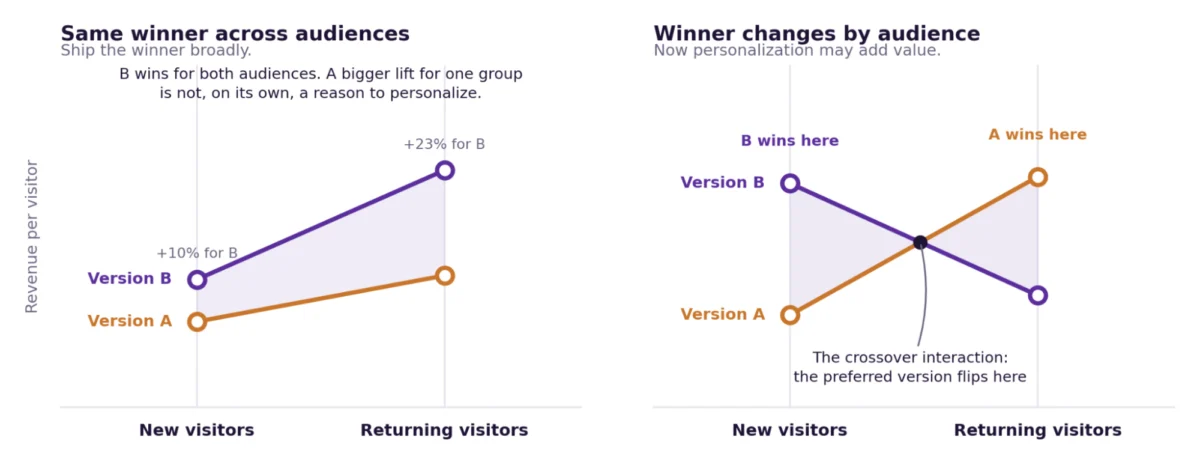
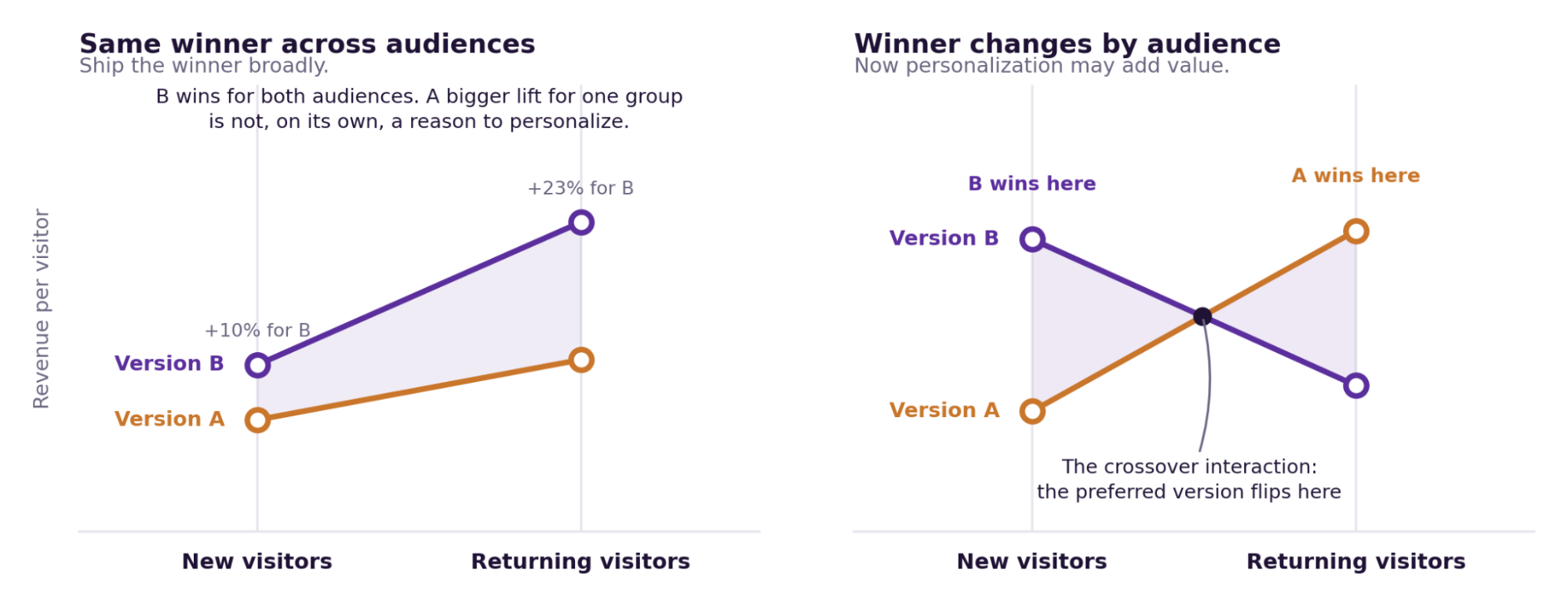
In the first study, personalization outperformed a universal rollout of the best-performing version by 18%. In the second study, that gain dropped to only 4%. The 4x difference in value was not attributed to the sophistication of the personalization algorithms but rather to whether the available customer data identified groups that responded differently to the experiences being tested. This leads to a counterintuitive conclusion for many digital marketers: increasing the volume of customer data does not automatically increase the value of personalization. Value is only unlocked when data identifies "crossover interactions"—instances where the optimal decision for one group is different from the optimal decision for another.

Chronology of Optimization Strategies in Digital Commerce
To understand the current emphasis on the Crossover Test, one must look at the chronological development of digital marketing tactics over the last two decades:
- The Era of Mass Marketing (2000–2010): Early digital commerce focused on universal experiences. A single website version was served to all users, with optimization focusing on broad usability.
- The Rise of A/B Testing (2010–2015): Tools became available for marketers to test "Version A" against "Version B." The goal was to find a "global winner" to ship to the entire database.
- The Personalization Gold Rush (2015–2022): With the advent of Customer Data Platforms (CDPs) and AI, the industry shifted toward hyper-segmentation. The prevailing logic was that more segments necessarily led to more revenue.
- The Rationalization Phase (2023–Present): Following global economic shifts and a focus on "efficiency years," companies are now scrutinizing the maintenance costs of personalization. The Crossover Test represents this new era of disciplined optimization.
The Four-Question Diagnostic for Strategic Personalization
Industry experts recommend a rigorous four-point diagnostic before committing resources to a personalized experience. If a proposed segment fails any of these criteria, the most profitable decision is typically to ship the best-performing experience to all users and redirect personalization efforts elsewhere.
1. Does the "Winner" Change by Audience?
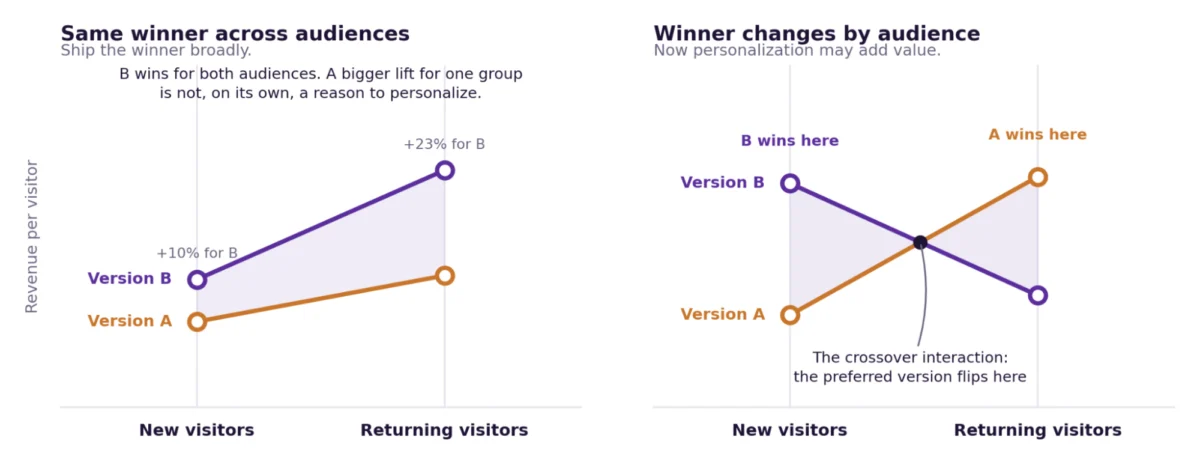
The primary goal is to identify a "flip" in preference, not just a variation in the magnitude of the response. If "Version B" beats "Version A" by 3% for new visitors and 9% for returning visitors, Version B is the universal winner. In this scenario, personalizing for returning visitors adds complexity without changing the fundamental decision to use Version B.
2. Was the Segment Pre-Defined?
Data mining after a test is completed often leads to "p-hacking" or finding patterns in random noise. A segment discovered post-hoc should be treated as a new hypothesis to be validated in a subsequent test, rather than a factual basis for an immediate rollout.
3. Is the Signal Actionable in Real-Time?
A common pitfall is identifying a high-value segment that cannot be recognized until the customer has already completed the journey. For instance, if a "high lifetime value" signal only triggers after a checkout is complete, it cannot be used to personalize the pre-purchase experience for that specific session.
4. Does the Incremental Value Exceed the Maintenance Cost?
Every personalized rule adds a layer of "technical debt" and operational cost. This includes initial development, ongoing content updates, quality assurance (QA), platform fees, and complex reporting requirements.

Financial Analysis: The Minimum Lift Needed
To provide the clarity required by financial leadership, organizations must calculate the "Minimum Lift Needed" for any personalization project. The formula is defined as:
Minimum Lift Needed = (Annualized Incremental Cost of Personalization) / (Annual Profit Generated by the Eligible Group)
Consider a hypothetical scenario for a retail website. If a specific segment represents 12% of traffic (240,000 visits) with a revenue-per-visit of $4.00, the annual revenue is $960,000. At a 40% profit margin, the group generates $384,000 in profit. If the cost to maintain a personalized rule for this group is $18,000 per year, the personalization must generate at least a 4.7% lift just to break even. If a test shows a 3% lift, the company actually loses $6,500 annually by choosing to personalize rather than shipping a universal winner.
A real-world example from the travel and hospitality sector reinforces this. A brand tested a personalized lodging page for premium repeat visitors. While the test showed a 6% revenue lift (approximately $54,000), the 25% profit margin reduced the actual gain to $13,500. When weighed against the $15,000 annual cost of managing seasonal offers and QA for that specific rule, the "winning" test resulted in a $1,500 annual loss.
Implementing Long-Term Measurement and Unified Data
To mitigate the risk of "phantom wins," leading organizations are adopting the Airbnb model of persistent holdout groups. By keeping a small percentage of traffic entirely away from all personalization "winners" over a long period, companies can measure the cumulative impact of their optimization program against a clean baseline. This provides a credible estimate of value-add that stands up to CFO scrutiny.
Furthermore, the transition from fragmented data to unified customer profiles is becoming essential. Tools such as the Wingify Data Platform allow businesses to bring together behavioral, purchase, and CRM data. While this data does not automatically prescribe the correct experience, it provides the "better signals" necessary to form hypotheses that are more likely to pass the Crossover Test.
Industry Implications and Future Outlook
The shift toward the Crossover Test signals a maturing of the digital optimization industry. Analysts suggest that the era of "personalization for the sake of personalization" is concluding. Instead, the focus is shifting toward "meaningful differentiation."
The broader implications for the market are twofold. First, there will likely be a consolidation of personalization rules as companies audit their histories and realize many rules are "underwater" financially. Second, there will be an increased demand for integrated platforms that combine data management with experimentation, reducing the "incremental cost" side of the equation and making lower-lift wins more viable.
In conclusion, the path to a high-ROI personalization program does not lie in the quantity of segments, but in the rigorous validation of which segments truly require a different experience. By applying the Crossover Test and maintaining a focus on the net economic impact, marketing teams can finally bridge the gap between "test wins" and "bottom-line revenue," securing their position as a verified engine of business growth.