The digital marketing landscape has reached a critical juncture where the ability to collect vast amounts of customer data has outpaced the ability of most organizations to generate a measurable return on investment from that data. While optimization programs frequently tout a long list of successful A/B test results, a significant gap remains between reported "wins" and the actual revenue reflected on corporate balance sheets. Industry experts suggest that this discrepancy is rarely a reporting error; rather, it is a fundamental strategic failure in how teams determine which data points are worth acting upon. As organizations face increasing pressure from Chief Financial Officers (CFOs) to justify digital spending, the focus is shifting from the mere implementation of personalization to a rigorous financial framework known as the Crossover Test.
The Personalization Paradox: Correlation vs. Causation
The drive toward hyper-personalization is often fueled by high-level industry reports that suggest a direct link between personalized experiences and rapid growth. A prominent study by McKinsey & Company found that faster-growing companies generate approximately 40% more of their revenue from personalization than their slower-growing counterparts. However, data scientists caution against a simplistic interpretation of these findings. While the correlation is clear, the causation is often inverted: companies that grow quickly typically possess the surplus capital, advanced data infrastructure, and specialized personnel required to implement complex personalization engines. In this context, personalization may be a symptom of success rather than its primary driver.
The risks of misinterpreting observational data were highlighted in a landmark study conducted by researchers at Yahoo. The team sought to determine whether display advertisements increased the frequency of brand-related searches. When analyzing the data observationally—comparing users who saw ads to those who did not—the apparent "lift" in search behavior was staggering, ranging from 870% to 1,200%. However, when a randomized controlled trial (RCT) was implemented using a strict holdout group, the actual causal lift was revealed to be a mere 5.4%.
This phenomenon, often cited by experimentation experts Ron Kohavi and Stefan Thomke, illustrates the "selection bias" inherent in most customer data. Data excels at describing who a customer is and how they have behaved in the past, but it is notoriously poor at predicting how that same customer will respond to a novel experience. Consequently, many organizations invest heavily in segmenting their audience based on historical behavior, only to find that these segments do not respond differently to new marketing interventions.

Defining the Crossover Interaction
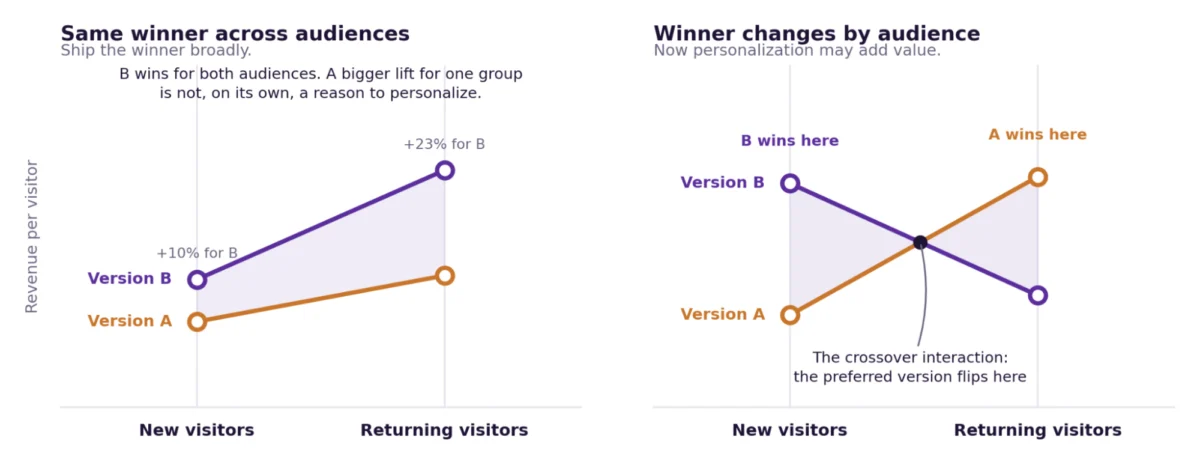
The fundamental requirement for profitable personalization is the existence of a "crossover interaction." In digital experimentation, a crossover occurs when one version of a digital experience (Version A) outperforms another (Version B) for one specific audience segment, while the opposite is true for a different segment.
Consider a standard optimization scenario: a company tests a redesigned product page. If Version B results in a 3% conversion lift for new visitors and a 9% lift for returning customers, many marketing teams would view the 9% lift as a prime opportunity for a personalized "returning customer" experience. However, from a resource-allocation perspective, this is a fallacy. If Version B is the superior choice for both groups, the most efficient decision is to deploy Version B to the entire audience.
Personalization only becomes economically viable when the "winner" changes between segments. If the data does not reveal a crossover where Version A is better for Group X and Version B is better for Group Y, then a unified experience is almost always more profitable. Creating separate experiences for segments that both prefer the same version introduces "complexity debt"—additional rules, content variations, and maintenance costs—without providing an incremental benefit over a universal rollout.
The Wharton Study: Why Data Volume Does Not Equal Value
Recent academic research underscores the variability of personalization outcomes. Anya Shchetkina and Ron Berman of the Wharton School conducted a comprehensive study, published in late 2024, analyzing five common personalization methods across two large-scale field studies. Despite the studies having nearly identical setups—including approximately 20 variations and similar performance metrics—the results were drastically different.
In the first study, personalization outperformed a universal rollout by 18%. In the second, the gain was a negligible 4%. The researchers concluded that the difference was not the sophistication of the algorithms used, but rather the nature of the customer data. In the first case, the data successfully identified groups with divergent preferences (crossovers). In the second, the data identified segments that behaved differently but ultimately wanted the same digital experience. This leads to a sobering conclusion for digital strategists: increasing the volume of customer data does not automatically increase the value of personalization. Value is only created when data identifies meaningful differences in response, not just differences in identity.

The Four-Step Diagnostic for Personalization ROI
To prevent the proliferation of low-value personalization rules, analysts recommend a four-question diagnostic before any separate experience is built:
- Does the winner change, or is it just a difference in magnitude? Organizations should look for a "flip" in preference between groups. A stronger response from one group is a reason to move faster on a general rollout, not a reason to fragment the user experience.
- Was the segment defined a priori? Post-hoc data mining—slicing results after a test is completed—frequently leads to "false positives" due to the multiple comparisons problem. Segments discovered after the fact should be treated as hypotheses for future testing, not as definitive guides for immediate action.
- Is the signal actionable in real-time? A segment based on Lifetime Value (LTV) is useless if the system cannot identify the customer until after they have completed a transaction. The data signal must be available at the "moment of truth" when the experience is served.
- Does the incremental lift cover the "Complexity Tax"? Every personalized rule carries an annualized incremental cost. This includes the initial build, content production, Quality Assurance (QA) across multiple devices, reporting overhead, and platform fees.
The Financial Formula: Calculating the Break-Even Point
A critical component of the Crossover Test is the calculation of the "Minimum Win Needed." This formula allows teams to determine the exact percentage of lift required to justify the operational costs of a personalized experience:
Minimum Lift Needed = (Annualized Incremental Cost of Personalization) / (Annual Profit Generated by the Target Group)
For example, if a personalized experience for a high-value segment costs $20,000 per year to maintain (including staff time and software costs) and that segment currently generates $400,000 in annual profit, the personalization must drive a minimum lift of 5% just to break even. If a confirmed test shows a 3% lift, the project is technically a "winner" in the analytics tool but a net loss for the company’s bottom line.
A case study from the travel and hospitality industry illustrates this risk. A brand developed a personalized lodging page for "premium browsers." While the test showed a 6% revenue lift, the relatively small size of the audience meant the total incremental profit was only $13,500. When weighed against the $15,000 annual cost of managing seasonal content and QA for that specific rule, the "winning" personalization was projected to lose the company $1,500 per year. The project was subsequently shelved in favor of a broader booking-path improvement that applied to all users.
Strategic Implications for Data Infrastructure
The realization that many segments do not require personalization is prompting a shift in how companies invest in their data stacks. Rather than simply collecting more data, leading firms are focusing on "unified signals." Platforms like the Wingify Data Platform are being utilized to merge behavioral, CRM, and purchase data into a single profile. The goal is not to create more segments, but to find better ones—those that are more likely to exhibit crossover interactions.
Furthermore, industry leaders are moving away from measuring individual "wins" and toward measuring "program impact." Minyong Lee and Milan Shen at Airbnb have advocated for the use of persistent holdout groups. By keeping a small percentage of traffic (e.g., 1% to 5%) entirely insulated from all optimization changes over a long period (6-12 months), a company can accurately measure the cumulative lift of its entire personalization and testing program. This provides a "ground truth" that accounts for the fact that some statistically significant wins are actually the result of random noise.
Future Outlook: Principled Personalization
As the "growth at all costs" era of the last decade gives way to an era of "profitable growth," the standards for digital optimization are rising. The future of personalization lies not in the quantity of rules an organization can launch, but in the precision with which it identifies true crossover opportunities.
Industry analysts suggest that the next phase of digital maturity will involve a "less is more" approach. By applying the Crossover Test and rigorous ROI calculations, organizations can prune low-value complexity and focus their engineering and creative resources on the small subset of personalization opportunities that drive genuine, bottom-line impact. For most companies, this will mean running fewer, more meaningful experiments and prioritizing universal experience improvements until the data provides an undeniable signal that a segment requires a different path.