The burgeoning landscape of artificial intelligence has fundamentally reshaped how users interact with information, and at the forefront of this revolution stands ChatGPT. With an astonishing user base exceeding 800 million monthly active users, approaching one-tenth of the global population, and processing approximately two billion prompts daily, ChatGPT has become a dominant force in AI assistant traffic, accounting for roughly 70% of all such interactions. This widespread adoption is directly impacting consumer behavior, with a significant 63% of users turning to AI for research and discovery, and 53% utilizing it to compare products and prices. This seismic shift means consideration stages of the buyer journey are now accessible to brands in ways previously unimaginable. The conversation has thus evolved from whether brands should be present on these platforms to understanding the tangible impact and functionality of advertising within them.
This article delves into the results of extensive testing conducted on the advertising capabilities within ChatGPT, offering a comprehensive look at its current operational mechanics, targeting nuances, cost implications, measurement challenges, and strategic purchasing avenues. The insights garnered are crucial for marketers seeking to navigate this nascent yet rapidly evolving advertising channel.
Understanding the ChatGPT Advertising Unit and Targeting Mechanisms
The advertising unit within ChatGPT is integrated directly below the AI’s generated response, clearly demarcated with a "Sponsored" label. Each ad comprises a single 1:1 image, a headline, a concise descriptive text, and a direct click-through link to the advertiser’s website. This format prioritizes visual appeal and immediate information delivery, aiming to capture user attention within the context of their AI-generated output.
However, the targeting capabilities of this channel are notably less sophisticated than those commonly found in established digital advertising ecosystems. The system operates on a purely contextual basis, aligning advertisements with the user’s original prompt rather than the AI’s generated response. This means that relevance to the initial query is the sole determinant of ad visibility. Notably, there is no audience segmentation, demographic overlay, or granular geographic control currently available. This "blunt instrument" approach to targeting emphasizes the importance of precise prompt alignment for advertisers to achieve effective reach.
The Role of Precision in Cost Efficiency
The pricing structure within ChatGPT’s advertising environment is a critical factor shaping advertiser strategy, characterized by an opaque relevancy model layered atop a proto-auction system. In practice, this results in a bifurcated pricing landscape. For advertisers targeting niche prompts with minimal competition, the cost per mille (CPM) can be as low as $15. Conversely, bids on highly contested prompts, where multiple advertisers vie for visibility, can drive CPMs upwards of $60.
Analysis across various brands indicates that typical CPMs are fluctuating between $25 and $35, with the final cost being heavily influenced by the specificity and niche appeal of the advertising message. Our own testing efforts revealed CPMs clustering closer to the $40 mark. This pattern underscores a clear correlation: the more precisely an advertiser’s creative content resonates with the user’s prompt, the greater the cost efficiency.

The current advertising framework strongly suggests a preference for CPM bidding over cost-per-click (CPC). The underlying methodology for CPC is deemed too obscure to provide reliable performance metrics. By focusing on CPM and allowing clicks to materialize organically based on ad relevance, advertisers have demonstrated a more favorable effective cost per click. This strategic approach allows for broader reach and impressions while managing expenditure based on visibility rather than direct action, which is particularly advantageous in a channel still finding its footing.
Navigating the Measurement Challenge in a New Frontier
One of the most significant hurdles currently faced by advertisers in the ChatGPT ad channel is the limitation in measurement capabilities. At present, advertisers receive basic metrics such as impressions and clicks. The platform has yet to implement conversion optimization, meaning it cannot proactively optimize ad delivery to achieve specific desired outcomes or conversions.
Consequently, advertisers must focus on measuring the indirect or "knock-on" effects of these clicks. This necessitates a critical evaluation: do users who arrive on a website via ChatGPT exhibit a higher intent than those originating from more established channels like native ads, display, video, social media, or search? This question is best answered by analyzing user behavior once they land on the advertiser’s site.
Sharing pixel and conversion data with advertising partners is a vital step in this process. Early indicators from our testing are encouraging, with click-through rates (CTRs) proving comparable to those of native advertising formats. This is a robust signal for a channel that is still in its nascent stages of development. The practical imperative for advertisers is to establish a comprehensive evaluation framework before committing advertising spend. This framework should clearly define how the intent demonstrated by users from ChatGPT will be benchmarked against the on-site behavior of users from other digital channels. This proactive planning ensures that performance can be accurately assessed and strategies can be refined based on concrete data.
Purchasing Pathways: Three Routes and Associated Investment Levels
Advertisers have three primary avenues for engaging with ChatGPT advertising, with the optimal choice dependent on specific campaign objectives.
-
Criteo Integration: This option is particularly well-suited for commerce-focused brands, especially those in the CPG and retail sectors. Criteo can ingest product feeds, enabling the simultaneous activation of thousands of advertisements. This scalability makes it an attractive proposition for businesses with extensive product catalogs. The estimated monthly investment for this route ranges from $50,000 to $100,000.
-
StackAdapt Partnership: StackAdapt offers a solution that includes some incentive programs and geo-targeting capabilities, albeit with the same contextual targeting limitations as the broader platform. This option typically requires a monthly investment of approximately $50,000.

-
Direct OpenAI Integration: For advertisers seeking the most direct engagement, a direct partnership with OpenAI is available. However, this option comes with a significantly higher minimum spend, starting at approximately $250,000 per month.
While there is limited data to definitively pinpoint the ideal use cases for this advertising format, its primary strength lies in reaching users during a moment of high consideration. Therefore, before committing to a budget, advertisers must first clarify two fundamental aspects:
- How will they guide users from ChatGPT to their website?
- How will they measure the subsequent impact of these users on their site?
The answers to these questions should dictate the budget, rather than the other way around. This user-centric and data-driven approach ensures that advertising investments are strategically aligned with measurable business outcomes.
The Future Trajectory: Evolution and Opportunity
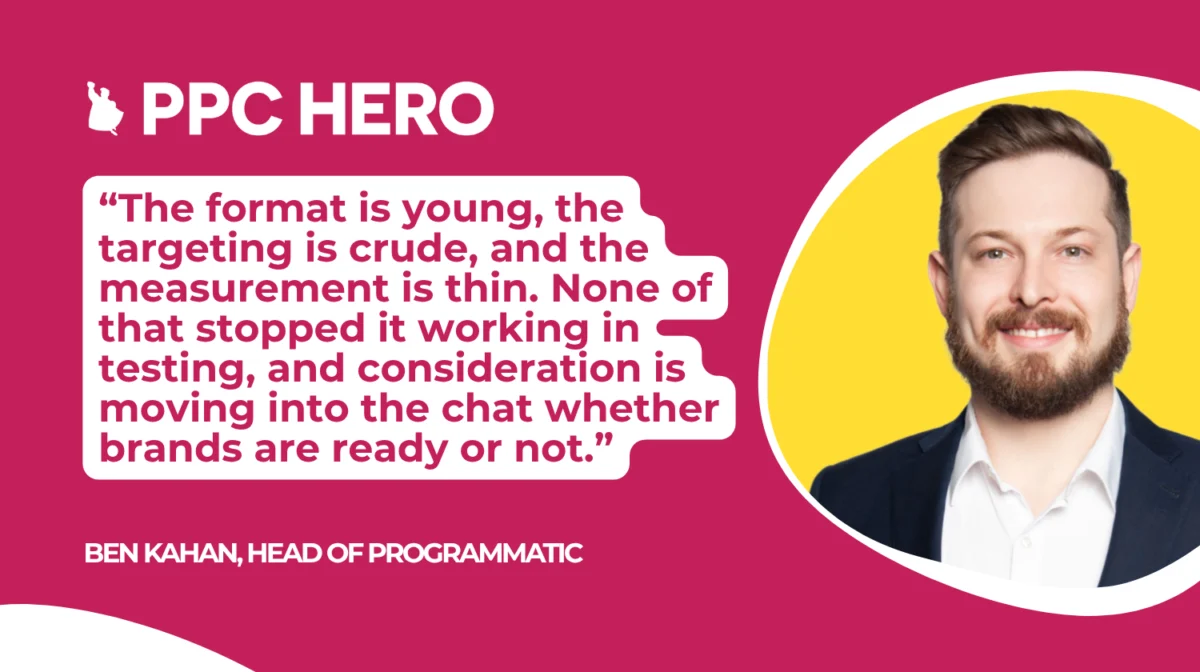
The current iteration of ChatGPT advertising presents a young format with rudimentary targeting and limited measurement tools. Despite these constraints, initial testing has demonstrated its efficacy. The undeniable trend of user consideration migrating into AI-driven chat interfaces means brands must engage, whether they feel fully prepared or not.
Drawing parallels with the evolution of programmatic advertising, the future development of this channel can be predicted with a reasonable degree of certainty. Audience targeting is an almost inevitable progression, given OpenAI’s extensive user data and clear incentives to leverage it. Conversion optimization will undoubtedly follow, enabling more sophisticated campaign management. As more brands enter this space, driven by the potential for early-mover advantage and reach, CPMs are expected to rise. Concurrently, the auction mechanisms will likely become more transparent, gradually resembling the established channels already prevalent in the digital advertising ecosystem.
Brands that are actively testing and investing in this channel now are positioning themselves to gain a significant head start. This competitive edge is crucial, as the gap in cost and efficiency will narrow rapidly once increased competition drives up prices and introduces more sophisticated advertising strategies. The early adopters are essentially building valuable institutional knowledge and brand presence in a space that is poised for exponential growth and integration into mainstream digital marketing strategies. The proactive engagement with this evolving platform is not merely an experiment but a strategic imperative for long-term market relevance.