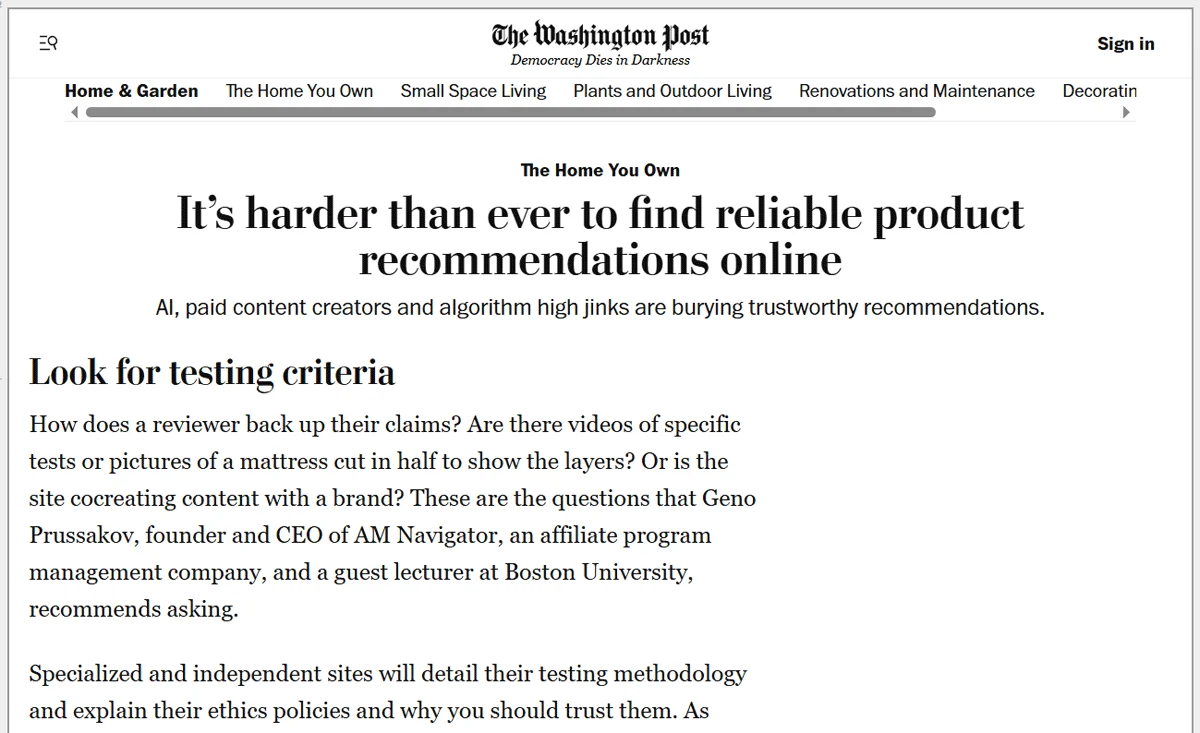
The landscape of digital publishing has undergone a fundamental transformation over the last decade, shifting from a reliance on traditional display advertising toward a sophisticated model of commerce-driven content. As legacy media organizations seek sustainable revenue streams in an era of declining print circulation and ad-blocking software, the "product roundup" or "best of" list has emerged as a cornerstone of modern digital journalism. This evolution was recently highlighted by a report in The Washington Post, which sought expert analysis on how consumers should interpret the product recommendations published by major media outlets. The inquiry underscores a growing concern: as media brands leverage their long-standing authority to generate affiliate revenue, the line between objective editorial advice and paid promotion becomes increasingly blurred.
The Rise of Commerce Journalism and Affiliate Integration
The integration of affiliate marketing into high-authority newsrooms is not a new phenomenon, but its scale has reached unprecedented levels. Historically, product reviews were relegated to specific lifestyle sections or specialized magazines. Today, however, major publishers—including The New York Times, Hearst, Condé Nast, and Dotdash Meredith—operate dedicated commerce divisions. These teams are tasked with creating content that ranks highly on search engine results pages (SERPs) and encourages readers to click through to retailers like Amazon, Walmart, or niche direct-to-consumer brands.
When a reader purchases a product through a link in an article, the publisher typically receives a commission ranging from 1% to 20%, depending on the category and the specific agreement with the merchant. This model, known as performance-based marketing, has proven highly lucrative. For many publishers, commerce content now accounts for 25% to 40% of their total digital revenue. This financial dependency has raised questions regarding the objectivity of the "expert" advice provided to the public.
Historical Context and the Shift in Media Business Models
To understand the current state of online product recommendations, one must examine the chronological shift in how media is funded.
- The Pre-Digital Era (Post-WWII – 1990s): Media revenue was driven by a "church and state" separation between editorial and advertising. Advertisers paid for proximity to high-quality content, but rarely had direct influence over the content itself.
- The Initial Digital Disruption (2000s): The rise of the internet decimated classified ads and print subscriptions. Publishers turned to programmatic display ads (banners), which eventually suffered from "banner blindness" and low click-through rates.
- The Pivot to Affiliate Marketing (2011 – 2016): A pivotal moment occurred in 2016 when The New York Times acquired Wirecutter, a product review site, for approximately $30 million. This signaled to the industry that "service journalism" backed by affiliate links was a viable and prestigious business model.
- The SEO Dominance Era (2017 – Present): Publishers began leveraging their high "Domain Authority"—a metric used by search engines to determine trustworthiness—to dominate search results for lucrative keywords like "best vacuum cleaner" or "best credit cards."
The Mechanics of Authority: How Big Media Vets Recommendations
Despite the inherent potential for conflict of interest, industry experts, including Geno Prussakov of AM Navigator, suggest that many major publishers maintain rigorous standards to protect their brand equity. A media brand’s most valuable asset is its reputation; if it recommends substandard products for the sake of a quick commission, it risks losing the long-term trust of its audience.
To mitigate this risk, top-tier media outlets generally employ four primary strategies:
- Dedicated Editorial Testing: Leading publishers often invest in physical testing labs. They employ specialists who spend hundreds of hours using products in real-world scenarios before any recommendation is published.
- Separation of Teams: In many reputable houses, the editorial team that tests and selects products is kept separate from the business team that negotiates affiliate rates. This is intended to ensure that a product is chosen for its quality rather than its commission potential.
- Compliance and Legal Oversight: The Federal Trade Commission (FTC) in the United States requires clear and conspicuous disclosures when a link provides a financial benefit to the publisher. Most major media outlets have standardized these disclosures to avoid regulatory scrutiny.
- Data-Driven Feedback Loops: Publishers monitor return rates. If a recommended product is frequently returned by readers, it signals to the editorial team that the recommendation was inaccurate, prompting a review of the content.
The Financial Influence: Placement Fees and EPC Guarantees
While editorial integrity is a stated goal, the financial realities of the industry cannot be ignored. In some instances, the ranking of a product is influenced by "placement fees" or "tenancy payments." These are flat fees paid by brands to ensure they are included in a specific list or given a more prominent position.
Furthermore, publishers often look at "Earnings Per Click" (EPC) and conversion rates. If Product A offers a 10% commission and converts at a high rate, while Product B offers a 2% commission and converts poorly, there is a systemic pressure to prioritize Product A in "best of" lists, provided Product A meets a minimum threshold of quality. This creates a "pay-to-play" environment where smaller brands with superior products but smaller marketing budgets may be excluded from the conversation entirely.

Consumer Protection: Strategies for Navigating Online Reviews
As the distinction between a neutral review and a commercial advertisement continues to thin, consumers must adopt a more analytical approach to online shopping. Industry analysts recommend several steps to verify the authenticity of a recommendation:
1. Identification of Affiliate Disclosures
Consumers should look for statements such as "We may earn a commission if you buy through our links." While this does not automatically invalidate the review, it alerts the reader to the financial incentive involved.
2. Cross-Referencing Multiple Sources
A "Best of" list should never be the sole basis for a purchase. By comparing lists from three or four different major publications, a consumer can see which products are consistently praised and which appear only on a single site.
3. Seeking Original Imagery and Video
One of the most reliable signs of a legitimate review is original photography or video of the product being tested. If an article only uses "stock" photos provided by the manufacturer, it is highly likely the author never physically handled the item.
4. Analyzing the Rationale
A high-quality review will explain why a product was chosen and, equally importantly, what its flaws are. Reviews that are 100% positive without any mention of drawbacks are often more indicative of marketing copy than journalistic evaluation.
Implications for the Future of the Open Web
The proliferation of media-led product recommendations has significant implications for the broader digital ecosystem. As major publishers dominate the first page of Google search results, independent review blogs and niche experts are being pushed further down the rankings. This consolidation of "search engine authority" means that a handful of large corporations now act as the primary gatekeepers for consumer information.
Moreover, the rise of Generative Artificial Intelligence (AI) presents a new challenge. As AI models are trained on existing web content, they may inadvertently ingest and amplify biased or monetized recommendations, creating a feedback loop where commercial interests are presented as objective facts.
The future of commerce journalism will likely depend on a "flight to quality." As consumers become more aware of affiliate tactics, they may gravitate toward platforms that offer transparency and rigorous, verifiable testing. For media organizations, the challenge will be balancing the need for revenue with the necessity of maintaining the editorial standards that gave them their authority in the first place.
Conclusion
The evolution of the media industry into a major player in the e-commerce space is a logical response to the economic pressures of the digital age. While the "Washington Post" inquiry highlights the skepticism many feel toward online shopping roundups, it also reveals the complex infrastructure of vetting and testing that exists behind the scenes at many reputable outlets. Ultimately, the responsibility lies with both the publisher to maintain transparency and the consumer to exercise critical thinking. In a marketplace where trust is the primary currency, the most successful media brands will be those that prioritize the accuracy of their recommendations over the size of their commissions.