
The landscape of the American affiliate marketing industry underwent a seismic shift in January 2026 as two of the world’s most prominent affiliate networks, Rakuten Advertising and impact.com, took unprecedented disciplinary action against PayPal Honey. The move follows a series of high-profile investigations into the browser extension’s technical practices, marking one of the most significant enforcement actions in the history of the partnership economy. PayPal Honey, which was acquired by the fintech giant PayPal in 2020 for approximately $4 billion, now finds itself at the center of a debate regarding attribution integrity and the ethical boundaries of automated shopping tools.
The Catalyst: Investigations into Attribution Manipulation
The fallout began following the release of a detailed video report by the investigative content creator MegaLag and a concurrent technical investigation by Ben Edelman, a well-known expert in online advertising fraud and consumer protection. These investigations alleged that Honey was engaging in "stand-down" violations—a technical term referring to the requirement that browser extensions must not fire their affiliate links if another affiliate has already established a valid tracking cookie for the consumer’s session.
In the affiliate marketing world, most programs operate on a "last-click-wins" model. This means the affiliate responsible for the final click before a purchase receives 100% of the commission. To prevent unfair practices, industry standards mandate that browser extensions "stand down" to avoid overwriting the cookies of content creators, bloggers, or influencers who initially drove the customer to the merchant. The investigations suggested that Honey was bypassing these rules, effectively "hijacking" commissions that should have been attributed to other partners.
A Chronology of Disciplinary Actions
The enforcement actions by the major networks were swift and coincided with the industry’s most significant annual gathering, Affiliate Summit West. This timing served to amplify the news across the digital marketing sector, turning a technical compliance issue into a major industry talking point.
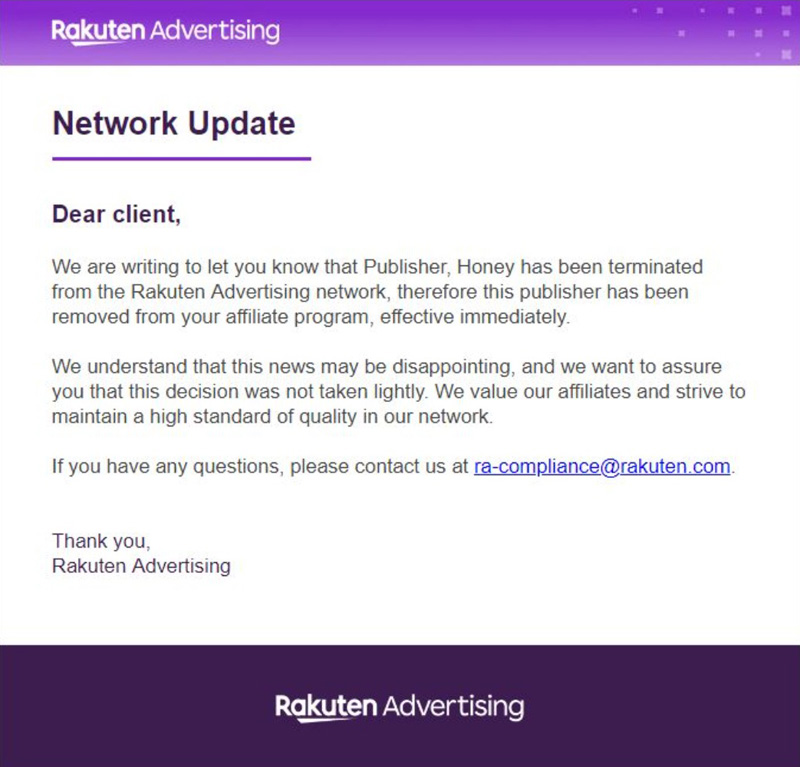
On Monday, January 12, Rakuten Advertising officially announced that Honey had been "terminated from the network." In a public statement, Rakuten framed the decision as a necessary measure to "maintain a high standard of quality" within its ecosystem. Unlike a temporary suspension, a termination suggests a severe breach of the network’s terms of service, effectively severing the tie between Honey and the thousands of brands managed through Rakuten’s platform.
The momentum continued through the week. On Friday, January 16, impact.com, another titan in the partnership management space, revealed that Honey had been found "out of compliance" with its platform policies. David A. Yovanno, CEO of impact.com, explicitly cited "attribution manipulation" as the driving factor behind the decision. While impact.com’s action was characterized as a removal from their "Discovery Marketplace" and a suspension rather than a permanent termination, the message was clear: the industry’s leading platforms would no longer tolerate behavior that undermines the trust of the partnership economy.

Understanding the Technical Violation: The "Stand-Down" Rule
To understand the severity of these removals, one must look at the mechanics of the "stand-down" rule. Browser extensions like Honey offer users coupons and cashback rewards. Because these extensions reside within the user’s browser, they have the technical capability to inject affiliate code at the very last second of a checkout process.
If a consumer reads a product review on a blog, clicks an affiliate link, and adds an item to their cart, the blogger is the rightful recipient of the commission. However, if a browser extension detects the checkout and "refreshes" the page with its own affiliate link, it overwrites the blogger’s tracking cookie. The "stand-down" rule is a self-regulatory policy where the extension checks for existing affiliate cookies and remains dormant if one is found. The allegations against Honey suggest not only a failure to stand down but an intentional effort to conceal these violations from network auditors.
The $4 Billion Context: PayPal’s Strategic Dilemma
The suspension of Honey is particularly noteworthy given its corporate parentage. When PayPal acquired Honey Science Corp. in 2020 for $4 billion, it was the largest acquisition in PayPal’s history. The goal was to move PayPal "upstream" in the customer journey, capturing consumers at the point of discovery rather than just the point of payment.
At the time of the acquisition, Honey boasted over 17 million monthly active users. However, the pressure to maintain growth and justify a multi-billion-dollar valuation may have contributed to aggressive technical strategies. The current removal from Rakuten and impact.com puts PayPal in a difficult position, as a significant portion of Honey’s revenue is derived from the commissions paid by merchants on these very networks. If Honey cannot regain the trust of the major platforms, its utility as a revenue-generating asset for PayPal could be significantly diminished.
Broader Implications for Affiliate Managers
Industry experts at AM Navigator and other leading consultancies suggest that the Honey case provides five critical lessons for affiliate managers and brand owners moving forward:
1. The Risk of Brand Contamination
A single "bad apple" in an affiliate program can deter high-quality content creators from participating. Savvy influencers and publishers often use policing tools to see which other affiliates are in a brand’s program. If they see a known "cookie-stuffer" or an extension that violates stand-down rules, they may choose not to promote that brand, fearing their hard-earned commissions will be stolen at the last second.
2. The Necessity of Independent Policing
While networks like Rakuten and impact.com have compliance departments, they are often monitoring for network-wide violations rather than program-specific breaches. Brands are increasingly being advised to perform their own audits. The Honey case demonstrates that even the largest players can circumvent network detection for periods of time, making brand-level vigilance essential.
3. The Complexity of Attribution Audits
The Affiliate & Partner Marketing Association (APMA) in the UK recently conducted an audit of 30 brands across 10 networks, highlighting the complexity of "soft clicks" versus "stand-down" rules. The Honey situation underscores the need for affiliate managers to understand the deep technical nuances of how their partners’ software interacts with the browser.
4. Avoiding Generalizations
Despite the Honey controversy, industry experts warn against banning all browser extensions. Not all Downloadable Software Publishers (DSPs) engage in illicit behavior. Some extensions provide genuine incremental value by increasing conversion rates or preventing cart abandonment without manipulating attribution. The key is individual evaluation rather than broad-stroke bans.
5. The Imperative for Diversification
The most significant takeaway for brands is the danger of over-reliance on a single affiliate type. Many programs find that 50% or more of their revenue comes from a single partner or a single category (like coupons/extensions). If that partner is suspended—as Honey was—the brand’s digital revenue can crater overnight.
A Roadmap for Future Diversification
In light of the Honey suspension, affiliate managers are being urged to diversify their affiliate base across a broader spectrum of partner types. A robust program in 2026 should ideally include a mix of the following:
- Content Producers: Bloggers and news sites that drive top-of-funnel awareness.
- Social Media Influencers: Creators who build brand trust on platforms like Instagram and TikTok.
- Card-Linked Offers: Rewards tied directly to a consumer’s credit card, bypassing browser-based tracking issues.
- Mass Media: Large-scale publications (e.g., NYT Wirecutter) that offer high-authority placements.
- Complementary Brands: Strategic partnerships between non-competing companies (e.g., a travel site partnering with a luggage brand).
- Niche Communities: Forums and educators who provide deep expertise to specific consumer segments.
The Future of the Partnership Economy
The removal of PayPal Honey from major networks marks a "maturation moment" for the affiliate industry. It signals that the era of "growth at any cost" is being replaced by an era of "integrity-first" partnerships. As brands demand more transparency and better data on where their customers are coming from, the tools and publishers that rely on technical obfuscation will find themselves increasingly marginalized.
For PayPal, the path forward involves a rigorous review of Honey’s codebase and a potential overhaul of its compliance protocols to satisfy the requirements of Rakuten and impact.com. For the rest of the industry, the event serves as a stark reminder that in the world of digital marketing, trust is the most valuable currency—and once lost, it is incredibly difficult to regain.
As the industry moves deeper into 2026, the focus will likely shift toward "holistic" affiliate management, where the value of a partner is measured not just by the volume of sales they drive, but by the incrementality and ethical standing of their methods. The Honey saga is not just a story of one company’s suspension; it is the beginning of a new standard for the entire digital advertising ecosystem.