The digital landscape, often characterized by its relentless pursuit of efficiency and information, occasionally reveals pockets of unexpected humor and playful design. Such was the case recently when users discovered a peculiar AI Overview response within Google Search, delivering a "Deez Nuts" punchline upon conducting a highly unconventional "blank search." This discovery, quickly circulated across social media platforms, highlights Google’s enduring tradition of embedding whimsical Easter eggs into its products, even as its artificial intelligence capabilities become increasingly sophisticated and integrated into core search functionalities.
The Unconventional Discovery of a Digital Joke
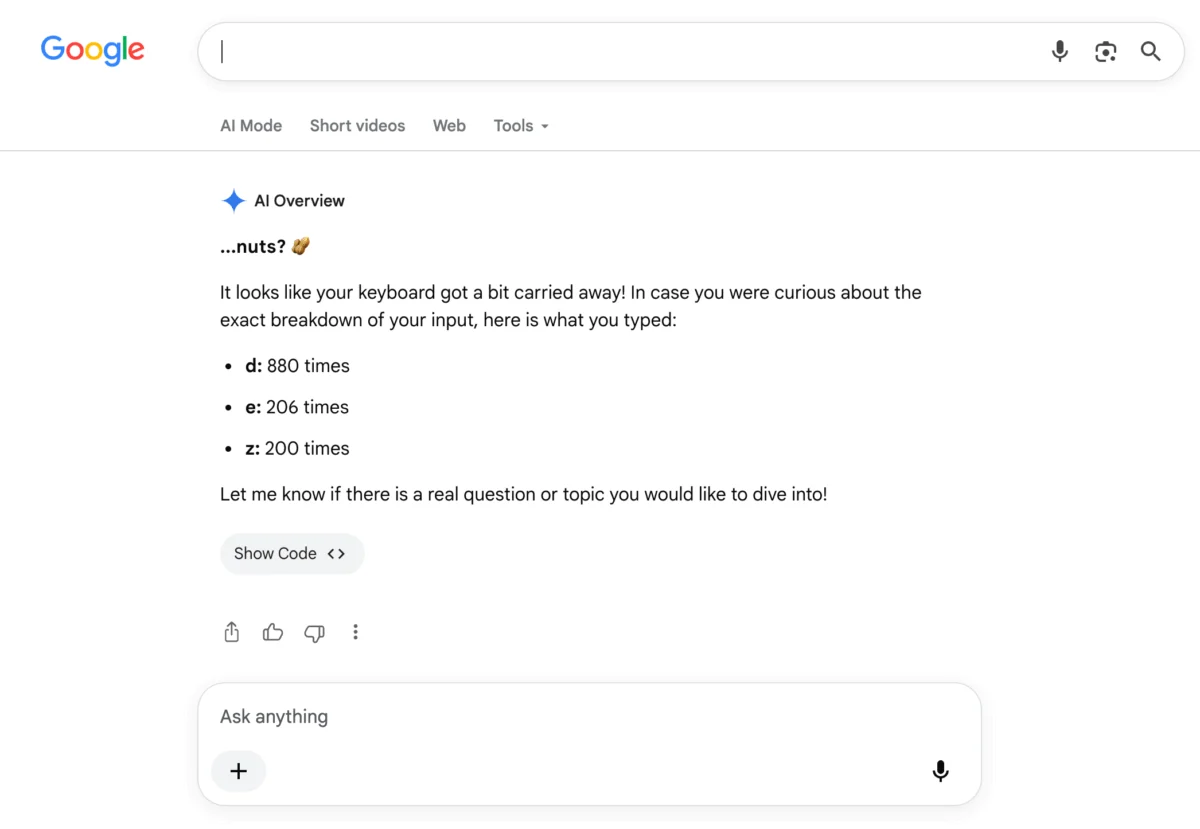
The peculiar incident came to light following a report by @harmo_snipe on the social media platform X (formerly Twitter), detailing an unusual AI Overview generated by Google Search. When users navigated to a specific URL – google.com/search?si= – effectively initiating a "blank search" without any query input, the AI Overview section presented an unexpected and culturally resonant message. Instead of an error or a generic prompt, the AI-generated summary stated, "…nuts? 🥜" accompanied by a playful emoji. This initial, cryptic response was then followed by a more detailed, albeit equally humorous, explanation: "It looks like your keyboard got a bit carried away! In case you were curious about the exact breakdown of your input, here is what you typed. d: 880 times e: 206 times z: 200 times."
The specific string google.com/search?si= appears to be a unique trigger, as a truly empty or malformed query might typically result in different default behaviors or error messages. The si= parameter, generally used for search identification, when left without a value, seems to have been programmed to activate this particular Easter egg. This demonstrates a deliberate, pre-programmed response rather than a random AI generation or "hallucination," underscoring an intentional design choice by Google’s developers. The immediate reaction from the online community was a mix of amusement and surprise, with many attempting to replicate the obscure search query to witness the digital prank firsthand. The "Deez Nuts" reference, a widely recognized internet meme and slang expression, further cemented its status as a deliberate nod to internet culture.
A Legacy of Digital Playfulness: Google’s Enduring Easter Eggs
Google has a well-documented history of integrating Easter eggs into its search engine and various products, transforming mundane interactions into moments of delight for users. These hidden features, ranging from simple text-based jokes to interactive mini-games, serve multiple purposes: they foster a sense of discovery, showcase developer creativity, and inject personality into a ubiquitous utility. This latest "Deez Nuts" AI Overview Easter egg fits squarely within this established tradition, reinforcing Google’s reputation for digital playfulness.
Over the years, numerous Google Easter eggs have captivated audiences globally, becoming cultural touchstones in their own right. Iconic examples include "do a barrel roll," which causes the search results page to perform a 360-degree rotation; "askew," which subtly tilts the entire page; and "Festivus," which adds a ceremonial aluminum pole to the left side of the results in honor of the Seinfeld-invented holiday. Beyond these classic text-based triggers, Google has embraced more elaborate, interactive experiences. The "Thanos snap" effect, tied to the Marvel cinematic universe, allowed users to click an Infinity Gauntlet icon, making half the search results disappear with an animation. Similarly, searching for "The Last of Us" might cause a green fungal growth to appear on the screen, referencing the popular video game and TV series. The "Cha-Cha Slide" query famously prompts an interactive dance party on the screen, guiding users through the song’s iconic moves. These diverse examples illustrate a consistent design philosophy: to surprise and engage users, demonstrating that even a dominant tech company, handling billions of searches daily, can maintain a playful spirit. The integration of such an Easter egg into an AI Overview, a relatively new and significant feature, marks an interesting evolution in this tradition, signaling that even advanced AI systems are not immune to a touch of human-like humor and deliberate programming. This practice not only enhances user experience but also subtly reinforces brand identity in a highly competitive market.
The Rise of AI Overviews: Contextualizing Google’s New Frontier
The context of this Easter egg is particularly noteworthy given its appearance within Google’s AI Overview feature. AI Overviews represent a significant strategic shift for Google Search, integrating generative artificial intelligence directly into the search results page. Launched as part of the broader Search Generative Experience (SGE) initiative, and increasingly powered by Google’s Gemini large language model, these overviews aim to provide concise, comprehensive, and contextually relevant summaries at the top of search results. Instead of simply listing links, AI Overviews synthesize information from multiple web sources to answer complex queries directly, offering a more conversational and efficient search experience.
The rollout of AI Overviews has been gradual, starting with experimental access for select users and progressively expanding to a wider user base. Google’s stated goal is to enhance user productivity by quickly delivering key information, reducing the need to click through multiple websites and streamlining the information discovery process. This ambition, however, comes with inherent challenges, including ensuring factual accuracy, preventing "hallucinations" (AI-generated false or misleading information), and maintaining the delicate balance between AI-generated content and traditional web results, which are crucial for the health of the broader web ecosystem. The integration of AI Overviews signifies Google’s profound commitment to leading the charge in AI-powered search, a domain where competition from other tech giants is intensifying rapidly. The appearance of a deliberate Easter egg within this cutting-edge feature suggests that Google views AI Overviews not merely as a functional tool but also as a platform capable of embodying brand personality and user engagement beyond pure utility. It highlights a conscious decision to imbue even the most advanced search features with elements of human creativity and humor, demonstrating a nuanced approach to AI integration that extends beyond mere functionality.
Decoding "Deez Nuts": A Cultural Phenomenon
The specific phrase "Deez Nuts" holds a distinct and indelible place within internet and broader popular culture. Its origins trace back to a skit featured on Dr. Dre’s seminal 1992 album, "The Chronic," where a character answers the phone with the provocative phrase. However, its true virality and widespread recognition as a meme exploded in the early to mid-2010s, primarily through user-generated content and platforms like Vine and YouTube. The phrase is typically employed as a punchline or an interjection, designed to disrupt a conversation, tease, or playfully disrespect in a lighthearted manner. Its effectiveness lies in its unexpectedness and its ability to elicit a reaction, often laughter or mild annoyance, making it a powerful tool for comedic timing.
The meme’s virality was propelled by various internet personalities and its inherent shareability, cementing its status as a shorthand for playful defiance and irreverence across online communities. Its ubiquitous presence in online comment sections, forums, social media feeds, and even mainstream media adaptations made it a recognizable cultural touchstone for a generation of internet users. By incorporating "Deez Nuts" into an AI Overview, Google is not only acknowledging a popular meme but also demonstrating a keen awareness of contemporary internet slang and humor. This choice of reference is unlikely to be accidental; it suggests an understanding of its target audience’s cultural lexicon and a willingness to engage with it in a lighthearted manner. The inclusion reflects a deliberate choice to connect with users on a cultural level, using a meme that resonates with a significant portion of the online population and showcases Google’s ability to stay attuned to evolving digital trends.
Technical Implementation and System Response
From a technical standpoint, the "Deez Nuts" AI Overview Easter egg provides an interesting glimpse into how Google might program specific responses for unusual or edge-case queries within its generative AI framework. The detailed breakdown of character counts ("d: 880 times e: 206 times z: 200 times") for a blank search is a clever diversion, humorously suggesting that the user’s "keyboard got carried away." This strongly indicates a pre-programmed conditional response rather than a truly generative one for this specific input, designed to handle a very particular, non-standard user action.
When a user accesses google.com/search?si=, the system likely identifies this as an empty or malformed query parameter that falls outside the scope of typical search queries. Instead of defaulting to a standard "no results" page, an error message, or prompting the user for input, a specific rule or algorithm is triggered. This rule dictates the display of the "Deez Nuts" punchline, followed by the fabricated keyboard statistics. This approach allows Google to maintain strict control over the message, ensuring it aligns with their intended humor and avoids any unintended or potentially inappropriate AI-generated content that might arise from attempting to "generate" a meaningful response for an empty or nonsensical query. It showcases a sophisticated layer of logic built into the AI Overview system, designed to handle specific non-standard inputs with pre-defined, entertaining outputs. This precision in programming differentiates a deliberate Easter egg from the more unpredictable or erroneous outputs that can sometimes characterize large language models in their nascent stages of integration. Such careful design demonstrates a robust engineering approach even for lighthearted features.
Reactions and Broader Implications for AI and Search
The discovery of the "Deez Nuts" Easter egg elicited widespread reactions across the internet. Users on X and other social media platforms shared screenshots, expressed amusement, and engaged in discussions about Google’s playful side. For many, it was a reminder that even the most powerful tech companies retain a sense of humor and a connection to internet culture. The general sentiment was overwhelmingly positive, with users appreciating the unexpected levity in a tool primarily designed for serious information retrieval. This positive reception underscores the value users place on human elements within technology.
While Google rarely issues formal official statements regarding specific Easter eggs, their continued inclusion reflects a corporate culture that values creativity and user engagement beyond purely utilitarian functions. One can infer that Google sees these hidden gems as opportunities to humanize its technology, foster brand loyalty, and create memorable user experiences that differentiate their products. The lack of a formal response often adds to the mystique and fun of discovering these features, allowing the community to revel in the shared secret and actively participate in its dissemination.
The broader implications of such an Easter egg appearing within an AI Overview are multifaceted and significant for the evolving landscape of AI and search:
- Humanizing AI: It demonstrates a deliberate effort to imbue AI-powered features with personality and approachability, counteracting potential perceptions of AI as purely cold, mechanical, or overly serious. This could significantly help build user trust and make advanced AI feel less intimidating and more relatable.
- Balancing Seriousness and Fun: It highlights Google’s ongoing challenge and strategic approach in balancing the serious, factual nature of search with elements of entertainment and engagement. As AI Overviews become more central to information discovery for billions of users worldwide, maintaining credibility and accuracy while also allowing for playful elements is a delicate but crucial act.
- Developer Autonomy and Creativity: The existence of such an Easter egg points to a corporate culture that fosters and empowers developers to inject creativity and humor into their work. This environment can lead to more vibrant and innovative product development, encouraging a sense of ownership and fun among engineering teams.
- Internet Culture Integration: It signifies a deeper integration of internet meme culture into mainstream technology products, reflecting a growing recognition of these cultural phenomena by major tech players. This can strengthen user connection, particularly with younger demographics who are native to online cultural trends.
- Future of AI-Powered User Experience: As artificial intelligence becomes more sophisticated and ubiquitous, the line between purely functional responses and deliberately engaging, personality-driven interactions may continue to blur. This Easter egg could be seen as a small, yet significant, step towards AI systems that are not just informative and efficient but also subtly entertaining and capable of evoking human emotions like amusement.
In an era where the capabilities, ethical considerations, and societal impact of artificial intelligence are constantly under scrutiny, a lighthearted moment like the "Deez Nuts" AI Overview Easter egg serves as a powerful reminder of the human element behind even the most advanced technologies. It underscores Google’s ongoing commitment to innovation, not just in terms of computational power and information delivery, but also in crafting a user experience that is occasionally surprising, consistently engaging, and undeniably human. As AI Overviews continue to evolve and become an increasingly integral part of the daily search experience for billions, these subtle nods to popular culture and playful design will likely continue to shape public perception of Google’s advanced technological endeavors, proving that even in the serious business of search, there’s always room for a good, old-fashioned punchline.