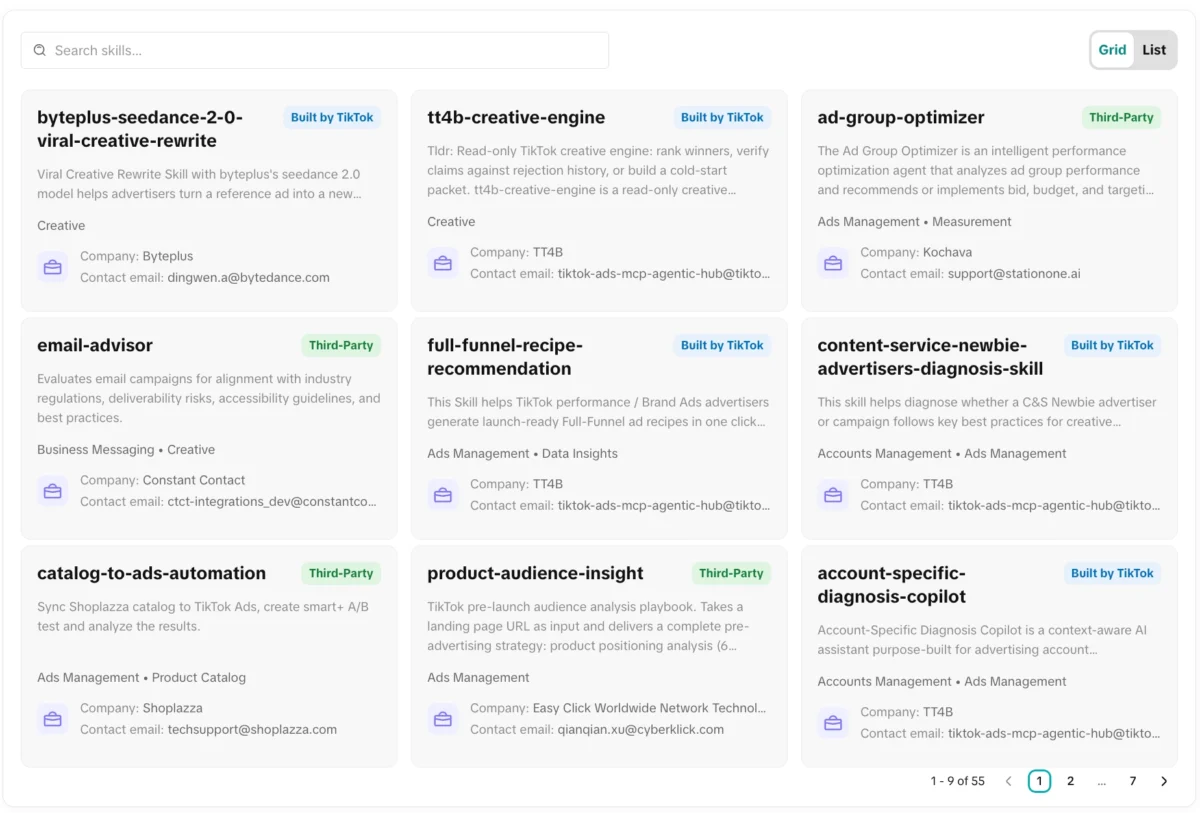
TikTok is ushering in a new era of advertising automation with the recent launch of its TikTok Ads MCP (Multi-Channel Partner) and Agentic Hub. This significant development integrates agentic artificial intelligence directly into advertising workflows, promising to streamline campaign management and unlock new levels of efficiency for marketers. While the MCP connector itself represents a crucial piece of infrastructure, enabling AI tools to interact directly with the TikTok Ads platform, the true innovation lies in the capabilities being built atop this foundation through the Agentic Hub and its accompanying "Skills."
This strategic move positions TikTok as a frontrunner in leveraging AI to empower advertisers, moving beyond simple automation to a more sophisticated model where established best practices and methodologies can be codified and scaled. This evolution has far-reaching implications for how paid social campaigns are conceived, executed, and optimized, potentially reshaping the roles and responsibilities within marketing teams.
The Foundation: TikTok Ads MCP Connector
At its core, the TikTok Ads MCP connector serves as the critical infrastructure layer. It acts as a bridge, granting AI agents direct access to the TikTok Ads platform. This integration allows these AI entities to understand and interact with advertising data, campaign settings, and performance metrics through natural language processing. In essence, it democratizes access to campaign management, enabling AI tools to perform complex tasks without the need for manual intervention or extensive technical expertise from the human marketer.
The MCP connector allows AI tools to:
- Analyze Performance: Deep dive into campaign metrics, identifying trends, anomalies, and areas for improvement.
- Manage Campaigns: Adjust bidding strategies, allocate budgets, and modify targeting parameters based on real-time data.
- Work with Audiences and Creative: Identify high-performing audience segments and assess the effectiveness of creative assets, suggesting optimizations or new directions.
- Execute Advertising Workflows: Automate repetitive tasks and execute predefined sequences of actions, freeing up marketers from tedious manual processes.
This direct integration means marketers no longer need to navigate between their AI environments and the TikTok Ads Manager, creating a more seamless and efficient operational flow. This mirrors recent advancements by other major platforms; Meta, for instance, introduced its Ads AI Connectors, signaling a broader industry trend towards AI-powered advertising platforms. However, TikTok’s approach with Agentic Hub and Skills aims to go a step further by fostering an ecosystem for packaging, reusing, and sharing specific paid social workflows.
Agentic Hub and Skills: Codifying Expertise and Reusable Workflows
The true potential of TikTok’s AI integration unfolds with the Agentic Hub and its associated "Skills." This component transforms the MCP connector from a mere access point into a dynamic environment for intelligent automation. Instead of each marketer needing to meticulously craft prompts and design workflows from scratch for every campaign or optimization task, TikTok Skills offer pre-packaged instructions, methodologies, and processes. These codified workflows are then made available within supported AI environments, allowing for rapid deployment and consistent application of best practices.
Consider the common challenge of creative fatigue. Traditionally, a paid social practitioner would undertake a multi-step process:
- Data Extraction: Pulling detailed performance data for various ad creatives.
- Comparative Analysis: Comparing engagement rates, click-through rates, conversion efficiency, and cost per acquisition (CPA) across different assets.
- Trend Identification: Spotting declining performance or momentum loss for specific creatives.
- Recommendation Generation: Suggesting which creatives to refresh, pause, or scale based on this analysis.
A TikTok Skill can encapsulate this entire methodology into a repeatable workflow. For example, a "Creative Fatigue Analysis Skill" could automatically perform these steps, categorizing ads into actionable groups: those ready for scaling due to strong performance, those requiring closer monitoring, and those that have become inefficient and should be retired.
This concept extends beyond creative management to a wide array of critical paid social functions:
- Budget Optimization: AI agents can analyze spending patterns across campaigns and ad sets, identifying inefficiencies and reallocating budgets to higher-performing areas.
- Audience Discovery: By analyzing vast datasets, AI can uncover new, high-potential audience segments that human analysts might overlook.
- Reporting Automation: Generating comprehensive performance reports tailored to specific business objectives, saving considerable time.
- Campaign Quality Assurance (QA): Automatically checking campaigns for common errors, policy violations, or suboptimal configurations before launch.
- Performance Anomaly Detection: Proactively flagging significant deviations in performance, enabling swift investigation and corrective action.
This capability represents a fundamental shift, moving towards a future where teams can systematically encode the expertise of their most successful paid social practitioners. It allows for the replication of proven strategies at scale, ensuring that high-level decision-making processes are consistently applied across all campaigns.
The Nuance of Authority: Defining AI’s Role and Human Oversight
The introduction of such powerful automated workflows naturally raises critical questions about the level of authority granted to these AI agents. There is a significant distinction between an AI flagging creative fatigue and automatically pausing that creative. Similarly, identifying inefficient spend is distinct from automatically reallocating budget. As marketing teams begin to embed more of their methodologies into AI systems, they must carefully define the boundaries of AI autonomy.
Key considerations include:
- Actionable Insights vs. Autonomous Action: Should AI merely provide recommendations for human review, or should it be empowered to execute certain actions independently?
- Approval Workflows: Establishing clear protocols for when AI-driven actions require human approval, particularly for significant budget shifts or campaign strategy changes.
- Guardrails and Limits: Implementing robust guardrails to prevent unintended consequences or costly errors. This could involve setting daily spending caps, limiting the scope of campaign modifications, or defining specific thresholds for triggering automated actions.
- Human Oversight and Intervention: Recognizing that complex business decisions, strategic pivots, and nuanced market interpretations will still require human judgment and oversight.
This careful calibration of AI authority is crucial for building trust and ensuring that automation enhances, rather than compromises, campaign effectiveness and brand integrity. The conversation around AI in paid social is thus evolving from simply asking "what can AI do?" to "what should AI do, and under what conditions?"
Where Human Judgment Remains Indispensable
While the allure of full automation is strong, it’s essential to recognize the enduring value of human judgment in advertising. The most effective application of agentic AI will likely lie in distinguishing where repeatable logic concludes and where nuanced business acumen must begin. For teams embarking on this journey with agentic paid social, focusing on four core principles can guide their experimentation and implementation:
- Identify High-Impact, Repetitive Tasks: Prioritize workflows that are time-consuming, prone to human error, and follow a predictable pattern. This is where AI can deliver the most immediate efficiency gains.
- Codify Proven Methodologies: Document and translate your team’s most successful strategies and decision-making frameworks into clear, actionable instructions for AI. This is the essence of turning expertise into infrastructure.
- Establish Clear Approval Gates: For any AI action that carries significant financial or strategic risk, implement a mandatory human review and approval process. This ensures that critical decisions align with broader business objectives.
- Continuously Monitor and Refine: AI systems are not static. Regularly review AI performance, identify areas for improvement, and update workflows based on evolving market dynamics and campaign outcomes. Human oversight is vital for this iterative process.
The Broader Shift for Paid Social Teams
The implications of platforms like TikTok exposing their advertising infrastructure to AI agents extend beyond immediate workflow improvements. As these capabilities become more widespread, platform execution becomes increasingly replicable. The competitive advantage will gradually shift from mastering the intricacies of a specific platform’s interface to understanding how to best leverage AI within that platform.
This means that while knowing how to operate TikTok Ads Manager will remain relevant, the more significant differentiator will be the strategic insight into what an AI agent should be tasked with, when it should perform these tasks, what data it should consider, what ethical and operational guardrails it must adhere to, and, critically, when its recommendations are flawed.
This evolution places a premium on:
- Strategic Judgment: The ability to set overarching goals, define KPIs, and guide AI towards achieving these objectives.
- Systems Thinking: Understanding how different components of a campaign and the AI tools interact to create an effective whole.
- Data Literacy: The capacity to interpret AI-generated insights and data to make informed strategic decisions.
For brands, this presents a unique opportunity to transform years of accumulated advertising expertise into tangible, scalable infrastructure. The frameworks, decision-making processes, and strategic insights that have historically driven performance can now be embedded directly into the operational fabric of the marketing team through AI.
The competitive edge will no longer reside solely in having access to advanced AI tools, as such access will likely become ubiquitous. Instead, the true advantage will lie in the sophistication and intelligence of the instructions and parameters that teams provide to these agents. What you teach the AI to do, and how effectively you guide its learning and execution, will become the paramount determinant of success.
Bottom Line: Redefining Paid Social Expertise
TikTok Ads MCP provides AI with direct access to advertising workflows, a significant step in itself. However, the Agentic Hub and its Skills introduce a potentially more consequential development: a mechanism for making the underlying methodologies of these workflows reusable and scalable. This points towards a fundamental reimagining of the operational model for paid social teams.
As more execution becomes agentic, marketing teams will need to adopt a far more deliberate and systematic approach to defining their processes. This includes meticulously detailing how they analyze performance, how they arrive at critical decisions, and how they govern the actions that AI is empowered to take.
The teams that will lead the pack in this evolving landscape will be those capable of identifying their most potent strategic thinking, translating it into robust, repeatable systems, and leveraging the newfound capacity to focus on higher-level, more strategic decision-making. Paid social expertise is no longer solely about individual practitioner skill; it is increasingly becoming something that teams can engineer and embed directly into the operational systems themselves, creating a powerful and sustainable competitive advantage.