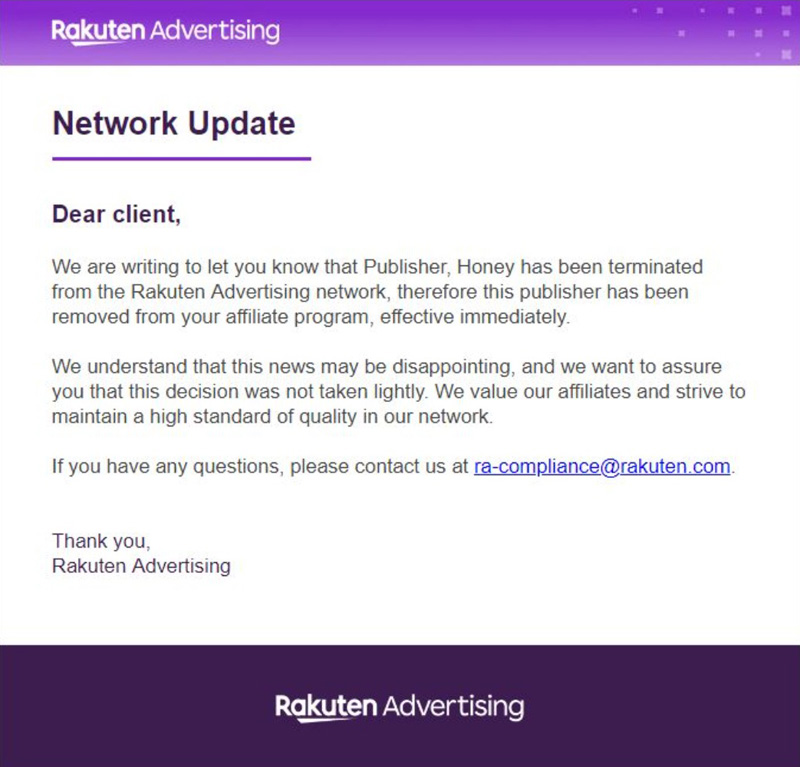
In a move that has sent shockwaves through the global performance marketing industry, PayPal Honey, one of the world’s most prominent coupon and rewards browser extensions, has been removed from two of North America’s largest affiliate networks. Rakuten Advertising and Impact.com, which collectively facilitate billions of dollars in annual e-commerce transactions, announced the termination and suspension of PayPal Honey following allegations of systematic attribution manipulation and violations of network policies. This development represents a significant turning point for the affiliate marketing sector, highlighting an intensified focus on compliance and the technical integrity of the "partnership economy."
The removal comes roughly six years after PayPal acquired Honey Science Corp. for approximately $4 billion, a deal that at the time was the largest acquisition in PayPal’s history. The current fallout was catalyzed by a series of high-profile investigations, most notably a technical deep-dive by independent researcher Ben Edelman and a viral exposé by the investigative content creator MegaLag. These reports alleged that the Honey browser extension engaged in deceptive practices designed to circumvent "stand-down" rules—industry-standard protocols intended to ensure that rewards extensions do not unfairly claim credit for sales driven by other marketing partners.
A Chronology of Disruption: The Week the Networks Responded
The timeline of PayPal Honey’s removal unfolded rapidly in mid-January 2026, coinciding with Affiliate Summit West, the largest industry conference in the United States. The timing of the announcements served to amplify the news, as thousands of industry professionals were gathered in Las Vegas to discuss the future of performance marketing.
On Monday, January 12, Rakuten Advertising issued an official statement confirming that Honey had been "terminated from the network." The network characterized the move as a necessary measure to "maintain a high standard of quality" and protect the interests of its brand partners and other publishers. The use of the word "terminated" suggested a permanent severance of the relationship, a rare occurrence for a publisher of Honey’s scale and corporate pedigree.
By Friday, January 16, Impact.com followed suit, though with a slightly different administrative approach. Impact.com announced that Honey was found to be "out of compliance" with its platform policies and had been removed from its Discovery Marketplace. David A. Yovanno, CEO of Impact.com, addressed the situation by explicitly citing "attribution manipulation" as the cause for the suspension. While Impact.com’s action was framed as a suspension rather than an outright permanent termination, the removal from the public marketplace effectively halted Honey’s ability to form new partnerships on the platform.

The Technical Heart of the Controversy: Stand-Down Violations
To understand the severity of the allegations, one must look at the "stand-down" rule, a cornerstone of ethical behavior for browser-based affiliate tools. In a typical e-commerce transaction, a consumer might be influenced by multiple marketing touchpoints, such as a content blog, a social media influencer, or a loyalty site. Most affiliate programs operate on a "last-click" basis, meaning the last affiliate to "touch" the customer before the purchase receives the full commission.
Stand-down rules mandate that if a consumer has already clicked an affiliate link from another source (e.g., a review site), a browser extension like Honey must not fire its own tracking cookie unless the user explicitly interacts with the extension to find a coupon. The investigations by Ben Edelman and MegaLag suggested that Honey employed sophisticated "tester detection" scripts. These scripts were allegedly designed to identify when the extension was being monitored by researchers or network compliance teams. When not being watched, the extension would allegedly "hijack" the attribution by dropping a cookie even when it should have remained dormant, thereby overwriting the cookies of smaller content creators and taking the commission for itself.
The $4 Billion Question: Implications for PayPal
The suspension of Honey is not merely a technical dispute between a publisher and a network; it is a major reputational blow to PayPal. When PayPal acquired Honey in late 2019, the goal was to move "upstream" in the customer journey, capturing users at the point of discovery rather than just the point of payment. Honey’s massive user base—estimated at over 17 million monthly active users at the time of acquisition—was seen as a goldmine for data and cross-selling opportunities.
However, the recent network removals suggest that the growth and profitability of the Honey division may have been propped up by practices that undermined the very ecosystem PayPal sought to dominate. While PayPal has not issued a comprehensive public rebuttal to the specific technical allegations of "tester detection," the loss of access to Rakuten and Impact.com represents a massive contraction in Honey’s "inventory" of merchants. If Honey cannot track sales or earn commissions from the thousands of brands hosted on these networks, its revenue model faces an existential threat.
Industry Reactions and the "Bad Apple" Effect
The reaction from the broader affiliate marketing community has been a mix of vindication and concern. For years, smaller publishers—bloggers, review sites, and influencers—have complained that large browser extensions were "cannibalizing" their sales.
Industry analysts point to five critical lessons that affiliate managers and brands are now taking away from the Honey saga:
- The Risk of Homogenization: Many affiliate programs suffer from a lack of diversity. If 80% of a program’s revenue comes from a single publisher like Honey, the program is inherently fragile. The removal of Honey has left many brands with a sudden, significant hole in their performance data.
- The Failure of Passive Oversight: For years, brands relied on affiliate networks to police publisher behavior. This incident has demonstrated that networks may sometimes be slow to act against high-volume publishers who generate significant fees. Experts now urge brands to conduct their own independent audits of publisher behavior.
- The Importance of Clear Terms and Conditions: The "stand-down" rule must be explicitly codified in program agreements. Without clear contractual language, enforcing compliance becomes a legal quagmire.
- The Distinction Between Affiliate Types: The industry is moving away from broad generalizations. While Honey has been penalized, other browser extensions and loyalty tools continue to operate within compliance. The goal for brands is not to ban an entire category of software but to reward those that provide incremental value.
- The Shift Toward Multi-Touch Attribution: The Honey controversy has renewed calls for the industry to move away from "last-click" attribution toward models that reward every partner involved in the funnel, reducing the incentive for "attribution hijacking" at the final stage of the checkout.
Data and Market Impact
The scale of the affiliate marketing industry is substantial, with spending in the United States alone projected to exceed $10 billion in the coming years. According to data from the Performance Marketing Association (PMA), affiliate marketing accounts for roughly 15% of all digital media advertising revenue.
When a publisher of Honey’s size is removed, the data suggests a significant shift in where commission dollars flow. In the weeks following the Rakuten announcement, several mid-sized coupon and loyalty publishers reported a slight uptick in "last-click" attribution, suggesting that the removal of a dominant, potentially non-compliant player allows for a more equitable distribution of rewards among other partners.
The Path Forward: Rebuilding Trust in the Partnership Economy
The suspension of PayPal Honey serves as a stark reminder that in the world of digital marketing, trust is the most valuable currency. Impact.com’s CEO David A. Yovanno emphasized that behavior which "undermines trust" cannot be tolerated if the partnership economy is to thrive.
For PayPal, the path forward involves a rigorous internal audit and potentially a complete overhaul of Honey’s tracking logic. To be readmitted to major networks, the extension will likely need to prove that it no longer uses "concealment" tactics to hide its behavior from compliance monitors.
For the affiliate industry at large, the "Honey Incident" is being viewed as a professionalization milestone. It signals that the "Wild West" era of browser extensions is coming to an end, replaced by a more transparent environment where technical compliance is just as important as user acquisition. As brands look toward 2026 and beyond, the focus is shifting toward a diversified affiliate base, encompassing content producers, podcasters, social media influencers, and card-linked offer providers, ensuring that no single "bad apple" can spoil the entire program.