For years, content creators and SEO professionals operated under a paradigm largely defined by keyword density and rudimentary keyword matching. The early days of Google’s search engine were, by its own admission, primarily focused on matching a user’s query to keywords present within web documents. This foundational approach gave birth to the widely adopted, and still surprisingly prevalent, method of "keyword research and optimization." However, the digital landscape has transformed dramatically, and clinging to these outdated strategies risks leaving content strategies significantly behind Google’s sophisticated algorithmic advancements.
The Evolution of Google’s Search Philosophy
Google’s journey from a simple keyword matcher to a complex semantic understanding engine has been a long and intricate one. The search giant no longer merely scans for exact keyword matches; it now deeply comprehends search intent, contextual nuances, and the intrinsic concept of "content quality." This shift represents a monumental leap, driven by the challenge of teaching a machine to discern quality – a concept inherently subjective and varying based on the individual searcher’s needs and informational goals.
This quest for quality led to the development and formalization of E-E-A-T, an acronym central to Google’s evaluation of content. E-E-A-T was conceived as a framework to guide human quality raters, who manually assess auto-generated search results, thereby providing invaluable feedback to refine Google’s algorithms on what constitutes a "high-quality" result.
Unpacking E-E-A-T: Experience, Expertise, Authoritativeness, and Trustworthiness
E-E-A-T stands for Experience, Expertise, Authoritativeness, and Trustworthiness. Crucially, this framework applies to both the website itself and the content creator. This dual focus underscores Google’s commitment to evaluating not just the information presented, but also the credibility of its source.
The E-E-A-T concept is extensively detailed in Google’s "Quality Raters’ Guidelines," an exhaustive document that outlines the criteria human raters use to evaluate pages encountered via Google search. While the core principles of E-A-T (Expertise, Authoritativeness, Trustworthiness) have been a cornerstone of these guidelines for many years, the addition of "Experience" as the first ‘E’ was a significant update, introduced later to further emphasize first-hand knowledge and practical application. This evolution highlights Google’s continuous refinement of its understanding of what makes content truly valuable to users.
E-E-A-T in Context: Tailoring Quality for Diverse Topics
Google’s quality raters are instructed to assess E-E-A-T dynamically, recognizing that a website or author may possess high E-E-A-T for one subject but not another. The stringency of E-E-A-T requirements is particularly pronounced for what Google terms "Your-Money-Your-Life" (YMYL) topics. These are subjects where inaccurate, misleading, or low-quality information could directly or indirectly cause harm to a user’s health, financial stability, or safety.
Examples of YMYL topics demanding exceptional E-E-A-T include:
- Medical, Health, and Science-Related Topics: Content must demonstrate expertise from qualified sources such as medical doctors, scientists, or reputable scientific publications. Misinformation in these areas can have severe real-world consequences.
- Financial and Legal Advice: Information pertaining to personal finance, investments, or legal matters requires input from professional sources like certified accountants, lawyers, or official regulatory bodies.
- News Reporting: News articles must be factually accurate, thoroughly researched, and presented by experienced journalists who adhere to journalistic ethics and standards.
- Voting, Legislation, Public Policy: Content related to civic duties, governmental processes, or policy discussions should primarily reference official government sources to ensure accuracy and impartiality.
- Topics Related to Children: Any advice or information concerning children, especially their health, safety, or development, necessitates reliance on highly reliable and credible sources.
- Product Reviews: For reviews, genuine first-hand experience with the product is paramount. If third-party reviews are incorporated, the methodology for their inclusion and assessment should be transparent and detailed.
It is important to note that a lack of widespread reputation does not automatically equate to low E-E-A-T. Many small websites and individual creators, while not widely recognized, can still produce high-quality content. In such cases, demonstrable first-hand experience or unique insights can effectively counterbalance a nascent public profile, particularly for non-YMYL topics.
Strategies for Elevating Your Content’s E-E-A-T Score
The era of manipulating search rankings through keyword stuffing or other "black hat" SEO tactics is firmly behind us. To achieve sustainable visibility and rank favorably on Google, content strategies must be fundamentally realigned with the E-E-A-T framework. This necessitates a profound shift towards understanding customer intent and delivering genuinely valuable, authoritative content.
Here are six actionable strategies to significantly enhance your content’s E-E-A-T:
1. Learn from High-Quality Content and User Engagement
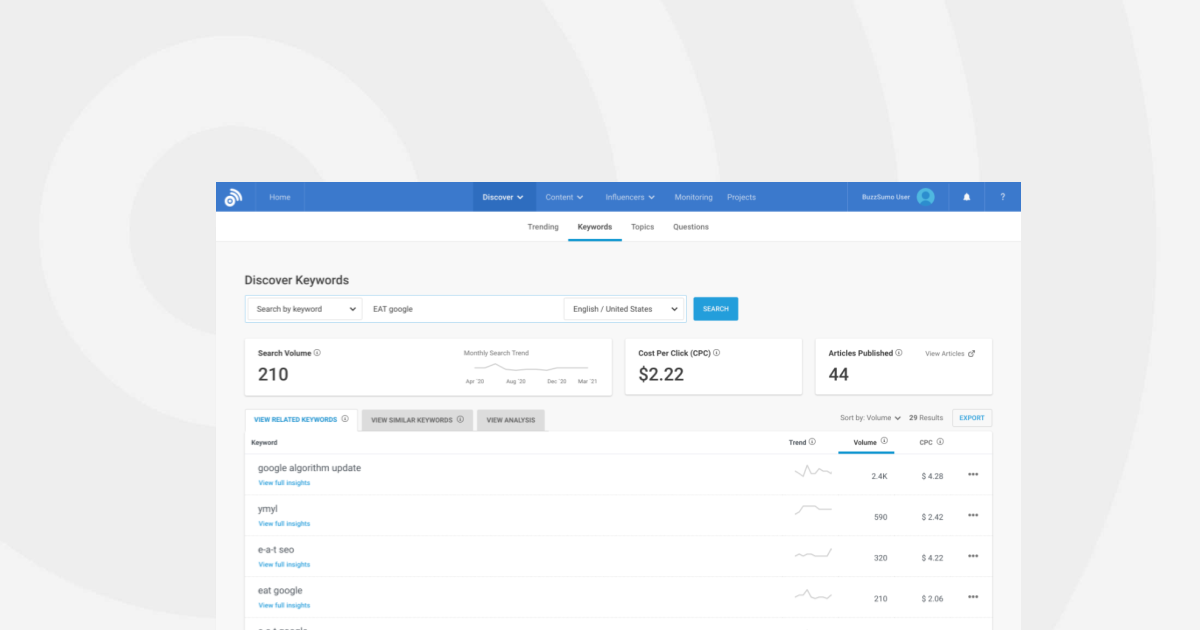
Understanding what resonates with audiences and earns trust is foundational. Analyzing successful content provides invaluable insights. Tools like content analyzers can reveal patterns in:
- Shares and Engagement: High social shares and engagement metrics indicate content that connects with readers, often signaling strong emotional resonance or practical utility. Examining headlines, content formats, and narrative styles of highly engaged pieces can inform your own content creation. For example, studies often show that "how-to" guides, comprehensive listicles, and opinion pieces tend to generate high levels of engagement due to their practical value or ability to spark discussion.
- Links: Content that earns numerous backlinks from reputable sources is often perceived as authoritative and trustworthy. Analyzing top-linked articles in your niche can reveal topics, research, or unique angles that attract editorial citations, providing a blueprint for developing link-worthy content.
- Evergreen Visibility: Content that maintains high social engagement and search visibility over extended periods demonstrates enduring value and relevance. Identifying these "evergreen" topics allows you to focus on creating foundational content that continues to attract traffic long after publication. This often involves addressing core questions, providing timeless advice, or offering comprehensive resources.
- Rankings: Directly observing the top-ranking content in Search Engine Results Pages (SERPs) for your target keywords and topics provides a real-time snapshot of what Google currently deems authoritative. Analyzing the depth, format, and E-E-A-T signals of these pages offers direct guidance for your own content development.
By systematically learning from these indicators, content creators can move beyond assumptions and build strategies based on empirically proven success.
2. Cultivate and Project Your Authority
Google actively encourages its quality raters to investigate the background and credentials of content authors and the reputation of the publishing website. While "expertise" and "authoritativeness" are not always absolute prerequisites for good ratings, they are significant advantages. Building a strong niche authority is a long-term investment that yields substantial benefits, including improved rankings for associated content.
Strategies to become a recognized authority include:
- Active Participation and Thought Leadership: Regularly contribute to industry discussions, speak at conferences, publish original research, and engage with your community. This establishes you as a knowledgeable and influential voice.
- Strategic Media Outreach: Identify publications, podcasts, and media outlets that feature interviews or discussions relevant to your expertise. Actively seek opportunities to be featured, sharing your insights and expanding your public profile.
- Monitor Industry Leaders: Observe and learn from established authorities in your niche. Analyze their content, their engagement strategies, and the platforms they utilize to maintain their influence.
- Leverage Schema Markup: Implement Organization and Author schema markup on your website. This technical SEO element provides structured data to search engines, explicitly communicating who is behind the content and the organization it represents. This helps Google connect your brand and authorship across the web more effectively.
- Consolidate Your Digital Presence: Utilize platforms that allow you to create a unified digital hub, listing all your professional activities, publications, and social media channels.
- Consistent Bylines and Bios: Ensure that all your content bylines and social media profiles clearly articulate your credentials, experience, and areas of expertise. This makes it easier for Google and users to verify your authority.
This comprehensive approach helps Google’s algorithms understand your entity’s standing within its knowledge graph, linking your identity with your contributions.
3. Embrace a Topic-Centric Content Strategy
Given Google’s emphasis on understanding topics and entities over isolated keywords, a topic-centric approach to content planning is indispensable. This strategy, often implemented through "topic clusters," involves identifying overarching "pillar content" topics and then creating numerous supporting "cluster content" articles that delve into related sub-topics. These cluster pages then link back to the pillar content, creating a robust, interconnected web of information.
- Semantic Search: This approach aligns perfectly with semantic search, where Google aims to understand the meaning and context of a query rather than just matching keywords. By covering a topic comprehensively through clusters, you demonstrate deep knowledge.
- Improved User Experience: Topic clusters guide users through related information, enhancing their journey and keeping them on your site longer.
- Internal Linking and SEO: The structured internal linking within topic clusters significantly improves site crawlability and indexation, signaling to Google that your site is a comprehensive resource on a particular subject.
- Tools for Topic Discovery: Utilize topic explorer tools to uncover thousands of popular associated topics around a core keyword. This provides a data-driven understanding of what your audience genuinely seeks, allowing you to prioritize content creation that aligns with user intent and Google’s algorithmic preferences.
For instance, a pillar piece on "Content Marketing" could be supported by cluster articles on "Blogging Best Practices," "Email Marketing Strategies," "Video Content Production," and "SEO for Content." This holistic approach not only satisfies user curiosity but also signals deep expertise to search engines. The success of SEO experts like Samuel Schmitt, who boosted website traffic by 1,000% using this model, underscores its effectiveness.
4. Deliver a "Satisfying" Amount of Content
Google’s guidelines advocate for a "satisfying amount" of content, a metric that is highly contextual. What constitutes "satisfying" is entirely dependent on the searcher’s intent and the specific topic or purpose of the page. A brief answer may be satisfying for a simple factual query, while a complex problem demands extensive, detailed explanations.
- Align with User Intent: The primary goal is to fully address the user’s query. If the intent is informational and complex, long-form content is often necessary. If it’s a quick navigational query, concise information is better.
- Content Depth vs. Brevity: While there’s no magic word count, content should be deep enough to cover the topic comprehensively without being verbose or repetitive. Thin content, lacking substance, can be penalized, while overly long content that doesn’t add value can frustrate users.
- Data-Driven Length Optimization: Content analysis tools can help assess optimal content length by correlating word count with engagement metrics. For example, for a broad topic like "Social Media Marketing," analysis might reveal that articles between 3,000 and 10,000 words tend to achieve higher engagement, suggesting that a thorough, guide-like format is preferred by the audience and rewarded by search engines. This data helps tailor content length to specific topic expectations.
5. Forge Meaningful Relationships for Enhanced Visibility
The role of human quality raters – a team of over 10,000 individuals worldwide – in evaluating content quality means that real-world relationships and recognition play a crucial role in E-E-A-T. Beyond simple backlinks, Google’s advanced algorithms can semantically understand and reward "connections" – the association of your brand and content with other influential entities.
- Strategic Public Relations and Outreach: Proactively identify credible authors, journalists, and publications within your niche. Use media databases to find influential voices who are already writing about or engaging with topics relevant to your expertise.
- Build Authentic Connections: The goal is to foster genuine relationships, not just solicit links. Offer exclusive insights, provide compelling data, or collaborate on content. The mantra "#MatesFirstLinksLater" encapsulates this approach.
- The Power of Mentions: Google’s understanding of entities means that even if a journalist mentions your brand or content without providing a direct hyperlink, this co-citation from an authoritative source still contributes to your perceived E-E-A-T. These semantic signals help Google establish your brand as a recognized and authoritative entity in its own right.
- Long-term Brand Building: Cultivating ongoing relationships with influential voices ensures sustained visibility and reinforces your authority within the industry, providing powerful E-E-A-T signals to Google over time.
6. Prioritize and Cite Trusted Sources
The inclusion of diverse, credible sources is fundamental to demonstrating trustworthiness and thorough research, particularly for YMYL topics. Citing sources not only lends credibility to your content but also provides users with avenues for further exploration, enhancing their overall experience.
- Enhance Credibility and Verifiability: Proper sourcing allows Google’s algorithms and human raters to evaluate the depth of your research, the accuracy of your claims, and the impartiality of your content.
- Variety of Sources: Incorporate a mix of source types:
- Official Sources: Prioritize government agencies (e.g., using
site:.govin Google search for policy or health data), academic institutions, and international organizations. - Expert Opinions: Quote or reference recognized experts in the field.
- Primary Research: Cite original studies, surveys, and data when available.
- Reputable News Outlets: Reference well-established journalistic sources for factual reporting.
- Official Sources: Prioritize government agencies (e.g., using
- Transparency: Clearly attribute all data, statistics, and significant claims to their original sources. This transparency builds trust with your audience and with search engines.
- Google’s Algorithmic Recognition: Google’s algorithms are increasingly adept at identifying content that systematically references authoritative sources, thereby prioritizing such content in search results. Demonstrating a commitment to factual accuracy and verifiable information is a strong E-E-A-T signal.
The Future of Content: A Human-Centric Imperative
The continuous advancement of Google’s intelligence through AI and machine learning means its ability to evaluate content quality is steadily approaching human-like discernment. This evolution necessitates a fundamental reorientation for SEOs and content marketers: the focus must shift unequivocally from merely "ticking boxes" for search engines of a bygone era to genuinely creating content that serves, informs, and satisfies human users.
The initial step in this transformative journey involves a critical assessment of your current content strategy. Identify areas where E-E-A-T can be strengthened, where content can be made more experienced, more expert, more authoritative, and ultimately, more trustworthy. By embracing a user-centric, quality-driven approach, content creators can not only meet Google’s evolving demands but also build lasting value and trust with their audience.