The prevailing narrative in business growth often centers on expansion through increased staffing and aggressive marketing campaigns. However, a growing body of evidence and real-world examples suggests that true profitability and sustainable success may lie in a more counterintuitive approach: operational leanness and strategic financial optimization. This shift in perspective is being driven by e-commerce entrepreneurs who are demonstrating that maximizing profits and minimizing stress can be achieved not by simply scaling up, but by intelligently streamlining operations and proactively managing financial outflows.

A compelling case study emerged from an e-commerce store owner who, for years, managed a team of 35 employees. While revenue was consistent and operations appeared stable, the business consistently grappled with tighter-than-desired profit margins. The owner found himself perpetually stressed, describing the management of such a large team as a "full-time job on top of your full-time job." The turning point came when he implemented a series of strategic, albeit challenging, decisions. He transitioned the business to a remote operational model, engaged a third-party logistics (3PL) provider for fulfillment, and significantly restructured his workforce by replacing many full-time employees with freelance and contract workers. Today, the business operates with a core team of just one full-time employee and eight contractors. The outcome has been a dramatic increase in profitability and a substantial reduction in the owner’s stress levels.
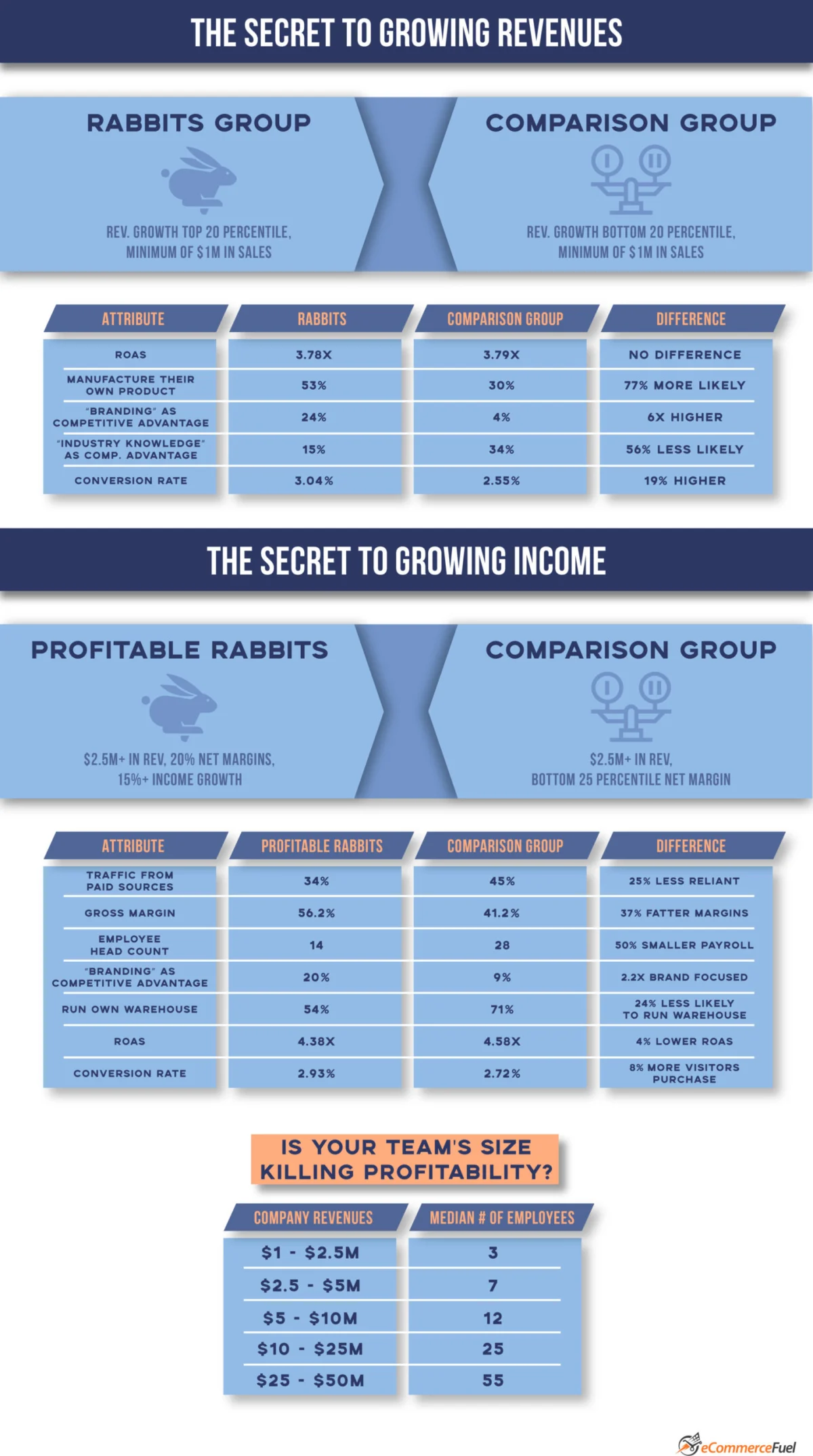
This individual story, while anecdotal, is indicative of a broader trend observed across the e-commerce landscape. A comprehensive analysis of hundreds of profitable and struggling e-commerce businesses revealed a stark contrast in operational strategies. Contrary to expectations that superior marketing acumen would be the primary differentiator, the research indicated that the difference in Return on Ad Spend (ROAS) between top and bottom performers was negligible. Businesses achieving exceptional profitability were not necessarily masters of Facebook advertising or SEO.

Instead, the key determinant of success was operational leanness. Top-performing businesses were found to have, on average, half the payroll expenses of their less profitable counterparts. Furthermore, they were 25% more likely to outsource their warehouse operations and 25% less reliant on paid traffic. This data underscores a fundamental principle: operational efficiency consistently outperforms marketing sophistication when it comes to driving profitability. This finding is particularly relevant in an era where customer acquisition costs can be volatile and market saturation can diminish the effectiveness of traditional advertising.
The concept of "lean" extends far beyond simply reducing headcount. It encompasses a critical evaluation of all business overheads. This includes reassessing the necessity of physical office spaces that may no longer be fully utilized in a remote or hybrid work environment, optimizing warehouse utilization through partnerships with 3PLs that can offer economies of scale, and meticulously auditing recurring Software as a Service (SaaS) subscriptions. Many businesses overlook the cumulative impact of seemingly small monthly expenses, such as $50 for a forgotten tool or $200 for an underutilized platform, which can significantly erode profit margins over time.

A crucial filter for identifying areas of potential leanness is to discern what is genuinely core to a brand’s unique selling proposition. For instance, if a brand’s distinctiveness lies in its innovative product design, retaining in-house design talent may be strategically vital. However, if the core competency is not in the intricate process of packing and shipping, outsourcing fulfillment to a specialized 3PL provider can lead to cost savings and improved efficiency. Profitable businesses are not merely cutting costs indiscriminately; they are making deliberate decisions about where to allocate resources based on strategic importance and competitive advantage.
The implementation of these lean strategies often necessitates engaging in "hard conversations." These are discussions that business owners frequently postpone until faced with financial exigency, such as economic downturns or a critical drop in profitability. However, the most successful entrepreneurs proactively address these issues. They conduct regular, candid assessments of their organizational structure, questioning the necessity of specific roles and whether they were created out of genuine need or simply to maintain a perception of growth. They scrutinize every expense, asking whether a particular software subscription is a necessity or a deeply ingrained habit. A critical exercise involves contemplating what 25% of the business’s expenses could be eliminated overnight if required, and then acting upon those insights proactively, not reactively.

Beyond operational efficiency, another significantly overlooked lever for enhancing profitability lies in strategic tax planning. While many business owners view taxes as a fixed cost, simply a percentage of income to be paid, astute entrepreneurs are discovering ways to legally minimize their tax burden. This is not achieved through illicit means or complex offshore schemes, but through intentional, well-structured financial planning.
Consider the divergence between two hypothetical e-commerce owners, both generating $2.5 million in revenue with $250,000 in profit, and with similar personal financial situations (married with three children). Owner A, without proactive tax planning, might pay approximately $75,000 in annual taxes. In stark contrast, Owner B, by employing strategic financial practices, could reduce their tax liability to around $21,000, realizing an annual savings of $54,000. This significant difference can be attributed to several deliberate actions, assuming a marginal tax rate of roughly 30%:

- Profit Sharing Contributions: Owner B contributes $45,000 to retirement accounts through profit-sharing plans, exceeding standard 401(k) limits. This strategy yields approximately $13,500 in tax savings.
- Donations of Appreciated Stock: Instead of donating cash, Owner B donates stock that has increased in value. This allows them to avoid capital gains tax on the appreciation while still receiving a full deduction for the stock’s fair market value, saving an estimated $3,500.
- Maximized Health Savings Account (HSA): By contributing the maximum family limit of $8,500 to their HSA, Owner B utilizes a triple tax-advantaged vehicle, resulting in savings of approximately $2,550.
- Paying Children for Work: Owner B employs their three children for legitimate work within the business, paying each $7,000. These payments are tax-deductible for the owner and can be invested by the children in Roth IRAs, allowing for decades of tax-free growth. This strategy provides savings of around $6,300.
- Inventory Donations: For $60,000 worth of slow-moving inventory, Owner B donates it to charities at fair market value rather than liquidating it at a loss. This deduction can result in substantial savings, estimated at $18,000.
The invisibility of these tax-saving opportunities often stems from the fragmented nature of tax reporting. Personal tax returns, business filings, brokerage statements, and payroll tax reports are typically managed separately, preventing a holistic view of the overall tax burden. Consequently, business owners may never fully grasp their total tax expenditure, nor consider whether it could be reduced. A "decent" accountant might ensure compliance, but they often do not proactively identify and present strategic tax-saving opportunities.
A simple yet effective test for the proactivity of one’s CPA involves asking: when was the last time your accountant approached you with a novel idea for saving money or improving your financial situation, rather than merely responding to your queries or processing your filings? If the answer is not readily recallable, it suggests that while the accountant may be competent in basic compliance, they might be costing the business significant amounts in missed opportunities. The $54,000 difference in tax savings between Owner A and Owner B is not a result of complex financial engineering, but of intentional, proactive financial management.

In essence, while marketing initiatives like ROAS, Customer Acquisition Cost (CAC), and Lifetime Value (LTV) rightly command attention and discussion, they are not the sole determinants of profitability. The e-commerce leaders who consistently achieve superior profit margins are often those who have mastered operational leanness, evidenced by smaller teams and strategic outsourcing, and who are exceptionally adept at minimizing their tax liabilities. For many businesses, the immediate focus on acquiring more customers might be less impactful than the strategic imperative of retaining a larger portion of the revenue they already generate. This foundational principle of maximizing after-tax profits offers a compelling path to sustainable growth and enhanced financial health.
The eComFuel Trends Report is slated to release updated data on these patterns. Businesses interested in contributing to this research and validating these financial and operational trends are encouraged to participate in the ongoing survey. Regular insights into building leaner, more profitable operations are available through communities focused on the experiences of seven- and eight-figure business owners.