Google has implemented minor yet significant revisions to its core documentation on canonicalization, specifically updating the "What is canonicalization" and "Fix canonicalization issues" help pages. These changes, primarily aimed at enhancing clarity and ease of understanding, were observed to have been made on Thursday, August 20th, with public reporting following on August 24, 2026, by Barry Schwartz of Search Engine Roundtable. While Google did not formally announce these updates, their nature suggests an ongoing effort to provide more precise guidance to webmasters and SEO professionals grappling with duplicate content and preferred URL management.
Understanding Canonicalization: A Core SEO Concept
Canonicalization is a fundamental aspect of search engine optimization (SEO) that addresses the challenge of duplicate content across the web. In essence, it is the process of selecting the best URL when there are several choices, or when multiple URLs lead to the same or very similar content. Without proper canonicalization, search engines like Google may struggle to determine which version of a page to index and rank, potentially diluting link equity, wasting crawl budget, and leading to an inconsistent user experience.

The prevalence of duplicate content is a common issue for websites of all sizes. It can arise from various sources, including:
- URL Variations: Different protocols (HTTP vs. HTTPS), subdomains (www vs. non-www), trailing slashes, case sensitivity, or parameters (e.g.,
example.com/page?color=redandexample.com/page). - Content Management Systems (CMS): Many CMS platforms automatically generate multiple URLs for the same content, such as category pages, tag pages, or printer-friendly versions.
- E-commerce Sites: Product pages often have multiple URLs due to variations in color, size, or other attributes, or through filtering and sorting options.
- Syndicated Content: When content is republished on multiple sites, or across different sections of the same site.
- Mobile Versions: Separate URLs for desktop and mobile versions of a page.
When Google encounters multiple URLs for identical or substantially similar content, it must choose a single canonical URL to represent that content in its search results. This decision impacts which URL receives ranking signals and which version users see. Google utilizes a complex algorithm that considers various signals to make this choice, including:
rel="canonical"tag: A HTML link element in the<head>section of a page that explicitly tells search engines which URL is the preferred version.- 301 redirects: Permanent redirects signal that a page has moved, effectively transferring link equity to the new destination.
- Internal linking: The way a website links internally can indicate which version of a URL is considered canonical.
- Sitemaps: Including only canonical URLs in an XML sitemap can guide search engines.
- External links: The URLs that other websites link to can also influence Google’s canonicalization decision.
- Hreflang tags: For international sites, these tags help Google understand language and regional variations, which can also play a role in canonicalization.
The objective of canonicalization is to consolidate ranking signals, prevent crawl budget waste, and ensure that the most authoritative version of a page is presented in search results. Misconfigurations can lead to significant SEO problems, including lower rankings, reduced organic traffic, and inefficient indexing. Therefore, clear and comprehensive documentation from Google is paramount for webmasters and SEO professionals.

The Specifics of the Recent Updates
The primary focus of Google’s recent documentation refresh appears to be on improving the readability and actionability of its guidance. While the core principles of canonicalization remain unchanged, the presentation and organization of information have been refined. The two main documents affected are:
- "What is canonicalization" (
developers.google.com/search/docs/crawling-indexing/canonicalization): This page serves as an introductory resource, explaining the concept of canonicalization and its importance. The updates here are less extensive but contribute to a smoother understanding of the foundational principles. The revised content aims to simplify the explanation of why canonical URLs are necessary and how Google generally determines them. - "Fix canonicalization issues" (
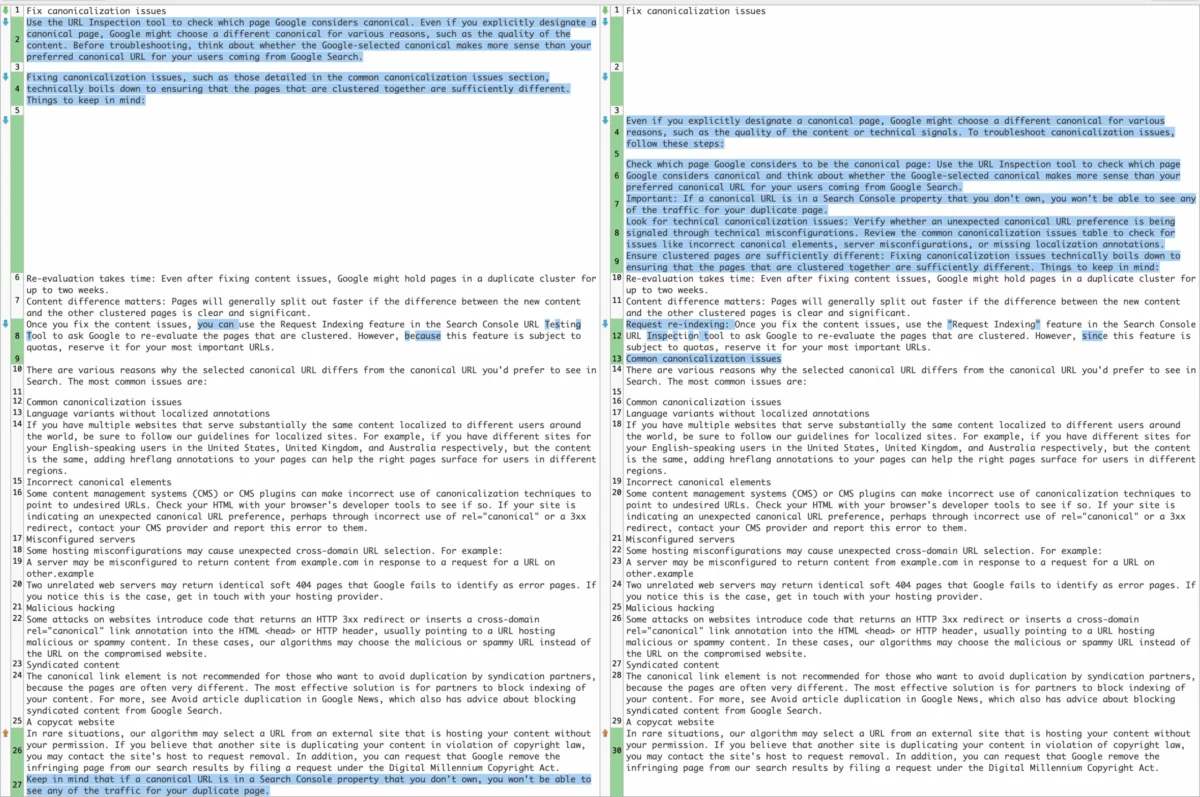
developers.google.com/search/docs/crawling-indexing/canonicalization-troubleshooting): This document, designed to guide webmasters through identifying and resolving common canonicalization problems, received the most substantial revisions. The top section of this page was notably updated to better categorize and present the troubleshooting content, making it more consumable and easier for users to navigate directly to relevant solutions. Side-by-side comparisons of the old and new versions reveal a reorganization of headings and bullet points, aimed at breaking down complex information into more digestible segments. For instance, sections might now be more clearly delineated by common scenarios or specific technical fixes.
These adjustments underscore Google’s recognition that canonicalization remains a challenging area for many webmasters. By structuring the troubleshooting guide more logically, Google aims to empower users to diagnose and correct issues more efficiently, reducing the need for trial-and-error and potential long-term negative impacts on search performance.
Timeline of the Update and Reporting
The specific documentation changes were implemented on Thursday, August 20th. However, these types of minor, unannounced updates often take a few days to be noticed and reported by the broader SEO community. Barry Schwartz, Executive Editor of Search Engine Roundtable and a highly respected figure in the search marketing industry, identified and reported these revisions on Sunday, August 24, 2026, at 7:51 am. His report highlighted the subtle nature of the changes, noting that they were likely not documented by Google due to their focus on clarity rather than fundamental shifts in policy. The reporting included visual side-by-side comparisons, allowing readers to immediately grasp the organizational and textual improvements. The initial discussions and observations regarding these updates quickly spread across SEO forums and platforms like X (formerly Twitter), where SEO professionals debated the implications and welcomed the clearer guidance.

Why Documentation Matters: Google’s Ongoing Commitment
Google’s official documentation is the authoritative source for webmasters and SEOs seeking to understand how the search engine operates. In an industry as dynamic and complex as search engine optimization, clear, accurate, and up-to-date guidance is invaluable. Updates, even minor ones, to critical technical SEO topics like canonicalization, serve several vital functions:
- Reducing Misinformation: By providing unambiguous instructions, Google helps counteract the spread of outdated or incorrect SEO advice.
- Empowering Webmasters: Well-structured documentation enables webmasters, even those with limited technical expertise, to implement best practices confidently.
- Improving Website Quality: When sites correctly implement technical SEO elements, it generally leads to better user experiences, more efficient crawling, and ultimately, a healthier web ecosystem.
- Setting Industry Standards: Google’s documentation often sets the de facto standards for technical SEO practices, influencing tool development and agency recommendations.
This latest refresh is consistent with Google’s long-standing pattern of iteratively improving its developer documentation. Over the years, Google has made significant investments in its Search Central (formerly Webmaster Central) resources, frequently updating guides, adding new sections, and providing more illustrative examples. This commitment reflects the ever-evolving nature of the web and the continuous need to clarify complex technical concepts for a diverse audience, ranging from novice bloggers to experienced enterprise SEO teams.
Insights from the SEO Community
The SEO community generally welcomes any efforts by Google to clarify its guidelines, especially for intricate topics like canonicalization. Initial reactions, as observed on platforms like X (formerly Twitter) following Barry Schwartz’s report, tended to be positive, albeit with the usual nuanced discussions. Many professionals expressed appreciation for the improved readability, hoping it would reduce the frequency of canonicalization errors, which are a common source of frustration and performance issues.

Canonicalization issues frequently appear in SEO audits, indicating that even seasoned professionals can misinterpret or misimplement Google’s signals. Common mistakes include:
- Incorrect
rel="canonical"implementation: Pointing to non-existent pages, canonicalizing to HTTP when HTTPS is preferred, or using relative URLs instead of absolute ones. - Conflicting signals: Using
rel="canonical"while also implementing a 302 redirect (temporary) to a different URL. - Canonicalizing pagination pages: Accidentally canonicalizing all paginated pages to the first page, causing subsequent pages to be de-indexed.
- Blocking canonicalized pages with robots.txt: Preventing Google from even seeing the canonical tag, thus hindering its ability to consolidate signals.
By making the "Fix canonicalization issues" page more accessible and user-friendly, Google is implicitly acknowledging these widespread challenges. The community often views such documentation updates as proactive measures by Google to help maintain a higher quality of indexed content, rather than reactive responses to specific algorithm changes. Experts like Barry Schwartz, with his extensive experience covering Google updates, often highlight these "minor" changes precisely because they offer valuable insights into Google’s priorities and areas where webmasters frequently struggle.
The Impact on Webmasters and Search Performance
The implications of clearer canonicalization documentation, though subtle, can be far-reaching for webmasters and their search performance:

- Improved Indexing Efficiency: Websites that correctly implement canonicalization will likely see more efficient crawling and indexing. Googlebot will spend less time processing duplicate content and more time discovering new or updated valuable pages.
- Consolidated Ranking Signals: Proper canonicalization ensures that all ranking signals (such as backlinks, page authority, and user engagement metrics) are consolidated to the preferred URL. This prevents dilution of SEO value across multiple URLs and can lead to stronger rankings for the canonical version.
- Reduced Duplicate Content Penalties (or Confusion): While Google technically doesn’t "penalize" for duplicate content in the traditional sense, excessive duplication can lead to Google choosing a less desirable URL to rank or simply not ranking any version effectively. Clear canonicalization helps Google understand the intended authoritative page, mitigating these risks.
- Better User Experience: Ensuring that search results consistently point to the intended, high-quality version of a page enhances the user experience, as visitors are less likely to encounter unexpected URL variations or outdated content.
- Faster Troubleshooting: For SEO professionals, the updated "Fix canonicalization issues" page can serve as a more effective first line of defense when diagnosing indexing problems. Its improved structure can accelerate the identification of common errors and guide them toward appropriate solutions. This reduces the time and resources spent on debugging and allows for quicker implementation of fixes.
- Educational Value: These updates contribute to the overall education of the SEO community, reinforcing best practices and clarifying nuances that might have been ambiguous previously. This continuous learning is crucial for staying competitive in search.
Google’s Perspective: Streamlining the Web
From Google’s vantage point, these documentation updates are not merely a service to webmasters but also an integral part of its strategy to maintain the quality and efficiency of its search index. The web is an ever-expanding universe of content, and a significant portion of it consists of duplicate or near-duplicate pages. If Google’s crawlers had to expend excessive resources on identifying and de-duplicating content, it would be a drain on their infrastructure and could potentially slow down the indexing of truly unique and valuable information.
By providing clearer guidelines, Google aims to:
- Reduce Crawl Waste: Sites that correctly signal their canonical URLs help Googlebot crawl more efficiently, focusing on unique content.
- Improve Index Quality: A cleaner index with fewer redundant pages means better search results for users.
- Automate Processes: The more clearly webmasters signal their preferences, the better Google’s automated systems can make accurate canonicalization decisions, reducing the need for manual intervention or complex algorithmic guesswork.
- Foster a Healthier Web: Ultimately, a web where content is clearly organized and presented in its canonical form benefits everyone – webmasters, users, and search engines alike.
Looking Ahead: The Dynamic Nature of SEO Guidelines
The minor updates to Google’s canonicalization documentation serve as a reminder of the dynamic nature of SEO and Google’s continuous efforts to adapt its guidance. As web technologies evolve, new content management patterns emerge, and user expectations shift, Google’s documentation will undoubtedly continue to be refined. These iterative improvements, even when seemingly small, cumulatively contribute to a more informed and capable SEO community. They underscore the importance of staying current with Google’s official resources and regularly reviewing technical SEO implementations to ensure alignment with best practices. For webmasters and SEOs, these updates are not just about fixing immediate problems but about fostering a deeper, more accurate understanding of how search engines perceive and process website content.