

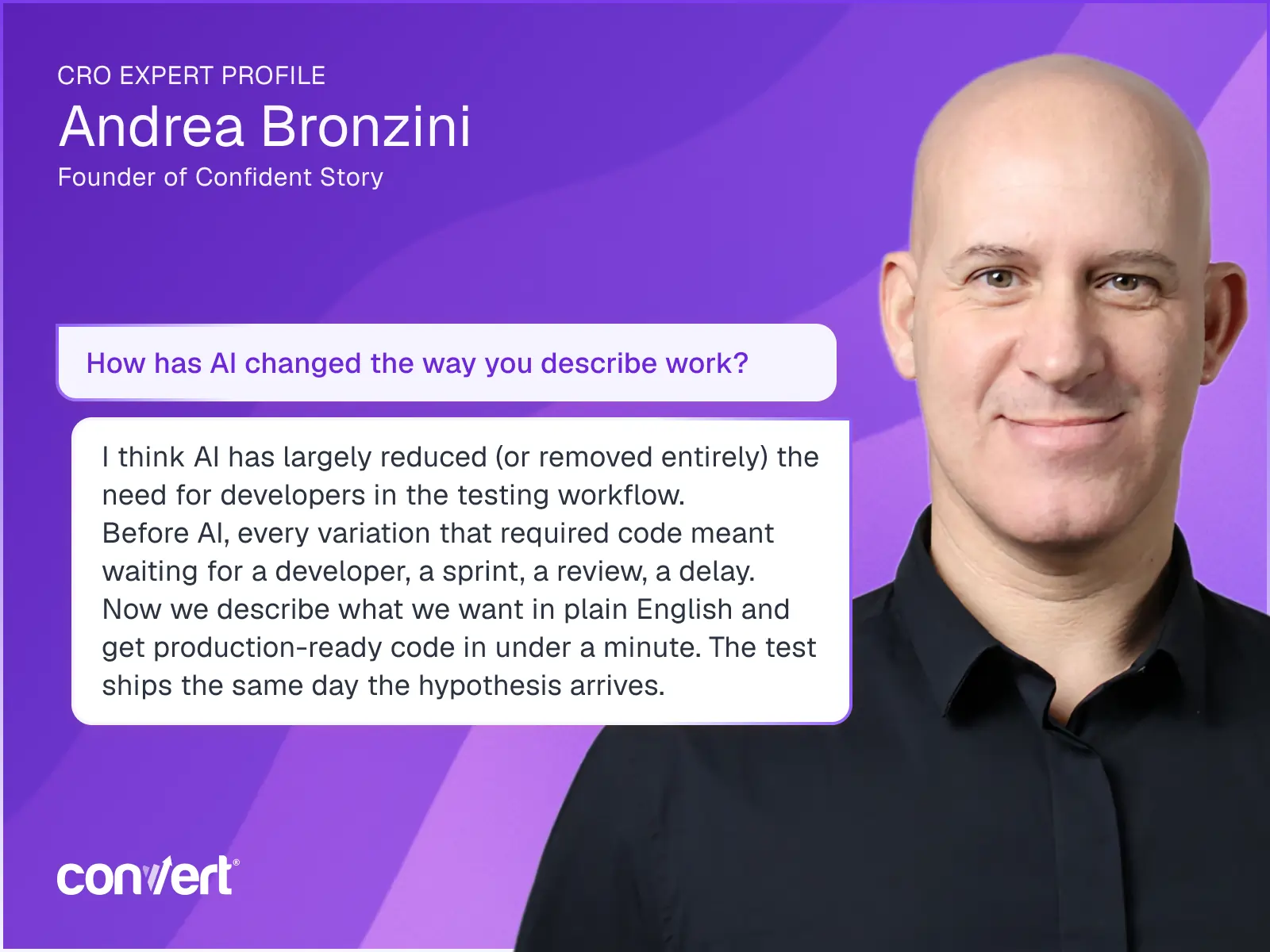
The discipline of digital optimization is undergoing a fundamental shift from traditional academic rigor toward a more nuanced model of decision-policy thinking, according to Andrea Bronzini, the founder of Confident Story and a prominent voice in the field of Conversion Rate Optimization (CRO). In a recent discussion regarding the state of modern experimentation, Bronzini challenged the long-standing industry reliance on "statistical significance" as the sole arbiter of success, arguing instead that the true nature of optimization is a "balancing act between errors." As businesses increasingly integrate artificial intelligence into their testing workflows, the focus is shifting away from mere measurement and toward the management of stochastic noise—the random fluctuations that often masquerade as actionable data.
The Subjectivity of Objective Data
For many years, the primary appeal of A/B testing and CRO was the promise of objectivity. The prevailing wisdom suggested that by letting "the data decide," organizations could bypass internal politics and "HiPPO" (Highest Paid Person’s Opinion) decision-making. However, Bronzini posits that the concept of objectivity in testing is more fragile than it appears. The parameters of an experiment—the chosen significance threshold, the required sample size, and the duration of the test—are themselves subjective judgment calls made by human practitioners.

These initial decisions shape the results long before the first visitor enters a test variation. Bronzini’s obsession with modeling stochastic noise stems from the realization that while the industry focuses heavily on "the signal"—the lift or conversion rate—it is the "noise" that ultimately determines whether a signal is visible or entirely obscured. Understanding this noise is what separates high-growth teams from those who find themselves frustrated by results that fail to hold steady after a full production rollout.
The Evolution of Experimentation: A Brief Chronology
To understand Bronzini’s perspective, one must look at the trajectory of digital experimentation over the last two decades. In the early 2000s, A/B testing was a luxury reserved for tech giants like Google and Amazon, often requiring massive engineering resources. By the 2010s, the rise of "plug-and-play" CRO tools like Optimizely and VWO democratized testing, allowing marketing teams to run experiments without deep technical backgrounds.
However, this democratization brought a reliance on academic statistical models—specifically the frequentist approach to p-values and a 95% confidence interval. While these models were designed for clinical trials and peer-reviewed journals where the cost of a false positive is high, they often proved ill-suited for the fast-paced, traffic-constrained world of e-commerce and SaaS. Bronzini’s work represents a new era in this chronology: the move toward "Decision Science," where the goal is not just to find "truth" in a scientific sense, but to make the most profitable decision given the available information and inherent risks.

The Three Failure Modes of Experimentation
Bronzini identifies three distinct ways an experiment can fail, arguing that the industry has historically focused on only one: the false positive.
- The False Positive (Calling the Wrong Winner): This occurs when a team ships a losing variation because random noise pushed the measurement in a positive direction. Standard statistical significance is designed to mitigate this risk.
- The Missed Winner: This is a failure of "power." It occurs when a change produces a genuine improvement, but the observed lift fails to cross the 95% threshold. In many organizations, these real improvements are filed as "inconclusive" and discarded. Bronzini notes that for companies with limited traffic, traditional power analysis often yields sample size requirements that are impossible to reach, leading to a massive "lost opportunity cost" that is rarely accounted for in CRO audits.
- The Inflated Winner: This failure mode is perhaps the most insidious and the most frequently ignored. It occurs when a team correctly identifies a winner, but the measured lift is significantly higher than the true lift (e.g., measuring a 12% lift when the reality is 4%). This happens because, under strict thresholds, only the experiments that "run hot"—those where noise amplifies the signal—cross the finish line.
Bronzini compares these three errors to a "short blanket." If a practitioner pulls the blanket up to cover their head (reducing false positives by increasing the significance threshold), their feet get cold (they miss more winners and inflate the ones they find). There is no configuration that eliminates all three errors; there is only a strategic choice about how to distribute them based on business goals.
The Impact of AI on the Testing Workflow
The integration of Artificial Intelligence is currently the most significant technological catalyst in the CRO space. Bronzini highlights that the most immediate impact has been the near-total removal of the developer bottleneck. Previously, every test variation required a developer, a sprint cycle, and a code review, creating a friction-heavy environment where only "safe" ideas were tested.
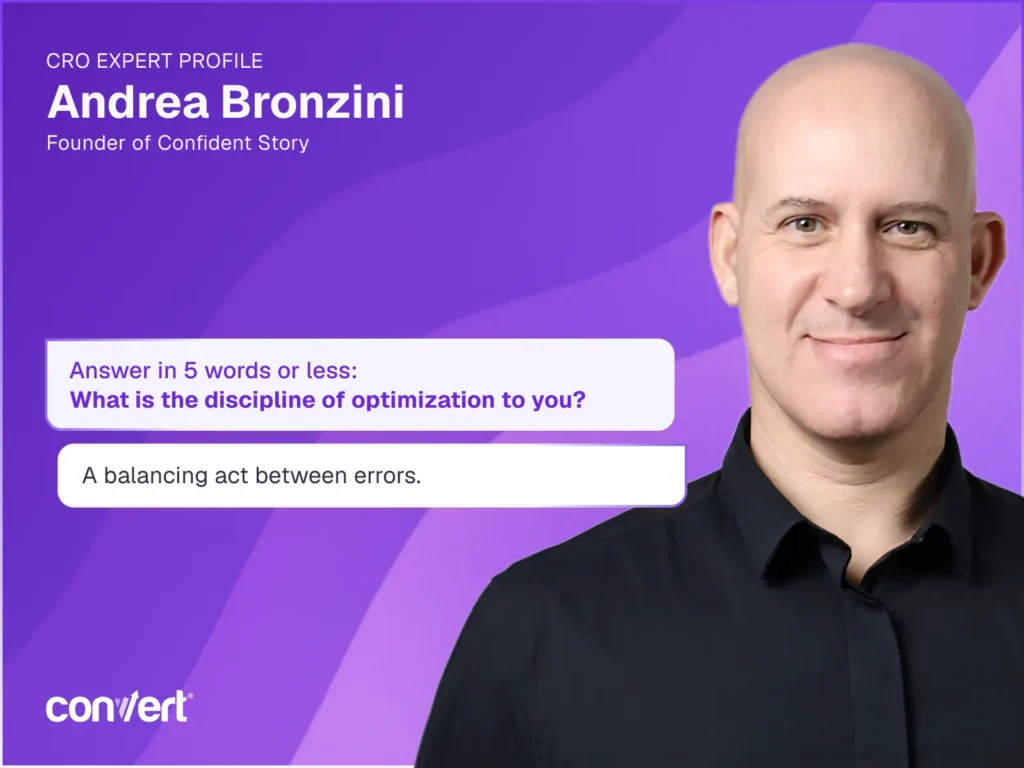
With AI, practitioners can describe a complex UI change in plain English—such as repositioning a Call to Action (CTA) or shifting the value proposition from features to urgency—and receive production-ready JavaScript in seconds. This allows tests to go live the same day an idea is conceived.
The broader implication of this shift is psychological. When the cost of implementation drops toward zero, teams become willing to test bolder, more structural hypotheses. AI is not just saving time; it is expanding the "hypothesis space" that companies are willing to explore. Bronzini notes that his internal workflows are already moving toward autonomous systems where AI examines a page, generates insights, prioritizes hypotheses, deploys code, and analyzes the results in a continuous loop.
Supporting Data: The Meta-Experiment Simulation
To validate his theories on noise and inflation, Bronzini conducted a large-scale simulation—an "experiment about experiments." He built a simulator to replay the same test 5,000 times with a known "true lift" of 3.2% and a fixed conversion rate.
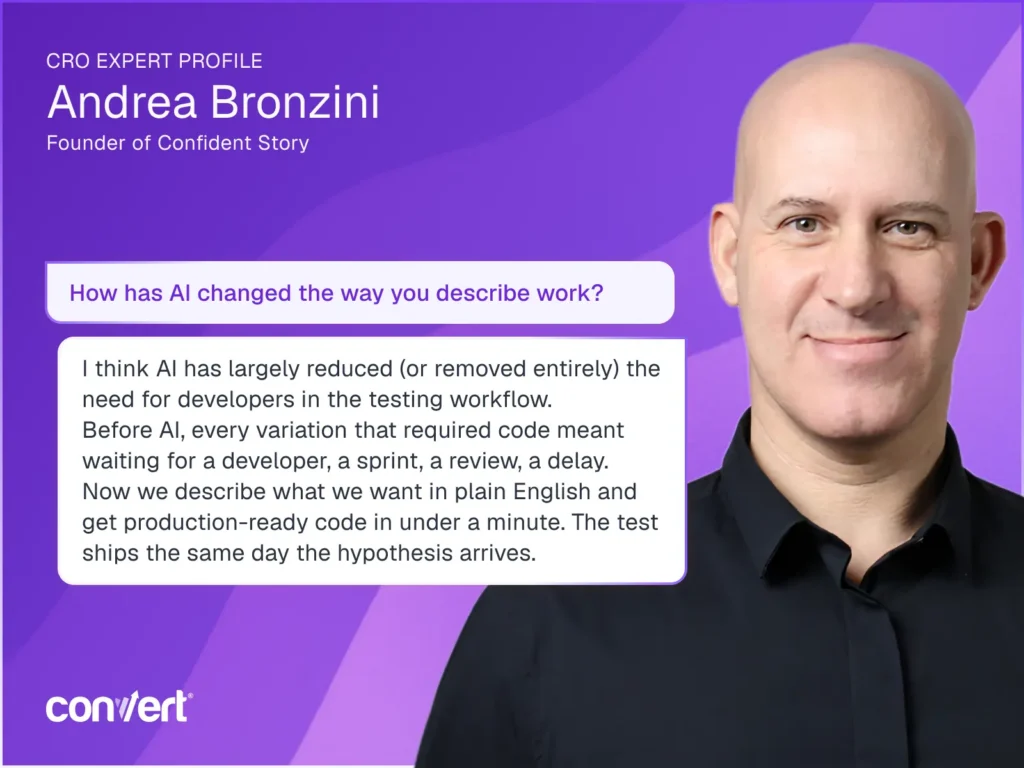
In a scenario with 500 total conversions over a four-week period, using a standard 95% two-tailed confidence interval, the results were startling:
- Only 12 out of every 100 runs were flagged as "significant."
- The remaining 88 runs were labeled "inconclusive," despite the fact that a real 3.2% improvement existed.
- The 12 "winners" showed a measured lift between 9% and 14%—drastically overstating the 3.2% reality.
This data provides a mathematical explanation for why many "winning" tests seem to disappear or "regress" after they are fully implemented. They didn’t fail because of seasonality or poor implementation; they were simply noise-amplified versions of a much smaller truth that only made it through a strict statistical filter because they happened to be "running hot" during the test window.
Official Responses and Industry Sentiment
While Bronzini’s approach challenges traditional norms, it aligns with a growing movement among data scientists who advocate for "Expected Value" frameworks over p-values. Industry leaders have noted that the "P-value crisis" in social sciences is now being mirrored in digital marketing, leading to a lack of trust in CRO programs.

Related parties in the analytics space have begun to echo Bronzini’s sentiment that the "95% confidence" rule is an arbitrary holdover from 20th-century agriculture and medicine. The consensus among modern growth leads is shifting toward a "Risk-Adjusted Return" model. In this view, if a test has a 70% chance of being a winner and the cost of implementation is low, it may be more profitable to ship it than to wait six months for a 95% confidence level that may never come.
Broader Impact and Future Implications
The transition from "significance-seeking" to "decision-policy thinking" has profound implications for how companies structure their growth teams. It requires a shift in culture, moving away from the celebration of "big wins" (which may be inflated) toward the consistent accumulation of marginal gains.
Practitioners are encouraged to adjust their strategies in three ways:

- Treat Confidence as a Variable: Stop viewing 95% as a fixed requirement. Evaluate the cost of a false positive versus the cost of a missed opportunity for each specific business case.
- Track Winner Capture: Measure not just the precision of your calls, but how many real improvements your program is identifying versus how many are being lost in the "inconclusive" pile.
- Human-Centric Hypotheses: As AI takes over the repetitive tasks of coding and basic analysis, the value of the human optimizer will shift toward "asking better questions." Understanding user psychology and forming sharp, creative hypotheses will remain the domain of human judgment.
In conclusion, the work of Andrea Bronzini and the philosophy behind Confident Story suggest that the future of CRO is not found in more data, but in a better understanding of the noise within that data. By embracing the "balancing act" of experimental errors and leveraging AI to reduce execution friction, organizations can move beyond the limitations of academic statistics and toward a more pragmatic, profitable model of digital growth. As the industry matures, the most successful teams will be those who stop hunting for "truth" and start mastering the policy of decision-making.







