The annual retail phenomenon of Black Friday and Cyber Monday (BFCM) has evolved into a critical "Cyber Week" for e-commerce brands, representing a peak opportunity for revenue generation and customer acquisition. As brands gear up for Black Friday on November 27, 2026, strategic planning, informed by data and executed across multiple channels, is paramount to success. Recent research indicates significant growth potential, with the average order value during Cyber Week having risen from $164 to $215 in 2025 for U.S. small and medium-sized businesses (SMBs). To capitalize on this trajectory, companies must initiate comprehensive marketing campaigns well in advance, leveraging integrated email, SMS, push notifications, and paid advertising from early list-building through the final Cyber Monday pushes.
The Evolution of Cyber Week: A Modern Retail Imperative
![Black Friday Marketing: Strategies and Examples [2026 ]](https://www.omnisend.com/blog/wp-content/uploads/2024/11/BF-marketing.png)
Black Friday, traditionally the day after Thanksgiving, marked the unofficial start of the Christmas shopping season with in-store deals. Its digital counterpart, Cyber Monday, emerged to boost online sales. Over the past decade, these two days have merged into a sprawling "Cyber Week," with promotions often beginning weeks before and extending beyond Cyber Monday itself. This extended period offers both opportunities and challenges, demanding sustained engagement and sophisticated multi-channel strategies. For 2026, e-commerce brands must acknowledge this extended timeline and plan accordingly, treating the entire period from Thanksgiving evening (November 26) through Cyber Monday (November 30) as a unified campaign.
Early Planning: The Cornerstone of BFCM Success
Industry experts universally recommend that Black Friday marketing strategies commence as early as July or August—a full four months before the November 27, 2026, sale date. This lead time allows brands to meticulously review previous Black Friday results, discerning which products and discounts generated substantial sales versus those that merely eroded profit margins. Store-specific data is an invaluable asset, providing a factual basis for future decisions rather than relying solely on broader industry averages.
![Black Friday Marketing: Strategies and Examples [2026 ]](https://www.omnisend.com/blog/wp-content/uploads/2025/10/1-Ruggable-BLack-Friday-popup.webp)
Before constructing a campaign, brands should focus on four critical preparatory areas:
- Performance Review: Analyze last year’s sales, popular products, discount effectiveness, and customer behavior.
- Goal Setting: Establish clear, measurable objectives for revenue, list growth, and key performance indicators.
- Inventory Management: Assess current stock levels, identify fast-moving and slow-moving items, and plan for potential restocks.
- Technical Audit: Ensure the e-commerce platform, payment gateways, and marketing technology stack are robust and scalable.
For new entrants or those undertaking their first Black Friday campaign, building an email list should be an immediate priority, starting as early as possible to cultivate a receptive audience. A detailed schedule is crucial for orchestrating the months leading up to the event:
| Month | Key Activities |
|---|---|
| July–August | Analyze prior year data, set revenue and list growth targets |
| September | Intensify list building, finalize offers and discount tiers |
| October | Develop customer segments and automated flows, warm up subscriber lists |
| Early November | Deploy teaser campaigns, grant early access to subscribers |
| Nov 27–30 (BFCM) | Launch sales, manage restocks, send last-chance reminders |
Adherence to such a timeline, often facilitated by a comprehensive Black Friday checklist, helps minimize last-minute errors and ensures a smooth, impactful campaign.
![Black Friday Marketing: Strategies and Examples [2026 ]](https://www.omnisend.com/blog/wp-content/uploads/2025/10/2-Rachel-Riley-BF-campaign.webp)
Defining Success: Clear Black Friday Goals
Effective Black Friday marketing hinges on setting precise, data-driven goals. Brands should establish targets across four key metrics:
- Average Order Value (AOV): Aim to increase the typical spend per customer. The reported rise from $164 to $215 in 2025 serves as a compelling benchmark, demonstrating the potential for growth in this area.
- Customer Reactivation: Focus on re-engaging previous buyers who have been inactive, converting them into repeat customers.
- New Customer Acquisition: Set targets for attracting first-time buyers, crucial for long-term business expansion.
- Inventory Targets: Plan for optimal stock levels to meet demand without incurring excessive carrying costs or stockouts.
Tracking these metrics weekly throughout the campaign allows for agile adjustments and performance optimization.
![Black Friday Marketing: Strategies and Examples [2026 ]](https://www.omnisend.com/blog/wp-content/uploads/2025/10/3.-fittea-1.webp)
Technical Readiness: Safeguarding the Customer Journey
The immense traffic volumes characteristic of BFCM can strain e-commerce infrastructure. A single website crash during peak hours can translate into thousands of dollars in lost sales and reputational damage. Therefore, a thorough website and tech stack audit by September is non-negotiable. This audit should cover:
- Load Testing: Simulate high traffic to ensure server stability and page load speed.
- Mobile Responsiveness: Verify that the website and checkout process are seamless across all mobile devices.
- Payment Gateway Functionality: Confirm all payment methods are working correctly and securely.
- Security Protocols: Implement robust cybersecurity measures to protect customer data.
- Integration Checks: Ensure all marketing tools (email, SMS, analytics) are properly integrated and communicating.
Cultivating Your Audience: List Growth as a Strategic Asset
![Black Friday Marketing: Strategies and Examples [2026 ]](https://www.omnisend.com/blog/wp-content/uploads/2025/10/4.-hismile.webp)
Building a robust subscriber list before Black Friday is a highly effective tactic, reducing reliance on costly paid traffic and ensuring direct access to interested shoppers on launch day. Strategies to boost sign-ups include:
- Targeted Pop-ups: Deploy pop-up forms that appear at strategic moments, offering exclusive BFCM perks.
- Early Access Incentives: Promote early access to Black Friday deals for new subscribers, making list membership a valuable privilege, as exemplified by Rachel Riley’s successful 24-hour early access campaign.
- Clear Value Proposition: Communicate the benefits of joining the list, such as exclusive discounts or sneak peeks.
- Simplified Forms: Keep pop-ups concise, ideally with one field and a single call-to-action button, mirroring Ruggable’s friction-reducing approach.
Platforms like Omnisend offer free plans that include forms, segments, and automations, allowing brands to establish a comprehensive capture setup without upfront investment.
Precision Targeting: Segmenting for Maximum Impact
![Black Friday Marketing: Strategies and Examples [2026 ]](https://www.omnisend.com/blog/wp-content/uploads/2025/10/5.-toak-scaled.webp)
Generic, one-size-fits-all discounts are increasingly ineffective. A cornerstone of modern Black Friday marketing is list segmentation, tailoring offers based on customer behavior. By categorizing shoppers into groups such as top spenders, price-sensitive individuals, cart abandoners, and recent buyers, brands can deliver highly relevant offers that resonate more deeply. Dukier, for instance, achieved 45% of its email revenue from segmented campaigns during peak sales, contributing to a remarkable 525% business growth.
Key customer segments and their optimal engagement strategies include:
| Segment | Definition | BFCM Offer | Best Channel |
|---|---|---|---|
| VIPs (Top Spenders) | Top 10% by revenue in the last 12 months | Early access (24-48 hours) | Email/SMS |
| At-Risk Customers | Purchased but inactive for 6-12 months | Win-back offer with clear incentive | Email, then SMS |
| Cart Abandoners | Added to cart but didn’t purchase | Reminder with urgency, product info | Automated Email/SMS |
| Price-Sensitive Shoppers | Used discounts on ≥50% of previous orders | Deepest sitewide discount | Email (launch day) |
| Full-Price Buyers | Rarely use discount codes | Early access or new arrivals | |
| Recent Buyers | Purchased during the current BFCM campaign | Product recommendations, add-ons | |
| SMS Subscribers | Opted-in for text messages | Flash sale alerts, final reminders | SMS |
Advanced segmentation tools, including AI-driven analysis and RFM (Recency, Frequency, Monetary) analysis, available on platforms like Omnisend, enable brands to create sophisticated audience groups that can be reused across email, SMS, and paid advertising channels.
![Black Friday Marketing: Strategies and Examples [2026 ]](https://www.omnisend.com/blog/wp-content/uploads/2025/10/6.-amundsen.webp)
Optimizing Offers: Beyond the Discount
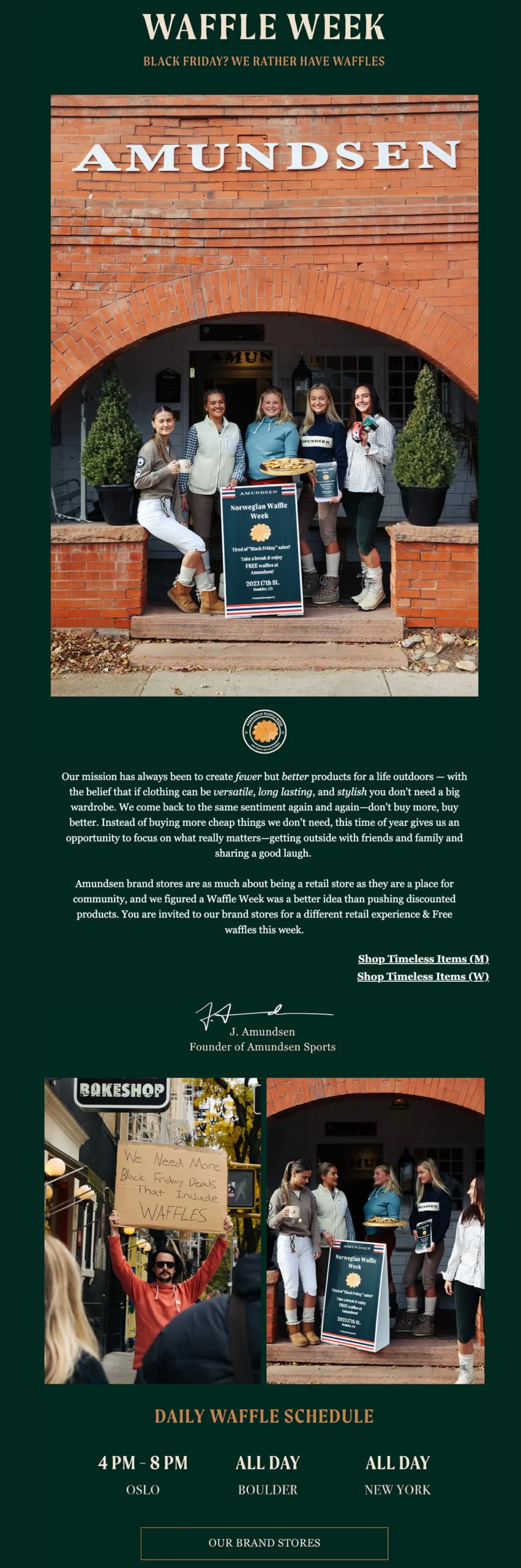
While discounts motivate 72% of BFCM shoppers, brands need not compromise profitability with excessively deep cuts. A 10-25% discount range can still attract clicks and create urgency without fostering skepticism about product quality or devaluing the brand. Attentive’s 2026 BFCM research indicates that four out of five shoppers are enticed by discounts lower than 40%, reinforcing the viability of more modest reductions.
Beyond percentage-off deals, several innovative promotional strategies can drive sales:
![Black Friday Marketing: Strategies and Examples [2026 ]](https://www.omnisend.com/blog/wp-content/uploads/2025/10/7-Organics-Ocean-email.webp)
- Tiered Discounts: Incentivize higher spending by offering escalating discounts (e.g., 10% off $50+, 15% off $100+, 20% off $150+). Organic Ocean successfully used this approach to encourage larger basket sizes.
- Product Bundles: Combine complementary items or pair slow-moving stock with bestsellers. Hismile and Manscaped effectively package products, offering customers perceived greater value than individual purchases.
- Buy One, Get One (BOGO): Ideal for consumable products with healthy margins, BOGO offers (including variations like "BOGO 50% off") can rapidly clear seasonal inventory, as demonstrated by FitTea.
- Freebies with Purchases: Offer a valuable, low-cost gift once a customer reaches a specific order value. To’ak’s premium tasting kit and MUJI’s free shipping over $50 illustrate how such incentives can boost AOV and introduce new products.
Enhancing Engagement: Interactive and Exclusive Promotions
Beyond transactional discounts, strategies that foster engagement can build long-term customer value:
- Mystery Discounts & Gamification: Interactive elements like "Wheel of Fortune" pop-ups, as offered by Omnisend, add an element of fun and anticipation, making offers more engaging.
- Flash Sales by Hour or Day: Daily or hourly deals create urgency and encourage repeat visits throughout Cyber Week. Rockstar Original’s "Fire Flash Sale" with up to 90% off denim is a prime example of generating immediate attention.
- VIP and Subscriber Exclusive Deals: Rewarding loyal customers and subscribers with early access or exclusive offers cultivates a sense of privilege, justifying list membership. Vape Jucce effectively uses VIP lists to build anticipation.
- Free Shipping Thresholds: Addressing the primary reason for cart abandonment (extra costs at checkout, cited by 40% of shoppers in Baymard Institute’s 2025 research), free shipping with a minimum spend is a powerful incentive. Setting the threshold just above the current AOV (e.g., $75 if AOV is $60) encourages customers to add more to their cart.
Brands should test different offers on smaller segments before BFCM to identify the most effective promotions for their specific customer base. Combining offers carefully, such as free shipping with tiered discounts, ensures clarity and avoids confusing customers.
![Black Friday Marketing: Strategies and Examples [2026 ]](https://www.omnisend.com/blog/wp-content/uploads/2025/10/8-MANSCAPED-promo.webp)
Operational Efficiency: Leveraging Automation for Sustained Sales
Automation is a high-performing component of any Black Friday strategy. According to Omnisend’s 2026 e-commerce marketing report, automated campaigns, despite constituting only 2% of all email sends, generated an impressive 30% of total email-driven revenue. Setting up these flows before Black Friday ensures they run seamlessly throughout the sale:
| Automation | Trigger | Recommended Timing |
|---|---|---|
| Cart Abandonment | Shopper leaves items in cart without buying | Email after 30 mins, then SMS after 1 hour |
| Browse Abandonment | Shopper views product but doesn’t add to cart | Email later the same day |
| Welcome Series | New subscriber joins list | Immediate send with early-access offer |
| Post-Purchase | Customer completes an order | Thank-you message, followed by product recommendations |
These automation flows, once built, can be reused for future sales events, requiring only offer updates for BFCM. To’ak Chocolate highlights the long-term value, with 39.4% of its email revenue originating from automated campaigns.
![Black Friday Marketing: Strategies and Examples [2026 ]](https://www.omnisend.com/blog/wp-content/uploads/2025/10/9-BOGO-SMS-1.webp)
Coordinated Outreach: Timing and Channel Strategy for Cyber Week
A well-orchestrated sending schedule across email, SMS, and push notifications is crucial for maintaining visibility throughout Cyber Week. A typical schedule might include:
| Time | Channel | Purpose |
|---|---|---|
| Thanksgiving evening, Nov 26 | Teaser: What’s coming and when | |
| Black Friday morning, Nov 27 | Email and Push | Launch: One offer, one button |
| Black Friday evening, Nov 27 | SMS | Deadline reminder before the day closes |
| Saturday and Sunday, Nov 28–29 | Quieter offer to non-openers and browsers | |
| Cyber Monday morning, Nov 30 | Email and Push | Relaunch: A new offer, not a repeat |
| Cyber Monday final hours, Nov 30 | SMS | Remind shoppers before the offer ends |
Crucially, customers who have already purchased should be excluded from subsequent promotional sends. Short, impactful subject lines (under 40 characters) and clear, bold offers placed high in the message, as seen in B-WEAR’s campaigns, maximize engagement. B-WEAR successfully generates up to 40% of its online sales through precisely timed and designed email and SMS campaigns.
![Black Friday Marketing: Strategies and Examples [2026 ]](https://www.omnisend.com/blog/wp-content/uploads/2025/10/10-MUJI-free-shipping-threshold.webp)
The urgency factor differentiates SMS from email. Omnisend’s BFCM 2023 data showed SMS click rates at 5.58%, significantly outperforming email’s 1.41%. SMS bypasses email obstacles like spam folders and promotional tabs, delivering immediate, concise calls to action, such as "Flash sale ends at 2 PM, only three hours left." Mobile-first design is paramount, prioritizing SMS for time-sensitive alerts and combining channels to cover the entire customer journey.
Amplifying Reach: Paid Advertising and Social Commerce
Beyond owned channels, paid advertising and social commerce play a vital role. Syncing customer segments to build ad audiences for platforms like Meta and Google ensures that campaigns target shoppers already familiar with the brand. Cart abandoners and recent visitors should receive the highest budget priority (50%) due to their high intent. Existing subscribers and customers warrant 30% of the budget, while cold prospects receive the remaining 20% to fill the top of the funnel, despite higher CPMs during peak season. Silver Street Jewellery’s Facebook retargeting campaigns, for example, contributed $100K in sales, underscoring the effectiveness of targeting warm audiences.
![Black Friday Marketing: Strategies and Examples [2026 ]](https://www.omnisend.com/blog/wp-content/uploads/2025/10/11-Wheel-of-fortune-popup.webp)
Platform-specific strategies are essential:
- TikTok Shop: With its Gross Merchandise Value (GMV) surging from $1 billion in 2021 to $33 billion in 2024, TikTok Shop offers immense potential. Shoppable videos featuring products in use and collaborations with micro-influencers are highly effective.
- Instagram Shopping: Utilize feed posts for product discovery and Stories for flash sales, leveraging the 24-hour urgency of the latter.
- Facebook: Ideal for retargeting, Dynamic Product Ads can display items customers previously browsed on the site, efficiently re-engaging interested individuals.
Managing rising ad costs involves optimizing budget allocation and testing ad formats. Nano-influencers (1K-10K followers), despite smaller reach, often yield higher engagement (average 2.61%) and better ROI due to their authentic connection with niche audiences. Collaborations should start in October with clear briefs, allowing influencers creative freedom for genuine content. User-Generated Content (UGC) also offers a cost-effective way to boost engagement, from reposting customer photos to incorporating reviews into social shopping listings, building trust and authenticity.
Post-Sale Strategy: Nurturing Customer Lifetime Value
![Black Friday Marketing: Strategies and Examples [2026 ]](https://www.omnisend.com/blog/wp-content/uploads/2025/10/12-Flash-sales-email.webp)
The conclusion of Cyber Week is not the end of the customer journey; it’s the beginning of a retention phase. A discount buyer typically becomes profitable only on their second, full-price order. Therefore, retention campaigns must be planned and activated immediately after the sale concludes.
Immediate post-purchase sequences should include:
- Order Confirmation: A necessary email, also an opportunity to confirm details, set delivery expectations, and introduce loyalty programs or social media channels.
- Thank-You Email: Sent 48 hours post-delivery, this strengthens customer relationships and can include product care tips or brand story elements. Rachel Riley successfully uses thank-you messages to foster deeper connections.
- Review Requests: Solicit product reviews, which provide valuable social proof and UGC.
- Upsell/Cross-sell: Recommend complementary products based on the recent purchase.
January reactivation campaigns are crucial for bringing back BFCM buyers. Segmenting these customers (e.g., loyal customers, discount hunters, lapsed buyers) allows for tailored messaging. Progressive discounting can appeal to bargain hunters, while exclusive product launches or personalized recommendations can re-engage loyal customers. Timing is key, avoiding promotional emails immediately after Christmas, then targeting resolution-makers in early January and addressing subsequent shopping occasions like Valentine’s Day or spring trends. Every post-purchase interaction is an opportunity to convert a one-time deal-seeker into a loyal, high-lifetime-value customer.
![Black Friday Marketing: Strategies and Examples [2026 ]](https://www.omnisend.com/blog/wp-content/uploads/2025/10/13-JUCCE-VIP-deal.webp)
Conclusion
Successful Black Friday marketing in 2026 demands meticulous planning, granular audience segmentation, robust automation, and consistent multi-channel messaging throughout the extended Cyber Week. E-commerce brands must embrace a data-driven approach, from initial goal setting and technical audits to the nuanced execution of offers and post-sale retention strategies. By leveraging integrated platforms like Omnisend, which centralize forms, segments, and automations, brands can streamline their operations and achieve sustained revenue growth beyond the initial peak sales period.
FAQs
![Black Friday Marketing: Strategies and Examples [2026 ]](https://www.omnisend.com/blog/wp-content/uploads/2025/10/14-Free-shipping-threshold-SMS.webp)
1. When should I start my Black Friday marketing?
Planning for Black Friday 2026 (November 27) should ideally begin in July or August, approximately four months in advance. This allows ample time for data analysis, goal setting, list building (through October), and teasing offers about a week before the sale.
2. How much should I discount for Black Friday?
While discounts are a strong motivator, a 10-25% discount range can be effective for protecting margins, as four in five shoppers are enticed by discounts lower than 40%. Brands should also consider alternative strategies such as product bundles, tiered discounts, or free gifts with purchase to add value without deep percentage markdowns.
3. Do I need SMS as well as email for BFCM marketing?
While not strictly mandatory, combining SMS with email significantly enhances BFCM marketing effectiveness. Email is ideal for detailed promotions, while SMS excels at delivering time-sensitive updates like sale launches, cart reminders, and last-chance alerts due to its immediate reach and higher engagement rates. SMS works best when integrated within the same automation flows as email, rather than as a standalone, separate channel.
![Black Friday Marketing: Strategies and Examples [2026 ]](https://www.omnisend.com/blog/wp-content/uploads/2025/10/15-BWEAR-Black-Friday.webp)
4. What’s the average ROI for Black Friday email campaigns?
While specific Black Friday ROI data varies, Omnisend merchants, on average, earn $79 for every $1 spent on email and SMS marketing. Furthermore, Omnisend’s 2025 research indicated that 58% of SMBs experienced higher performance on Black Friday compared to Cyber Monday, highlighting the strong potential returns from strategic email campaigns during this period.