

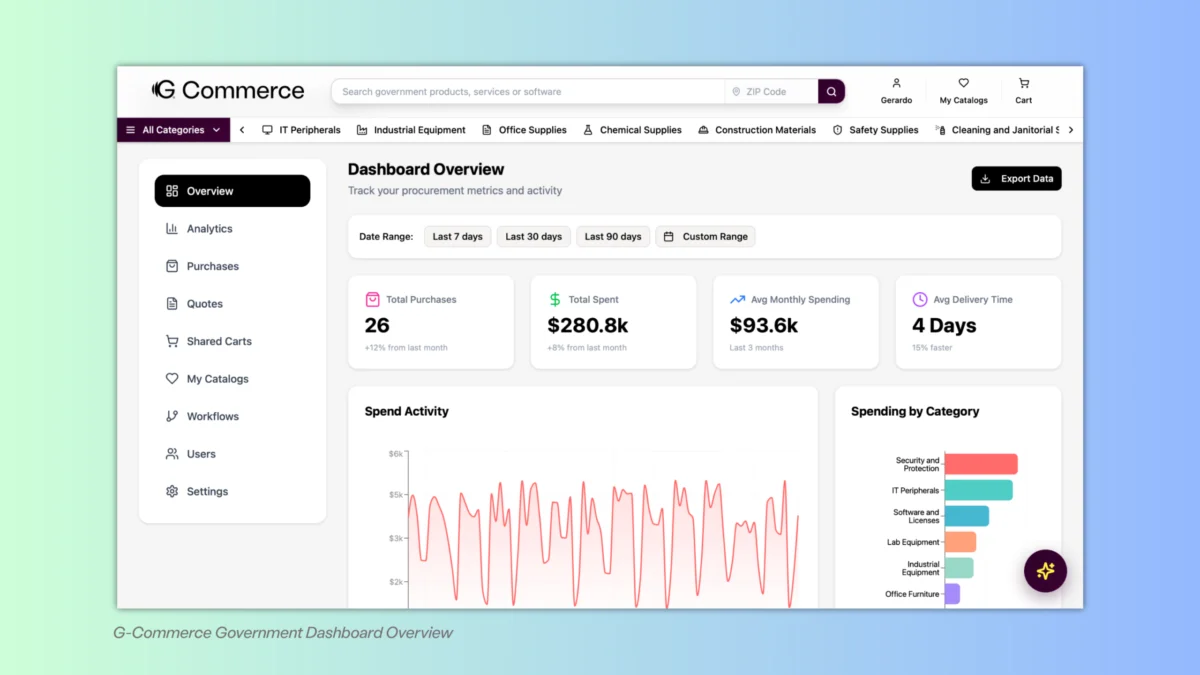
Glass, a technology company specializing in government procurement, has publicly unveiled a suite of artificial intelligence (AI)-driven features designed to significantly upgrade its G-Commerce marketplace. This strategic enhancement aims to reintroduce and revitalize the platform for government agencies, promising more efficient and intelligent purchasing processes. The new capabilities focus on critical areas such as search functionality, data analytics, and streamlined workflows for requesting quotes, signaling a significant leap forward in how public sector entities can acquire goods and services.
The company’s overarching goal with these advancements is to attract more suppliers to its platform, thereby expanding the range of offerings available to government buyers. Glass has identified federal agencies and public school districts as key sectors ripe for increased engagement, emphasizing the potential for these upgrades to address specific procurement challenges within these vital public institutions.
Transforming Public Education Through Smarter Procurement
Paola Santana, CEO of Glass, articulated the profound impact of improved procurement on the public education system. "How public schools buy has a direct impact on who they can serve and what they can provide," Santana stated. "Better procurement means maximizing every education dollar – giving more students access to public education while ensuring schools have the resources, technology, and learning environments they need to help students thrive." This statement underscores Glass’s commitment to a mission rooted in serving the public interest, viewing procurement reform as a catalyst for broader societal improvement.
Santana further elaborated on the company’s vision: "We believe transforming how schools buy can have a multiplier effect: better procurement enables better education and, ultimately, better futures." This philosophy suggests that by optimizing the purchasing processes for educational institutions, Glass aims to contribute to enhanced educational outcomes and brighter prospects for students across the nation.
A Trajectory of Growth and Impact
Since its inception in 2020, Glass has demonstrated a notable trajectory of growth. The company reports having facilitated over $15.2 million in government purchases to date, a figure that has nearly doubled since its January announcement of $8 million in processed transactions. This rapid expansion highlights the increasing adoption and utilization of the G-Commerce platform by government entities.
The platform currently serves a substantial user base, with at least 125 public agencies and 60,000 government users leveraging its capabilities. A significant aspect of Glass’s impact lies in its support for small businesses. The company reports directing over $5 million in procurement spending to these businesses, fostering economic growth and diversification within the government supply chain. Furthermore, the G-Commerce marketplace currently features at least 18.5 million products made available through an extensive network of supplier catalogs, offering a comprehensive selection for government buyers.
Key AI-Powered Upgrades to G-Commerce
Glass has detailed seven primary categories of new capabilities integrated into the G-Commerce platform. While the specific details of each of the seven categories were not fully enumerated in the original press release, the emphasis on AI suggests a transformative shift in how users interact with the marketplace. These upgrades are expected to address long-standing inefficiencies in government purchasing, which often involves complex processes and a wide array of specialized needs.
The introduction of AI-powered search is anticipated to enable users to find products and services more quickly and accurately, even with complex or nuanced queries. Traditional search functions can often be limited, requiring precise keywords. AI, however, can understand context and intent, leading to more relevant results and saving valuable time for busy government procurement officers.
Enhanced analytics are poised to provide agencies with deeper insights into their spending patterns, supplier performance, and market trends. This data-driven approach can inform future procurement strategies, identify cost-saving opportunities, and ensure compliance with budgetary regulations. By analyzing historical data, agencies can better forecast their needs and negotiate more favorable terms with suppliers.
The improvements to quote request flows are likely to simplify and expedite the process of obtaining bids from multiple vendors. This could involve automated generation of requests, streamlined submission portals for suppliers, and AI-assisted comparison of proposals. Such enhancements can significantly reduce administrative overhead and accelerate the acquisition cycle for critical goods and services.
Beyond these core improvements, the broader integration of AI is expected to touch upon areas such as predictive purchasing, automated compliance checks, and personalized recommendations for both buyers and suppliers. The aim is to create a more intuitive, responsive, and efficient procurement ecosystem.
Targeting Significant Market Opportunities
Glass is strategically positioning G-Commerce to capture a substantial share of the government procurement market. The company estimates that federal agencies alone spend approximately $40 billion annually through Government Purchase Card (GPC) programs. These agencies utilize over 250,000 cardholders who procure a diverse range of items, including technology, office supplies, industrial equipment, software, safety products, and mission-critical resources. By enhancing the G-Commerce platform, Glass aims to become a preferred channel for a significant portion of this spending.
The educational sector presents another colossal market opportunity. Glass identifies at least 100,000 public schools in the U.S., serving 49 million students, as a market with an estimated annual spending power of $1 trillion. This vast potential underscores the strategic importance of the G-Commerce platform’s enhancements for public school districts, which often face tight budgets and increasing demands for modern educational tools and infrastructure.
Investor Confidence and Future Outlook
Glass, headquartered in San Francisco, has garnered significant investor confidence, evidenced by its successful funding rounds. In 2023, the company raised $3 million in a round that saw participation from prominent investors including New Age Capital, Newtopia VC, Alcove Capital, SV Links, Kittyhawk Ventures, One Planet VC, Worldgate Group, Alchemist Accelerator, and Tubbs Ventures. This financial backing provides Glass with the resources necessary to continue its technological development and market expansion initiatives.
The company’s ongoing commitment to innovation, particularly in leveraging AI for government procurement, positions it as a key player in modernizing public sector purchasing. The successful integration of these new features on the G-Commerce platform is expected to drive further adoption, benefiting both government agencies seeking efficiency and suppliers looking for streamlined access to public sector contracts. The potential for these advancements to indirectly improve public services, from education to essential government operations, underscores the broader significance of Glass’s work in the B2B e-commerce landscape.
Broader Implications for Public Sector Efficiency and Innovation
The advancements introduced by Glass extend beyond mere technological upgrades; they represent a fundamental shift in the philosophy of government procurement. By embracing AI, Glass is not only enhancing operational efficiency but also laying the groundwork for more strategic and data-informed decision-making within public agencies.
For federal agencies, the ability to leverage AI-powered analytics can lead to significant cost savings through better vendor management, identification of bulk purchasing opportunities, and more accurate demand forecasting. This can free up valuable budget resources that can be reallocated to critical programs and services. Furthermore, the improved search and quote request functionalities can drastically reduce the time spent on administrative tasks, allowing procurement officers to focus on more strategic aspects of acquisition, such as ensuring the best value and compliance.
In the realm of public education, the impact of more efficient procurement is particularly profound. Schools often operate with limited budgets, and any improvement in their ability to acquire resources can directly translate into better learning environments for students. This could mean access to updated technology, improved classroom supplies, or more robust infrastructure. As CEO Paola Santana highlighted, maximizing education dollars is paramount, and AI-driven procurement platforms like G-Commerce offer a tangible path toward achieving this goal.
The emphasis on supporting small businesses is also a crucial element of Glass’s strategy. By creating a more accessible and efficient marketplace, Glass can help level the playing field, enabling smaller, innovative companies to compete for government contracts. This not only fosters economic growth but also introduces a wider range of specialized products and services into the government supply chain, potentially leading to more innovative solutions.
The $40 billion annual spending by federal agencies via GPC programs represents a significant target. If Glass can successfully onboard a substantial portion of these transactions, it would not only solidify its market position but also drive a widespread adoption of more modern procurement practices across federal departments. Similarly, tapping into the $1 trillion market for public schools could revolutionize how educational institutions are resourced, impacting millions of students.
The company’s recent $3 million funding round in 2023, supported by a strong syndicate of venture capital firms, signals continued investor confidence in Glass’s vision and execution capabilities. This financial backing will be critical for further development, marketing, and scaling operations to meet the demands of the public sector. As the digital transformation of government procurement continues to accelerate, Glass appears well-positioned to be a leading innovator, driving efficiency, transparency, and value for taxpayers. The future of government purchasing, it seems, is increasingly intelligent and AI-driven, with platforms like G-Commerce at the forefront of this evolution.








