
Commercial email marketing stands as a formidable pillar of digital strategy, boasting an impressive return on investment (ROI) that can range from $10 to $36 for every dollar spent. This financial efficacy, however, is contingent on intricate execution, demanding that carefully crafted campaigns not only bypass the dreaded spam folder but also render flawlessly across diverse digital environments, including the increasingly prevalent dark mode. The distinction between commercial and transactional email, far from mere industry jargon, represents a critical legal and technical delineation foundational to both compliance and successful deliverability.
This comprehensive analysis aims to demystify commercial email, exploring its definition, examining the strategic types that consistently yield tangible results, and detailing the essential technical best practices that elevate campaigns from potential spam casualties to inbox champions.
Defining Commercial Email: A Legal and Practical Imperative
At its core, commercial email refers to any electronic message primarily intended for the advertisement or promotion of a product or service. This definition is not simply a marketing guideline but a legal bedrock, particularly in the United States, as established by the Federal Trade Commission’s (FTC) CAN-SPAM Act. Enacted in 2003, CAN-SPAM (Controlling the Assault of Non-Solicited Pornography And Marketing Act) provides a framework for commercial email, mandating specific requirements to protect consumers while allowing legitimate businesses to engage in email marketing. Adherence to this legal definition is paramount for maintaining campaign compliance and safeguarding a sender’s crucial reputation.
The legislative landscape extends beyond U.S. borders, with significant regulations like the General Data Protection Regulation (GDPR) in Europe and Canada’s Anti-Spam Legislation (CASL) imposing even stricter consent requirements. GDPR, which came into effect in May 2018, demands explicit, affirmative consent for data processing, including email marketing, and grants individuals extensive rights over their personal data, such as the right to access, rectify, and erase it. Similarly, CASL, introduced in 2014, requires express consent for sending commercial electronic messages, placing a strong emphasis on verifiable opt-in processes. Navigating these varied international regulations is a complex but non-negotiable aspect of modern commercial email.
Commercial vs. Transactional Email: A Crucial Distinction
While both involve sending messages, the functional and legal differences between commercial and transactional emails are profound. Commercial emails are promotional, aiming to drive sales or engagement with products and services. Transactional emails, conversely, facilitate an agreed-upon transaction or relationship. Examples include order confirmations, shipping updates, password resets, account notifications, and customer service responses.
Understanding this differentiation is vital because transactional emails typically face different legal requirements and often enjoy superior deliverability rates. For instance, under CAN-SPAM, transactional messages are generally exempt from certain requirements applicable to commercial emails, such as the prominent display of an unsubscribe link, provided their primary purpose is not promotional. However, this exemption is not absolute, and adding promotional content to a transactional email can shift its legal classification.
The Hybrid Gray Area: Applying the Primary Purpose Test

The line between commercial and transactional can blur, particularly with "hybrid" emails that combine elements of both. A common example is a receipt email that also includes a promotional coupon code or a recommendation for related products. In such cases, regulatory bodies like the FTC apply the "primary purpose test." If the main goal of the email is to confirm a purchase or provide essential information related to a transaction, it is considered transactional. If the dominant intent is to persuade the recipient to make another purchase or engage with a new promotion, it is classified as commercial. Misinterpreting this can lead to compliance issues and negatively impact sender reputation.
The Enduring Power of Email Marketing: Supporting Data
Despite the proliferation of new digital marketing channels, email marketing consistently demonstrates its enduring power and superior ROI. Industry reports frequently cite email as one of the most effective channels, often outperforming social media, direct mail, and paid search in terms of conversion rates. The projected global email marketing market size underscores this, with estimates suggesting continued robust growth, driven by its direct reach, measurability, and capacity for personalization.
The high ROI figures – $10-$36 for every dollar spent – are not arbitrary. They reflect email’s unique ability to foster direct communication, nurture leads, and drive conversions through targeted messaging. For businesses, this means that optimizing email campaigns is not just an option but a strategic imperative to capitalize on one of the most cost-effective marketing tools available.
A Brief Chronology of Email Marketing and Regulation
- 1971: Ray Tomlinson sends the first network email, marking the birth of electronic mail.
- 1978: The first unsolicited bulk email (spam) is sent by Gary Thuerk to promote a new computer.
- 1990s: The rise of the internet leads to a surge in email usage and, consequently, spam, creating a need for regulation.
- 2003: The U.S. Congress passes the CAN-SPAM Act, establishing the first federal standards for commercial email.
- 2004-2010s: Email Service Providers (ESPs) and Mailbox Providers (MBPs) develop increasingly sophisticated spam filters and authentication protocols (SPF, DKIM, DMARC) to combat unsolicited mail.
- 22014: Canada implements CASL, one of the strictest anti-spam laws globally, requiring explicit consent.
- 2018: The European Union enacts GDPR, profoundly impacting how personal data, including email addresses, is collected, stored, and used, requiring explicit consent for marketing communications.
- Present: Focus shifts to hyper-personalization, AI-driven optimization, and enhanced deliverability best practices to navigate evolving regulations and sophisticated spam filtering.
Types of Commercial Emails Driving Real Results
Effective commercial email marketing is not a one-size-fits-all endeavor. Savvy marketers understand that different email types serve distinct strategic objectives, each tailored to a specific stage of the customer journey or business goal.
- The Promotional Blast: These are the high-impact, direct-response emails designed for speed and immediate action. They typically announce sales, special offers, new product arrivals, or limited-time promotions. The objective is clear: drive traffic, generate immediate sales, or encourage specific conversions. Success metrics include click-through rates (CTR), conversion rates, and immediate revenue generation. While effective, their frequency must be carefully managed to avoid subscriber fatigue and increased unsubscribe rates.
- The Newsletter: In contrast to the sprint-like nature of promotional blasts, newsletters are the marathon runners of email marketing. Their primary purpose is to build and nurture long-term relationships by consistently delivering valuable content. This can include industry insights, company news, blog post summaries, educational resources, or curated content. Newsletters aim to establish brand authority, foster loyalty, and keep the brand top-of-mind. Key performance indicators (KPIs) often revolve around open rates, content engagement (clicks on articles), and ultimately, customer lifetime value.
- The Retention/Re-engagement Email: These emails act as the comeback specialists, strategically deployed to win back subscribers who have shown signs of disengagement or inactivity. This might include customers who haven’t made a purchase in a while, subscribers who haven’t opened emails, or those whose subscriptions are nearing expiration. Re-engagement campaigns often feature special offers, updated content, or a direct plea to reaffirm interest, sometimes asking subscribers to update their preferences. The goal is to prevent churn, reactivate dormant accounts, and restore positive sender reputation signals.
- The Product Launch/Update Email: These messages serve as the starting pistol for new innovations or significant product enhancements. They are designed to generate excitement, inform the audience about upcoming features, and drive early adoption. Launch emails often involve a sequence, from "coming soon" teasers to detailed feature breakdowns and direct calls to action for pre-orders or purchases. They are crucial for building anticipation and ensuring a successful market entry for new offerings.
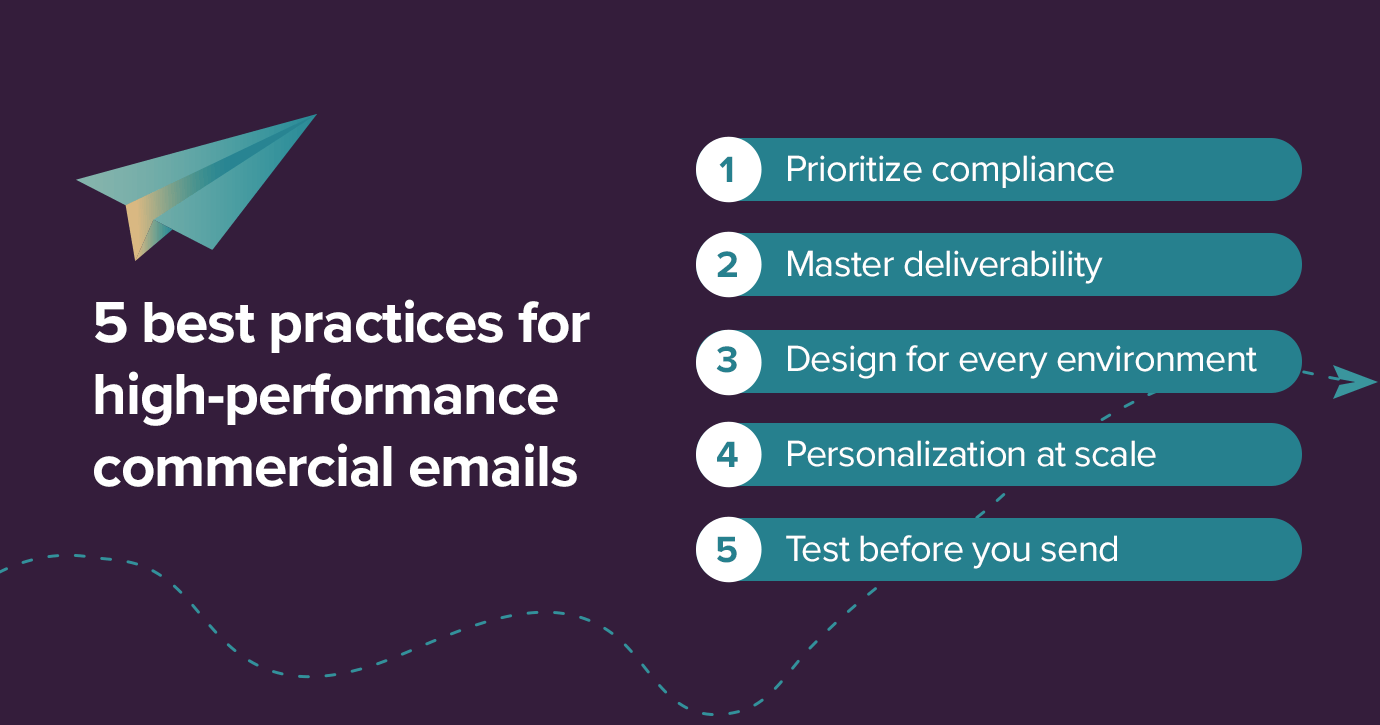
5 Best Practices for High-Performance Commercial Emails
Strategic planning sets the stage, but meticulous execution is what ultimately drives success in commercial email. These five best practices are critical for ensuring campaigns perform at their peak, maximizing ROI, and maintaining a positive sender reputation.
1. Prioritize Compliance Above All Else
Compliance is the non-negotiable foundation of any successful commercial email program. Failure to adhere to regulations like CAN-SPAM, GDPR, or CASL can result in severe penalties, including hefty fines, damage to brand reputation, and even blacklisting by mailbox providers.
CAN-SPAM Requirements (U.S.):
- Accurate Header Information: The "From," "To," and routing information must be accurate and identify the person or business initiating the message.
- No Deceptive Subject Lines: Subject lines must accurately reflect the content of the message.
- Advertisement Disclosure: The email must clearly and conspicuously disclose that it is an advertisement.
- Physical Postal Address: Every commercial email must include a valid physical postal address of the sender.
- Clear Unsubscribe Mechanism: Provide a clear and conspicuous way for recipients to opt out of future emails. This must be a one-click process that is easy to find and use.
- Honor Opt-Out Requests Promptly: Unsubscribe requests must be honored within 10 business days.
GDPR (Europe) and CASL (Canada) Additional Requirements:
- Explicit Consent: Marketers must obtain explicit, verifiable consent from individuals before sending commercial emails. Pre-checked boxes or implied consent are generally not sufficient.
- Right to Access/Erasure: Individuals have the right to access their data and request its deletion.
- Proof of Consent: Businesses must be able to demonstrate that consent was given.
Compliance builds trust. Transparent and honest email practices signal to recipients and Internet Service Providers (ISPs) that a sender is legitimate and trustworthy. This trust directly translates into improved engagement rates and, consequently, better deliverability.
2. Master Deliverability: Reaching the Inbox, Not the Spam Folder
Email deliverability is not merely about sending a message; it’s about ensuring that message successfully lands in the recipient’s primary inbox. Mailbox providers (MBPs) continuously assess every sender’s reputation based on a multitude of signals, including engagement rates, complaint rates, and list hygiene. This reputation dictates whether emails are delivered, filtered to spam, or blocked entirely.
Key Pillars of Deliverability:
- Email Authentication (SPF, DKIM, DMARC): These protocols are table stakes. SPF (Sender Policy Framework) verifies that the sending server is authorized by the domain owner. DKIM (DomainKeys Identified Mail) uses digital signatures to confirm that the email hasn’t been tampered with in transit. DMARC (Domain-based Message Authentication, Reporting & Conformance) builds on SPF and DKIM, instructing MBPs on how to handle emails that fail authentication. Implementing these protocols is crucial for proving sender legitimacy.
- Engagement: MBPs closely monitor how recipients interact with emails. Low open and click rates signal disinterest, potentially leading MBPs to filter future messages to spam. Conversely, high engagement, especially replies and emails marked as "not spam," boosts sender reputation. Regular re-engagement campaigns and suppressing inactive subscribers are vital.
- Complaint Rates: Every time a recipient marks an email as spam, it significantly damages sender reputation. The goal is to keep complaint rates below 0.1%. High complaint rates often indicate issues with list acquisition (e.g., purchased lists, unclear opt-in) or sending frequency.
- List Hygiene: A clean email list is fundamental. Hard bounces (permanent delivery failures), spam traps (email addresses specifically designed to catch spammers), and role-based addresses (like info@ or admin@) all harm sender reputation. Regular list validation and removal of inactive or problematic addresses are essential.
- Send Consistency and IP/Domain Warming: Sudden, drastic increases in email volume can trigger spam filters, as it resembles typical spammer behavior. When increasing sending volume, a gradual "warming up" process allows MBPs to recalibrate and recognize the legitimate increase.
- Separation of Sending Streams: Best practice dictates using separate subdomains or dedicated IP addresses for commercial and transactional emails. This segregation ensures that any deliverability issues with a marketing campaign do not negatively impact the delivery of critical transactional messages like order confirmations or password resets.
Industry data reveals that global average email deliverability hovers around 85-90%, meaning a significant portion of emails never reach the inbox. Mastering these deliverability best practices can push a sender’s rates closer to 95% or higher, directly impacting campaign effectiveness and revenue.
3. Design for Every Environment and Accessibility
A beautifully designed email is useless if it breaks in the recipient’s inbox. The fragmented nature of email clients and devices, coupled with the rise of dark mode, presents significant design challenges.
- Dark Mode Compatibility: Dark mode, a display setting that uses a darker color palette, can cause major rendering issues. Invisible text (e.g., black text on a dark background), disappearing logos, and poor contrast are common problems. Solutions involve specific CSS techniques (e.g.,
@media (prefers-color-scheme: dark)) and rigorous testing to ensure brand colors, images, and text remain visible and legible in both light and dark interfaces. - Mobile Responsiveness: With a majority of emails now opened on mobile devices, responsive design is non-negotiable. This includes single-column layouts for easy scrolling, large touch targets (at least 44×44 pixels) for buttons, and thumb-friendly placement of calls to action (CTAs). Images should be optimized for mobile screens to ensure fast loading times.
- Accessibility: Designing for accessibility ensures emails are usable by everyone, including those with disabilities. This means using sufficient color contrast, providing descriptive alt text for images, structuring content logically with proper headings, and avoiding small, hard-to-read fonts. Adhering to Web Content Accessibility Guidelines (WCAG) improves the experience for all users and broadens audience reach.
Testing designs across a wide array of email clients (Gmail, Outlook, Apple Mail, etc.) and devices (various smartphones, tablets, desktops) in both light and dark modes is crucial to prevent rendering failures that can erode brand credibility.
4. Personalization at Scale: Beyond "Hi [Name]"
Basic personalization, such as addressing a recipient by their first name, is now a minimum expectation. True personalization leverages data to create highly relevant and engaging experiences at scale.
- Dynamic Content: This involves using data points like purchase history, browsing behavior, demographic information, or geographic location to display different content blocks to different segments of an audience within the same email. For example, a retail email might show product recommendations based on a customer’s past purchases or items viewed on the website.
- Behavioral Triggers: Automated emails triggered by specific user actions (or inactions) are incredibly effective. Examples include cart abandonment emails, browse abandonment reminders, post-purchase follow-ups, and welcome series for new subscribers. These timely and contextually relevant messages significantly boost engagement and conversion rates.
- Segmentation: Moving beyond broad demographic segmentation, advanced strategies involve micro-segmentation based on engagement patterns (e.g., highly engaged, occasional opener, inactive), customer value (e.g., VIPs, new customers), or expressed preferences.
- AI-Driven Optimization: Emerging technologies, including artificial intelligence and machine learning, are enabling hyper-personalization by predicting individual preferences, optimizing send times, and even dynamically generating content elements to maximize relevance for each recipient.
The impact of advanced personalization is significant. Studies consistently show that personalized emails generate higher open rates, click-through rates, and conversion rates compared to generic blasts. Starting with simple behavioral triggers and gradually expanding to more sophisticated segmentation and dynamic content is a pragmatic approach.
5. Test Before You Send: The Ultimate Quality Control
The complexity of modern email marketing, with its myriad of clients, devices, and display modes, means that even a perfectly coded email can encounter rendering issues. Broken links, formatting errors, invisible text, or non-functional CTAs can instantly undermine a campaign, damage brand perception, and waste marketing resources.
- Pre-Send Testing Tools: Platforms like Litmus allow marketers to preview their emails across 90+ email clients and devices before hitting send. This enables the identification and correction of rendering issues, dark mode failures, and mobile formatting disasters.
- Link Validation: Automated tools can check all links within an email to ensure they are functional and direct to the correct landing pages. Broken links are a common and easily avoidable error that severely frustrates recipients.
- Spam Filter Testing: Some testing tools can analyze email content, subject lines, and sender reputation against common spam filter criteria, providing insights into potential deliverability roadblocks and suggesting adjustments.
- A/B Testing: Beyond pre-send checks, A/B testing allows marketers to experiment with different subject lines, CTA copy, images, layouts, and send times to determine what resonates best with their audience, continually optimizing for higher engagement and conversions.
Investing in robust testing protocols is not an optional luxury but a fundamental component of a high-performance email strategy. It safeguards brand credibility and ensures that every campaign has the best possible chance of achieving its objectives.
Broader Impact and Future Implications
The landscape of commercial email is continuously evolving, driven by technological advancements, changing consumer expectations, and an increasingly stringent regulatory environment. The implications for businesses are profound:
- Enhanced Customer Experience: As personalization becomes more sophisticated, email marketing will play an even greater role in delivering tailored, relevant experiences that foster customer loyalty and satisfaction.
- Data Privacy as a Competitive Advantage: With global regulations like GDPR setting a high bar, businesses that prioritize data privacy and transparency will build greater trust with their audience, turning compliance into a competitive differentiator.
- AI and Automation: The integration of AI will further refine email optimization, enabling predictive analytics for content, send times, and audience segmentation, leading to unprecedented levels of efficiency and effectiveness.
- Integration with Omnichannel Strategies: Email will remain a central hub, seamlessly integrating with other marketing channels (social media, SMS, web push notifications) to create a cohesive and consistent customer journey.
Conclusion: Train Like a Champion, Send Like a Pro
Commercial email marketing, when executed with strategic foresight and technical precision, is an unparalleled revenue driver. The journey from crafting a campaign to achieving that coveted $36 ROI per dollar spent is paved with an understanding of legal compliance, mastery of deliverability, meticulous design, intelligent personalization, and rigorous testing. The distinction between commercial and transactional emails, the various types of campaigns, and the five best practices discussed herein are not merely suggestions but critical components that differentiate inbox champions from those languishing in spam folders.
In an increasingly competitive digital arena, businesses must commit to continuous improvement in their email marketing endeavors. It is time to embrace the technical nuances, leverage data for smarter strategies, and rigorously test every message. By doing so, organizations can confidently sprint toward inbox success, transforming commercial email into a powerful engine for sustained growth and customer engagement.