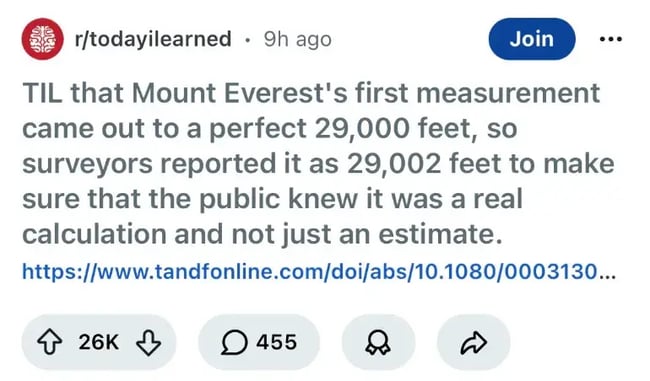
The world’s highest peak, Mount Everest, stands as a testament not only to nature’s grandeur but also to a peculiar human psychological quirk concerning numerical precision. Early measurements of Everest’s elevation, particularly the seminal 1856 announcement by the British Royal Geographical Society, illustrate a fascinating insight into how people perceive and trust numbers. Rather than declaring the precisely calculated 29,000 feet, the surveyors officially announced an elevation of 29,002 feet. This seemingly minor alteration was a deliberate strategic choice, rooted in the understanding that rounded figures, while perhaps tidier, often appear less believable and less accurate to the human mind. This historical anecdote, though seemingly trivial, foreshadowed decades of psychological research confirming that specific, non-rounded numbers carry a greater weight of authenticity and precision, influencing everything from charitable donations to high-stakes negotiations.
The Great Trigonometrical Survey and Everest’s Elusive Height
The story of Mount Everest’s measurement is intertwined with the ambitious Great Trigonometrical Survey of India, initiated in 1802 by the British East India Company. This monumental undertaking aimed to map the entire Indian subcontinent with scientific precision. For decades, surveyors painstakingly traversed vast territories, using giant theodolites and complex trigonometric calculations to determine heights and positions. Sir George Everest, Surveyor General of India from 1830 to 1843, played a pivotal role in this endeavor, though he retired before the peak bearing his name was fully surveyed.
It was his successor, Andrew Waugh, who in 1852 announced that a peak known as Peak XV was the highest in the world. The crucial calculation was performed by Radhanath Sikdar, an Indian mathematician and chief computer of the survey, who, working from observations taken from six different stations, determined the peak’s height to be exactly 29,000 feet (8,839 meters). However, Waugh and the Royal Geographical Society faced a dilemma: a perfectly rounded number like 29,000 feet might be perceived with skepticism. It could easily be dismissed as an estimate, a convenient approximation rather than a rigorous scientific finding. To lend an air of indisputable accuracy and scientific diligence to their groundbreaking discovery, they added two feet, officially declaring the height as 29,002 feet. This decision, driven by an intuitive understanding of human psychology, aimed to preempt any doubts about the meticulousness of their work. The rationale was simple: a less round, more specific number would inherently suggest a greater degree of care and exactitude in the measurement process. This initial declared height stood for nearly a century until more advanced techniques led to new measurements, yet the principle behind that initial "extra two feet" remains profoundly relevant.
The Pique Technique: Disrupting Mindless Refusal
The intuitive wisdom of the Everest surveyors found robust scientific backing in later psychological research, particularly studies exploring the "pique technique." This concept, first formally investigated in the 1990s, posits that unusual or non-normative requests can disrupt an individual’s "mindless refusal" script, thereby increasing compliance. When confronted with an unexpected or specific request, people are forced to pause, process the information, and consider it more deeply, rather than automatically defaulting to a "no."

One of the foundational studies on the pique technique was published in the Journal of Applied Social Psychology in 1994. Researchers Michael D. Santos, Craig Leve, and Anthony R. Pratkanis from the University of California, Santa Cruz, designed an experiment to test this theory in a real-world setting. They recruited three female actors to approach a total of 289 adults in public over several days, asking for spare change. The core manipulation lay in the wording of the request.
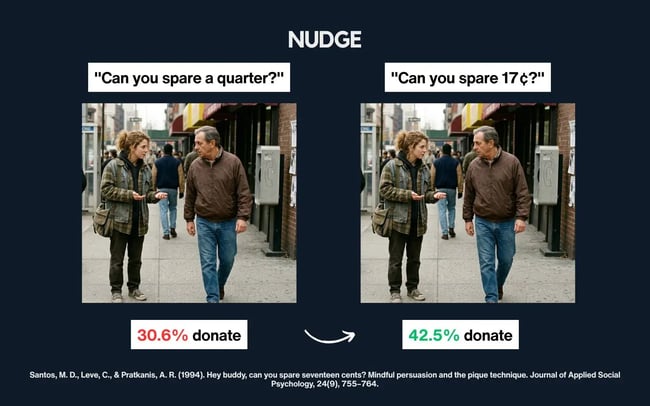
In the control condition, actors used a conventional, rounded request: "Can you spare a quarter (or any change)?" This type of general request often triggers an automatic, often negative, response from passersby who are accustomed to such solicitations. However, in the experimental condition, actors employed a specific, non-rounded request: "Can you spare 17¢ (or 37¢)?" The researchers hypothesized that these unusual, precise amounts would "pique" the interest of the individuals, compelling them to consider the request more carefully.
The results were compelling. A significantly higher percentage of people complied with the specific, non-rounded requests compared to the general ones. The act of asking for an odd amount like 17 cents or 37 cents forced people to think: "Why 17 cents? What is that person going to do with 17 cents?" This cognitive interruption broke the typical "mindless refusal" pattern, making individuals more likely to engage with the request and, consequently, more likely to donate. This study provided clear empirical evidence that numerical specificity, even in seemingly trivial amounts, could dramatically influence compliance.
Extending the Pique Technique: Time as a Commodity
The success of the 1994 study in demonstrating the power of specific numerical requests for monetary donations led researchers to question if this psychological phenomenon extended beyond financial transactions. Could the pique technique also be effective when asking for someone’s time, another valuable commodity in modern society?
In 2015, Nicolas Guéguen, a professor of behavioral sciences at the University of Southern Brittany in France, sought to re-examine the pique technique in the context of non-monetary requests. His study aimed to determine if asking for a precise, unusual amount of time would similarly boost compliance compared to a general request for "a little time."
For this experiment, four female actors, uniformly dressed in black to minimize visual biases, were instructed to approach 300 passersby (an equal split of 150 men and 150 women) and ask them to complete a survey. The critical variable was the phrasing of the request for their time.

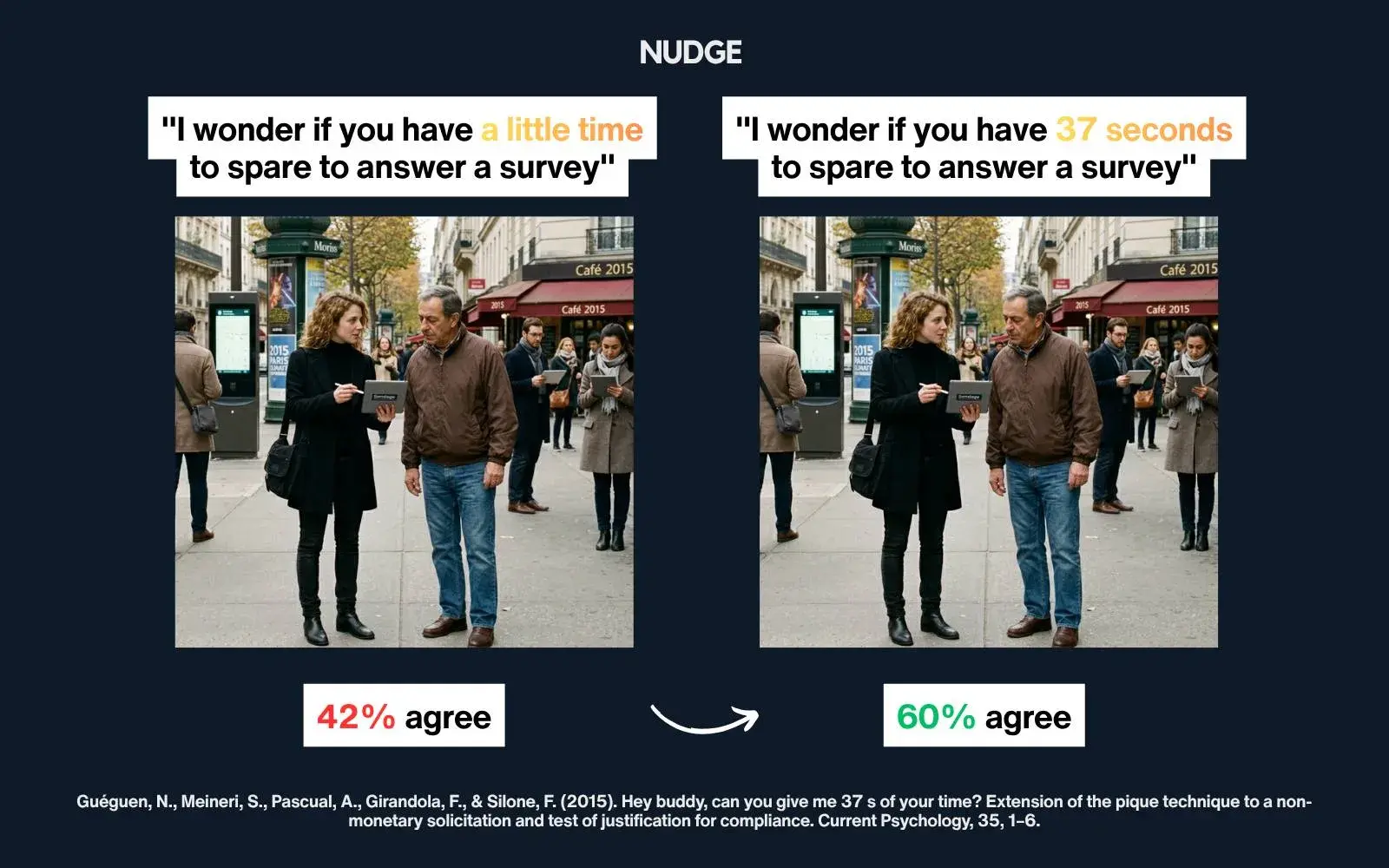
One group of 150 passersby received the general request: "I wonder if you have a little time to spare to answer a survey." This is a common and often vaguely worded solicitation, which, like the general monetary request, can be easily dismissed without much thought. The other group of 150 passersby received the specific request: "I wonder if you have 37 seconds to spare to answer a survey." The choice of "37 seconds" was deliberately precise and unusual, designed to trigger the pique effect.
The findings mirrored the earlier monetary study. Of the 150 individuals asked for "a little time," only 63 agreed to participate in the survey, representing a compliance rate of 42%. In stark contrast, among the 150 individuals asked for "37 seconds," a remarkable 90 agreed to complete the survey, pushing the compliance rate to 60%. This represented a substantial increase in compliance of 42.9% due to the use of a specific time request.
Guéguen’s study solidified the understanding that the psychological impact of numerical precision is not limited to financial contexts. Whether it’s money or time, a specific, non-rounded number interrupts automatic refusal, forces cognitive processing, and implicitly communicates a sense of legitimacy and a clear, manageable expectation. The precision suggests that the requester has a well-defined reason and a clear understanding of the commitment being asked for, making the request seem more reasonable and less open-ended.
Negotiations and the Anchoring Effect: The Power of Precise Offers
The influence of precise numbers extends beyond simple requests for charity or time, significantly impacting complex interactions like negotiations. In these scenarios, the use of specific figures can activate psychological principles such as the "anchoring effect," where an initial piece of information (the "anchor") influences subsequent judgments and decisions.
In 2013, a study published in the Journal of Experimental Social Psychology by four researchers delved into the role of precise offers in negotiation settings. The experiment involved hundreds of participants who were asked to engage in a hypothetical negotiation for the sale of a second-hand car. The buyers in the study were divided into groups, each instructed to open the negotiation with a specific type of price.
Half of the buyers were told to initiate the sale with a rounded, conventional price, specifically $2,000. This served as a control, representing a typical, less precise opening offer. The other half of the buyers were instructed to use a precise, non-rounded price point as their opening offer. These precise anchors were either $1,865 or $2,135. The researchers were keenly interested in observing how these different opening bids would influence the sellers’ counter-offers and, ultimately, the final agreed-upon price.
The results clearly demonstrated the persuasive power of precise numbers in negotiation. When buyers presented a precise asking price (either $1,865 or $2,135), sellers responded with significantly smaller adjustments in their counter-offers compared to when the initial offer was a rounded $2,000. The specific, non-rounded anchors created a stronger, more credible reference point. Sellers perceived these precise numbers as being more thoughtfully calculated and therefore more justified, leading them to haggle less aggressively and to propose counter-offers that were closer to the initial precise bid. This phenomenon ultimately resulted in higher final selling prices for the buyers who used precise opening offers.
The implication here is profound: a precise number, particularly in a negotiation, acts as a stronger psychological anchor. It suggests that the offer is based on detailed consideration, valuation, or specific market research, rather than a loose estimate. This perception of legitimacy and diligence reduces the room for aggressive counter-negotiation, as the opposing party is implicitly led to believe there’s a strong, specific rationale behind the number.
Broader Implications for Marketing, Sales, and Public Trust
The psychological principle that underpins the Everest measurement, the pique technique, and negotiation strategies holds significant implications across various sectors, particularly in marketing, sales, and public communication.
Marketing and Pricing Strategies: Marketers often gravitate towards rounded, "clean" numbers for pricing, such as $9.99 or $100.00, believing they appear simpler and more appealing. However, the research suggests that for certain products or services, especially those where perceived value, quality, or precision is paramount, a more specific price point might convey greater authenticity and value. For example, a software subscription priced at $27.49 per month might subtly imply a highly granular valuation of features, whereas $25.00 might seem arbitrary. When communicating savings, "Save 37.5%" might resonate more than "Save over 30%," suggesting a meticulously calculated discount.
Sales and Performance Metrics: When presenting sales figures, project timelines, or performance statistics, specificity can build trust. Instead of stating "Our team increased efficiency by over 20%," a statement like "Our team achieved a 23.7% increase in process efficiency" sounds more credible and is likely to be taken more seriously by clients or stakeholders. This level of detail suggests a rigorous tracking and analytical process, enhancing the presenter’s authority and trustworthiness.
Building Public Trust and Authority: In public discourse, scientific reporting, or policy announcements, precise numbers lend an air of authority and factual grounding. A government report stating "We aim to reduce emissions by 17.4% by 2030" sounds more committed and thoroughly researched than "We aim to significantly reduce emissions." Similarly, a scientific study detailing "a sample size of 4,387 participants" inherently feels more robust than "thousands of participants."
Content Creation and Storytelling: Even in storytelling or content creation, precise numbers can make narratives more engaging and believable. Describing "a village of 1,283 inhabitants" or "a journey of 734 miles" creates a more vivid and authentic picture than vague approximations. This detail draws the audience in, making the information feel more tangible and real.
Why Precision Resonates:
The underlying psychological mechanism is multifaceted. Firstly, cognitive processing: Rounded numbers allow for "mindless refusal" or easy dismissal. Precise numbers demand a moment of thought, forcing the recipient to process the information, which increases engagement. Secondly, perceived effort and legitimacy: A precise number implies that someone has put in the effort to measure, calculate, or carefully consider the figure. This perceived diligence translates into a sense of legitimacy and trustworthiness. It suggests the number is not an arbitrary guess but a well-founded fact. Thirdly, anchoring: As seen in negotiations, precise numbers set a stronger, more specific anchor, influencing subsequent judgments and making it harder to deviate significantly from that initial reference point.
In essence, we have a natural tendency to be skeptical of information that appears too neat or too convenient. Round numbers often fall into this trap, signaling an approximation rather than an exact measurement. Specific, non-rounded numbers, on the other hand, disrupt this expectation, signaling genuine effort, meticulousness, and an underlying factual basis.
From the pioneering surveyors who intuitively understood that 29,002 feet would command more respect than 29,000, to modern psychologists demonstrating its effect on donations and negotiations, the message is clear: precision earns trust. In an information-saturated world where credibility is a valuable currency, leaning into precise numbers can be a powerful and effective communication strategy. It tells customers, clients, and the public that claims are not pulled from thin air but are grounded in reality, carefully measured, and thoroughly considered. Therefore, whether in scientific reports, marketing campaigns, or daily interactions, embracing numerical specificity is not just about accuracy; it’s about building belief and fostering compliance.