The digital marketing ecosystem is undergoing a profound transformation, driven by the rapid ascent of artificial intelligence in search. While Semrush has long stood as a benchmark for tracking traditional Search Engine Results Page (SERP) rankings, its recent integration of AI visibility features has opened a new frontier for digital strategists. However, the market for AI visibility tools is dynamic and expanding, presenting a robust array of alternatives that warrant careful evaluation by SEO leaders, content marketers, demand generation managers, and RevOps teams seeking the optimal fit for their operational stacks, reporting exigencies, and budgetary constraints. This guide delves into the nuances of AI search visibility, contrasts it with conventional rank tracking, and provides an in-depth analysis of key alternatives to Semrush’s AI capabilities, including HubSpot AEO, LLM Pulse, BrightEdge, Authoritas, and Advanced Web Ranking.
The Paradigm Shift: Understanding AI Search Visibility
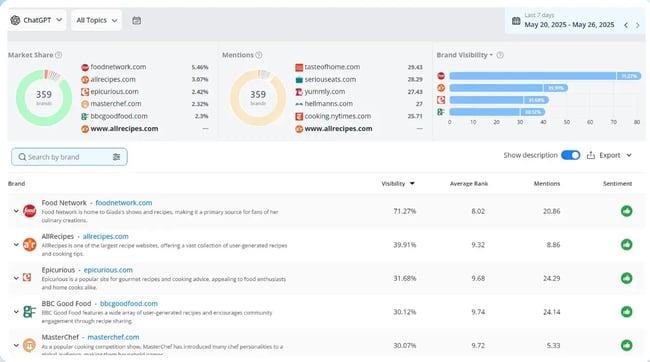
AI search visibility represents a brand’s presence within the AI-generated answers that increasingly dominate modern search experiences. This encompasses the citations, summaries, and recommendations produced by sophisticated AI engines such as ChatGPT, Perplexity, Google AI Overviews, and Gemini in response to user queries. Unlike traditional rank tracking, which quantifies a webpage’s position in a sequential list of blue links, AI search visibility measures whether a brand’s content is effectively retrieved, synthesized, and surfaced as a credible source within these generated responses.
The fundamental divergence lies in structural emphasis. Traditional search ranking algorithms historically prioritized factors like backlinks, domain authority, and precise keyword alignment. In contrast, AI search visibility is contingent upon an AI search engine’s ability to confidently interpret, extract, and attribute a brand’s content. A webpage might achieve a formidable position in Google’s organic results yet remain conspicuously absent from AI-generated answers. This is primarily because AI systems prioritize clarity, demonstrable entity authority, and cross-platform consistency, often transcending the singular influence of traditional ranking signals. This shift necessitates a re-evaluation of content creation and optimization strategies, moving beyond mere keyword stuffing to focus on structured data, factual accuracy, and comprehensive topic authority.
Key Metrics Defining AI Search Visibility

In practice, AI search visibility is primarily defined by three critical metrics:
- Citations: This metric quantifies how frequently a brand or its content is referenced or linked as a source within AI-generated responses. A high citation frequency indicates strong recognition and relevance by AI models.
- Share of Voice: This metric measures a brand’s presence relative to its competitors within AI-generated answers for a specific set of queries. It provides insight into competitive landscape and market dominance in the AI-driven search space.
- Sentiment: This metric analyzes the emotional tone and overall portrayal of a brand within AI-generated responses. Positive sentiment reinforces brand perception, while negative sentiment necessitates strategic intervention.
Collectively, these three metrics offer a holistic insight into AI search visibility, surpassing the analytical depth of any single metric alone. A brand might exhibit high citation frequency but struggle with poor sentiment, or achieve a low share of voice but secure strong, authoritative positioning in the citations it does earn. A nuanced understanding of all three is paramount for developing actionable AI visibility measurement strategies.
The Evolution of AI in Search: A Brief Chronology
The journey towards AI-driven search visibility has been swift and transformative. For decades, search engine optimization primarily revolved around understanding Google’s algorithmic updates, which dictated the ranking of webpages. The emergence of large language models (LLMs) like OpenAI’s ChatGPT in late 2022 marked a pivotal moment, showcasing the potential for conversational AI to summarize information and answer complex queries directly.
- 2022-2023: The LLM Revolution: ChatGPT’s public release sparked a global interest in generative AI. Soon after, Google introduced Bard (now Gemini), and other players like Perplexity AI emerged, specifically designed as "answer engines" that synthesize information from various sources and provide citations.
- 2023-2024: Integration into Mainstream Search: Google began piloting "Search Generative Experience" (SGE), which later evolved into "AI Overviews," integrating AI-generated summaries directly into traditional search results. This signaled a clear intent from the dominant search provider to fundamentally alter the search experience, moving beyond simple blue links.
- Present Day: AI-powered search is no longer a niche concept but a growing reality. Users are increasingly interacting with AI assistants and overviews to get quick, synthesized answers, often without clicking through to source websites. This shift has profound implications for how brands capture attention and drive traffic.
Semrush, a long-standing leader in SEO tooling, responded by adding AI visibility tracking to its suite. This extension monitors Google AI Overviews, provides limited citation insights, and offers keyword data for AI-influenced queries, aiming to keep its users within a single workspace for comprehensive SEO tasks. However, its current iteration often leans heavily towards Google’s AI offerings and may not encompass the full spectrum of emerging AI assistants like Meta AI, Copilot, or Yahoo Scout, creating potential visibility gaps for organizations requiring broader cross-engine coverage. Furthermore, for entities not already integrated into the Semrush ecosystem, the pricing structure can represent a significant barrier to entry for its AI layer.
Exploring Leading Semrush AI Visibility Alternatives

The market offers several specialized tools designed to address the evolving demands of AI search visibility, each with unique strengths.
1. HubSpot AEO (Answer Engine Optimization)
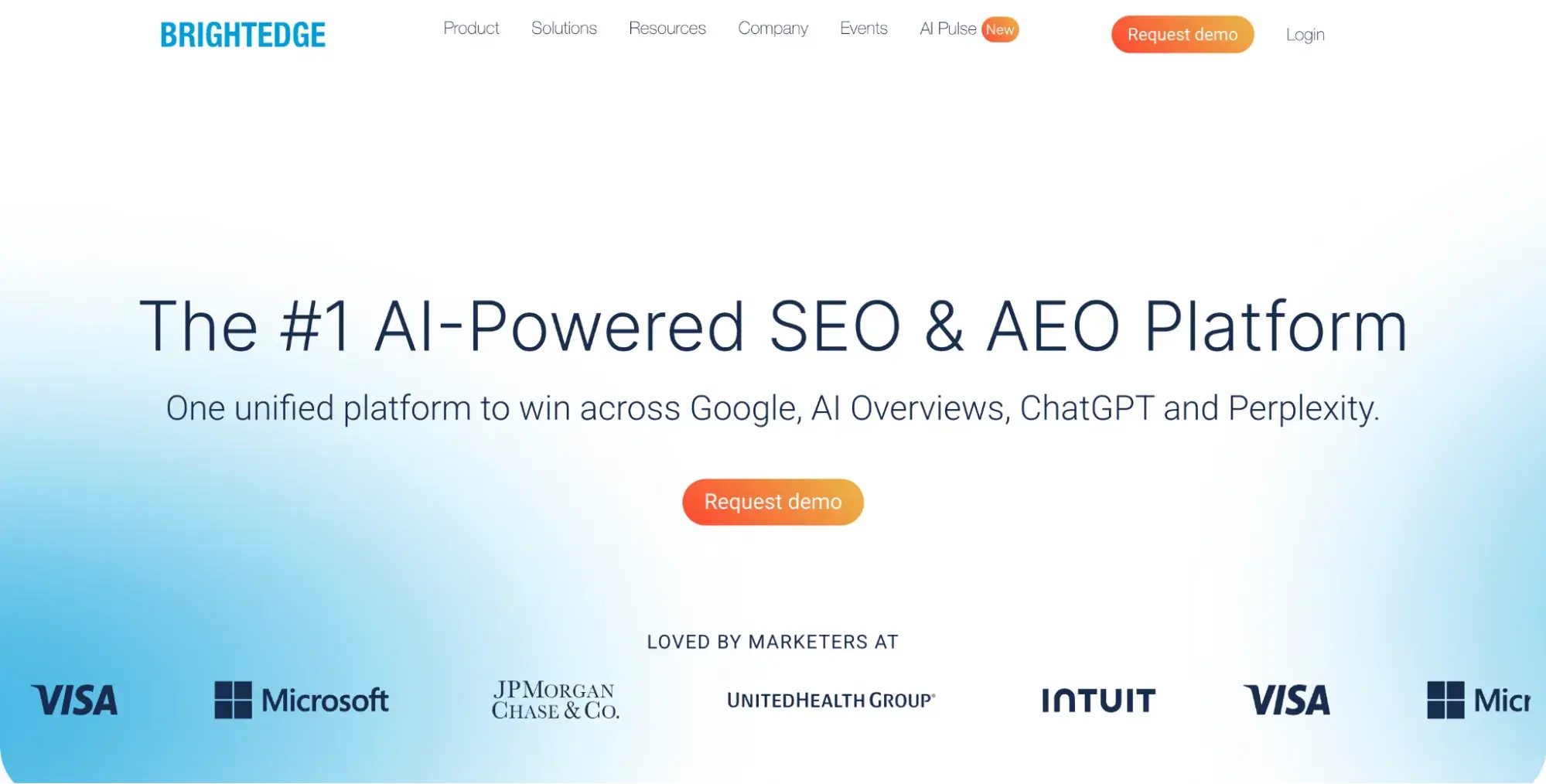
HubSpot AEO is purpose-built to track and enhance brand visibility within AI-generated answers, differentiating itself by treating AI visibility not as an add-on, but as its core design principle. This tool seamlessly integrates citation data, share of voice metrics, and competitive comparisons directly into HubSpot’s CRM context and content management tools, which many teams already utilize.
- Key Tracking Capabilities: HubSpot AEO provides granular tracking of brand citations, competitive comparisons within AI responses, sentiment analysis, and overall AI visibility scores across major AI engines.
- Unique Differentiator: Its profound integration with HubSpot’s Marketing Hub and Smart CRM is a game-changer. This connectivity allows demand generation teams to not only ascertain their brand’s appearance in AI answers but also attribute those AI-influenced touchpoints to tangible business outcomes, such as new contacts, qualified deals, and ultimately, pipeline revenue. This closed-loop attribution is critical for RevOps teams needing to quantify the ROI of their AI visibility efforts.
- Free Baseline Tool: The HubSpot AEO Grader offers a free, structured starting point, providing a benchmark of AI visibility across key engines and highlighting instances where competitors are cited instead.
- Expert Insight: Peter Baraník, founder of ColorWee, lauded HubSpot AEO for its "visibility score, prompt tracking, citation analysis, and prioritized recommendations," emphasizing its user-friendliness and affordability at $50 per month. He noted its limitation to ChatGPT, Gemini, and Perplexity, leaving gaps for other platforms like Claude or Grok.
- Best For: Marketing, demand generation, and RevOps teams that require AI visibility data directly linked to CRM reporting and quantifiable pipeline impact.
- Pro Tip: Initiating with the free AEO Grader establishes a data-driven baseline, providing a defensible starting point for measuring progress and securing stakeholder buy-in.
2. LLM Pulse
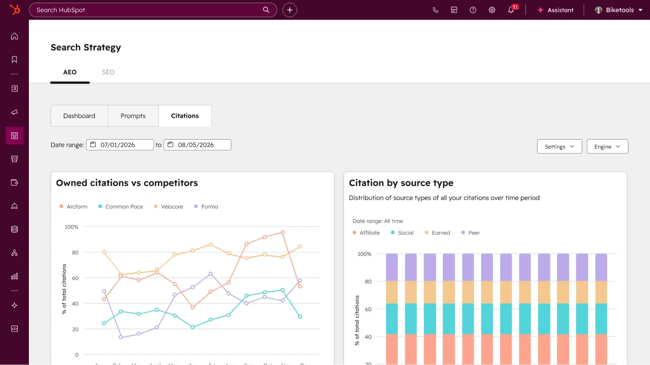
LLM Pulse positions itself as a specialized AI visibility platform, emphasizing comprehensive citation analysis, sentiment tracking, and in-depth query fan-out research across a broad spectrum of major AI models. A distinctive feature is its ability to surface actual AI responses, allowing teams to directly audit the precise language and context in which their brand is discussed.
- Key Features: Offers detailed citation analysis, sentiment monitoring, query fan-out data (revealing the range of prompts AI engines use to retrieve content), and direct access to AI responses. It also provides white-label reporting, making it ideal for agencies.
- Distinctive Advantage: The query fan-out data is particularly valuable for content strategists, as it illuminates the diverse linguistic pathways AI engines employ to access information on a given topic. This insight enables the development of more robust and AI-optimized content strategies, moving beyond mere monitoring to proactive content design.
- Pricing: Starts at $59/month.
- Expert Insight: Doug Darroch, Managing Director at Renaissance Digital Marketing, highlighted LLM Pulse’s "white-label reporting" and its comprehensive coverage of "citation analysis, sentiment, query fan-out, and prompt research across the major models." He also pointed out that while it provides AI-generated optimization recommendations, the strategic execution remains with the user.
- Best For: Marketing agencies managing AI visibility for multiple clients due to its white-label capabilities, and brands that prioritize seeing the exact AI responses that cite their content.
3. BrightEdge
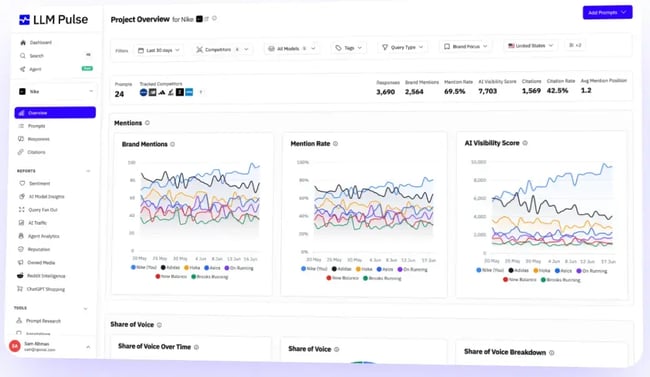
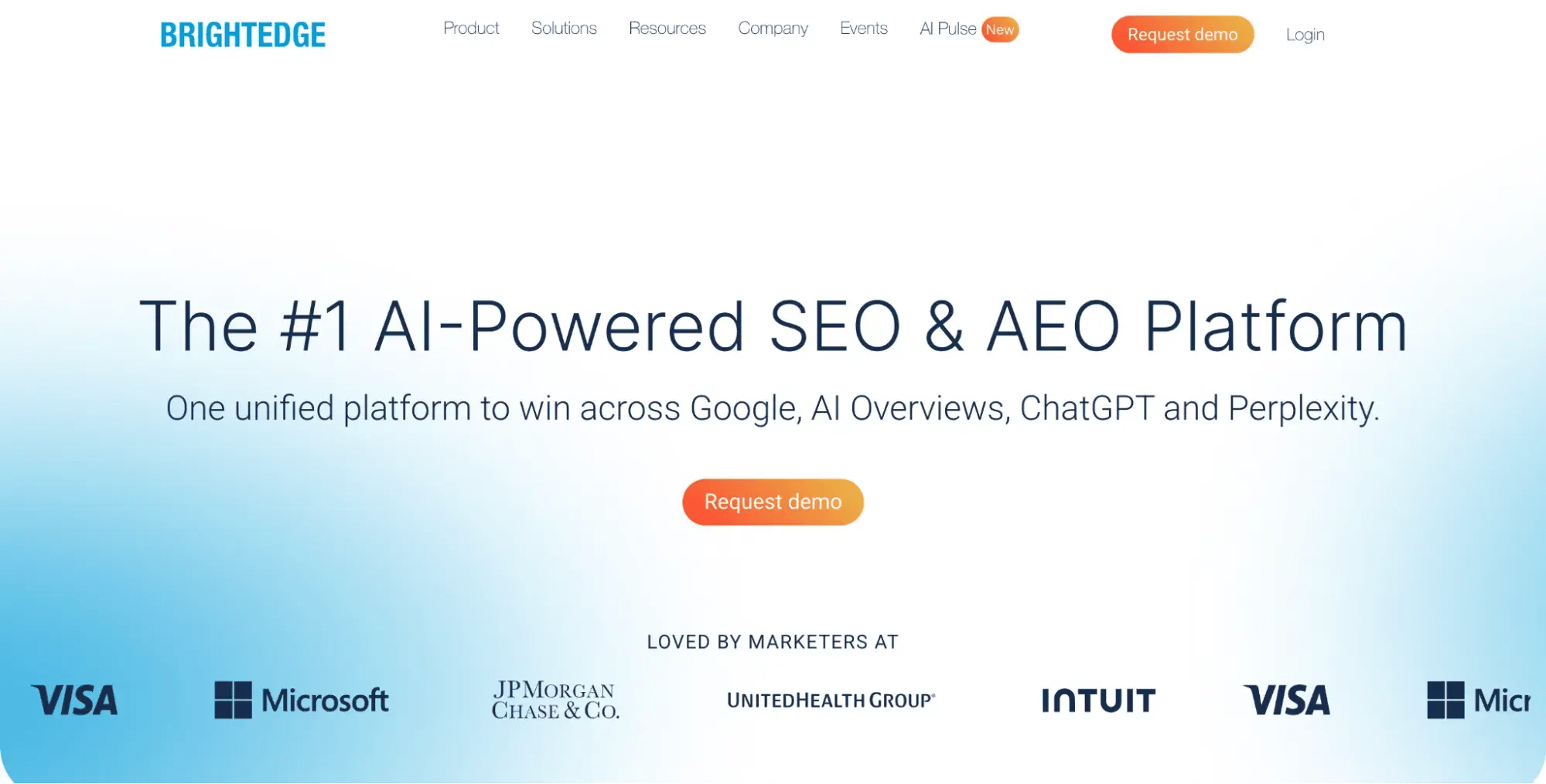
BrightEdge is a well-established enterprise SEO platform that has strategically extended its capabilities into AI search tracking. It offers a robust suite of features designed for large-scale operations.
- Key Features: Includes AI Overview monitoring, sophisticated content recommendations, and extensive keyword analysis, all integrated into a broader enterprise SEO framework.
- Integration Strength: Its primary strength lies in integrating AI visibility features into an existing, comprehensive enterprise AI SEO workflow. This reduces tool fragmentation for large organizations with extensive content operations.
- Pricing: Requires direct contact with BrightEdge for a custom quote, reflecting its enterprise focus.
- Expert Insight: Peter Baraník acknowledged BrightEdge’s utility for "enterprise SEO workflow" but cautioned that it might be "more tools than you need" for smaller brands or individual marketers, given its focus on large teams and corresponding pricing. He underscored the importance of specific AI search visibility tools as buyers increasingly rely on AI summaries.
- Best For: Enterprise SEO teams already using BrightEdge who wish to seamlessly extend their visibility tracking into AI Overviews without adopting new platforms.
4. Authoritas
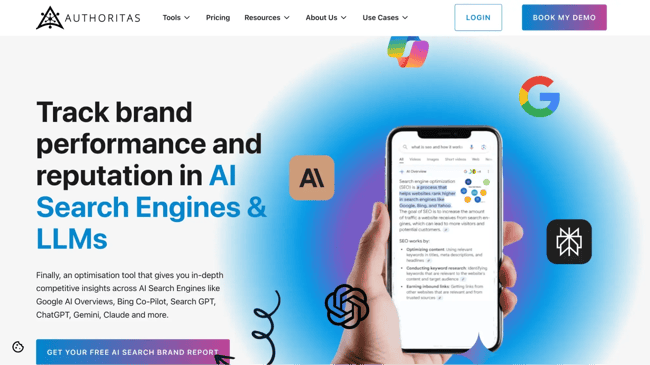
Authoritas provides focused measurement of brand visibility across various AI search experiences, with a particular emphasis on Google AI Overviews. It meticulously tracks which entities, products, and competitors appear in AI answers and their frequency.
- Key Features: Offers URL-level AI Overview tracking, entity and competitor monitoring, and detailed citation frequency analysis.
- Granular Google Focus: Its strong suit is providing granular, page-level citation data specifically for Google AI Overviews. This allows SEO teams to pinpoint exactly which content assets are being cited and prioritize updates accordingly.
- Pricing: Custom quotes available upon request.
- Expert Insight: Raúl Menoyo, Founder of Citora, specifically praised its "URL-level AI Overview tracking," which offers precise page identification rather than vague visibility scores. He noted its "blind spot" in covering standalone AI assistants like ChatGPT, Claude, and Perplexity, necessitating its pairing with other tools for broader coverage.
- Best For: SEO teams whose primary focus is Google AI Overviews and who require highly granular, page-level citation data to inform and prioritize content optimization efforts.
5. Advanced Web Ranking (AWR)
Advanced Web Ranking is a long-standing tool in the SEO space that has adapted to track brand appearances across AI search results. It focuses on identifying competitor surfacing and analyzing shifts in brand visibility over time.
- Key Features: Provides AI brand visibility tracking, competitor surfacing identification, and robust historical data for trend analysis. It also excels in traditional rank tracking across various locations, devices, and search engines.
- Historical Context: AWR’s strength lies in its ability to provide comprehensive historical data, making it invaluable for demonstrating progress to stakeholders who require trend lines and longitudinal analysis rather than just snapshots.
- Pricing: Starting from $139/month.
- Expert Insight: Manpreet Kaur, an SEO Specialist, lauded AWR as a "go-to tool" for keyword tracking and SEO reporting, specifically appreciating its "opportunity to track ranking positions across various locations, devices, and search engines, providing historical trend information."
- Best For: SEO teams managing multi-location or multi-market visibility, who need reliable historical tracking alongside emerging AI search data to report on long-term performance.
Strategic Considerations for Choosing AI Visibility Alternatives
Selecting the optimal AI visibility tool hinges on aligning its capabilities with buyer behavior, internal reporting frameworks, and the necessity of connecting visibility data to revenue workflows.
-
Prioritize AI Engine Coverage: The initial step is to understand where the target audience conducts most of its AI-driven research. If Google AI Overviews are predominant, tools like Authoritas or BrightEdge, with their strong Google-centric coverage, will provide the clearest signals. Conversely, if audiences frequently utilize conversational AI platforms such as ChatGPT, Perplexity, or Gemini, cross-assistant tracking becomes indispensable. HubSpot AEO and LLM Pulse are designed to monitor multiple major AI assistants, making them more suitable for teams requiring broader visibility beyond Google’s ecosystem. Given the rapid evolution of this space, it is always prudent to confirm current engine support directly with vendors before committing to a platform.
-
Align with Optimization Workflow Needs: The "best" tool is inherently subjective and dependent on the specific workflow being optimized.
- For direct linkage of visibility data to pipeline, attribution, and CRM context, HubSpot AEO stands out due to its native integration with Smart CRM and Marketing Hub.
- For agencies or teams requiring client-ready, customizable deliverables, LLM Pulse offers flexible white-label reporting.
- For deep, granular insights into Google AI Overview citations, Authoritas provides unparalleled detail.
-
CRM Integration for Revenue Attribution: A significant challenge with many standalone AI visibility tools is the manual effort required to export citation data and integrate it into CRM reporting. HubSpot AEO uniquely addresses this by natively connecting visibility data with CRM records, campaign performance, and pipeline metrics, thereby eliminating manual integration friction. For other tools, a manual bridge must be established, involving tagging contacts by AI-influenced touchpoints and tracking their conversion paths within the CRM. This is a critical step for RevOps teams seeking to quantify the direct business impact of AI visibility.
Developing a Pilot Plan for AI Search Visibility
For marketing teams embarking on an AI visibility strategy, defining success metrics before initiating measurement or content strategy modifications is paramount. This foundational step ensures the pilot program generates meaningful, actionable data. A structured six-step approach is recommended:
-
Define Target Queries: Begin by identifying 10 to 15 high-impact queries that authentically reflect how buyers conduct research within AI engines. These should be real buyer questions at the evaluation and decision stages, rather than merely internal keyword lists. Examples include "best CRM for small business," "how to implement marketing automation," or "alternatives to [competitor product]."
-
Establish a Baseline: Manually run the defined target queries across platforms like ChatGPT, Perplexity, and Gemini. Document the frequency of citations, mentions of competitors, and the specific ways in which the brand is described. This initial baseline serves as the critical starting point for measuring subsequent progress. HubSpot’s AEO Grader offers a structured method for benchmarking, scoring visibility across major AI engines and identifying competitive gaps.
-
Select a Tracking Platform: Based on the criteria outlined above, choose the AI visibility tool that best aligns with the team’s requirements. For CRM-connected reporting, HubSpot AEO is a strong contender. For white-label deliverables, LLM Pulse merits evaluation. For primary focus on Google AI Overviews, Authoritas warrants testing.
-
Prioritize Content Updates: AI visibility gaps often indicate content deficiencies where a brand’s expertise on a topic is either unclear, poorly structured, or not sufficiently up-to-date for confident retrieval by AI engines. Review top-performing pages against baseline citation data. Pages that rank well in traditional search but are infrequently cited by AI often require structural enhancements. This includes optimizing for clarity, implementing structured data (e.g., schema markup), ensuring entity consistency across platforms, and bolstering E-E-A-T (Experience, Expertise, Authoritativeness, Trustworthiness) signals.
-
Measure Presence, Citations, Sentiment, and Business Impact: At the conclusion of the initial reporting cycle (typically 4 to 8 weeks), assess four key areas:
- Presence: Overall frequency of brand appearance in AI responses.
- Citations: Specific instances and contexts of brand citations.
- Sentiment: The qualitative perception of the brand within AI-generated content.
- Business Impact: The influence of AI-driven touchpoints on lead generation and pipeline progression.
-
Connect Visibility to Revenue: This is often the most challenging, yet crucial, step. Citation data without corresponding revenue attribution struggles to justify ongoing budget allocation. HubSpot AEO’s native integration with Smart CRM and Marketing Hub streamlines this process by linking AI-influenced touchpoints directly to contacts, deals, and pipeline within the platform. For standalone tools, a manual attribution model involves tagging contacts by their AI-influenced discovery sources and tracking their conversion pathways in the CRM. The key is to define AI-influenced touchpoints and attribution logic before the pilot commences, ensuring data flows into meaningful revenue reporting.
Frequently Asked Questions About Semrush AI Visibility Alternatives
Can AI visibility be tracked without replacing Semrush?
Yes, AI visibility tracking can be implemented alongside Semrush. Many organizations retain Semrush for traditional SEO workflows—such as technical audits, backlink analysis, and keyword tracking—and augment it with a dedicated AI visibility tool like HubSpot AEO for citation monitoring, share of voice analysis, and comprehensive AI engine coverage. These two workflows operate independently, minimizing technical conflicts.
What distinguishes AI visibility from traditional rank tracking?
Rank tracking measures a webpage’s position within conventional search results based on keywords, search engine, and device. AI visibility, conversely, assesses whether and how a brand appears within AI-generated answers, which lack traditional ranked positions. Instead of numerical rankings, AI visibility tracks citation frequency (how often a brand is mentioned), share of voice (relative presence compared to competitors), and sentiment (the qualitative description of the brand).
Are there free AI visibility options available?
Yes, free options exist for initial exploration. HubSpot’s AEO Grader is a complimentary tool that scores brand visibility across major AI engines and highlights competitive gaps. Manual prompt testing—systematically querying ChatGPT, Perplexity, and Gemini with target buyer questions and documenting responses—also provides a zero-cost baseline. While valuable for initial insights, these free options typically lack the scalability for ongoing monitoring, automated reporting, or advanced analytics, making paid platforms more practical for continuous tracking and stakeholder communication.
How can AI visibility be linked to leads and revenue?
Connecting AI visibility to revenue necessitates a robust bridge between citation data and CRM records. The most direct method is utilizing a platform that natively integrates visibility tracking with CRM functionalities. HubSpot AEO, with its connection to Smart CRM and Marketing Hub, allows AI-influenced touchpoints to be directly tied to contacts, deals, and pipeline without manual data transfers. For standalone AI visibility tools, a manual approach involves defining and tagging AI-influenced discovery sources for contacts and subsequently tracking their conversion paths within the CRM. Establishing clear attribution logic before the pilot ensures that the data can be effectively leveraged for revenue reporting.
Your Next Strategic Move in AI Search Visibility
For the majority of marketing teams, AI search visibility currently represents a critical reporting gap. Experience consistently demonstrates that citation data’s utility is directly proportional to the robustness of the reporting infrastructure supporting it. Teams that successfully link AI visibility to tangible revenue conversations are the ones that secure sustained investment in this evolving channel. HubSpot AEO’s deep integration with Smart CRM and Marketing Hub offers one of the most comprehensive solutions for closing this attribution loop, while its free AEO Grader provides an accessible, structured entry point for any team.
When evaluating Semrush AI visibility alternatives, the strategic imperative is clear: leverage the AEO Grader for an initial baseline, meticulously define target queries and success metrics before launching any pilot program, and ultimately prioritize a tool that renders visibility data actionable within existing marketing and sales workflows. The future of digital presence is inextricably linked to AI, and proactive engagement with AI search visibility is no longer optional but essential for competitive advantage.