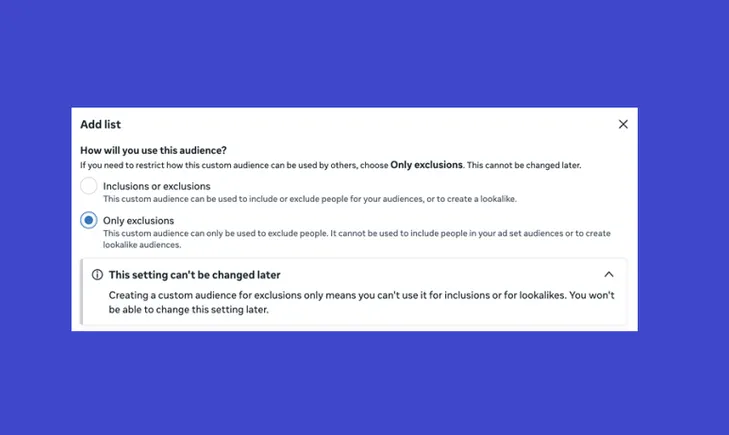
Meta has recently rolled out a significant enhancement to its advertising platform, introducing the capability to create exclusion-only custom audiences for ad sets. This new feature provides advertisers with a more robust and dedicated mechanism to precisely omit specific individuals from their ad targeting efforts, addressing critical needs related to regulatory compliance, brand reputation, and ad spend optimization. The update is designed to empower brands to avoid inadvertently reaching individuals who have explicitly opted out of promotions, or those who, due to legal or ethical considerations, should not be targeted with specific advertisements.
A Deep Dive into the Exclusion-Only Custom Audience Feature
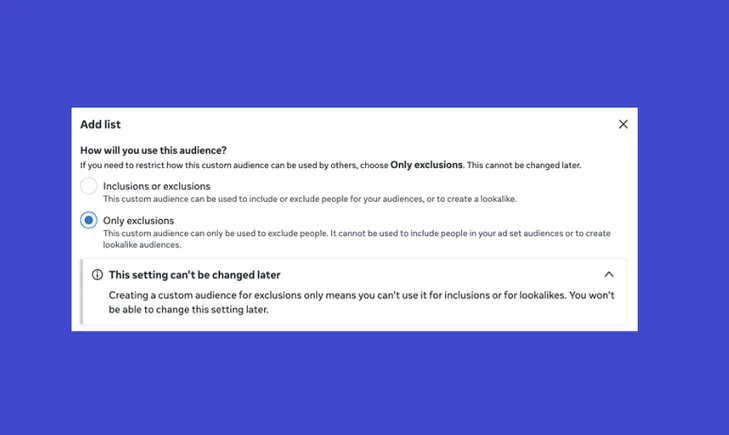
At its core, an exclusion-only custom audience functions as a specialized type of customer list custom audience. Unlike standard custom audiences, which offer the dual functionality of both including and excluding individuals from an ad audience, this new iteration is designed with a singular purpose: to permanently and exclusively exclude. As articulated by Meta itself, "An exclusion-only custom audience is a type of customer list custom audience that can only be used to exclude people from your ad audience. Unlike a regular custom audience, an exclusion-only custom audience cannot be used to include people in your audience." This crucial distinction underscores the feature’s role as a permanent guardrail against accidental inclusion, a challenge that has long persisted for advertisers managing complex campaigns.
The creation process for these audiences mirrors that of traditional custom audiences, typically involving the upload of customer data lists. These lists, often containing identifiers such as email addresses, phone numbers, or user IDs, are then hashed by Meta to preserve privacy, creating a secure, anonymized match with its user base. The resulting exclusion-only audience is immutable in its purpose; once designated as exclusion-only, it cannot be converted into a regular custom audience capable of inclusion. This design choice highlights Meta’s intent to provide a steadfast and unambiguous tool for advertisers to maintain strict control over who doesn’t see their ads.
The Rationale: Why Exclusion Matters in Modern Advertising
The introduction of exclusion-only custom audiences stems from several pressing concerns within the digital advertising landscape. Meta identifies two primary drivers: ensuring that individuals who have opted out of a business’s products or services no longer receive unwanted promotions, and enabling businesses to comply with legal or regulatory obligations that prohibit targeting certain demographics or individuals. These reasons resonate deeply with contemporary marketing challenges, where precision, privacy, and consumer experience are paramount.
Beyond these explicit justifications, the feature also serves as a proactive measure to reduce wasted ad spend. Every impression served to an uninterested, ineligible, or already converted customer represents a misallocation of resources. By systematically removing such individuals from targeting pools, advertisers can significantly enhance the efficiency and return on investment (ROI) of their campaigns.
Legal and Regulatory Imperatives: Navigating a Complex Landscape
One of the most compelling applications for exclusion-only custom audiences lies in addressing legal and regulatory compliance. In an era marked by stringent data privacy regulations like the General Data Protection Regulation (GDPR) in Europe, the California Consumer Privacy Act (CCPA) in the United States, and numerous other regional privacy frameworks, advertisers face increasing pressure to ensure their targeting practices are lawful and ethical.
Consider industries with age restrictions, such as alcohol, tobacco, or gambling. While Meta’s platform offers age-gating capabilities, the ability to upload a definitive list of individuals known to be underage or those who have self-excluded from gambling services provides an additional, robust layer of protection. Similarly, financial services often have complex disclosure requirements or restrictions on marketing certain products to specific vulnerable groups. Healthcare companies, dealing with sensitive personal information, may need to ensure advertisements for certain conditions or treatments do not reach individuals who have opted out of such communications, or those who are legally protected from unsolicited marketing.
The permanent nature of exclusion-only audiences offers a significant advantage here. It minimizes the risk of human error in campaign setup, acting as an unyielding barrier against accidental inclusion. This "guardrail" functionality is particularly valuable for large organizations managing multiple campaigns and diverse marketing teams, where the potential for oversight is higher. By embedding these exclusions at a foundational level, businesses can bolster their compliance posture and mitigate the risk of costly fines, reputational damage, or legal challenges associated with inappropriate targeting.
Optimizing Ad Spend and Enhancing Brand Experience
The financial implications of imprecise targeting are substantial. Industry reports consistently highlight that a significant portion of digital ad spend is wasted on irrelevant impressions. While figures vary, some estimates suggest that inefficiencies can account for 10-20% or even more of total ad budgets. Exclusion-only audiences offer a direct solution to this problem by allowing advertisers to meticulously prune their target audiences.
Beyond compliance, the feature presents numerous opportunities for improving the overall customer experience and brand perception. For instance:
- Preventing Ad Fatigue for Recent Purchasers: A common marketing misstep is continuing to show ads for a product to a customer who has just purchased it. This not only wastes ad spend but can also annoy the customer. An exclusion-only list of recent buyers can ensure they are not bombarded with irrelevant "buy now" ads, allowing for more strategic post-purchase engagement (e.g., upsell, cross-sell, or loyalty programs).
- Respecting Opt-Outs and Unsubscribes: When a user opts out of email communications or explicitly states they no longer wish to receive promotions, it’s crucial for brands to honor that preference across all channels. Exclusion-only audiences provide a powerful tool to ensure that individuals on these "do not contact" lists are consistently excluded from paid social campaigns, thereby reinforcing trust and respecting user choices.
- Excluding Employees and Internal Stakeholders: As Facebook ads expert Jon Loomer astutely pointed out, excluding employees is a practical application. There’s no value in paying to show ads to one’s own staff, who are already aware of the company’s offerings. This also extends to business partners, vendors, or even competitors whose engagement would not yield a positive ROI.
- Managing Customer Service Interactions: In cases where customers have had a negative service experience, continuing to target them with promotional ads can exacerbate dissatisfaction. A temporary or permanent exclusion for such individuals, based on their customer service records, could be a judicious move to prevent further brand alienation.
- A/B Testing and Control Groups: For sophisticated marketers running extensive A/B tests, exclusion-only audiences can ensure truly clean control groups. By excluding specific segments from test variations, advertisers can gain more accurate insights into campaign performance without cross-contamination.
The Evolution of Meta’s Ad Ecosystem and Privacy Landscape

Meta’s journey in ad targeting has been one of continuous evolution, driven by technological advancements, market demands, and increasingly, regulatory pressures. Custom audiences, first introduced over a decade ago, revolutionized targeting by allowing businesses to leverage their own first-party data. This capability, alongside lookalike audiences and detailed targeting options, positioned Meta as a powerhouse in personalized advertising.
However, the past few years have witnessed a significant shift in the digital advertising landscape, primarily influenced by heightened privacy concerns and platform changes. Apple’s App Tracking Transparency (ATT) framework, introduced with iOS 14.5, severely impacted Meta’s ability to track user activity across apps and websites, leading to challenges in audience matching and campaign measurement. Simultaneously, global privacy regulations have intensified scrutiny on how user data is collected, processed, and used for advertising.
In this context, Meta has been actively working to adapt its advertising solutions, striving to balance advertiser efficacy with user privacy. The introduction of exclusion-only custom audiences can be seen as part of this broader strategic pivot. While it doesn’t directly address the challenges posed by ATT in terms of inclusion targeting, it provides a robust mechanism for exclusion, which is equally vital for ethical and efficient advertising in a privacy-centric world. It signals Meta’s commitment to offering tools that help advertisers navigate compliance and user preference more effectively, thereby maintaining the integrity and value of its advertising platform.
Broader Impact and Implications
The implications of this new feature are far-reaching for various stakeholders:
- For Advertisers: The primary beneficiaries will be advertisers seeking greater control, efficiency, and compliance. It offers a cleaner, more reliable way to manage unwanted ad impressions, potentially leading to improved ROI, reduced legal risks, and enhanced brand reputation. However, it also places a greater onus on advertisers to maintain accurate and up-to-date customer exclusion lists. Data hygiene will become even more critical.
- For Meta: By providing a dedicated exclusion mechanism, Meta reinforces its commitment to supporting responsible advertising practices. This move can help Meta maintain advertiser trust, especially amidst ongoing discussions about data privacy. It also positions the platform as a sophisticated solution capable of addressing complex marketing challenges.
- For Users: While not directly visible to users, the feature can lead to a more positive ad experience. Users who have opted out of specific communications or are legally ineligible for certain promotions should theoretically encounter fewer irrelevant or intrusive ads. This subtle improvement contributes to a healthier digital ecosystem where advertising is perceived as less annoying and more respectful of personal boundaries.
Challenges and Future Outlook
While the benefits are clear, advertisers leveraging this feature will need to ensure meticulous data management. The accuracy and freshness of exclusion lists are paramount; an outdated list could either fail to exclude intended individuals or inadvertently exclude eligible ones. Businesses will need robust internal processes for updating these lists regularly, especially for dynamic scenarios like customer opt-outs or recent purchases.
Looking ahead, the digital advertising industry is likely to continue its trajectory towards greater privacy and transparency. Features like exclusion-only custom audiences represent an important step in this direction, enabling advertisers to refine their strategies in a manner that respects user preferences and regulatory mandates. It highlights a future where successful advertising is not just about reaching the right people, but equally about not reaching the wrong ones. As Meta and other platforms evolve, we can expect further innovations that provide marketers with increasingly granular control over audience segmentation, balancing the power of personalization with the imperative of privacy. This continuous refinement ensures that advertising remains an effective and sustainable engine for businesses in the digital age.