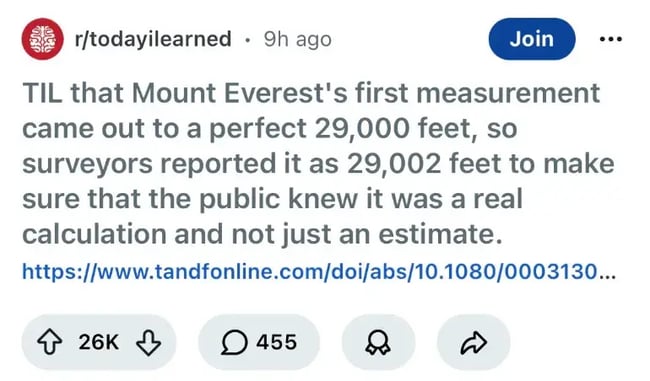
A fascinating historical anecdote from the mid-19th century illustrates a profound psychological principle that continues to shape human perception and behavior today. When the British Royal Geographical Society officially declared the height of Mount Everest, then known as Peak XV, they opted for a seemingly arbitrary figure: 29,002 feet. This was not merely the result of precise surveying; the actual measurement had concluded at a perfectly rounded 29,000 feet. The deliberate addition of two feet served a strategic purpose: to prevent public skepticism that a perfectly round number might be perceived as a mere estimate rather than a rigorously obtained scientific fact. This subtle adjustment highlights the "precise number effect," a cognitive bias where specific, non-rounded figures are inherently deemed more credible, accurate, and trustworthy than their rounded counterparts. This phenomenon, far from being a historical curiosity, is a robust finding in behavioral science, influencing everything from charitable donations and survey compliance to high-stakes negotiations and consumer marketing.
The Historic Measurement of Mount Everest and the Quest for Credibility
The story of Everest’s initial measurement is deeply embedded in the annals of the Great Trigonometrical Survey of India, an ambitious undertaking by the British colonial administration that began in 1802. Its primary goal was to accurately map the Indian subcontinent, a monumental task that spanned decades and involved thousands of personnel. Under the leadership of surveyors like Sir George Everest and later his successor, Andrew Waugh, the survey pushed into the formidable Himalayas, meticulously measuring peaks from distant observation points using giant theodolites and complex triangulation methods.
By the 1850s, the survey had identified "Peak XV" as potentially the world’s highest mountain. Its immense height and remote location presented unprecedented challenges, requiring observations from distances exceeding 100 miles to avoid interference from local authorities in Nepal, which was then a closed kingdom. After years of painstaking calculations, one of Waugh’s Indian chief computers, Radhanath Sikdar, concluded in 1852 that Peak XV stood at exactly 29,000 feet. This figure was considered groundbreaking, but Waugh, keenly aware of the psychological nuances of public perception and scientific credibility, made a calculated decision. He instructed that the official height be published as 29,002 feet. His rationale, as often recounted, was that a round number like 29,000 feet would appear to be a rough estimate, potentially undermining the monumental effort and scientific rigor of the survey. The addition of a seemingly insignificant "2" imbued the measurement with an air of absolute precision and scientific authority, making it more believable to a discerning public and skeptical scientific community.
The official announcement came in 1856, cementing the 29,002-foot figure for decades. While subsequent measurements, particularly with the advent of advanced technologies like GPS and satellite altimetry, have refined Everest’s height (the current internationally recognized height, jointly declared by Nepal and China in 2020, is 8,848.86 meters or approximately 29,031.7 feet), the historical decision to add those two feet remains a powerful testament to the early understanding of how numerical specificity impacts trust. It underscores that even in the most rigorous scientific endeavors, the presentation of data is as critical as its collection.

The Pique Technique: Disrupting Mindless Refusal
The phenomenon observed by Andrew Waugh centuries ago has since been thoroughly investigated by behavioral psychologists, leading to the development of concepts like the "pique technique." This technique posits that individuals are more likely to comply with a request if it disrupts their "mindless refusal" – the automatic tendency to decline unfamiliar or inconvenient requests – by presenting an unusual or specific ask. This specificity forces the recipient to pause, process the request more deeply, and often infer a legitimate reason behind the unusual ask, thereby increasing the likelihood of compliance.
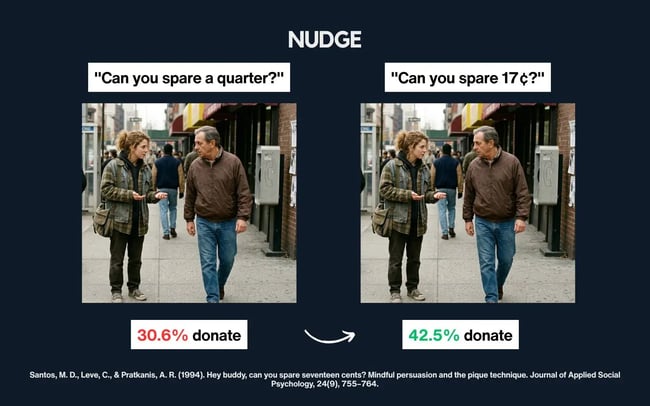
One of the seminal studies demonstrating the pique technique was published in the Journal of Applied Social Psychology in 1994. Researchers Michael D. Santos, Craig Leve, and Anthony R. Pratkanis from the University of California, Santa Cruz, designed an experiment to test this theory in a real-world setting. They deployed three female actors to approach 289 adults in public over several days, asking for spare change. The twist lay in the phrasing of the request. Half of the passersby were asked for a specific, unusual amount: "Can you spare 17¢ (or 37¢)?" The other half received a more general request: "Can you spare a quarter (or any change)?"
The results were striking. The group asked for a specific, unconventional amount of change demonstrated significantly higher rates of compliance compared to those who heard the general request. The researchers concluded that the unusual specificity of "17 cents" or "37 cents" broke through the automatic "no" response. It forced individuals to consider the request more carefully, perhaps wondering why such an odd amount was needed, and this cognitive engagement led to a greater willingness to help. This study provided robust empirical evidence that precision in monetary requests is not merely about exactness but is a potent tool for persuasion.
Extending Precision to Non-Monetary Requests: The Gift of Time
The effectiveness of specific numbers extends beyond monetary transactions, proving equally powerful when soliciting non-monetary resources, such as time. In 2015, Nicolas Guéguen, a professor of behavioral sciences at the University of Southern Brittany in France, conducted a study that reexamined the pique technique, this time focusing on requests for an individual’s time.
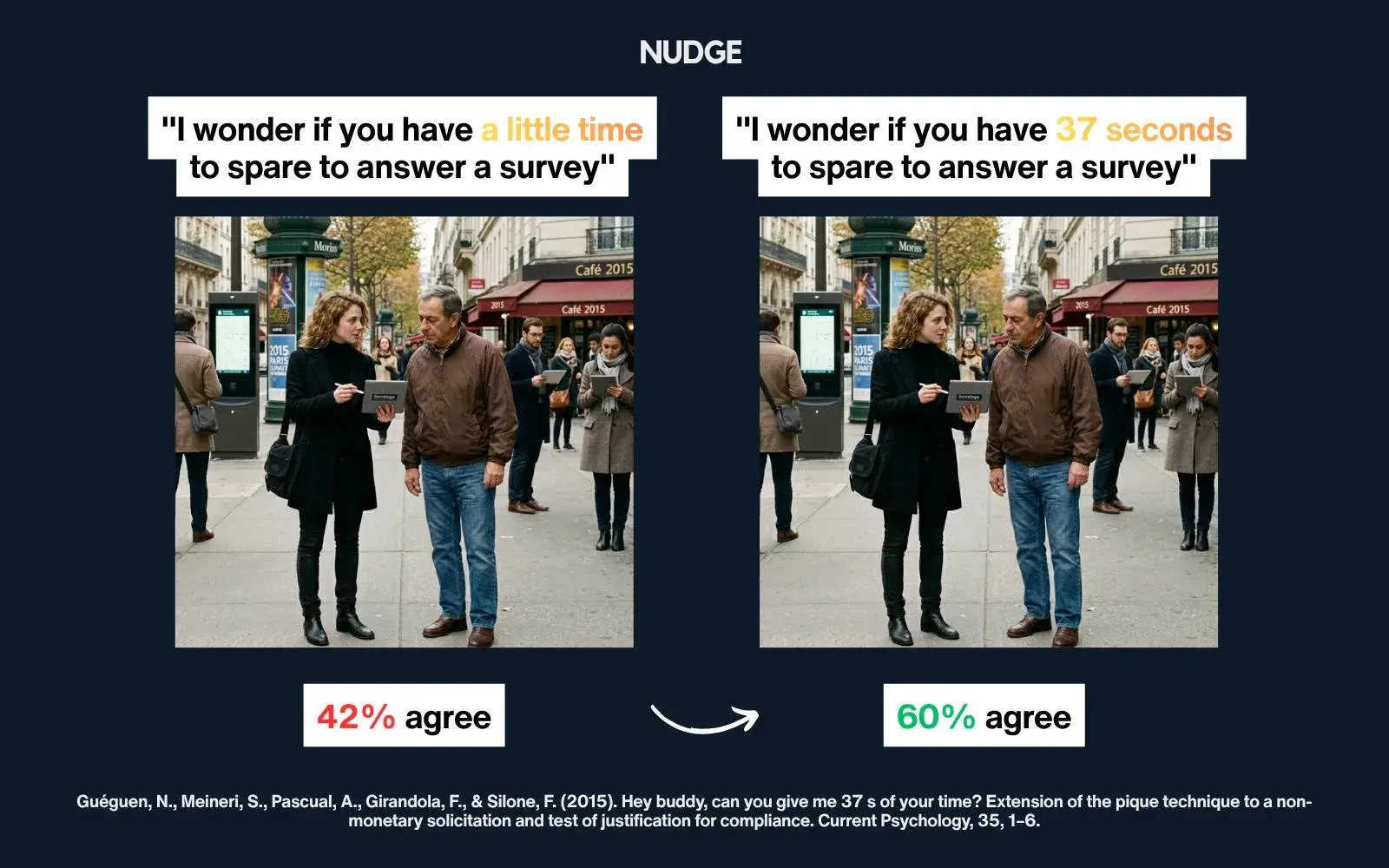
The experiment involved four female actors, all dressed identically in black to minimize external variables, approaching 300 passersby (an equal split of 150 men and 150 women). The actors’ task was to ask individuals to complete a survey. Again, the phrasing of the request was the critical variable. One group of 150 individuals was asked: "I wonder if you have a little time to spare to answer a survey." The other group of 150 received a highly specific request: "I wonder if you have 37 seconds to spare to answer a survey."

The findings mirrored the monetary study’s conclusions. Of the 150 people asked for "a little time," only 63 agreed to participate in the survey, representing a compliance rate of 42%. However, among the 150 individuals asked for the precise "37 seconds," 90 agreed to help, resulting in a compliance rate of 60%. This represented a remarkable 42.9% increase in compliance due to the use of a specific number. The specific time frame of "37 seconds" likely made the request seem less daunting and more manageable than the vague "a little time," which could imply an unknown, potentially lengthy commitment. It provided a clear mental anchor, signaling that the task was brief and easily accomplishable, thus overcoming the inertia of refusal.
Precision in Persuasion: Mastering the Art of Negotiation
The power of precise numbers is also a formidable force in the realm of negotiation, where initial offers can significantly anchor subsequent discussions. A 2013 paper published in the Journal of Experimental Social Psychology by four researchers delved into the impact of precise offers on negotiation outcomes.
In one of their studies, participants were tasked with negotiating the hypothetical sale of a second-hand car. The buyers were divided into two groups. One group was instructed to initiate the negotiation with a rounded asking price, specifically $2,000. The other group was told to begin with a more precise, non-rounded price point, either $1,865 or $2,135. The researchers’ objective was to ascertain whether the specificity of the opening offer would influence the sellers’ counter-offers and ultimately the final agreed-upon price.
The results clearly indicated that when buyers opened with a precise asking price ($1,865 or $2,135), sellers responded with significantly smaller counter-adjustments compared to when faced with a rounded price of $2,000. This suggests that precise numbers serve as stronger anchors, implying a thorough calculation or a well-researched valuation, making the precise offer seem more legitimate and less arbitrary. Consequently, using precise opening offers led to higher final selling prices for the buyers. The psychological inference is that a specific number signals confidence and a well-thought-out position, discouraging the counterparty from making large, dismissive counter-offers. Rounded numbers, conversely, might be interpreted as a ballpark figure, inviting more aggressive haggling.
Broader Implications and Applications Across Industries
The consistent findings across these diverse studies underscore a fundamental aspect of human psychology: we intrinsically associate precision with authenticity, diligence, and truth. Rounded numbers often trigger a subconscious suspicion of estimation or generalization, whereas specific figures suggest careful measurement, thorough consideration, and a basis in verifiable fact. This profound insight has far-reaching implications across numerous sectors:
Marketing and Sales: For marketers, this principle is invaluable. Instead of generic claims like "save a lot of money," a statement like "save 27.3% on your energy bill" or "over 93,452 satisfied customers" carries far more weight. Precise pricing strategies, such as setting a price at $19.97 instead of $20.00, not only leverage the "left-digit effect" (where consumers focus on the first digit) but also tap into the precise number effect, making the price appear more calculated and potentially a better deal. Testimonials, product specifications, and performance metrics gain significant credibility when presented with specific data rather than vague superlatives.
Public Communication and Policy: Governments, scientific institutions, and public health organizations can enhance trust and compliance by presenting data with precision. When communicating budget allocations, project timelines, or public health guidelines, specific figures ("the new policy will affect 1.3 million citizens" or "we expect results in 4.5 weeks") are more likely to be taken seriously and believed than generalized statements ("many citizens" or "in about a month"). This precision helps to build public confidence and reduces the perception of arbitrary decision-making.
Journalism and Reporting: For journalists, the use of specific numbers is foundational to credible reporting. Exact figures for casualties, economic indicators, poll results, or research findings lend authority and objectivity to a news story. Avoiding round numbers where precision is available reinforces the journalist’s commitment to factual accuracy and thorough investigation, thereby building audience trust.
Everyday Interactions and Personal Credibility: Even in daily life, employing precise numbers can boost personal credibility and effectiveness. When making a commitment, stating "I will finish this task by 3:15 PM" is often perceived as more reliable and organized than "I will finish this afternoon." When asking for help, "Can you lend me $18.50 for lunch?" might be more effective than "Can you lend me some money?" because it disrupts the routine refusal and suggests a specific, legitimate need.
Leading figures in the field of influence and persuasion, such as Dr. Robert Cialdini, whose work on the psychology of persuasion has shaped much of modern marketing and communication strategy, consistently advocate for the power of specificity. These academic insights affirm that precision is not just about factual accuracy; it is a strategic element in how information is processed and accepted by the human mind.
In conclusion, the story of Mount Everest’s initial measurement serves as a timeless illustration of a fundamental psychological truth: the human brain is predisposed to interpret precision as a hallmark of diligence, accuracy, and authenticity. Whether in the grand scientific endeavors of surveying the world’s highest peak, the subtle art of influencing consumer behavior, or the complex dynamics of negotiation, specific numbers possess an inherent power to persuade and build trust that rounded figures simply cannot match. In an increasingly data-driven and information-saturated world, where credibility is a prized commodity, embracing numerical precision is not merely a matter of scientific exactitude; it is a strategic imperative for effective communication and successful influence.