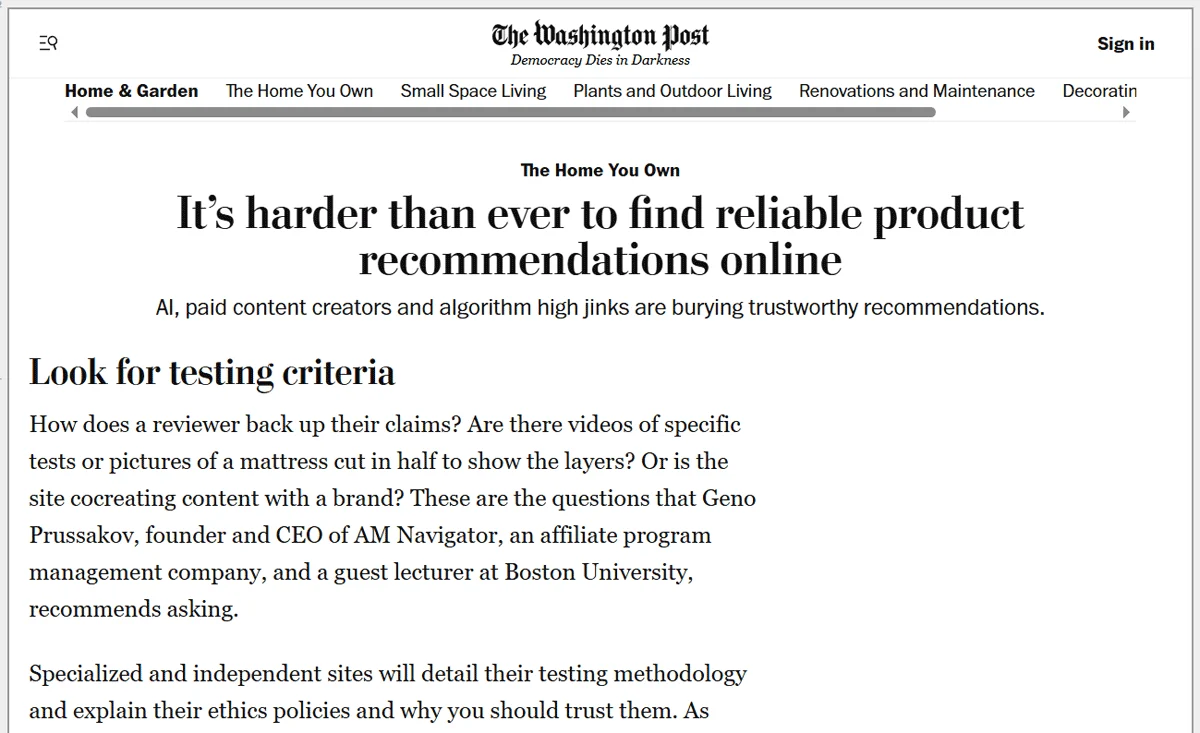
The digital publishing landscape has undergone a seismic shift as traditional media conglomerates increasingly leverage their established brand authority to dominate the lucrative world of online product recommendations. This evolution, often referred to as "commerce content," has come under renewed scrutiny following a recent investigative feature by The Washington Post, which explored the mechanisms behind "best-of" lists and product roundups. As legacy publications transition from traditional advertising models to affiliate-based revenue streams, the line between objective editorial guidance and profit-driven promotion has become a central point of debate for consumers and industry regulators alike.
The Rise of Commerce Content in Big Media
For decades, the primary revenue model for news organizations was built upon a foundation of subscriptions and display advertising. However, the decline of print media and the rise of digital ad-blocking technology forced a pivot toward more integrated monetization strategies. Affiliate marketing—a performance-based model where publishers earn a commission for sales generated through their links—emerged as a primary solution.
Today, nearly every major media outlet maintains a dedicated commerce division. Notable examples include CNN Underscored, Forbes Vetted, and The New York Times’ Wirecutter. These entities function as specialized reviews hubs, utilizing the high search engine authority of their parent domains to rank at the top of Google search results for high-intent keywords such as "best laptop for students" or "most comfortable mattress."
The Washington Post’s January 2025 inquiry into these practices highlighted a growing concern: whether the trust consumers place in established news brands is being leveraged to promote products based on financial incentives rather than merit. Industry experts, including Geno Prussakov, a veteran in the affiliate management space, suggest that while many organizations maintain rigorous testing standards, the financial infrastructure of these partnerships cannot be ignored.
Chronology of the Affiliate Content Evolution
The integration of affiliate marketing into mainstream media did not happen overnight. It is the result of a two-decade-long evolution in how digital content is valued and consumed.
- 2000–2010: The Niche Era. Affiliate marketing was largely the domain of individual bloggers, coupon sites, and specialized tech enthusiasts. Large media outlets viewed affiliate links as "low-brow" and potentially damaging to their journalistic integrity.
- 2011: The Wirecutter Turning Point. Brian Lam, a former editor at Gizmodo, founded The Wirecutter. Unlike previous review sites, The Wirecutter focused on exhaustive testing and a single "best" recommendation, monetized through affiliate links. Its success demonstrated that affiliate marketing could be paired with high-quality journalism.
- 2016: The Great Acquisition. The New York Times Company acquired The Wirecutter for approximately $30 million. This served as a signal to the entire media industry that commerce content was a legitimate and necessary revenue pillar.
- 2017–2022: Rapid Expansion. Major publishers like Hearst, Condé Nast, and Dotdash Meredith launched internal "commerce labs." These labs were designed to scale product testing and SEO-focused content production at an industrial level.
- 2023–2025: The Regulatory and Algorithmic Shift. Search engines, led by Google, began implementing "Product Review Updates" and "Helpful Content Updates" to prioritize reviews based on first-hand experience. Concurrently, the Federal Trade Commission (FTC) tightened guidelines regarding the disclosure of financial relationships in online reviews.
The Mechanics of Modern Product Roundups
When a major media outlet publishes a list of recommended products, the process is typically more complex than a simple editorial choice. Most "Big Media" players employ a multi-layered approach to ensure their recommendations appear credible while remaining profitable.
1. Dedicated Research and Testing Labs
To maintain their reputation, top-tier publishers often invest in physical testing facilities. For instance, some outlets employ "Testing Managers" who oversee controlled environments where kitchen appliances are used for hundreds of hours, or beauty products are subjected to chemical analysis. This rigorous approach provides the "social proof" necessary to justify their recommendations to both readers and search engines.
2. Subject Matter Expertise
Many outlets have transitioned from generalist staff writers to specialized contributors. These individuals often possess years of experience in specific niches, such as photography, automotive engineering, or childcare. By bylining experts, publishers attempt to insulate themselves from accusations of "thin content" or purely profit-motivated listicles.
3. Data-Driven Selection
Beyond physical testing, publishers use sophisticated software to analyze consumer trends. By monitoring "Earnings Per Click" (EPC) and conversion rates, commerce teams can identify which products are most likely to result in a sale. While this data helps in selecting popular products, it also creates a feedback loop where high-converting (and high-commission) products are prioritized over potentially superior but less "marketable" alternatives.
The Financial Influence: Placement Fees and Commission Rates
Despite the presence of editorial "church and state" separations, the financial reality of the affiliate industry introduces inherent biases. There are several ways financial arrangements can influence a product’s ranking on a list:

- Variable Commission Rates: Not all brands pay the same percentage. If two vacuum cleaners perform similarly in tests, but one brand offers an 8% commission while the other offers 3%, the higher-paying brand is frequently positioned more prominently.
- Placement Fees: Also known as "tenancy fees," some brands pay a flat fee to be included in a roundup or to be featured in a specific "above the fold" position. This is essentially a form of paid advertisement disguised as editorial selection.
- EPC Guarantees: Large publishers may demand a guaranteed "Earnings Per Click." If a merchant’s conversion rate drops, the publisher may threaten to remove them from the list unless the commission rate is increased to compensate for the lost revenue.
Supporting Data: The Scale of the Industry
The economic impact of commerce content is substantial. According to industry reports from the Performance Marketing Association and Statista:
- Market Size: Spending on affiliate marketing in the United States alone was estimated to surpass $8.2 billion by the end of 2024, up from $5.4 billion in 2017.
- Revenue Contribution: For many legacy publishers, commerce content now accounts for 20% to 40% of total digital revenue, in some cases outpacing traditional display advertising.
- Search Dominance: A 2023 study of "best product" search queries found that over 70% of the first-page results on Google were occupied by large media publishers with high domain authority, often displacing smaller, independent review sites.
Consumer Protection: How to Evaluate Recommendations
As the distinction between an advertisement and a review continues to blur, experts suggest that consumers adopt a more analytical approach to online shopping. The following strategies are recommended by consumer advocates:
Scrutinize Disclosure Statements: While the FTC requires disclosures, their placement and clarity vary. Consumers should look for clear statements at the beginning of an article that explain the financial relationship between the publisher and the brands mentioned.
Cross-Reference Multiple Sources: A product that appears as "Number One" on five different major media sites is more likely to be a genuine top-performer than one that only appears on a single site. However, consumers should be wary of "echo chambers" where publishers simply aggregate each other’s lists without original testing.
Verify Testing Methodology: Reliable reviews should clearly outline how a product was tested. If an article lacks specific data points—such as battery life measurements, decibel levels, or stress test results—it may be a "curated" list compiled from other online reviews rather than original research.
Check the "Last Updated" Date: Affiliate lists are frequently updated to keep them fresh for search engines. Consumers should check if the products mentioned are actually the latest models or if the publisher is simply recycling an old list to maintain its search ranking.
The Broader Impact on Journalism and the Internet
The shift toward commerce content has profound implications for the future of journalism. On one hand, affiliate revenue has provided a financial lifeline for struggling newsrooms, allowing them to continue funding investigative journalism and local reporting. Without the income generated by product reviews, many venerable institutions might have faced insolvency.
On the other hand, the "affiliate-ization" of the internet has led to a homogenization of content. As publishers chase the same high-volume search terms, the variety of products being discussed online has narrowed. Smaller, innovative brands that cannot afford high commission rates or placement fees often find themselves excluded from the conversation, regardless of the quality of their products.
Furthermore, the reliance on search engine traffic creates a vulnerability. If Google changes its algorithm to de-prioritize affiliate-heavy content, the financial foundations of major media companies could be destabilized overnight. This has led to a "cat and mouse" game where publishers must constantly adapt their content strategies to meet the evolving definitions of "quality" set by search engine engineers.
In conclusion, while the involvement of big media in product recommendations has professionalized the world of online reviews, it has also introduced a layer of commercial complexity that requires consumer vigilance. The trust that legacy brands have built over decades remains their most valuable asset, but as affiliate monetization becomes more aggressive, maintaining that trust will require a level of transparency and editorial independence that goes beyond mere compliance with regulatory guidelines. For the modern consumer, the "best" product is no longer just the one at the top of the list, but the one that stands up to independent scrutiny in an increasingly commercialized digital landscape.